Louis Freund, James Clinton Spohrer, Pavel Savva, Yash Gandhi (2024). T-shaped Professionals: The Past, Present, and Future of MyT-Me Development. In: The Human Side of Service Engineering. AHFE Open Access, vol. 143, pp. 1–11. https://doi.org/10.54941/ahfe1005078
This paper discusses the past, present, and future of developmental planning for T-shaped professionals (Gardner 2017; Freund 2018; Saviano et al 2016). Professionals with extensive T-shape experience are able to combine deep problem-solving expertise with broad communications skills across different roles and work more easily across disciplines, cultures, systems, emerging technologies, work practices, mindsets, and more. While the general notion of a T-shaped professional is well established in the literature, strategies for creating a “personalized T-shape development plan” for an individual, team, or organization remain elusive. A central challenge to date for creating a T-shape development plan is establishing a baseline assessment from which to set developmental goals. Herein, we present a proposed approach to meeting this need. MyT-Me is a prototype web-based T-metric tool that computes a MyT-Me score based on an analysis of a resume or LinkedIn profile and then displays a T-shape profile in a dashboard compared with the 25th, 50th, 75th, and 95th percentile scores of stratified subsets of others who are also on the MyT-Me platform. With the rise of generative AI for coaching tasks, there has never been a better time to revisit this topic of developmental planning for T-shaped professionals. While much work remains, our motivation in this conceptual paper is to begin to illuminate both diverse challenges and exciting opportunities ahead.
What does “T-shaped” mean in the realms of education, training, and work? The letter T is a paradigm for the idea that every professional has achieved some level of depth in a system or field of expertise (the Stem of the T) and some level of breadth across many systems or disciplines (the Top of the T) (Gardner, 2017; Freund, 2018; Saviano et al., 2016). Becoming more T-shaped, then, means adding depth or breadth through any one of a myriad of possible activities and occasions. “More” T-shaped means more depth and breadth are harnessed through your achievements, roles, recognitions, and other activities. The concept of the “T-shape” professional is helpful
for understanding how our working personas develop throughout lifetimes of experiences. Articles in the professional press, conference proceedings, research reports, and academic papers have appeared frequently over the past 10 years as the concept became defined, adopted, and refined by academics, service and manufacturing corporations (see next section).
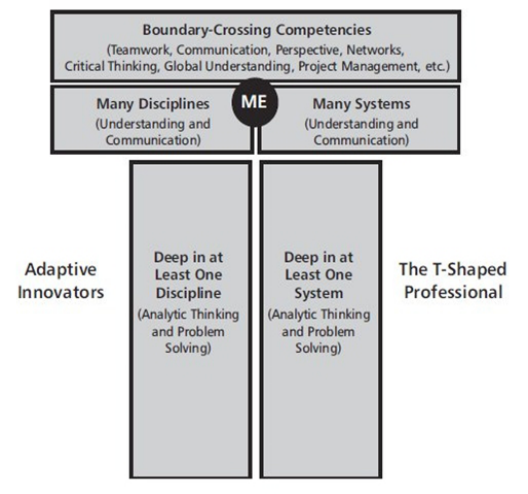
Variations of the graphic in Figure 1 have been used extensively to repre- sent a T-shaped professional model, with “T-Stem” and “T-Top” as stacked boxes.
Figure 1: A T-shaped professional model (Gardner, 2017; Spohrer & Maglio, 2010).
However, it is not only “professionals” who have T-shaped attributes – we submit that everyone does, to a greater or lesser extent; professionals in every sector, blue-collar workers, agricultural and mining workers, factory workers, service workers, and all others. We begin adding to our T-shape as we pursue our studies and working lives, and each person’s T-shape continues growing (seldom decreasing) at different rates through their lifetimes. After reviewing the history of the T-shaped model, this paper describes a metric system for establishing everyone’s T-Score called MyT-Me, and then explores future AI-enabled possibilities.
PAST: HISTORY OF T-SHAPED While the term “T-shaped skills” has been popular for decades (see Donofrio et al., 2018 for a concise history of origins and advocates), the term is espe- cially popular in the ISSIP.org (International Society of Service Innovation Professionals) community of practice. Service innovations integrate techni- cal, business, and social innovations requiring T-shaped skills (Moghaddam
T-Shaped Professionals: The Past, Present, and Future of MyT-Me Development 3
et al., 2018a; Gardner and Maietta, 2020), and T-shaped skills may help people keep up with accelerating change in the AI era (Spohrer et al., 2022). Even before the first publication mentioning T-professionals in 1991, the skills needed by professionals using computer technology to lead digital transformation in their organizations were rapidly changing (Gardner and Spohrer, 2020). In contrast, I-shaped skills are vulnerable to automation and disruption by technology (McGowan and Shipley, 2020; Boehm and Koolmonojwong, 2019).
Table 1. Publications with “T-shaped...” in the title highlight emerging research clusters. “T-shaped...” References Research Focus
Table available in the original PDF paper.
...Manager in title (Hansen and Von Oetinger, 2001; Ing, 2008) Good at transferring implicit knowledge across silos ...Innovator in title (Demirkan and Spohrer, 2018; Barile et al., 2015a)
Service innovation focus, faster digital transformation cycles ...Knowledge, Competency Profile, Expertise, Skills, Capabilities in title
(Barile et al., 2012; Uhlenbrook and De Jong, 2012; Conley et al., 2017; Hamdi et al., 2016; Hafeez-Baig and Gururajan, 2012; Trogstad et al., 2021; Saukkonen and Kreus, 2022)
Collaborative leadership in times of accelerating change (digital transformation), changing nature of academics and career readiness in knowledge society – design, engineering, management
Directed lifelong learning and knowledge management in fast changing, complex environments with technology uncertainty (wicked problems, holistic view) ...Professional in title (Donofrio et al., 2018; Demirkan and Spohrer„ 2018; McIntosh and Taylor, 2013; Enders and de Weert, 2009; Karjalainen et al., 2009; Moghaddam et al., 2018; Bierema, 2019; Caputo et al., 2023; Ninan et al., 2022) 21st century engineer curriculum requirements for holistic, parallel, interdisciplinary, humanity-centered systems thinkers – design engineers ...Engineer in title (Oskam, 2009; Tranquillo, 2017; Rogers and Freuler, 2015; Boehm and Koolmonojwong, 2019; Babatope et al., 2020; Sanders et al., 2021; Dekoninck and Bridge, 2023)
(Smathers, 2014; Mak, 2017; Barile, 2015b; Rippa et al., 2022; Eady et al., 2021; Ruokonen, 2020; Chan et al., 2020; Wetcho et al., 2022; Ho & Gan, 2024)
Challenges of sustainability, technology (including AI) and ethical dilemmas – roles and contexts, including entrepreneurship & employability
...Other such as: Lawyer, People, Educational Approach, Community, Model, Metaphor, Identity, or Teams in title
What is the T-shaped advantage? T-shaped professionals have the abil- ity to communicate across boundaries and learn new areas of expertise as needed (Moghaddam et al., 2018b). When the CEO of IDEO advocated the need for T-shaped design professionals, this gave a big boost to the popular- ity of T-shaped skills (Brown, 2009). The popularity of T-shaped skills has risen each time an innovation leader wrestled with skill gaps (Donofrio and DeMarco, 2022). Vocal leaders, advocates, and influencers have used the
metaphor of T-shaped skills to describe integrating across silos to drive inno- vation (Iansiti, 1993; Hansen and Von Oetinger, 2001). 21st century T-shaped skills are strategic to US National Science Foundation programs aimed at revolutionizing engineering departments (NSF 2023). Table 1 summarizes research clusters that explore the T-shaped advantage.
While a popular metaphor, quantifying and scaling its adoption in practice has been a thorny issue. Some progress occurred at T-Summits co-sponsored by IBM, Michigan State University, ISSIP, and the US National Academy of Engineering (Gardner and Spohrer, 2020; Moghaddam et al., 2018b). This paper’s first author ran workshops at T-Summits for individuals to “code” their resume to discover their MyT-Me T-score using a spreadsheet (Freund, 2018). These workshops set the stage for exploring individual development and learning plans, another important area of research (Seibert et al., 2024; Solberg et al., 2018).
PRESENT: MYT-ME OVERVIEW MyT-Me (pronounced “mighty-me”) aims to provide a comprehensive scor- ing system for any person to develop his or her own MyT-Me T-scores based on his or her experiences, accomplishments, and activities. As the user enters information about the activities and achievements in their jobs, voluntary activities, awards, publications, and similar accomplishments, the MyT-Me system assigns weights to each entry based on an internal weighting algo- rithm. The sums of the assigned weights become the T-Stem and T-Top metrics.
Metric for the T-Stem: The T-Stem score reflects the depth of a person’s knowledge and experience in various areas, such as memberships in pro- fessional organizations, publications, attendance and roles in professional meetings, and awards or recognitions that have been received. Educational achievements, certifications, licenses, and teaching and training experiences also contribute.
Metric for the T-Top: The T-Top score reflects a person’s total experience in various dimensions related to leadership and communication as well as their accumulated experience in project management, organizational design, communication skills, critical thinking, teamwork, networking, empathy, perspective, and global understanding. Each of these aspects is assessed based on professional and voluntary roles, as well as types of personal experiences.
The MyT-Me Score: The MyT-Me total score combines the T-Top and T- Stem scores and becomes a quantifiable representation of your background relative to the factors related to the T-Shape paradigm. The system provides a graphical representation of your score as you enter information. Other aspects, such as your industry sector diversity, non-paid roles, and online per- sona metrics, are also included in the score report. This scoring algorithm is designed to help individuals assess and represent their professional depth and breadth based on weights standardized across professions, jobs, and business sectors.
MyT-Me Resume-Based Profile: A MyT-Me profile is initiated and man- aged in the web app named MyT-Me. Authorized users (all members of
T-Shaped Professionals: The Past, Present, and Future of MyT-Me Development 5
ISSIP www.issip.org, for example) can register by using their LinkedIn accounts. LinkedIn is preferred so the user can use MyT-Me to upload their current complete public LinkedIn profile automatically. Other registration approaches are provided for users without LinkedIn profiles.
After the resume or LinkedIn profile has been uploaded, users will see tabs at the top of the Profile Dashboard page to select and view various components. There are separate tabbed sections for their Positions (includ- ing paid and volunteer positions), their Educational background and degrees earned, their “Deeds”, reflecting achievements, awards, publications, and similar accomplishments, and the Skills and Tools they have competency in using.
As they review the contents in each of these tabs, users can edit information that has been uploaded from their LinkedIn profile or resume and add any information or new records that were not included in the uploaded profile or resume.
MyT-Me Data Fields: Each item adds to your T score, but they are optional.
A. Positions: Detail about each paid or voluntary role, projects lasting longer than 3 months, committees. The position’s location, primary function, role, team size, team multi-disciplinary makeup, multi-cultural makeup. Also, 3 aspects of the scope of responsibility have dropdowns B. Education: A record for each academic degree C. Deeds: Honors, awards, certificates, licenses, writing, travel, languages D. Skills: Level of expertise in doing things and roles taken on E. Tools: Level of expertise in using things, hardware, software, etc
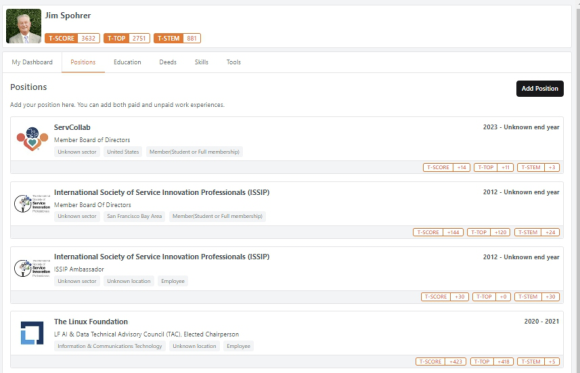
Selecting a data field tab presents a list of all of the records currently entered for that tab. Clicking on any record displays data associated with that entry, and the ability to edit, update, or correct it. New records can be created with an “Add”button at the upper right corner of each tab screen. For
example, Figure 2, below, shows the top of the Positions tab for a co-author of this paper. Note the five data field tabs across the top, when clicked open a group of records already entered.
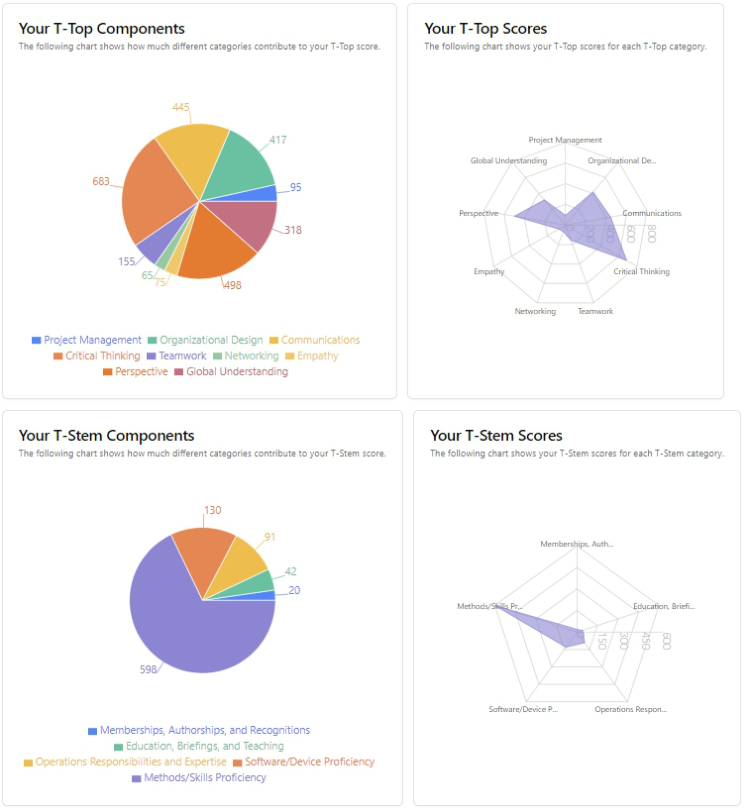
MyT-Me Dashboard: The Dashboard tab is at the far left of the top line of tabs in Figure 2. Clicking on this tab opens a set of diagrams that display the composition and size of your T-Top and T-Stem scores. An example of these charts, two for each score component, is shown in Figure 2. One display is the pie chart representation of the components. The other is a spider dia- gram of the component scores, shown relative to each other. Together, these two figures indicate strengths and primary experience, as well as potential directions for further development.
Figure 3: MyT-Me user’s T components, T-Top, and T-Stem – pie chart and spider diagrams (sample screenshot).
T-Shaped Professionals: The Past, Present, and Future of MyT-Me Development 7
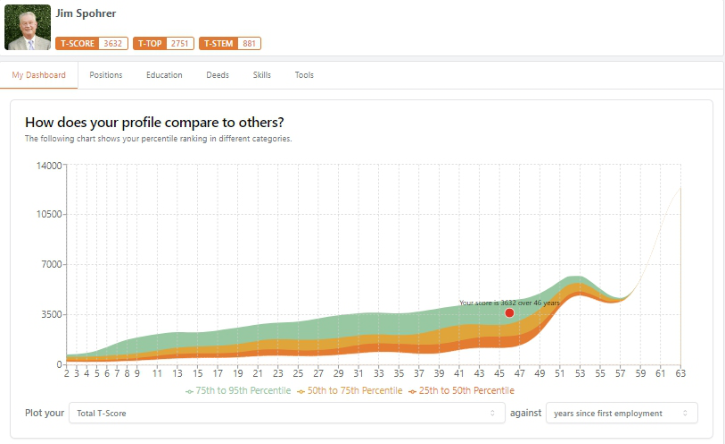
A unique graphical display of each person’s position relative to a popu- lation of members is also included in the user’s Dashboard (Figure 4). The design enables the user to view T-Score, T-Top, and T-Stem scores, as well as all components of each score. using drop-down selectors. The horizon- tal scale locates the user relative to their Years Since their last Degree, Years Since beginning their First Degree, or Years Since beginning their First Posi- tion. The three bands indicate (from the bottom) the 25th to 50th, 50th to 75th, and 75th to 95th percentiles.
FUTURE: POSSIBLE DEVELOPMENTS FOR MYT-ME Gap analysis with AI: By framing goals within the context of the MyT-Me platform, the system can be used to forecast the impact of planned activities before they take place. The activities can be scheduled or hypothetical. In addition, an AI tool is contemplated to recommend possible activities for consideration to fulfill near and long-term MyT-Me framed goals.
Team and Department T-Scores with AI: Teams have Team T-Shapes, and MyT-Me can be extended to present a Team Dashboard based on the MyT- Me scores of its members. The impact of adding and removing specific team members can be clearly displayed in the Team T Dashboard. AI-based rec- ommendations as to which individuals could enhance Team T-Shape targets could be offered.
Student and other user group versions and guidebooks: The terminology and drop-down list options currently in MyT-Me can be modified to align more closely with students and other specialized populations. User guides can be developed to provide assistance with MyT-Me profile management and use.
Specialized Weighting Systems: MyT-Me scores are based on an internal weighting system that is constant across all users. Organizations may wish to modify the weighting system based on the company’s priorities and goals.
CONCLUDING REMARKS This conceptual paper has introduced the MyT-Me platform as a tool for individuals, teams, and organizations to explore their T-scores and discover ways to increase both their T-Top and T-Stem scores. Using AI to assist in generating personalized developmental plans based on T-scores is future research.
ACKNOWLEDGMENT
We are grateful for feedback from participants in ISSIP’s MyT-Me event. For further information about MyT-Me, contact: lefreund@T-ShapeSolution s.com
REFERENCES
Babatope A., Samuel, T. M., Ajewole, P. I., Anyanwu, O. M. (2020). Competence- Driven Engineering Education: A Case for T-Shaped Engineers and Teachers. International Journal of Evaluation and Research in Education, 9(1), pp. 32–38. Barile, S., Franco, G., Nota, G. and Saviano, M., 2012. Structure and dynamics of a
“T-Shaped”knowledge: From individuals to cooperating communities of practice. Service Science, 4(2), pp. 161–180. Barile, S., Saviano, M., Simone, C. (2015a). Service economy, knowledge, and the need for T-shaped innovators. World Wide Web, 18, pp. 1177–1197. Barile, S., Saviano, M., Polese, F., Caputo, F. (2015b). T-shaped people for addressing
the global challenge of sustainability. In Service dominant logic. Bierema, L. L. (2019). Enhancing employability through developing T-shaped professionals. New Directions for Adult and Continuing Education, 163: 67–81. Boehm B, Koolmonojwong S. (2019). Educating I-Shaped Computer Science Students
to Become T-Shaped System Engineers. Procedia Computer Science. 153: 71–9. Brown, T. (2009). Change by design: How design thinking transforms organizations and inspires innovation. Harper Business. Caputo, F., Cillo, V., Fiano, F., Pironti, M., Romano, M. (2023). Building T-shaped
professionals for mastering digital transformation. Journal of Business Research, 154. Chan, K. Y., Ho, M. H. R., Ramaya, R. (2020). A “T-shaped” Metaphor for Holistic Development: Entrepreneurial, Professional and Leadership (EPL) Effi- cacies Predict Self-perceived Employability. In Entrepreneurship–Professionalism– Leadership: A Multidimensional Framework for Human Capital and Career Development in the 21st Century (pp. 113–130). Singapore: Springer Singapore. Conley, S. N., Foley, R. W., Gorman, M. E., Denham, J., Coleman, K. (2017). Acqui-
sition of T-shaped expertise: an exploratory study. Social Epistemology, 31(2), pp. 165–183. Dekoninck, E. and Bridge, L., 2023. The T-Shaped Design Engineer: Using Cohorts to Explore How Skills Profiles Differ Through Career Stages. Proceedings of the Design Society, 3, pp. 3533–3542.
T-Shaped Professionals: The Past, Present, and Future of MyT-Me Development 9
Demirkan, H. and Spohrer, J. (2015). T-shaped innovators: Identifying the right talent to support service innovation. Research-Technology Management, 58(5), pp. 12–15. Demirkan, H. and Spohrer, J. C. (2018). Commentary—cultivating T-shaped profes-
sionals in the era of digital transformation. Service Science, 10(1), pp. 98–109. Donofrio, N., DeMarco, M. (2022). If Nothing Changes, Nothing Changes: The Nick Donofrio Story. Houndstooth Press. Donofrio, N. M., Spohrer, J., Zadeh, H. S., Demirkan, H. (2018). Research-Driven
Medical Education and Practice: A Case for T-Shaped Professionals. Chapter 13 in T-Shaped Professional, Ed. Moghaddam, Demirkan, Spohrer. Business Expert Press. pp. 131–144. Eady, M. J., Abrahamson, E., Green, C. A., Arcellana-Panlilio, M., Hatfield, L., Namaste, N. (2021). Re-positioning SoTL toward the T-shaped Community. Teaching and Learning Inquiry, 9(1), pp. 262–278. Enders, J., de Weert, E. (2009). Towards a T-shaped profession: Academic work and
career in the knowledge society. In The changing face of academic life: Analytical and comparative perspectives (pp. 251–272). London: Palgrave Macmillan UK. Freund, L. E. (2018). MyT-Me—Your Personal T-Shape Scoring System. Chapter 11 in T-Shaped Professional, Ed. Moghaddam, Demirkan, Spohrer. Business Expert Press. pp. 107–114. Gardner, P. (2017). Flourishing in the face of constant disruption: Cultivating the
T-professional or adaptive innovator through WIL. In T. Bowan and M. Drysdale (Eds.), Work-integrated learning in the 21st century (International perspectives on education and society Vol. 32, pp. 69–81). Bingley, UK: Emerald. Gardner, P., Maietta, H. N. (2020). Advancing talent development: Steps toward a T-Model infused undergraduate education. Business Expert Press. Gardner, P., Spohrer, J. (2020). Introduction: Grasping the Foundations for Under-
standing the T-professional Model. In Advancing Talent Development: Steps Toward a T-model Infused Undergraduate Education, Editors Gardner and Maietta. pp. xv–xxxv. Hafeez-Baig, A. and Gururajan, R. (2012). Critical role of ‘T-shaped skills & incentive rewards’ as determinants for knowledge management enablers: A case of Indian study. Modern Information Systems, InTech Europe, Rijeka, Croatia, pp. 133–146. Hamdi, S., Silong, A. D., Binti Omar, Z. and Mohd Rasdi, R. (2016). Impact
of T-shaped skill and top management support on innovation speed; the mod- erating role of technology uncertainty. Cogent Business & Management, 3(1), p. 1153768. Hansen, M. T., Von Oetinger, B. (2001). Introducing T-shaped managers. Knowledge management’s next generation. Harvard business review. 79(3): 106–116. Ho, L. T., Gan, C. (2024). Artificial Intelligence, T-Shaped Teams, and Risk Man-
agement Post COVID-19 and Beyond. In Corporate Risk Management after the COVID-19 Crisis (pp. 153–194). Iansiti, M. (1993). Real Word R&D: Jumping the Product Generation Gap, Harvard Business Review, 71 (3): 138–147. Ing, D. (2008). T-shaped professionals, t-shaped skills, hybrid managers. Coevolving. Karjalainen, T. M., Koria, M., Salimäki, M. (2009). Educating T-shaped design,
business and engineering professionals. In Proceedings of the 19th CIRP Design Conference–Competitive Design. Cranfield University Press.
Mak, E. (2017). The T-shaped lawyer and beyond. Rethinking Legal Professionalism and Legal Education for Contemporary Societies. Inaugural Lecture for the Chair of Jurisprudence at Utrecht University, 19. McGowan, H. E., Shipley, C. (2020). The adaptation advantage: Let go, learn fast,
and thrive in the future of work. John Wiley & Sons. McIntosh, B. S., Taylor, A. (2013). Developing T-shaped water professionals: Building capacity in collaboration, learning, and leadership to drive innovation. Journal of Contemporary Water Research & Education, 150(1), pp. 6–17. Moghaddam, Y., Demirkan, H., Spohrer, J. (2018a). T-shaped professionals: Adap-
tive Innovators. Business Expert Press. Moghaddam, Y., Demirkan, H., Spohrer, J. (2018b). Introduction: Toward an ISSIP T-Shaped Curriculum and research Framework. Chapter 1 in T-Shaped Professionals, Editors Moghaddam, Demirkan, Spohrer. Business Expert Press. pp. 3–5. Ninan, J., Hertogh, M. and Liu, Y., 2022. Educating engineers of the future: T-
shaped professionals for managing infrastructure projects. Project Leadership and Society, 3, p. 100071. NSF (2023). IUSE / Professional Formation of Engineers: Revolutionizing Engineering Departments (IUSE/PFE: RED): Program Solicitation (NSF 23-553). National Science Foundation (NSF). URL: https://www.nsf.gov/pubs/2023/nsf23553/ns f23553.htm. Oskam, I. F. (2009). T-shaped engineers for interdisciplinary innovation: an attractive
perspective for young people as well as a must for innovative organisations. In 37th Annual Conference–Attracting students in Engineering. (Vol. 14, pp. 1–10). Rippa, P., Landi, G., Cosimato, S., Turriziani, L., Gheith, M. (2022). Embedding entrepreneurship in doctoral students: the impact of a T-shaped educational approach. European Journal of Innovation Management, 25(1), pp. 249–270. Rogers, P., Freuler, R. J. (2015). The “T-shaped” engineer. In 2015 ASEE Annual
Conference & Exposition (pp. 26–1507). Ruokonen, A. (2020). T-shaped model as a tool for personal development–Case software industry company’s Customer Service Function. (Thesis). Sanders, J. R., Jorgensen, S. N., Arce-Trigatti, A., Arce, P. E. (2021). A Parallel Think-
ing Problem Solving Pedagogy towards Development of T-Shaped Engineers. In Manuscript (Work-in-Progress) accepted for presentation at the American Society for Engineering Education Southeastern Section Conference, March (pp. 8–11). Saukkonen, J., Kreus, P. (2022). T-shaped Capabilities of the next Generation: Prospecting for an Improved Model. In European Conf. on KM (Vol. 23, No. 2, pp. 1032–1041). Saviano, M,. Polese F, Caputo F, Walletzký L (2016) A T-shaped model for rethink-
ing higher education programs. In Proceedings of the Toulon-Verona Conference “Excellence in Services”, Huelva, Spain 2016 Sep 5 (pp. 425–440). Seibert, S., Akkermans, J., Liu, C. H. (2024). Understanding contemporary career success: A critical review. Annual Review of Org. Psych. and Org. Behavior, Vol. 11: 509–534. Smathers, R. A. (2014). The 21st century T-shaped lawyer. Law Prac., 40, p. 32. Solberg, S., Martin, J., Larson, M., Nichols, K., Booth, H., Lillis, J. and Costa, L.
(2018). Promoting Quality Individualized Learning Plans throughout the Lifes- pan: A Revised and Updated “ILP How to Guide 2.0”. National Collaborative on Workforce and Disability for Youth.
T-Shaped Professionals: The Past, Present, and Future of MyT-Me Development 11
Spohrer JC, Maglio PP (2010) Toward a science of service systems. In Maglio, P. P., Kieliszewski, C. A., Spohrer, J. C. (eds.), Handbook of service science. New York: Springer, (pp. 157–194). Spohrer J, Maglio PP, Vargo SL, Warg M (2022) Service in the AI Era: Science, Logic,
and Architecture Perspectives. Business Expert Press. Tranquillo, J. (2017). The T-shaped engineer. Journal of Engineering Education Transformations, 30(4), pp. 12–24. Trogstad, I. K., Kokkula, S. and van der Aker, J. (2021). Application of T-shaped
engineering skills in complex multidisciplinary projects. In INCOSE International Symposium (Vol. 31, No. 1, pp. 1113–1129). Uhlenbrook, S. and De Jong, E. (2012). T-shaped competency profile for water professionals of the future. Hydrology and Earth System Sciences, 16(10): 3475–3483. Wetcho, S., Peacock, R., Arslan, O. (2022). Supporting a T-Shaped Identity through
Prof. Associations: A Graduate Student Perspective. TechTrends, 66(3): 391–393.
LISTED IN THE AHFE DIGITAL BOOKSTORE CATALOGUE
Explore the complete digital volume
The Human Side of Service Engineering
Read this individual research paper free through the original publisher, or explore the full digital proceedings book.
ISBN 978-1-964867-19-9
Explore this ISBN in the AHFE Bookstore ↗Listed in the July 2026 bookstore catalogue; search by ISBN to confirm current availability · Digital book purchase optional