Teresa Marrone, Pierpaolo Testa (2022). Brand algorithms and social engagement in digital era. In: The Human Side of Service Engineering. AHFE Open Access, vol. 62, pp. 227–236. https://doi.org/10.54941/ahfe1002562
The world we live in today is pervaded by digital, the net is increasingly present and mixes the dimensions of the physical and the virtual, changing the way we understand, decide and evaluate things and also the way we do business. Artificial intelligence (AI) and related technologies are transforming the way we think and do marketing and the way companies relate to consumers and society.Internet has assumed a key role in nurturing innovation within business ecosystems. AI, big data and Internet of things (IoT) are key drivers of the current revolution in the way of communicating and relating among both individuals and products. This change is mainly due to the impact of algorithms’ mediations on the creation of value and customer engagement.Recent years, growing attention has been devoted to consumer brand engagement through emerging technological platforms (e.g., social media/artificial intelligence-based). However, despite important knowledge advancement, much remains unknown regarding the effect of Consumers’ Technology-Facilitated Brand Engagement (CTFBE) on individuals’ wellbeing, thus determining an important research gap (Hollebeek and Belk, 2021). CTFBE comprises a vital social facet. Hollebeek and Belk (2021) define CTFBE as a consumer’s bloodedly volitional resource investment in technology-mediated brand interactions (Kumar et al., 2019; Hollebeek et al, 2020). Online behavioral customer engagement occurs because of the rise of the new media and the advancement of technology, which have changed the way customers connect and interact with firms (Jahn and Kunz, 2012). One of the most active channels for such an aim are social media (Gummerus et al, 2012) where customers share their own experiences, information, review brands and manifest enthusiasm, delight, or disgust about a brand with others (Hollebeek and Chen, 2014).Digital transformation has totally transformed the value creation process (Reinartz et al., 2019) revolutionizing the way of doing business using the large mass of available data and information, through sophisticated service platforms that increase both effectiveness and efficiency in the value creation processes. AI has been a key component of digital transformation, substantially affecting consumer decision-making (Duan et al., 2021).AI, big data and the IoT are supporting and / or automating many decision-making processes: product, price, channel, supply chain, communication, etc. The customer experience is also redesigned starting from new value creation objectives and can become a stimulus for the creation of new business models. This, in turn, can provide a customized experience that is highly valued by consumers (Lemon and Verhoef, 2016). While new technologies have brought more ways for customers to interact with brands and companies, digital technologies have similarly enabled the automation of company’s interactions with customers (Kunz et al., 2017).According to Kumar et al (2010), AI represents the enabling technology for the transformation of marketing theory and practices: the enormous availability of data, the explosion of the possibilities to reach and interact on the markets and an increased speed of transactions. AI-enabled digital platform helps organizations to attract their customers (Bag et al, 2021; Chawla and Goyal, 2021).An increasing number of marketing decisions already use artificial intelligence in some way, and with the rise of big data is becoming easier to incorporate AI into business practices. Marketers may develop a more effective and personalized communication approach (Mogaji et al., 2020). For this reason, today AI is adopted in all activities where classification, forecasts and clustering are useful or necessary to solve problems and support decisions (management of anomalies in processes, logistics and optimization planning, customer service and customization).In the contemporary world the ubiquity of digital has made fluid the distinctions between channels and has integrated two dimensions of reality (physical and virtual one in phygital), the management of complex processes has become agile and adaptive, the advantages of integration and dynamic use of resources condition the operation of entire businesses. Well, what influence all this changes, new technologies and brand algorithms will have on social engagement?Prior studies on artificial intelligence in service and marketing research have not addressed customer engagement (Kaartemo & Helkkula, 2018). Perhaps, even Kaartemo & Helkkula (2018) specifically called for more research to answer the question: “How can we improve customer engagement through AI?”The article proposal is theoretical/conceptual in nature and starts from an updated review of academic literature on the aforementioned topics, mainly within marketing and business management disciplines, to achieve an interpretative attempt of Brand algorithm and social engagement (role) in digital era. References on request.
INTRODUCTION AND AIM This article proposal is conceptual in nature and goes on to explain how digital technologies can help foster the ability of individual brands or the brand platforms themselves to engage, by the means of specific algorithms, with consumers, business partners and the overall society. The impact of this enlarged engagement is the co-creation of new symbiotic value at a societal level, cultural meaning in technological environments, and an increase in the brand platform’s servitization.
The article is organized as follows. In the second paragraph managerial literature is recalled to explain how new technologies are changing the world we live in and the way to do marketing. In the third paragraph it is recalled the brand engagement literature explaining how digital technologies are aiding to expand the frame of engagement from consumers to business ecosystem actors and to the overall society (social engagement). In the fourth paragraph it is highlighted the way brand algorithms and avatar marketing are auto- mating the brand platform management. Finally, in the fifth we propose a conceptual model of a spiral brand platform in which we synthetize what we have already reasoned about. Finally, the research design is explained in the six paragraph and, in paragraph 7, are identified research limitations and future research trajectories.
NEW TECHNOLOGIES ARE CHANGING THE WORLD WE LIVE IN The world we live in today is pervaded by digital, the web is increasingly pre- sent and mixes the dimensions of the physical and the virtual, changing the way we understand, decide and evaluate things and also the way we do busi- ness. Artificial intelligence (AI) and related technologies are transforming the way we think and do marketing and the way companies relate to consumers and society.
The last years of the last century were decisive for the role that the internet has assumed as a driver of innovation in business. AI, big data and Inter- net of things (IoT) are the elements of the current revolution in the way of communicating and relating with each other’s. These elements support offer decisions in an extremely detailed and rapid way and constantly follow us in our lives as consumers and decision makers in interconnected markets. Recently, the management literature is increasingly reflecting awareness of a shift toward a platform economy (Kenney & Zysman, 2016), which is also contributing to a transformation of capitalism (Rahman & Thelen, 2019) and society alike (Testa et al. 2021). The role of technological platforms has allowed greater societal permeability and, at the same time, has increased the ability of firms to deal with and tune in to society and several of its key actors. Malthouse, et al. (2019) argue “that in the evolving network economy, data and value diffusion to all stakeholders in the network (platform) are critical for the long-term growth and competitive advantage of service firms. Specifi- cally, we suggest that, for data to become a source of competitive advantage, there must be a symbiotic relationship among all the stakeholders of the data ecosystem” (p. 508).
Digital transformation has totally transformed the value creation process (Reinartz et al., 2019). With the term digital transformation today we mean the possibility of revolutionizing the way of doing business by the consolida- ted firms, even in the most basic principles, starting from the possibility of using the large mass of data and information available, through sophisticated service platforms that seek the maximization of both effectiveness and effici- ency in the value creation processes. AI has been a key component of digital transformation, with a substantial impact on consumer decision-making (Duan et al., 2021).
AI, big data and the IoT are supporting and / or automating many decision- making processes: product, price, channel, supply chain, communication, and ultimately even the brand. The customer experience is also redesigned starting from new value creation objectives and can become a stimulus for the creation of new business models. This, in turn, can provide a customized experience that is highly valued by consumers (Lemon and Verhoef, 2016). While new technologies have brought more ways for customers to interact with brands and companies, digital technologies have similarly enabled the automation of a company’s interactions with customers (Kunz et al. (2017).
According to Kumar et al (2010), AI represents the enabling technology for the transformation drivers of marketing theory and practices: the enormous availability of data, the explosion of reach and interaction opportunities on the markets and the increased speed of transactions. AI-enabled digital
Brand Algorithms and Social Engagement in Digital Era 229
platform helps the organizations to attract the customers (Bag et al, 2021; Chawla and Goyal, 2021).
These technologies allow companies to generate accurate forecasts on rele- vant events and on the behavior of individuals and society in order to deal with increasingly complex problems.
In fact, according to Davenport et al. (2012) there are too many decisi- ons involving too many variables and too much data to be managed only manually. Marketing decisions and activities are growing faster than avai- lable budgets and the number and capacity of human marketers are not growing alike. An increasing number of marketing decisions already use arti- ficial intelligence in some way, and this trend is bound to become even more relevant. Companies typically try to target increasingly specific segments and customers, and if there are thousands or millions of customers, you can’t do without artificial intelligence to get to this level of detail. As a consequence of the rise of big data, it is becoming easier to incorporate AI into business practices. Marketers may develop a more effective and personalized commu- nication approach (Mogaji et al., 2020). For this reason, today AI is mainly applied in all activities where classification, forecasts and clustering are use- ful or necessary to solve problems and support decisions (management of anomalies in processes, logistics and programming optimization, customer service and customization).
These changes are mainly due to the impact of the advent of algorithmic mediations on the creation of value and social engagement.
Artificial intelligence, big data, the IoT have changed the way of thinking and practicing the design of customer experiences. In this world the ubiquity of digital has made the fluid distinction not only between channels but also between dimensions of reality (physical and virtual). Under a managerial per- spective complex processes become agile and adaptive in an economy where the advantages of integration and dynamic use of resources make the dif- ference. Well, what impact all this changes can have on the value creation processes at the brand level?
Today, everything around us speaks and listens: the streets, the cars, the shops, the websites, our home, and the products/services we buy. All these things have become complex listening environments and service platforms, immersed in networks and software infrastructures that regulate the use of the data produced and accessible. From identifying a diagnosis for a disease to prepare a tasty meal.
The dynamic design of the customer experience, guided by digital data stre- ams and behavior predictive algorithms, is conceived as an accumulation of value, emerging from brand-consumer encounters in the various touchpoints of the customer journey. It is a customer journey that is generated by different networks and platforms, materialized as data infrastructures, algorithms and services in the market (from Google, Airbnb, Amazon, Facebook, up to the physical store).
Prior studies on artificial intelligence in service and marketing research have not addressed customer engagement (Kaartemo & Helkkula, 2018). Therefore, Kaartemo & Helkkula (2018) specifically called for more research
230 Marrone and Testa
to answer the question: “What are the ways to improve customer engagement through AI?”
NEW DIGITAL TECHNOLOGIES FACILITATE BRAND ENGAGEMENT Recent years, growing attention has been devoted to consumer engagement with brands (Cantone et al. 2015; Marrone, 2021) even through emer- ging technological (e.g., social media/artificial intelligence-based) platforms. However, despite important advances, much remains unknown regarding the effect of Consumers’ Technology-Facilitated Brand Engagement (CTFBE) on their wellbeing, thus posing an important research gap (Hollebeek and Belk, 2021). CTFBE comprises a vital social facet. Hollebeek and Belk (2021) define CTFBE as a consumer’s boundedly volitional resource investment in technology-mediated brand interactions (Kumar et al., 2019; Hollebeek et al, 2020). Online behavioral customer engagement occurs as a result of the rise of the new media and the advancement of technology, which have changed the way customers connect and interact with firms (Jahn and Kunz, 2012). One of the most omnipresent channels for this is social media (Gummerus et al, 2012) where customers talks about their experiences, share information, review brands and manifest enthusiasm, delight, or disgust about a brand with others (Hollebeek and Chen, 2014).
According to Hollebeek and Belk (2021) CCT also facilitates understan- ding of CTFBE through meaning-making mythology, rituals, and related brand practices that have shared meanings. CCT research also proposes that consumer rituals and practices are aggregate and cultural in nature. Many of these practices can be implemented on digital platforms (Hollebeek and Belk, 2021; Rose, 2014). For example, participation in virtual worlds (e.g., Second Life, Metaverse) entails ritualistic consumption practices, including building homes, hosting parties, and dancing (Hollebeek and Belk, 2021; Boellstorff, 2015). Moreover, changes in online avatar behaviors (e.g., fitness, saving for retirement) tend to be replicated in users’ offline environment (Hollebeek and Belk, 2021; Yee, Bailenson, & Ducheneau, 2009). In other cases, offline physical engagement is necessary (e.g., nature worship/tourism; Canniford & Shankar, 2013), revealing the typical limitations and inadequacies inherent in virtual versions of these activities that have become commonplace since the onset of COVID-19 (e.g., a virtual Facebook tour of the Rocky Mountains), (Hollebeek and Belk, 2021).
We recall some contribution that underline (Storbacka et al. 2016; Breid- bach and Brodie, 2017; Brodie et al. 2019), the role that engagement platforms have in being essential intermediaries in the AE (actor engage- ment) process in a service ecosystem because they facilitate and orchestrate connections and resource investments among multiple actors. Substantially, the digital platforms expand the boundaries of engagement behind firm- consumer and consumer-consumer relationships justifying a network based perspective (human vs not human) of engagement.
The IoT attributes a digital characteristic to real-world objects, putting them online and developing connections with consumers and brands, the same connection that develops through voice assistants (VA). Van Doorn
Brand Algorithms and Social Engagement in Digital Era 231
et al. (2017) conceptualization affirms that technology infused brand enga- gement develops social relationships between automated service technology and humans. Thus, as part of the wider actor engagement ecosystem, the Authors propose that automated VAs can be considered an actor in the enga- gement process, contributing to co-creation activities. Due to the machine learning capabilities of AI VAs and the automated social presence inherent within them, consumers are interacting with VAs in the same way they would with another human (McLean et al., 2021). VAs move beyond the ‘vehicle sta- tus’ and hold the role of an actor in the engagement process (McLean et al., 2021). The literature suggests that those robots perceived as a companion are not viewed as an assistant, rather as a trustworthy friend and that consumers display behavior towards the technological system in the same manner as they would with a human (Guzman, 2019). Accordingly, such ‘companion’ robots are used for hedonic benefits (Sundar et al., 2017). Conversely, the results of this study indicate that while consumers develop a relationship with the VA in the form of friendship (companionship), such VAs are used for utilitarian benefits rather than hedonic benefits when interacting with a brand (McLean et al., 2021).
Furthermore, thinking to the role of content providers, creatives, media specialists, social media vendors, in fostering the engagement intermediated by the platform with the brand, consumers and other business ecosystem’s actors. When we expand the engagement even to institutional actors (govern- ments, associations, university, public firms) and individual no consumers (opinion leaders, celebrities, influencers, and other cultural intermediaries) outside the business ecosystem but within society we more properly could adopt the term social engagement (Johnston, 2018).
BRAND ALGORITHMS AUTOMATE AND FOSTER BRAND INITIATIVES Algorithms are formal process or a set of step-by-step procedures that are usually expressed mathematically and often used to sort people or conce- pts into categories (such as market segments or SEO opportunities) that can then be operated upon (Kozinets, 2021). Drawing on the assemblage theory of Deleuze and Guattari (1983), “networks of desire” are a notion that com- bines algorithmic technologies, consumers, energized passion and virtual and physical objects into interconnected systems that produce and amplify con- sumption interest among the network’s interconnected actors as well as inside parts of the wider social system that embed the network (Kozinets et al., 2017, p. 667). We can consider these networks of brand desire that occur as consumers, marketers and other relevant brand actors interface through the various consumption-driven and consumer-driving affordances of netw- orked computing machines and service platforms. Some important concepts – technocultural fields, platform assemblages, algorithms, affordances and networks of brand desire –are central elements allowing us to better under- stand algorithmic branding. According to Bag et al (2021) social media is one of the most important platforms that help companies to increase sales
232 Marrone and Testa
volume. Agung & Darma (2019) argument about the opportunities and chal- lenges of Instagram algorithm in improving competitive advantage of the firms. Miao et al. (2022) affirm that a general theory of avatar marketing is emerging in literature. The extensive adoption of algorithms by brands allows for the acquisition of a series of advantages including the following ones: a better profiling of customers to interact with, a better understanding of their requests that allows rapid offered product and services alignment on the e.commerce sites, a more refined interaction with customers based on the previous history of visits and the contents they consulted, a quick response to frequent requests for information through chatboxes, a better interaction with commercial partners, the measurement of popularity of links in the networks, the identification of commercial opportunities, a rapid pro- cessing of the big data collected in the web on the tastes and trends of the company.
RESEARCH DESIGN In the contemporary world the ubiquity of digital has made fluid the distincti- ons between channels and has integrated two dimensions of reality (physical and virtual one in phygital), the management of complex processes has become agile and adaptive, the advantages of integration and dynamic use of resources condition the operation of entire businesses. Prior studies on artificial intelligence in service and marketing research have not addressed customer engagement (Kaartemo & Helkkula, 2018). Perhaps, even Kaar- temo & Helkkula (2018) specifically called for more research to answer the question: “How can we improve customer engagement through AI?”
The article is organized as follows: first are recalled method theories (Impact of digital technologies on management, brand engagement, brand algorithms) from management literature that can help to explain the research- ers conceptual reasoning and finally a domain theory is proposed (Jaakkola, 2020) that explain how brand algorithms and social engagement fertilize each other in a brand platform spiral model.
Thus the research question investigated in this contribution is: what influ- ence all these changes, enabled by new digital technologies, in terms of brand algorithms and social engagement will have on brand platform?
The article proposal is theoretical/conceptual in nature and starts from an updated review of academic literature on the aforementioned topics, mainly within marketing and business management disciplines, to achieve an inter- pretative attempt of Brand algorithms and social engagement (role) in digital era.
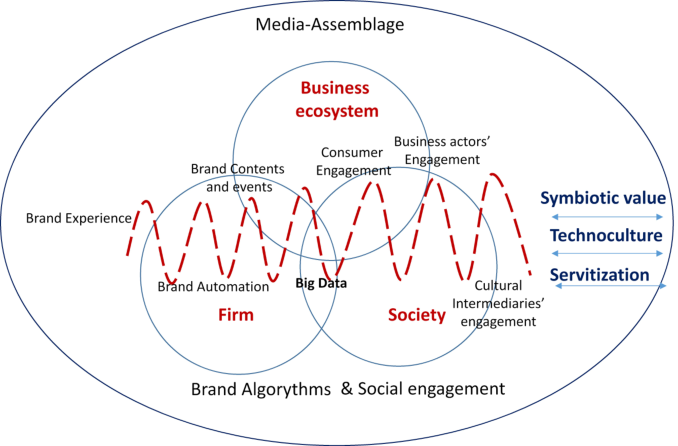
THE PROPOSAL OF AN EMERGING SPIRAL MODEL OF A BRAND PLATFORM IS EMERGING FROM LITERATURE We propose in the following (Figure 1) a conceptual model of brand spi- ral that integrates brand algorithms and social engagement at several over ordinate levels: firm, business ecosystem and the overall society. The bran algorithms therefore allows the firm to customize and improve the customer experience on the brand platform, to automate the interaction and response
Brand Algorithms and Social Engagement in Digital Era 233
Figure 1: The proposal of a conceptual model of a spiral brand platform.
to user requests, to improve the content proposal and digital customer enga- gement initiatives. The digital context therefore entails an improvement in consumer engagement and an extension of the network of players who con- tribute to the definition and creation of the online brand experience. Think to the involvement of marketing agencies’ creatives, business partners, social media managers, event managers who collaborate with the brand and contri- bute with their professionalism to increase the customer’s experience and the overall brand engagement. Therefore, it becomes possible to initiate actors’ engagement that improve the overall engagement of the brand. Finally, the peculiarity of the experiential and immersive context of the brand on the digital environment, allows the involvement of social actors, influencers, cele- brities, cultural intermediaries (journalists, directors, etc.), opinion leaders that improve the symbiosis between brands, actors of the business ecosystem, and society as a whole. This spiral model of the brand here proposed aims to emphasize above all the output that derives from the increased integration between brand algorithms and social engagement: the symbiotic value of the brand, the service brand contents and the techno-cultural expression that derives from it. Technocultures are “the various identities, practices, values, rituals, hierarchies, and other sources and structures of meanings that are influenced, created by, or expressed through technology consumption”(Kozi- nets, 2019, p. 621). Some familiar manifestations (Kozinets et al, 2021) are selfies, emojis, avatars, memes, augmented reality, online word-of-mouth, chatbots, Instafame and Zoombombing but also the identities of consumers expressed in physical world but created or derived by the digital one. “When working in collaboration with different stakeholders and bringing in all the relevant knowledge and skills, the firm and its stakeholders can achieve colle- ctive impact in society and create what we call “symbiotic value” that would
234 Marrone and Testa
not be possible alone” (Aksoy et al. 2020, p. 1046; Testa et al. 2021). Finally, the integration of brand algorithms and social engagement in addition to being itself an expression of service to the customer, to other business players and to society, improves the further level of personalization and servitization (Field et al., 2018; Zeithaml et al., 2014) of the brand platform itself. At the center of the model are the big data: all this is permitted by the ability of firm to elaborate data coming from three distinctive sources: firm, service ecosystem and society.
RESEARCH LIMITATIONS AND FUTURE RESEARCH TRAJECTORIES The main limitation of this article proposal is related to its conceptual nature. In the future, a multi case-study approach will be adopted at the brand plat- form level to explore the model even under a field research and managerial perspective.
REFERENCES
Agung, N. F. A., & Darma, G. S. (2019), “Opportunities and challenges of Instagram algorithm in improving competitive advantage”, International Journal of Innovative Science and Research Technology, 4(1), 743–747. Aksoy, L., Alkire, L., Kandampully, J., Kemppainen, L., Kong, L., McClelland, L.
E. (2020), “The Role of Service Firms in Societal Health: the Case for Symbiotic Value”, Journal of Service Management, 31, 1041–1058. Breidbach, C. & Brodie, R.J. (2017), “Engagement Platforms in the Sharing Economy: Conceptual Foundations and Research Directions,” Journal of Service Theory and Practice, 27(4), 761–777. Bag, S., Srivastava, G., Al Bashir, M. M., Kumari, S., Giannakis, M., & Chowdhury,
A. H. (2021), “Journey of customers in this digital era: Understanding the role of artificial intelligence technologies in user engagement and conversion”, Bench- marking: An International Journal, 1463-5771, DOI 10.1108/BIJ-07-2021-0415. Boellstorff, T. (2015), “Three Real Futures for Virtual Worlds”, Journal For Virtual Worlds Research, 8(2), 1–5. Brodie, R. J., Fehrer, J. A., Jaakkola, E., & Conduit, J. (2019), “Actor engagement in
networks: Defining the conceptual domain”, Journal of Service Research, 22(2), 173–188. Canniford, R., & Shankar, A. (2013), “Purifying practices: How consumers assemble romantic experiences of nature”, Journal of Consumer Research, 39(5), 1051–1069. Cantone, L., Testa, P., Marrone, T. (2015), “Consumer Brand Engagement Posi-
tioning in Marketing Theory under a Service Dominant Logic Perspective”, in Gummesson, E., Mele, C. & Polese, F. (Eds.) (2015), Naples Forum on Service. Service Dominant Logic, Network and Systems Theory and Service Science: Integrating three Perspectives for a New Service Agenda; June 9-12, Naples, Italy. Chawla, R. N., & Goyal, P. (2021), “Emerging trends in digital transformation: a bibliometric analysis”, Benchmarking: An International Journal, 1463–5771, DOI 10.1108/BIJ-01-2021-0009 Davenport, T. H., Barth, P., & Bean, R. (2012), “How ‘big data’ ‘is different”, MIT
Sloan Management Review, 54(1), 22–25. Deleuze, G. & Guattari, F. (1983), Anti-Oedipus: Capitalism and Schizophrenia, University of Minnesota Press, Minneapolis, Minnesota.
Brand Algorithms and Social Engagement in Digital Era 235
Duan, C., Kotey, B., & Sandhu, K. (2021), “Ecosystem Strategies for Transnational Digital Entrepreneurship: A Conceptual Framework of Three Ecosystems”. In Disruptive Technology and Digital Transformation for Business and Government, IGI Global, 1–23. Field, J.M., Victorino, L., Buell, R.W., Dixon, M.J., Goldstein, S.M., Menor, L.J.,
Pullman, M.E., Roth, A.V., Secchi, E. & Zhang, J.J. (2018), “Service operations: what’s next?”, Journal of Service Management, 29(1), 55–97. Gummerus, J., Liljander, V., Weman, E., & Pihlström, M. (2012), “Customer engagement in a Facebook brand community”, Management Research Review, 35(9), 857–87. Guzman, A. L. (2019), “Voices in and of the machine: Source orientation toward
mobile virtual assistants”, Computers in Human Behavior, 90, 343–350. Hollebeek, L. D., & Belk, R. (2021), “Consumers’ technology-facilitated brand engagement and wellbeing: Positivist TAM/PERMA-vs. Consumer Culture Theory perspectives”, International Journal of Research in Marketing, 38(2), 387–401. Hollebeek, L. D., and Chen, T. (2014), “Exploring positively- versus negatively-
valenced brand engagement: a conceptual model”, Journal of Product & Brand Management, 23(1), 62–74. Hollebeek, L. D., Kumar, V., & Srivastava, R. K. (2020), “From customer-, to actor-, to stakeholder engagement: taking stock, conceptualization, and future directi- ons”, Journal of Service Research, 1–16, DOI: 10.1177/1094670520977680. Jaakkola, E. (2020), “Designing conceptual articles: four approaches”, AMS review,
10(1), 18–26. Jahn, B., & Kunz, W. (2012), “How to transform consumers into fans of your brand”, Journal of Service Management, 23(3), 344–361. Johnston, K. A. (2018), “Toward a theory of social engagement”, in Johnston,
K.A. & Taylor M. (2018), The handbook of communication engagement, Wiley Blackwell, 19–32. Malthouse, E. C., Buoye, A., Line, N., El-Manstrly, D., Dogru, T., & Kandampully, J. (2019), “Beyond reciprocal: the role of platforms in diffusing data value across multiple stakeholders”, Journal of Service Management, 30, 507–518. Marrone T., (2021), Il customer engagement nella teoria di marketing. G. Giappich-
elli Editore. Torino. Kaartemo, V., & Helkkula, A. (2018), “A systematic review of artificial intelligence and robots in value co-creation: current status and future research avenues”, Journal of Creating Value, 4(2), 211–228. Kenney, M., & Zysman, J. (2016), “The rise of the platform economy”, Issues in
science and technology, 32(3), 61. Kozinets, R.V., Patterson, A. and Ashman, R. (2017), “Networks of desire: how technology increases our passion to consume”, Journal of Consumer Research, 43(5), 659–682. Kozinets, R. V. (2021), Algorithmic branding through platform assemblages: core
conceptions and research directions for a new era of marketing and service management”, Journal of Service Management, 1757–5818, DOI 10.1108/JOSM- 07-2021-0263. Kumar, V., Aksoy, L., Donkers, B., Venkatesan, R., Wiesel, T., & Tillmanns, S. (2010), “Undervalued or overvalued customers: Capturing total customer engagement value”, Journal of Service Research, 13(3), 297–310. Kumar, V., Rajan, B., Venkatesan, R., & Lecinski, J. (2019), “Understanding the
role of artificial intelligence in personalized engagement marketing”, California Management Review, 61(4), 135–155.
236 Marrone and Testa
Kunz, W., Aksoy, L., Bart, Y., Heinonen, K., Kabadayi, S., Ordenes, F.V., Sigala, M., Diaz, D. and Theodoulidis, B. (2017), “Customer engagement in a Big Data world”, Journal of Services Marketing, 31(2), 161–171. Lemon, K. N., & Verhoef, P. C. (2016), “Understanding customer experience
throughout the customer journey”, Journal of Marketing, 80(6), 69–96. McLean, G., Osei-Frimpong, K., & Barhorst, J. (2021), “Alexa, do voice assistants influence consumer brand engagement?–Examining the role of AI powered voice assistants in influencing consumer brand engagement”, Journal of Business Research, 124, 312–328. Miao, F., Kozlenkova, I. V., Wang, H., Xie, T., & Palmatier, R. W. (2022), “An
emerging theory of avatar marketing”, Journal of Marketing, 86(1), 67–90. Mogaji, E., Soetan, T. O., & Kieu, T. A. (2020), “The implications of artificial intelligence on the digital marketing of financial services to vulnerable customers”, Australasian Marketing Journal, 29(3), 235-242. Rahman, K. S., & Thelen, K. (2019), “The rise of the platform business model and
the transformation of twenty-first-century capitalism”, Politics & Society, 47(2), 177–204. Reinartz, W., Wiegand, N., & Imschloss, M. (2019), “The impact of digital transformation on the retailing value chain”, International Journal of Research in Marketing, 36(3), 350–366. Rose, J. L. (2014), Ultrasonic guided waves in solid mediaCambridge University
Press. Storbacka, Kaj, Roderick J. Brodie, Tilo Böhmann, Paul P. Maglio, & Suvi Nenonen (2016), “Actor Engagement as a Microfoundation for Value Co-creation”, Journal of Business Research, 69 (8), 3008–3017. Sundar, S. S., Jung, E. H., Waddell, F. T. & Kim, K. J. (2017), “Cheery companions
or serious assistants? Role and demeanour congruity as predictors of robot attra- ction and use intentions among senior citizens”, International Journal of Human Computer Studies, 97, 88–97. Testa, P., Cantone, L., Cantone, G. F., & Kandampully, J. (2021), “The Role of Technological Platforms in Co-creating Symbiotic Relationships Between Firms and Society” In International Conference on Applied Human Factors and Ergonomics (pp. 89–96), Springer, Cham. Van Doorn, J., Mende, M., Noble, S. M., Hulland, J., Ostrom, A. L., Grewal, D.,
& Petersen, J. A. (2017), “Domo arigato Mr. Roboto: Emergence of automated social presence in organizational frontlines and customers’ service experiences”, Journal of Service Research, 20(1), 43–58. Yee, N., Bailenson, J., Ducheneaut, N. (2009),” The proteus effect: Implications of transformed digital self-representation on online and offline behavior”, Communication Research, 36, 285–312. Zeithaml, V.A., Brown, S.W., Bitner, M.J. & Salas, J. (2014), Profiting from Services
and Solutions: What Product-Centric Firms Need to Know, Business Expert Press, New York, NY.
LISTED IN THE AHFE DIGITAL BOOKSTORE CATALOGUE
Explore the complete digital volume
The Human Side of Service Engineering
Read this individual research paper free through the original publisher, or explore the full digital proceedings book.
ISBN 978-1-958651-38-4
Explore this ISBN in the AHFE Bookstore ↗Listed in the July 2026 bookstore catalogue; search by ISBN to confirm current availability · Digital book purchase optional