Qi Xiao (2025). Analysis of Research Progress and Trends in Extended Reality Therapy Based on Bibliometrics. In: Intelligent Human Systems Integration (IHSI 2025): Integrating People and Intelligent Systems. AHFE Open Access, vol. 160, pp. 696–708. https://doi.org/10.54941/ahfe1005876
XR technology has provided a great deal of academic research in treating and improving physical and mental diseases. In this paper, 315 articles related to "Extended Reality" and "Art Therapy" collected by Web of Science were retrieved by bibliometric method, and the research status of this research field was analyzed visually by combining Citespace and VOSviewer, and the future trend was predicted. It references the XR healing system in health research direction, discipline frontier, research gaps, etc. The results showed an increasing trend in the amount of literature on the cable range. The United States, Germany, and Italy are leading in research, but the cooperation between institutions could be closer. Finally, from the technical point of view, XR therapy's research hot spots, opportunities and challenges are evaluated. From the interdisciplinary and artistic point of view, the artistry of the XR therapy system and XR art therapy are distinguished.
Nowadays, human health and well-being have become an increasingly important issue for the residents of contemweporary society. With the vigorous development of digital technology and artificial intelligence, many emerging solutions have been provided for the field of human health and well-being, and virtual digital technology has brought new possibilities and challenges to the field of healing, among which XR technology has provided more and more research and practice in the treatment and improvement of physical and mental diseases. XR therapy system has the advantages of an interactive environment combining real and virtual space and human- computer interactive experience equipment. It provides the audience with more immersive, private, flexible, safe and other characteristics of the treatment environment or treatment mode of virtual and real therapy systems (Ong et al., 2023). For example, De Mauro et al. (De Mauro et al., 2013) used VR and XR techniques in motor rehabilitation for patients with cerebrovascular accidents, spinal cord injuries and cerebral palsy; Gatto et al. (Gatto et al., 2020) investigated a positive thinking intervention combining mixed reality, virtual reality, and XR for the treatment of psychological problems associated with neocoronary pneumonia.
Analysis of Research Progress and Trends in Extended Reality Therapy 697
It can be seen that XR therapy involves many fields, such as psychology, medicine, art, and design, and it has a solid interdisciplinary attribute. With the development of digital technology in recent years, different disciplines have provided a wealth of interdisciplinary literature research for this field. The literature research on XR therapy includes the difference and evaluation between technology and artistry of virtual reality, extended reality and even mixed reality. At the same time, the knowledge structure in this field is complex and diversified. The traditional literature review method makes it difficult to define the research focus in this field clearly. It is difficult to objectively analyze the change of research hotspots in this field because of the lack of quantitative research that summarizes the research status and trend analysis. In order to more rigorously analyze the research progress and future trends in the field of Extended Reality Therapy, distinguish VR and AR healing, and analyze and evaluate its technical and artistic aspects. In this paper, the journal papers related to XR healing collected by the core journal database Web of Science (WoS) in the United States are taken as data sources. The literature is combed through the retrieval data system through scientific bibliometrics. The knowledge structure of the existing literature is visually presented, and the knowledge graph is drawn to determine the current research hotspots and frontier trends. Comprehensive use of document metrology software for visual analysis of relevant literature, compared with the text description of traditional theoretical review, can present the mutual relationship between literature in a particular discipline or research field as a scientific knowledge map, not only can sort out the past research track, but also better grasp the future research trend and direction (Song et al., 2022). Then, it provides an overview and reference for scholars in this field.
DESIGN RESEARCH METHODOLOGY Research Methodology
In this paper, scientific bibliometric methods and knowledge structure visualisation in quantitative data analysis are used in a comprehensive way to analyse and visualise data in a more comprehensive way using software such as VOSviewer and CiteSpace. Bibliometrics has become an influential in-depth quantitative analysis method, and it is a scientific tool to investigate the hot spots and progress of a specific research field and reveal future trends (Durieux and Gevenois, 2010) (Liang et al., 2023).
VOSviewer can build author or journal maps based on co-citation data or keyword maps based on co-occurrence data. The program provides a way for viewers to examine bibliometric maps comprehensively (van Eck and Waltman, 2010). CiteSpace is a Java application for analysing and visualising co-citation networks, the primary goal of which is to facilitate the analysis of emerging trends in the field of knowledge (Chen, 2006), and it has been widely used in scientometric research (Hou, Yang, and Chen, 2018). By comprehensively using VOSviewer and CiteSpace, the scientific knowledge map can be drawn on the output year distribution, country, research institution, keyword clustering, reference co-citation and mutation
698 Xiao
trend of highly cited references of all literature in this research field, and the relevant data can be visually analyzed and sorted out scientifically and intuitively. To study this field’s development status and future potential and identify the research hotspots and frontiers.
Date Sources The data used in this study came from Web of Science (WoS). The resources on the WoS platform build a broad, trusted, high-quality, interdisciplinary research and academic literature base, providing comprehensive coverage of all metadata information from journals, books, and conference proceedings across the natural sciences, social sciences, arts, and humanities (Liang et al., 2023). Therefore, this paper searched the WoS full-text database for data on Extended Reality technology combined with Art Therapy to assist with health and well-being issues.
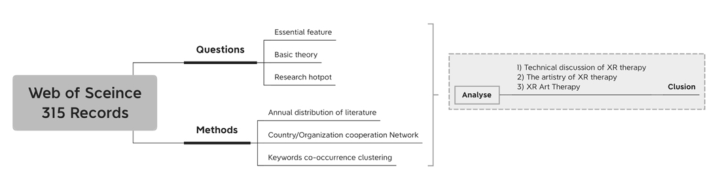
The research design is shown in the Figure1. In order to collect more comprehensive literature covering a wider range of therapeutic modalities to analyze the current state of the XR therapy system, the various forms of art therapy, as well as all the technical forms included in XR, are used as search terms. Set the search strategy to TS = ((“Extended Reality “OR” Virtual Reality “OR” Augmented Reality”) AND (“Art Therapy “OR” Art Healing”)). To ensure the comprehensiveness of literature across disciplines, citation index sources are set as “All” (SSCI, SCI, A&HCI, CPCI-S, CPCI- SSH, BKCI-S, BKCI-SSH, ESCI, etc.). In order to collect all relevant articles, the search time is not set, and the search time is set to all relevant documents for the whole year (until May 2024). And a total of 315 literatures were retrieved as the data source of this study. All retrieved documents were exported as txt files in the format of “full records and cited references” and then imported into VOSViewer 1.6.20 and CiteSpace 6.3.R1 for further analysis.
Figure 1: Research design.
BILBLIOMETRIC RESULTS & ANALYSES XR Therapy Study Timeframe Analysis
The pattern of change in the output of academic research literature as it develops over time is an important measure of the trend in the development of a research topic. It allows for an effective assessment of the dynamics of research in the subject area(Chen et al., 2022). In the SoC full-text database,
Analysis of Research Progress and Trends in Extended Reality Therapy 699
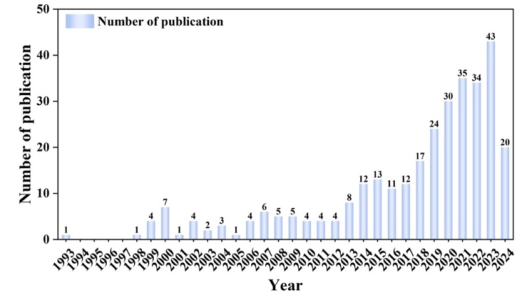
the distribution of research publications on Extended Reality Therapy is shown in the Figure 2. From the point of view of publication, the first article in the scope of the search was published in 1993, and there was a gap in the following four years from 1994 to 1997, and new articles began to appear in 1998. Over the ten years 2014–2023, the number of annual articles published increased from 12 in 2014 to 43 in 2023. This shows that XR Therapy has received more and more attention since 2014. Based on the overall number of publications, the research field of XR Therapy is constantly developing, and in the past five years, more and more scholars have paid attention to it.
Figure 2: A distribution map of the annual publication volume of XR therapy literature.
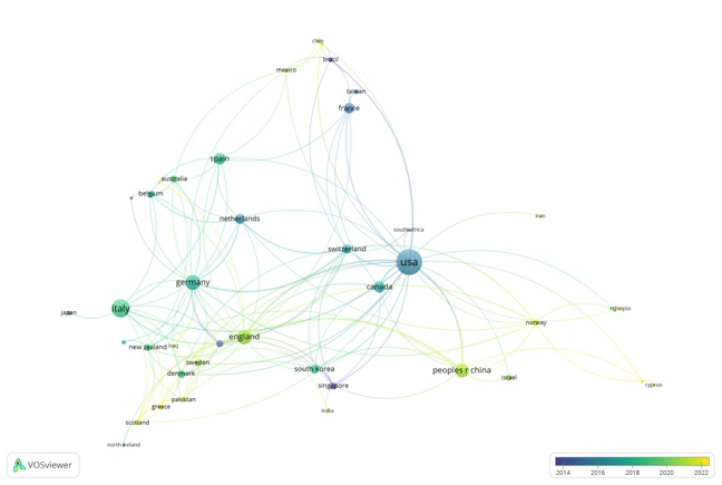
Distribution of Literature by Country In the WoS database, in terms of country/region outputs, a total of 41 countries/regions around the world have contributed research in this field, as shown in Figure 3. Among them, the top 10 countries have a total of 304 publications, accounting for 70% of the total publications. Among them, the USA is the most productive country in the research field of XR Therapy, with a total of 92 articles, which is in first place of the total number of articles. It can be seen that the USA is the leader in XR Therapy research, with more than twice the number of articles than the second place, Italy (45 articles). In addition to this, the USA also leads in the number of citations for its publications, with 3440 citations compared to 928 citations for the second place Italy. In the collaborative network, there is a relationship between the USA and Germany, Italy, England and China. However, the overall distribution could be more cohesive, and the collaboration could be closer. These results suggest that the United States has made the greatest contribution to the field of XR Therapy research, has had the greatest impact on practical applications in other countries, and has laid the research foundation for the development of XR Therapy.
700 Xiao
Figure 3: A distribution map of the country publication of XR therapy literature.
Research Hotspot and Frontier Trend Analysis
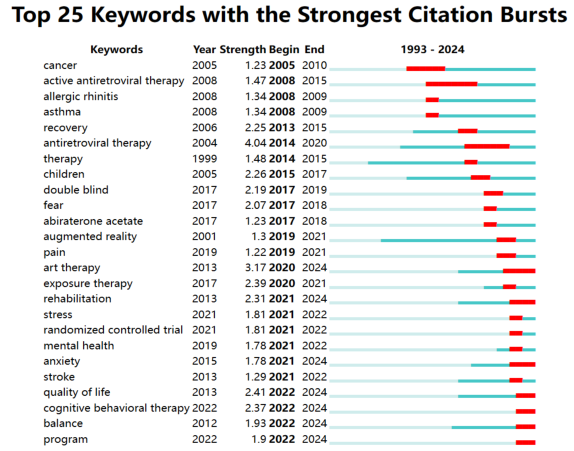
Figure 4 shows the top 25 keywords with the strongest citation explosion, which can further analyze the development trend in the field of XR Therapy. The study uses CiteSpace’s Burst Term graph, where the red index represents the frequent citation of keywords. Comprehensive analysis shows that the research content shows a changing trend from physical disease to mental health. “Antiretroviral therapy” is the most explosive keyword (4.04), which is a treatment method for HIV, indicating a trend in the research field from 2014 to 2020. Similarly, “art Therapy”is one of the most explosive keywords in the last five years (3.17), highlighting the emerging trend in the field of XR Therapy in the direction of art Therapy in recent years. In addition to that, the keywords that have emerged in the past five years are rehabilitation (2.31), quality of life (2.41), cognitive behavioural therapy (2.37), and mental health (1.78) has gradually gained widespread attention and become the focus of research in the field of XR Therapy in recent years.
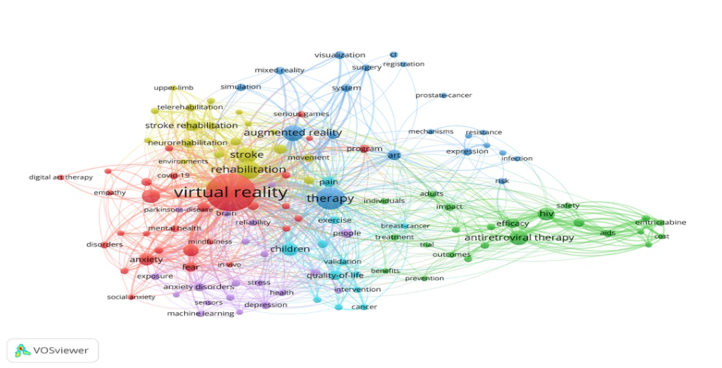
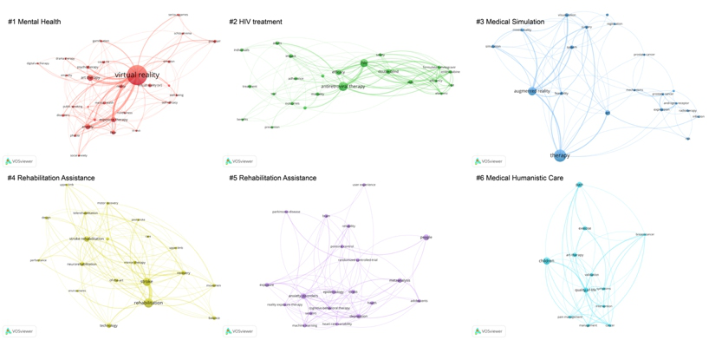
For a more intuitive and clear view of XR Therapy research hotspots and topics, as well as the relationship between key hotspots. A comprehensive use of VOSviewer was made to draw the co-occurrence network view of keywords in 315 documents (see Figure 5), in which a total of 2027 keywords were included, the frequency was set to 4, and 124 keywords were obtained after filtering and merging synonyms for visualization. The colours of the nodes represent different clusters, i.e., research topics, resulting in a total of six main clusters. According to the analysis results and combined with professional knowledge, each cluster can be summarized, and the themes are divided into #1 mental health, #2 HIV treatment, #3 medical simulation, #4 rehabilitation assistance, #5 personality disorder treatment,
Analysis of Research Progress and Trends in Extended Reality Therapy 701
and #6 medical humanistic care. The research content of each topic is further analyzed.
Figure 4: The top 25 keywords with the strongest citation bursts.Figure 5: XR therapy research keywords co-occurrence network.
Keywords in each topic are refined and classified in Figure 6. All keywords can be roughly divided into technology and therapy and research question and application, as shown in Table 1. The tendency of each research topic can be more clearly seen so as to analyze the clustering hotspots in the research field of XR Therapy.
702 Xiao
Figure 6: XR therapy research keyword co-occurrence clustering 1–6.Table 1. XR therapy clustering keyword type classification.
Table available in the original PDF paper.
Cluster Topic Topic Classification Representative Keywords 1 Mental Health Technology & Therapy virtual reality, immersion, biofeedback, in-vivo, art therapy, exposure therapy, psychotherapy sgamification, serious games, digital art therapy, drama therapy, mindfulness Problems & Applications
mental health, anxiety, fear, behavior, covid-19, disorders, emotion, phobia, self-efficacy, well-being, empathy, public speaking, schizophrenia, social anxiety 2 HIV treatment Technology & Therapy antiretroviral therapy Problems & Applications
Analysis of Research Progress and Trends in Extended Reality Therapy 703
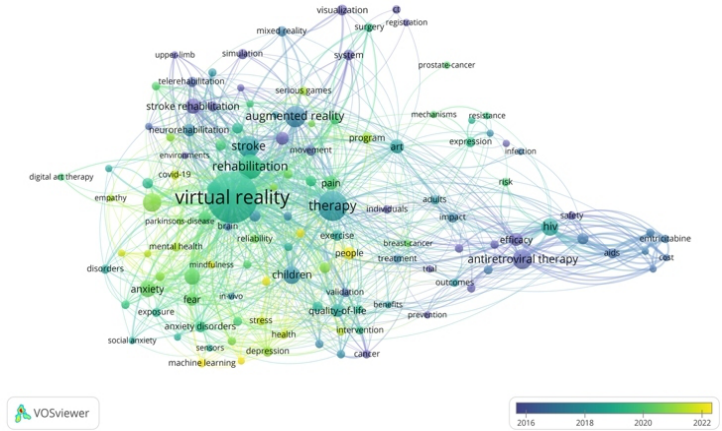
In order to further analyze the cutting-edge topics and development trends in the research field of XR Therapy, statistical analysis was continued on the occurrence time of keywords (2016–2022), and the keyword co-occurrence cluster network diagram was superimposed to form the keyword contribution cluster superposition, as shown in Figure 7. From the perspective of time, the whole time of keywords in the treatment of personality disorder is the closest to now, which is at the forefront of the current XR Therapy research. Secondly, cluster #1_ mental health is also the focus of current XR Therapy research. On the whole, the field of XR Therapy has gradually paid more and more attention to the field of medical care from the early stage of medical treatment, especially after COVID-19; the development of mental health is the direction of development in this field, and medicine, psychology and art have formed a broader cooperative relationship. machine learning, heart-rate-variability, well-being and mindfulness are the hot research trends in recent years.
Figure 7: XR therapy research keywords co-occurrence clustering superposition diagram.
DISCUSSION
The results showed that XR Therapy research has been widely carried out in various disciplines around the world and provided suggestions for scholars to research further. First of all, in terms of time, the annual publication volume of XR Therapy has steadily increased every year in the past ten years in this field. Since 2019, the development of this field has been on the rise. After COVID-19, more and more scholars have begun to pay attention to the field of XR Therapy. Overall, XR Therapy has attracted more and more attention from scholars. From the perspective of countries and institutions, a total of 41 countries and 68 institutions are covered. Among them, the United States
704 Xiao
is the country with the largest number of articles, a total of 92; Yale univ in the United States contributed the most, with a total of 9 articles. According to the number of citations, the number of citations per paper, and the H- index, the influence of XR Therapy papers in Western developed countries (such as the United States, Italy, Germany, etc.) is greater than that in other countries or regions.
As early as 1998, J Périssat, D Collet et al. discussed the application of virtual reality technology in laparoscopic surgery, minimally invasive treatments, etc (Périssat and Monguillon, 1998). In 2013, Giovanni Abbruzzese, Roberta Marchese et al. proposed the use of virtual reality combined with motor games for assisted rehabilitation of Parkinson’s disease rehabilitation (Abbruzzese et al., 2016). Marco Iosa, Cristiano Maria Verrelli, and others use virtual reality combined with serious games to provide intensive and fun rehabilitation for children with neurological disorders (Iosa et al., 2022).
A comprehensive analysis of past research shows that compared to VR Therapy, AR Therapy systems provide stimulating virtual environments and natural force interactions with real-world objects during therapy because of the advantage of being able to integrate virtual and real environments (Alamri, Cha, and El Saddik, 2010). The AR user does not “leave” the space he is in and “maintains a sense of presence” in the non-synthetic world (Botella et al., 2005). Therefore, AR technology has a unique advantage in specific therapeutic scenarios. From the analysis of keyword co-occurrence results, the number of research and applications of AR therapy is significantly lower than that of VR. However, AR has obvious advantages in terms of the sense of presence and immersive feeling for users in therapy. However, an important technical challenge is to make the virtual elements as seamless as possible into the non-synthetic environment so that the user can produce the experience of coexistence of virtual elements and non-synthetic elements in a “unique world” (Botella et al., 2004). VR/AR devices still face key challenges that impede their integration into everyday life and other applications (Yin et al., 2021). The technological advantages and possibilities of AR therapy are still a hot topic today, and various experts and scholars in the therapy field are still exploring its effectiveness.
From the bibliometric results, the field of MR therapy has fewer publications and slower research progress compared to the previous two. However, in recent years, it has gradually become a hot spot in the field of XR technology that is being paid attention to. Mixed reality has the obvious advantage of providing a more portable human-computer interaction environment for the therapeutic field. At the same time, it focuses on enhancing the humanistic care of medicine, especially in the treatment of mental health and personality disorders, because it can be applied in the more familiar home of the patient instead of the cold treatment room. It can also be a shared space with emotional communication (Patrão et al., 2019). In conclusion, there is still a great deal of value in this area that deserves to be explored and researched by scholars in the field of therapeutic research.
In terms of “art therapy” alone, art has a unique therapeutic effect in its own right, particularly in mental health. So far, XR technology has brought
Analysis of Research Progress and Trends in Extended Reality Therapy 705
many new opportunities for art therapy, such as serious games, digital art therapy, etc., gradually moving to the field of treatment experts’ vision, in addition to the application in mental health, in the field of medical treatment also has outstanding advantages. In the latest development, Daniel Lima Sousa, Silmar Teixeira, Jose Everton Fontenele and others designed an app called RG4Face, a serious facial rehabilitation game based on mime therapy and supported by healthcare professionals, using computer vision for human facial motion recognition and estimation (Sousa et al., 2024).
Overall, there is a strong connection between art engagement and the therapeutic field. However, the field of XR art therapy is still in the developing stage. Its challenges may exist in the form of interaction technologies and powerful data collection devices suitable for remote experiments, which require joint decision-making by experts from interdisciplinary fields (medicine, psychology, design, art, human-computer interaction, etc.).
CONCLUSION
The field of XR therapy research has been on a general upward trend in terms of paper output, especially in the last five years, and the heat of development has been gradually increasing. In the development process, there are not many countries and institutions with high output, and the cooperation between institutions is not very close. Finally, a comprehensive discussion after the analysis was conducted, evaluating the hotspots, opportunities, and challenges of VR therapy, AR therapy, and MR therapy included in XR therapy from the perspective of technicality and distinguishing between the artistry of XR therapy system and XR art therapy from the perspective of interdisciplinarity and artistry, respectively. The research in this paper still has limitations; this paper only bibliometric analysis of the Web of Science database did not extend the retrieval data of XR therapy to multiple databases in different fields; future research can be based on this status quo research and limitations as the basis of the research, further to carry out more profound research on XR Therapy.
REFERENCES
Alamri, Atif, Jongeun Cha, and Abdulmotaleb El Saddik. 2010. ‘AR-REHAB: An Augmented Reality Framework for Poststroke-Patient Rehabilitation’. IEEE T. Instrumentation and Measurement 59 (October):2554–63. https://doi.org/10. 1109/TIM.2010.2057750 Baker, Barbara Ann. 2006. ‘Art Speaks in Healing Survivors of War’. Journal
of Aggression, Maltreatment & Trauma, May. https://doi.org/10.1300/J146v12n 01_10 Botella, C., J. Osma, A. Garcia-Palacios, S. Quero, and R.m. Baños. 2004. ‘Treatment of Flying Phobia Using Virtual Reality: Data from a 1-Year Follow-up Using a Multiple Baseline Design’. Clinical Psychology & Psychotherapy 11 (5): 311–23. https://doi.org/10.1002/cpp.404 Botella, C. M., M. C. Juan, R. M. Baños, M. Alcañiz, V. Guillén, and B. Rey. 2005.
‘Mixing Realities? An Application of Augmented Reality for the Treatment of Cockroach Phobia’. CyberPsychology & Behavior 8 (2): 162–71. https://doi.org/ 10.1089/cpb.2005.8.162
706 Xiao
Burdea, Grigore C., and Philippe Coiffet. 2003. Virtual Reality Technology. John Wiley & Sons. Chen, Chaomei. 2006. ‘CiteSpace II: Detecting and Visualizing Emerging Trends
and Transient Patterns in Scientific Literature’. Journal of the American Society for Information Science and Technology 57 (3): 359–77. https://doi.org/10.1002/ asi.20317 Chen, Yinpeng, Michael Baran, Hari Sundaram, and Thanassis Rikakis. 2011.
‘A Low Cost, Adaptive Mixed Reality System for Home-Based Stroke Rehabilitation’. Annual International Conference of the IEEE Engineering in Medicine and Biology Society. IEEE Engineering in Medicine and Biology Society. Annual International Conference 2011:1827–30. https://doi.org/10.1109/IEMBS. 2011.6090520 Chen, Y., Jiang, Yuhao, He, Renke, and Wu, Xingting. 2022. ‘Bibliometric-based analysis of research progress, hotspots and trends in affective design’. Packaging Engineering 43 (6): 32–40. https://doi.org/10.19554/j.cnki.1001-3563.2022.06. 004 De Mauro, Alessandro, Aitor Ardanza, Esther Monge, and Francisco Molina Rueda.
2013. ‘New Perspectives and Limitations in the Use of Virtual Reality in the Rehabilitation of Motor Disorders’. In Engineering Reality of Virtual Reality 2013, edited by M. Dolinsky and I. E. McDowall, 8649:86490G. Proceedings of SPIE. Bellingham: Spie-Int Soc Optical Engineering. https://doi.org/10.1117/12. 2010753 Di Loreto, Ines, and Abdelkader Gouaich. 2010. ‘Mixed Reality Serious Games: The Therapist Perspective’. 2011 IEEE 1st International Conference on Serious Games and Applications for Health, SeGAH 2011, November. https://doi.org/10. 1109/SeGAH.2011.6165462 Durieux, Valérie, and Pierre Alain Gevenois. 2010. ‘Bibliometric Indicators: Quality
Measurements of Scientific Publication’. Radiology 255 (2): 342–51. https://doi. org/10.1148/radiol.09090626. Eck, Nees Jan van, and Ludo Waltman. 2010. ‘Software Survey: VOSviewer, a Computer Program for Bibliometric Mapping’. Scientometrics 84 (2): 523–38. https://doi.org/10.1007/s11192-009-0146-3 Frutos-Pascual, M., B. García-Zapirain, and A. Méndez-Zorrilla. 2012. ‘Improvement in Cognitive Therapies Aimed at the Elderly Using a Mixed-Reality Tool Based on Tangram Game’. In Computer Applications for Graphics, Grid Computing, and Industrial Environment, edited by Tai-hoon Kim, Hyun-seob Cho, Osvaldo Gervasi, and Stephen S. Yau, 68–75. Berlin, Heidelberg: Springer. https://doi.org/10.1007/978-3-642-35600-1_10 G, Abbruzzese, Marchese R, Avanzino L, and Pelosin E. 2016. ‘Rehabilitation
for Parkinson’s Disease: Current Outlook and Future Challenges’. Parkinsonism & Related Disorders 22 Suppl 1 (January). https://doi.org/10.1016/j.parkreldis .2015.09.005 Gatto, Carola, Giovanni D’Errico, Fabiana Nuccetelli, Valerio De Luca, Giovanna Ilenia Paladini, and Lucio Tommaso De Paolis. 2020. ‘XR-Based Mindfulness and Art Therapy: Facing the Psychological Impact of Covid-19 Emergency’. In Augmented Reality, Virtual Reality, and Computer Graphics, AVR 2020, PT II, edited by L. T. DePaolis and P. Bourdot, 12243:147–55. Lecture Notes in Computer Science. Cham: Springer International Publishing Ag. https://doi.org/ 10.1007/978-3-030-58468-9_11 Hou, Jianhua, Xiucai Yang, and Chaomei Chen. 2018. ‘Emerging Trends and
New Developments in Information Science: A Document Co-Citation Analysis (2009–2016)’. Scientometrics 115 (2): 869–92. https://doi.org/10.1007/s11192- 018-2695-9
Analysis of Research Progress and Trends in Extended Reality Therapy 707
Hong Zhou. 2014. ‘The development of art therapy: review and prospect’. Journal of East China Normal University (Educational Science Edition) 32 (1): 97. Iosa, Marco, Cristiano Maria Verrelli, Amalia Egle Gentile, Martino Ruggieri, and
Agata Polizzi. 2022. ‘Gaming Technology for Pediatric Neurorehabilitation: A Systematic Review’. Frontiers in Pediatrics 10:775356. https://doi.org/10.3389/fp ed.2022.775356 J, Périssat, Collet D, and Monguillon N. 1998. ‘Advances in Laparoscopic Surgery’.
Digestion 59 (5). https://doi.org/10.1159/000007535 Liang, Qianrong, Jiarong Ye, Yingyin Lu, Junjie Dong, Heyong Shen, and Hongzhong Qiu. 2023. ‘Hotspots, Trends, and Advice: A 10-Year Visualization- Based Analysis of Painting Therapy from a Scientometric Perspective’. Frontiers in Psychology 14 (May):1148391. https://doi.org/10.3389/fpsyg.2023.1148391 Marescaux, Jacques, and Michele Diana. 2015. ‘Next Step in Minimally Invasive
Surgery: Hybrid Image-Guided Surgery’. Journal of Pediatric Surgery 50 (1): 30–36. https://doi.org/10.1016/j.jpedsurg.2014.10.022 Marescaux, Jacques, Francesco Rubino, Mara Arenas, Didier Mutter, and Luc Soler.
2004. ‘Augmented-Reality–Assisted Laparoscopic Adrenalectomy’. JAMA 292 (18): 2211–15. https://doi.org/10.1001/jama.292.18.2214-c Merigo, Jose M., Enrique Herrera-Viedma, Ronald Yager, and Janusz Kacprzyk.
2018. ‘A Bibliometric Overview of the Research Impact of Lotfi A. Zadeh’. In, 441–46. https://doi.org/10.1109/SSCI.2018.8628761 Moro, Christian, Zane Štromberga, Athanasios Raikos, and Allan Stirling. 2017.
‘The Effectiveness of Virtual and Augmented Reality in Health Sciences and Medical Anatomy’. Anatomical Sciences Education 10 (6): 549–59. https://doi. org/10.1002/ase.1696 Ong, Triton, Hattie Wilczewski, Hiral Soni, Julia Ivanova, Janelle Barrera, Mollie Cummins, Brandon Welch, and Brian Bunnell. 2023. ‘Therapist Perspectives on Telehealth-Based Virtual Reality Exposure Therapy’. Research Square, July, rs.3.rs-3161151. https://doi.org/10.21203/rs.3.rs-3161151/v1 Patrão, Bruno, Paulo Menezes, and Nuno Gonçalves. 2019. ‘Augmenting Shared
Spaces in Psychotherapy Contexts’. In, 264–65. https://doi.org/10.1109/EXPAT. 2019.8876513 Ratcliffe, Jack, Francesco Soave, Nick Bryan-Kinns, Laurissa Tokarchuk, and Ildar Farkhatdinov. 2021. ‘Extended Reality (XR) Remote Research: A Survey of Drawbacks and Opportunities’. In Proceedings of the 2021 CHI Conference on Human Factors in Computing Systems, 1–13. CHI ’21. New York, NY, USA: Association for Computing Machinery. https://doi.org/10.1145/3411764. 3445170 Song, Peng, Hui Li, Kuo Xu, Zi-Wei Li, Xia Ren, and Xian-Jun Fu. 2022.
‘A Bibliometric and Visualization-Based Analysis of Temozolomide Research Hotspots and Frontier Evolution’. Frontiers in Oncology 12 (November):905868. https://doi.org/10.3389/fonc.2022.905868 Sousa, Daniel Lima, Silmar Teixeira, José Everton Fontenele, Renato Mendes Santos, Leynilson Pereira, Rodrigo Baluz, Victor Hugo Bastos, and Ariel Soares Teles. 2024. ‘Health Care Professional-Supported Co-Design of a Mime Therapy-Based Serious Game for Facial Rehabilitation’. JMIR Serious Games 12 (January): e52661. https://doi.org/10.2196/52661 Speicher, Maximilian, Brian D. Hall, and Michael Nebeling. 2019. ‘What Is Mixed
Reality?’ In Proceedings of the 2019 CHI Conference on Human Factors in Computing Systems, 1–15. CHI ’19. New York, NY, USA: Association for Computing Machinery. https://doi.org/10.1145/3290605.3300767
708 Xiao
Sutherland, Justin, Jason Belec, Adnan Sheikh, Leonid Chepelev, Waleed Althobaity, Benjamin J. W. Chow, Dimitrios Mitsouras, Andy Christensen, Frank J. Rybicki, and Daniel J. La Russa. 2019. ‘Applying Modern Virtual and Augmented Reality Technologies to Medical Images and Models’. Journal of Digital Imaging 32 (1): 38–53. https://doi.org/10.1007/s10278-018-0122-7 Traymbak, Shruti, Meghna Sharma, Aastha Anand, and Anju Shukla. 2024. ‘Chatbot
Technology in the Education Sector: A Bibliometrics Analysis Using VOS Viewer’. International Journal of System Assurance Engineering and Management, January. https://doi.org/10.1007/s13198-023-02230-6 Wikipedia. 2024. ‘Extended Reality’. In Wikipedia. https://en.wikipedia.org/w/ index.php?title=Extended_reality&oldid=1229507441. Wrzesien, Maja, Cristina Botella, Juani Bretón-López, Eva Del Río, Jean-Marie
Burkhardt, Mariano Alcañiz Raya, and María Ángeles Pérez-Ara. 2015. ‘Treating Small Animal Phobias Using a Projective-Augmented Reality System: A Single- Case Study’. Computers in Human Behavior 49 (March):343–53. https://doi.org/ 10.1016/j.chb.2015.01.065 Yin, Jessica, Ronan Hinchet, Herbert Shea, and Carmel Majidi. 2021. ‘Wearable Soft Technologies for Haptic Sensing and Feedback’. Advanced Functional Materials 31 (39): 2007428. https://doi.org/10.1002/adfm.202007428 Yuan, Jie, Sohail S. S. Hassan, Jiaojiao Wu, Casey R. R. Koger, Rene R. Sevag Packard,
Intelligent Human Systems Integration (IHSI 2025): Integrating People and Intelligent Systems
Read this individual research paper free through the original publisher, or explore the full digital proceedings book.
ISBN 978-1-964867-36-6
Explore this ISBN in the AHFE Bookstore ↗Listed in the July 2026 bookstore catalogue; search by ISBN to confirm current availability · Digital book purchase optional