Yilan Jin (2023). Emotional space design research based on bibliometric tools. In: Affective and Pleasurable Design. AHFE Open Access, vol. 71, pp. 270–280. https://doi.org/10.54941/ahfe1003940
Environmental psychology research and the emotional design boom have led to a series of theoretical studies and practical activities on emotional design in space. It includes interior design, architectural design, display design, and other space planning and design work. In order to conduct a deeper study and practice of emotional space design, a bibliometric and review approach was used to visualise and analyse data from the literature on emotional space design to understand the development trends of emotional space design. The literature data were sourced from the Web of Science (WoS), Science Citation Index Expanded (SCI Expanded), Social Science Citation Index (SSCI), and Arts Humanities Citation Index (AHCI) as the literature search source, enter TS=((emotion OR affective) AND (space design OR interior design OR landscape architecture )) in the advanced search formula generator, and set the search time to the whole year, i.e., 1991-2023. And 1146 documents were obtained. After excluding articles with missing field information, duplicate data, and those with no relevance to the selected topic, 629 valid documents were finally accepted. This paper uses two bibliometric tools, VOSviewer (Version 1.6.19) and CiteSpace (Version 5.6.R3), to obtain critical data such as keyword clustering profiles, Strongest Citation Bursts, highly cited literature, and visual images for this research topic. This information shows that the literature on emotional space design is generally rising. There is no downward trend in the literature output at this research stage, so it is judged that research in this area is in a high-growth phase. The United States, England, China, Australia, and Canada are the major research countries in this field; Cornell, Leeds, UCL, and other leading institutions in architecture and design-related disciplines are the primary subjects of research in emotional space design. International journals of environmental research and public health, Sustainability, and Building and environment are core journals in the field of environmental science and engineering. They all have a high volume of articles (≥20) and an impact factor (IF) of over 4.00, which shows the importance of emotional spatial design in this field of research. The 629 imported documents were imported into VOSviewer, and the co-occurrence frequency was set to 4. Finally, 204 keywords were obtained by merging synonyms. The four clusters formed were named #1 Affective Space Design; #2 Healthcare; #3 Virtual; and #4 Design Evaluation, based on the primary keyword information. In conjunction with the analysis of the Top 30 Keywords with the Strongest Citation Bursts generated by Citespace, future research on emotional space design is expected to focus on Virtual Environment, Healthcare, Difference Sustainable design, topical social issues, interdisciplinarity and user experience and Affective Response. The analysis of the top ten high-frequency references regarding co-citations shows that the underlying theoretical support for emotional space design comes mainly from research in environmental psychology, psychology, and colour psychology. Evidence-based healthcare design research repeatedly appears in the references to emotional space design, which is a research hotspot for emotional space design.
Modern human life is already inseparable from the artificial environment provided by buildings as distinct from nature, and our physical, psychologi- cal, and social consciousness is constantly influenced by these architectural spaces (Higuera-Trujillo et al., 2021). When spaces are given emotio- nal elements, users’ behaviour and experiences are enriched as a result, and this study of psychological responses related to the environment is known as environmental psychology or architectural psychology (Kaplan and Kaplan, 1989). It has been shown that the environment in a specific space impacts cognitive emotions. For example, open classroom spaces posi- tively affect academic performance for students with self-regulatory skills
Emotional Space Design Research Based on Bibliometric 271
(Ahrentzen and Evans, 1984); patients living in hospital wards with no rela- xing outdoor green space outside their windows recover relatively poorly (Ulrich, 1984).
Emotion is an affective process that incorporates both physical and consci- ous feedback, and our subconscious impulses to consume will be influenced by changes in emotion, meaning that in addition to the product’s function, users will pay for the emotional experience it conveys (Jensen, 1999). In the past thirty years, designers have been inspired by the connection between emotion, products and users and have gradually shifted the critical entry point for developing new designs from function to emotion (Schmitt, 1999). At the same time, more and more scholars are focusing on the impact of emotion on the user experience and are conducting systematic research. Emotional Design has become a hot topic in the design field (Dazkir and Read, 2011).
Environmental psychology research and the emotional design boom have led to a series of theoretical studies and practical activities on emotional design in space. It includes interior design, architecture design, display design, and other space planning and design work. Under the influence of both industry trends and its characteristics, emotional space design will have far- reaching economic, social, and personal benefits (Li, 2019). Bibliometrics and reviews can effectively learn about the trends in emotional space design, thereby allowing for in-depth research and practice. The current review of research on emotional space design is few and lacks comprehensiveness. The available studies rarely use quantitative analysis and mainly focus on qualitative analysis. Quantitative analysis allows for the inclusion of a signi- ficant amount of relevant literature in a particular field to compensate for the incomplete sample that occurs in qualitative research due to the limi- ted effort of the researchers. Therefore, this paper will use VOSviewer and CiteSpace, two bibliometric visualisation data analysis software, as research tools to quantitatively analyse the retrieved data to obtain the status of rese- arch and to predict its future research direction, to provide a reference for future research and practice.
DATA SOURCE AND RESEARCH METHODS Web of Science (WoS) as one of the most authoritative academic databases, it contains various information in different disciplines, including abstracts (Meho and Yang, 2007). Therefore, WoS will be used as the source of all data in this paper.
Select Science Citation Index Expanded (SCI Expanded), Social Science Citation Index (SSCI), and Arts Humanities Citation Index (AHCI) from the WOS core databases as the literature search source and enter TS= ((emotion OR affective) AND (space design OR interior design OR landscape archite- cture)) in the Advanced Search Formulas Generator and set the search period to the entire year, i.e., 1991 - May 2023, resulting in 1146 documents. After eliminating missing fields, duplicates, and articles irrelevant to the selected topic, 629 valid pieces of literature were obtained.
272 Jin
This study uses VOSviewer (Version 1.6.19) and CiteSpace (Version 5.6.R3), two bibliometric tools are Java-based software for visualising information and have recently been widely used for bibliometric analysis. VOSviewer can extract publication authorship and other critical information and graphically represent this data to clearly show their correlation (Van Eck and Waltman, 2010). CiteSpace is primarily used to learn about trends in citation hotspots in a particular area of research (Chen, 2006).
BIBLIOMETRIC RESULTS AND ANALYSIS Analysis of Annual Output Trends of Publications
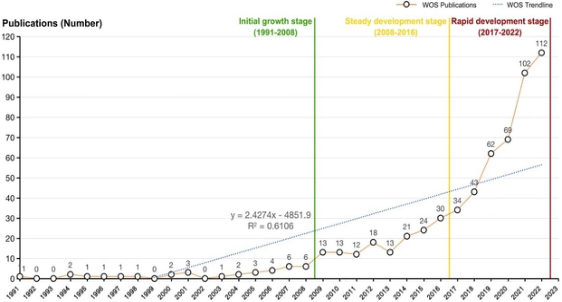
Statistics and analysis of the development of the volume of academic lite- rature over time can provide a valuable assessment of trends in the field of study. Excluding the 29 publications from 2023, the 600 publications rela- ted to emotional space design are summarised in Figure 1, which shows a general upward trend in this research area. 1991–2008 was the initial stage of emotional space design research, with a slow growth rate and no more than ten publications/per year. 2009–2016 was the development stage, with a steady increase in literature output. 2017–2022 is the maturity stage of emotional space design. With a rapid rise in literature output, the average annual literature output reached 70 publications/year, and in 2022, the lite- rature publication reached 112 publications. There is no downward trend in the literature publication at this study stage, and it does not show a peak for the time being.
Analysis of Countries and Institutions Contributing to the Publications By analysing the countries and institutions of academic publications, it is adequate to infer who has an essential status in the field of study (Liang et al., 2018). Table 1 shows the top five countries in terms of the number of publications on emotional space design, i.e., USA (115), England (98), China (89), Australia (47), and Canada (35). From 1991 to 2022, 65 countries
Figure 1: Annual output of publications on emotional space design.
Emotional Space Design Research Based on Bibliometric 273
Table 1. Main countries of emotional space design publications.
Table available in the original PDF paper.
No. Country Publications Citations
01 USA 115 1676 02 England 98 2405 03 China 89 431 04 Australia 47 922 05 Canada 35 619
Table 2. Main institutions of emotional space design publications.
Table available in the original PDF paper.
No. Institution Publications Citations 01 Cornell University (USA) 9 63 01 University of Leeds (England) 9 184 01 Polytechnic University of Valencia (Spain) 9 195 04 UCL (England) 8 355 04 University of British Columbia (Canada) 8 140 06 Eindhoven University of Technology (Netherlands) 7 74 06 Hanyang University (Korea) 7 77 06 University of Melbourne (Australia) 7 50 09 Deakin University (Australia) 6 79 09 Politecnico di Milano (Italy) 6 30 09 University of Sheffield (England) 6 294
published academic papers in this field. A network of national collaborations over the last thirty-one years, with the USA, England, and China at the core.
Table 2 shows the top ten institutions in terms of the number of publicati- ons on emotional space design, which are Cornell University (9), University of Leeds (9), Polytechnic University of Valencia (9), UCL (8), University of British Columbia (8), Eindhoven University of Technology (7), Hanyang Uni- versity (7), University of Melbourne (7), Deakin University (6), Politecnico di Milano (6) and University of Sheffield (6). From 1991 to 2022, 792 orga- nisations published academic papers related to this field. According to the disciplinary distribution, the dominant institutions in architecture and design-related disciplines are the main research contributors.
Analysis of Journals of Publications The research frontier in a particular field can be reflected by the journals in which it is published (Tan and Hao, 2022). Table 3 shows the top ten publications of journals on emotional space design, its publishers, and their impact factors (IF) over five years. International Journal of environmental research and public health, Sustainability and Building and Environment are core journals in the field of environmental science and engineering, with a high number of publications (≥20) and an impact factor (IF) of over 4.00, which shows the importance of emotional space design in this field of research.
274 Jin
Table 3. Main journals of emotional space design publications.
Table available in the original PDF paper.
No. Journal Publications Publisher IF 5-year 26 MDPI 4.799
01 International journal of environmental research and public
health 02 Color research and application 22 WILEY 1.606 02 Sustainability 22 WILEY 4.089 04 Building and environment 20 ELSEVIER 7.503 05 Frontiers in psychology 19 FRONTIERS 4.426 06 Herd-health environments research
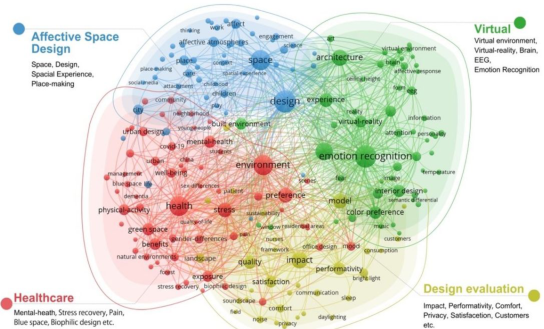
Analysis of Research Hotspots From the Literature Keywords are usually an overview of the author’s research outcomes, so by analysing the keywords that repeatedly appear in the literature, it is help- ful to infer and summarise the research hotspots in emotional space design. Running VOSviewer, and importing 629 literature into it, showed that it contained 3181 keywords. The co-occurrence frequency was set to 4 to ensure the quality of the mapping. Finally, 204 keywords were obtained by merging synonyms. As shown in Figure 2, the keywords form four clu- sters, named #1 Affective Space Design; #2 Healthcare; #3 Virtual; and #4 Design Evaluation, based on the primary keyword information in each cluster.
By analysing the content of each cluster shown in the keyword cluste- ring map: Cluster #1, Affective Space Design, has 52 items with the main keywords: Design, Space, Affect, and Affective Atmospheres. The content of
Figure 2: Keyword cluster mapping.
Emotional Space Design Research Based on Bibliometric 275
this cluster is directly and explicitly related to the research theme of emoti- onal space design, which analyses the theoretical and practical application of emotional design in architectural spaces and how it contributes to the affective atmosphere and spatial experience in spaces. The co-occurrence of Children and Childhood in the clusters reflects scholars’ concern for groups of children in emotional spaces and presents an inclusive perspective. Cluster #2, Healthcare, has 63 items with the main keywords: Health, Benefits, Mental Health, Stress, Well-being, Stress recovery. This cluster was born around the healthcare theme, and environmental psychology research has confirmed that human health can be stimulated and influenced by the sur- rounding architecture (Evans and McCoy, 1998). More and more healthcare environments are attempting to alleviate patients’ psychological stress and anxiety through emotional design to achieve greater patient satisfaction and promote physical recovery (Schweitzer et al., 2004). Cluster #3, Virtual, has 54 items with the main keywords: Virtual Environment, Virtual-reality, Emotion Recognition, Brain, EEG. According to these keywords, scholars no longer limit their definition of environmental space to physical space but have developed research into emotional design and the emotional perception of the user’s experience in virtual environments, the emergence of which is inseparable from technological developments. Virtual space design can be used in various contexts depending on its purpose, including exhibition areas (e.g., museums), game scenes, historical event recreations, and animations, etc. (Barab et al., 2007). Cluster #4, Design Evaluation, has 35 items with the main keywords: Impact, Satisfaction, Consumption, Quality, Comfort. This cluster focuses on design evaluation studies of emotive space design. Designers should consider meeting the requirements of future users and other people involved for practicality and satisfaction as a design criterion (Verschuren and Hartog, 2005). The conduct of design evaluation programs is seen as an effective way of moving towards more formal design theory and methods (Chandrasekaran, 1989).
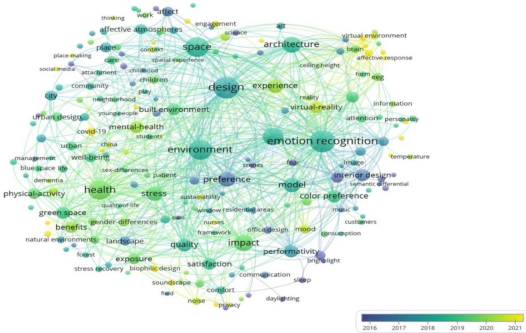
Research Hotspots Evolution and Future Frontier Trends Statistics and analysis of the average time of occurrence of keywords can provide further insight into the cutting-edge themes of today’s emotional space design research and predict its future trends. According to the keyw- ord time mapping in Figure 3, the keywords in 2016–2017 are concentrated in Cluster #1 Affective Space Design and Cluster #4 Design Evaluation, with the main keywords appearing in Affect, interior design, and Bright Light. Daylight, Office Design, the research direction of emotional space design during this period is relatively homogeneous, except for the funda- mental theoretical research, which is based on the traditional design direction and essential design elements in interior design. During 2017-2019, the main keywords that emerged were Emotion recognition, quality, Landscape, city, architecture, performative, Space, and Urban Design. Design eva- luation is also a popular research theme in this period. In 2019-2021, the main keywords that appeared included Sex-difference, Health, Mental health, Virtual environment, Virtual reality, Covid-19, and Sustainability. In
276 Jin
Figure 3: Keyword time mapping.
this phase, emotional space design intersected with other disciplines (VR, psychology, Sex-difference, etc.). Combining theoretical knowledge from different fields will allow designers to generate new, more creative ideas (Chesbrough, 2003).
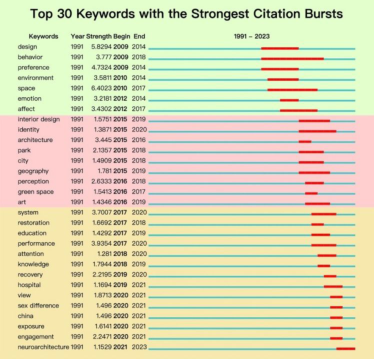
Figure 4 lists the Top 30 Keywords with the Strongest Citation Bursts gene- rated by Citespace, with the years in which the keywords appear prominently highlighted in red. According to the ranking, the research hotspots can be divided into three stages. In terms of the changing trends of keywords in these three periods: in the first stage, the research content of emotional space design was mainly focused on the fundamental theories derived from environmental psychology; In the second stage, the emergence of the critical words Interior design, Architecture, Park, City, and Green space, shows that practical work has become the focus of research into emotional space design; In the third stage, the content of emotional space design studies is combined with research hotspots such as Education, Attention, Hospital, Recovery, Restoration, and Social Issues (Sex difference, Exposure). Diversity and multi-disciplinarity characterise the content of this phase of research.
A comprehensive analysis of the keyword time mapping and Burst Term shows that the trend of keyword hotspots is consistent in the two graphs. The main keywords in the time mapping with an average occurrence time after 2021 are Virtual Environment, Sustainability, Social media, Biophilic design, Covid19, China, and Affective Response. The keywords that appear with Burst Term in the last three years and continue to appear until 2021 are Hospital, View, Sex difference, China, Exposure, Engagement, and Neuro- architecture. Therefore, future research in emotional space design is predi- cted will focus on Virtual Environment, Healthcare, Difference, Sustainable design, and the interdisciplinary intersection with topical social issues and research areas. The research content will be more detailed and adapted to the space’s purpose and the user group’s characteristics while creating a good space experience. Affective Responses for the user will continue to be a trend in future research.
Emotional Space Design Research Based on Bibliometric 277
Figure 4: Top 30 keywords with the strongest citation bursts.
Analysis of Reference Co-Citations VOSviewer showed that 29,862 valid references from 21,698 scholars were cited in the 629 literature in the search. Different studies have cited some references simultaneously and have formed a co-citation relation- ship. Analysis of the repeatedly co-cited references can effectively infer the underlying theoretical support for studying emotional space design and its evolution.
Table 4 shows the top ten literature in terms of reference co-citations, in which four of them were cited more than 30 times in total: An appro- ach to environmental psychology (Mehrabian and Russell, 1974), Stress recovery during exposure to natural and urban environments (Ulrich et al., 1991), The experience of nature: A psychological perspective (Kaplan and Kaplan, 1989), and The restorative benefits of nature: Toward an inte- grative framework (Kaplan, 1995), they are all classic studies in the field of environmental psychology. The foundational theory of Emotional Space Design is based on environmental psychology. Environmental psychology is the scientific study based on the interaction between human behaviour and its environmental context, and it has contributed significantly to the development of the discipline of environment design and planning (archi- tecture, urban design, landscape architecture, regional planning) (CRAIK, 1973). There is a close link between environmental space and the beha- vioural and psychological well-being of users, which is the main driving force behind the integration of emotional design into architectural spa- ces. Servicescapes: The Impact of Physical Surroundings on Customers and Employee (Bitner, 1992) is based on environmental psychology and further explores the impact of the physical environment on client and employee behaviour.
The measurement of meaning (Osgood et al., 1957), core affect, and the psychological construction of emotion (Russell, 2003) are classic literature in psychological research. Psychology is also the theory underlying the design of
278 Jin
Table 4. High frequency co-citation references.
Table available in the original PDF paper.
No. Literature Author Year Citations
01 An approach to environmental
Mehrabian, Albert Russell,
1974 42
psychology
James A.
02 Stress recovery during exposure to
Roger S. Ulrich, Robert F.
1991 40
natural and urban environments
Simons, etc.
03 The experience of nature: A
Rachel Kaplan, Stephen
1989 32
psychological perspective
Kaplan Stephen Kaplan 1995 32
03 The restorative benefits of nature: Toward an integrative framework
Roger S. Ulrich 1984 29
05 View Through a Window May Influence Recovery from Surgery
06 Core affect and the psychological
Russell, James A. 1980 20
construction of emotion
Roger S. Ulrich, Zimring
2008 20
06 A review of the research literature on evidence-based healthcare design
Craig, Xuemei Zhu, etc.
Mary Jo Bitner 1992 18
08 Servicescapes: The Impact of Physical Surroundings on Customers
and Employee
09 Tracking restoration in natural and
2003 17
urban field settings
Terry Hartig, Gary W Evans, Larry D Jamner etc.
09 The measurement of meaning CE Osgood, GJ Suci, PH
1957 17
Tannenbaum Li-Chen Ou, M. Ronnier
2004 17
09 A study of colour emotion and colour preference. Part I: Colour
Luo, etc.
emotions for single colours
emotional spaces, which can provide a basis for understanding user needs and design evaluation. A study of colour emotion and colour preference. Part I: Colour emotions for single colours (Ou et al., 2004) systematically studies the link between colour and emotion. Colour is intuitive and emotional, different users will have utterly other colour preferences, and colour also affects the mood of the user, which needs to be considered in any interior design scheme (Haller, 2017). Therefore, the psychology of colour has become one of the foundational theories of emotional space design.
View Through a Window May Influence Recovery from Surgery (Ulrich, 1984), A review of the research literature on evidence-based healthcare design (Ulrich et al., 2008), and Tracking restoration in natural and urban field settings (Hartig et al., 2003) are classic literature in evidence- based healthcare design. Together they explore the connections between healthcare outcomes and the environment. Roger S. Ulrich is the most cited researcher in evidence-based healthcare design internationally. He has improved patients’ health worldwide through the design of hospital construction.
In summary, the theoretical support for the foundations of emotional space design comes mainly from research in environmental psychology, psych- ology, and colour psychology. Evidence-based healthcare design research repeatedly appears in references to emotional space design and is a current research hotspot.
Emotional Space Design Research Based on Bibliometric 279
CONCLUSION
The output of literature on emotional space design has been on a continuous rise, with 112 papers published in 2022, and there is no downward trend in the production of literature at this stage of research, so it is judged that research in this field is in a phase of rapid development. A network of interna- tional collaborations in this field has been formed between the USA, England, and China; Cornell University, the University of Leeds, UCL, Politecnico di Milano, and the University of Sheffield are the central institutions for rese- arch in architecture and design-related disciplines. The core journals in the field of environmental science and engineering include most of the literature on emotional space design, it shows the importance of emotional space design in this area of research.
The current research themes in emotional space design form four disti- nct clusters, summarising their characteristics as #1 Affective Space Design; #2 Healthcare; #3 Virtual; and #4 Design Evaluation. Regarding trends, future research in emotional space design will focus on Virtual Environment, Healthcare, Difference, Sustainable design, topical social issues, interdiscipli- narity, user experience, and Affective Responses.
The analysis of high-frequency reference co-citations shows that the underlying theoretical support for emotional space design comes mainly from environmental psychology, psychology, and colour psychology resea- rch. Evidence-based healthcare design research often appears in the references and is a hot spot for research on emotional space design.
REFERENCES
Ahrentzen, S. & Evans, G. W. 1984. Distraction, privacy, and classroom design.
Environment and Behavior, 16, 437–454. Barab, S., Dodge, T., Tuzun, H., Job-Sluder, K., Jackson, C., Arici, A., Job-Sluder, L., Carteaux JR, R., Gilbertson, J. & Heiselt, C. 2007. The Quest Atlantis Project: A socially-responsive play space for learning. The design and use of simulation computer games in education. Brill. Bitner, M. J. 1992. Servicescapes: The impact of physical surroundings on customers
and employees. Journal of marketing, 56, 57–71. Chandrasekaran, B. 1989. A framework for design problem-solving. Research in Engineering Design, 1, 75–86. Chen, C. 2006. CiteSpace II: Detecting and visualizing emerging trends and transient
patterns in scientific literature. Journal of the American Society for information Science and Technology, 57, 359–377. Chesbrough, H. W. 2003. Open innovation: The new imperative for creating and profiting from technology., Harvard Business Press. Craik, K. 1973. ENVIRONMENTAL PSYCHOLOGY. Dazkir, S. S. & Read, M. A. 2011. Furniture Forms and Their Influence on Our
Emotional Responses Toward Interior Environments. Environment and Behavior, 44, 722–732. Evans, G. W. & Mccoy, J. M. 1998. When buildings don’t work: The role of architecture in human health. Journal of Environmental psychology, 18, 85–94. Haller, K. 2017. Colour in interior design. Colour design. Elsevier.
280 Jin
Hartig, T., Evans, G. W., Jamner, L. D., Davis, D. S. & Gärling, T. 2003. Tracking restoration in natural and urban field settings. Journal of environmental psychology, 23, 109–123. Higuera-Trujillo, J. L., Llinares, C. & Macagno, E. 2021. The Cognitive-Emotional
Design and Study of Architectural Space: A Scoping Review of Neuroarchitecture and Its Precursor Approaches. Sensors (Basel), 21. Jensen, R. 1999. The dream society: How the coming shift from information to imagination will transform your business, McGraw-Hill New York. Kaplan, R. & Kaplan, S. 1989. The experience of nature: A psychological perspective,
Cambridge university press. Kaplan, S. 1995. The restorative benefits of nature: Toward an integrative framework. Journal of environmental psychology, 15, 169–182. Li, G. 2019. The Dynamics of Architectural Form: Space, Emotion and Memory. Art
and Design Review, 07, 187–205. Liang, C., Luo, A. & Zhong, Z. 2018. Knowledge mapping of medication literacy study: a visualized analysis using CiteSpace. SAGE open medicine, 6, 2050312118800199. Meho, L. I. & Yang, K. 2007. Impact of data sources on citation counts and rankings
of LIS faculty: Web of science versus scopus and google scholar. Journal of the American Society for Information Science and Technology, 58, 2105–2125. Mehrabian, A. & Russell, J. A. 1974. An approach to environmental psychology, the MIT Press. Osgood, C. E., Suci, G. J. & Tannenbaum, P. H. 1957. The measurement of meaning,
University of Illinois press. Ou, L. C., Luo, M. R., Woodcock, A. & Wright, A. 2004. A study of colour emotion and colour preference. Part I: Colour emotions for single colours. Color Research & Application, 29, 232–240. Russell, J. A. 2003. Core affect and the psychological construction of emotion.
Psychological review, 110, 145. Schmitt, B. 1999. Experiential marketing. Journal of marketing management, 15, 53–67. Schweitzer, M., Gilpin, L. & Frampton, S. 2004. Healing spaces: elements of
environmental design that make an impact on health. Journal of Alternative & Complementary Medicine, 10, S-71-S-83. Tan, H. & Hao, Y. 2022. Mapping the Global Evolution and Research Directions of Information Seeking, Sharing and Communication in Disasters: A Bibliometric Study. Int J Environ Res Public Health, 19. Ulrich, R. S. 1984. View through a window may influence recovery from surgery.
science, 224, 420–421. Ulrich, R. S., Simons, R. F., Losito, B. D., Fiorito, E., Miles, M. A. & Zelson, M. 1991.
Stress recovery during exposure to natural and urban environments. Journal of environmental psychology, 11, 201–230. Ulrich, R. S., Zimring, C., Zhu, X., Dubose, J., Seo, H.-B., Choi, Y.-S., Quan, X. & Joseph, A. 2008. A review of the research literature on evidence-based healthcare design. HERD: Health Environments Research & Design Journal, 1, 61–125. Van Eck, N. & Waltman, L. 2010. Software survey: VOSviewer, a computer program
for bibliometric mapping. scientometrics, 84, 523–538. Verschuren, P. & Hartog, R. 2005. Evaluation in design-oriented research. Quality and Quantity, 39, 733–762.
LISTED IN THE AHFE DIGITAL BOOKSTORE CATALOGUE
Explore the complete digital volume
Affective and Pleasurable Design
Read this individual research paper free through the original publisher, or explore the full digital proceedings book.
ISBN 978-1-958651-47-6
Explore this ISBN in the AHFE Bookstore ↗Listed in the July 2026 bookstore catalogue; search by ISBN to confirm current availability · Digital book purchase optional