Zhitao Yu (2024). Mapping the Evolution of Tangible User Interface: A Bibliometric Analysis and Future Trends. In: Human Factors in Design, Engineering, and Computing. AHFE Open Access, vol. 159, pp. 1004–1015. https://doi.org/10.54941/ahfe1005667
In today's digital era, user-computer interface experiences are increasingly intuitive and immersive. Tangible User Interface (TUI) enables users to interact with digital content through physical manipulation. This design paradigm, emphasizing interaction with physical objects, garners significant attention from academia and industry. Literature review helps to strengthen the knowledge framework of research topics by reviewing relevant literature, and it aids in summarizing the current research status. Although this field has achieved certain research results and practical applications after years of development, the extensive and interdisciplinary nature of the literature makes it difficult to systematically analyze the research hotspots and trends through traditional literature review methods alone. Therefore, this study utilizes relevant literature collected from the Web of Science database as the data source. Through bibliometric analysis, it systematically reviews and visually analyzes the field of TUI to identify the progress and future trends over the past two decades.Method: This paper employs bibliometrics, content analysis, and information visualization. Bibliometrics, first proposed by Pritchard in 1969, quantitatively analyzes diverse literature data to uncover patterns and insights. To obtain more rigorous and comprehensive data indicators, this study integrates the use of CiteSpace and VOSviewer. CiteSpace and VOSviewer are bibliometric analysis tools that run on JAVA programs and can effectively establish mapping relationships between literature knowledge units. Visual analysis and research lineage sorting are conducted across the distribution of literature outputs by year, country, research organization, keyword clustering, and co-citation of literature entries in this study. This study selects the Web of Science core database for retrieval. The search strategy is set as TS=((tangible user interface design OR TUI design OR physical user interface design)). The five major citation indexes in the WOS database, including SSCI, SCI-Expanded, A&HCI, CPCI-S, and CPCI-SSH, are selected as retrieval sources. To avoid the loss of interdisciplinary literature, no reduction is made to the literature sources. The retrieved literature is exported to a txt file in the format of "full records and cited references". Irrelevant articles, such as those deviating from the research topic or containing duplicate data, are removed. In the end, a total of 3994 articles were obtained (from 2004 to 2023).Conclusion: The output of literature related to TUI peaked in 2019 and has since exhibited a declining trend. Few institutions are highly productive in this field, with Massachusetts Institute of Technology, Carnegie Mellon University, University of Washington, Tsinghua University, University of Tokyo being core institutions in academia. Through keyword clustering analysis, TUI research content can be classified into four categories: #1 Physical Interaction Technology, #2 Sensory Simulation, #3 Intelligent IoT, #4 User Behavior Study. Analysis of the evolution of TUI hotspots reveals that the current focus of most scholars is on enhancing TUI's application in virtual reality and augmented reality environments, as well as innovative applications in education and entertainment. Future research may concentrate on the integration of TUI with artificial intelligence technology, human-centered computing, and human-robot interaction.
Tangible Interaction is a paradigm in Human-Computer Interaction (HCI) that allows users to engage directly with digital information or computational systems through physical objects and real-world actions. Unlike traditional screen-based interactions, the design philosophy of tangible interaction emphasizes the role of physical objects as mediators in the digital realm. With advancements in computing technologies, TUI have found broad applications across education, entertainment and healthcare. To facilitate intuitive interaction with digital information, designers must deeply understand the needs of their target users, carefully plan the application scenarios, and integrate technologies into designs to meet functional requirements. As direct media for user engagement with digital information, the quality of TUI significantly impacts the effectiveness of user experience.The design quality of TUI directly influences the effectiveness of user experience, necessitating
Mapping the Evolution of Tangible User Interface 1005
a systematic approach to analyzing sensor technologies, user behaviors, and design engineering within this field.
Literature reviews play a crucial role in helping researchers grasp the latest developments, identify research gaps, and contribute to the knowledge framework of a discipline. However, in the domain of TUI design, existing literature reviews often exhibit fragmentation and lack comprehensiveness. Most reviews tend to concentrate on a specific aspect of TUI design, without providing an overarching perspective on the entire landscape of TUI theory and practice.
Over the past two decades, the field has generated a vast body of academic literature. TUI research is inherently interdisciplinary, encompassing computer science, psychology, and design. Traditional literature review methods struggle to systematically analyze the current state and future directions.Bibliometrics, a quantitative method since 1969, addresses analysis challenges in cross-disciplinary domains.This study uses bibliometric analysis, visualization, and content review to chart TUI trends, spot academic networks, and predict research paths. It aims to summarize the field, clarify structures and advancements, and set a groundwork for future investigation, including AI’s impact on TUI trends.
RESEARCH DESIGN The Web of Science Core Collection was searched using the query:TS=(tangible user interface design OR TUI design OR physical user interface design), covering SSCI, SCI-Expanded, A&HCI, CPCI-S, and CPCI-SSH from 2004 to 2023. Documents were exported in full records with cited references format. After excluding non-English, review articles, and off-topic documents, 3,994 articles remained for analysis.This study employs bibliometric methods and utilizes software such as VOSviewer and Citespace for analysis (see Figure 1). Bibliometrics quantitatively analyzes literature to identify patterns and predict directions. VOSviewer, a free tool developed by Dutch researchers van Eck and Waltman, constructs visual maps of scientific knowledge from large datasets, illustrating connections among documents, authors, and institutions.Citespace, developed by Chen et al. at Drexel University, specializes in citation analysis and mapping the evolution of scientific knowledge.
Figure 1: Analytical framework for TUI knowledge networks and trends.
Figure available in the original PDF paper.
1006 Yu
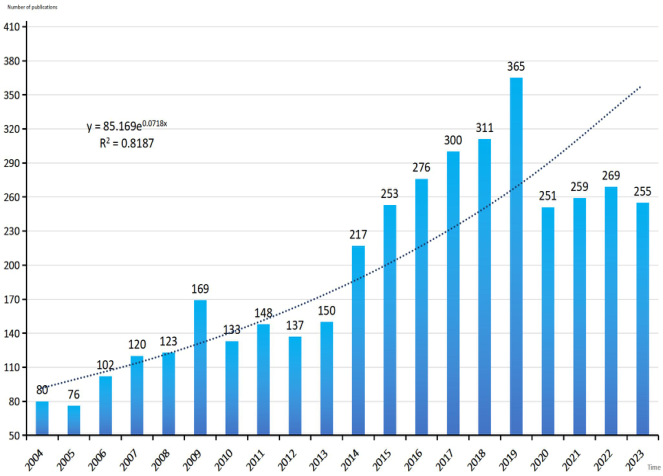
Figure 2: Annual publication volume in TUI research (2004–2023).
TANGIBLE USER INTERFACES BIBLIOMETRIC ANALYSIS Time series analysis of academic literature uncovers the development trends and knowledge progression in specific research domains by examining patterns of publication volume over time.Based on publication volumes from 2004 to 2023, the field’s development can be segmented into 3 phases: the Initial Phase (2004–2005), the Rapid Growth Phase (2006–2019), and the Fluctuating Decline Phase (2020–2023). During the early stages (2004–2005), TUI outputs were modest, averaging 78 publications per year. Publications surged from 2006, peaking in 2019 with 365 papers. Thereafter, volumes declined, with a 31.23% reduction in 2020 compared to 2019, followed by 259 and 269 publications in 2021 and 2022, respectively, and a subsequent drop to 255 in 2023 (see Figure 2).
Between 2004 and 2023, contributions in the field of TUI research came from 61 countries and regions worldwide. The United States leads in terms of publication output, producing 1,035 papers (25.9% of all publications). Following closely are China (384 papers), Germany (317 papers), the United Kingdom (291 papers), Canada (229 papers). Notably, the U.S. has an average citation count of 15,196, while South Korea ranks second with 4,413 average citations. In terms of research collaboration networks, many countries maintain close ties, with the U.S., the U.K., China, and Germany serving as key nodes.
ANALYSIS OF RESEARCH HOTSPOTS Literature keywords accurately reflect the central themes, methodologies,findings, and core concepts discussed in articles, serving as
Mapping the Evolution of Tangible User Interface 1007
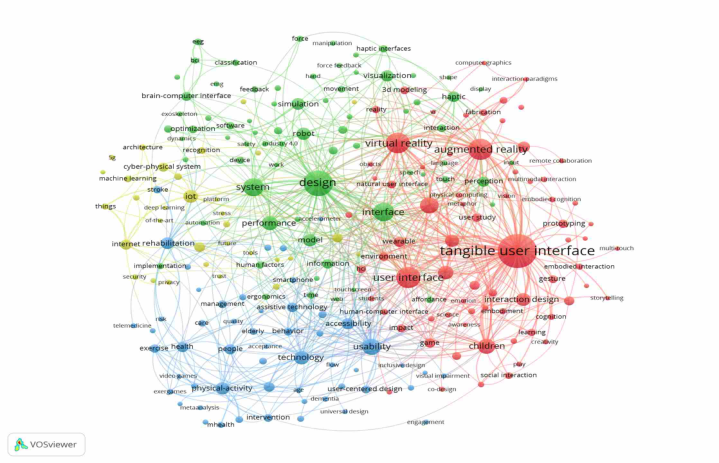
a concise encapsulation of the author’s research content. The recurrence of particular keywords illuminates prevailing research trends within the domain of TUI. Across the 3,994 documents surveyed, a total of 12,308 keywords were extracted. I ensured terminological consistency through synonym amalgamation, such as replacing ‘movement’ with ‘movements’, ‘Tangible user interface’ with ‘TUI’, and ‘gesture’ with ‘gestures’. To enhance the visual efficacy of the analysis, I set the keyword co-occurrence frequency threshold to 10, yielding a cluster map comprised of 229 keywords interconnected by 4,820 links (see Figure 3). Keywords sharing the same color denote membership in the same cluster, resulting in four predominant clusters. The analysis indicates that the salient research themes in TUI can be categorized into four major areas: #1Physical Interaction Technology, #2Sensory Simulation, #3Intelligent IoT, #4User Behavior Study.
Cluster #1(red): Physical Interaction Technology, encompassing 72 members, spotlights keywords including 3D modeling, artificial, augmented reality, e-learning, embodied interaction, gesture, information visualization, and multi-touch.Tangible Interaction Technology, a key HCI branch, emerged to address the limitations of graphic user interface, fostering direct physical object manipulation to control digital content. Originating in the late 1990s, amid computing advancements, it bridges physical-digital realms. Influenced by MIT’s Media Lab, notably Mark Weiser and John Seeley Brown’s Ubiquitous Computing, this tech emphasizes physical objects’ role in HCI. Integrating sensors, actuators, and wireless communication transforms everyday items into smart, responsive digital system components. This technology expands the boundaries of HCI, enhancing multi-sensory engagement and social interactions.
Cluster #2(green): Sensory Simulation comprises 71 members, featuring keywords such as algorithm, animation, brain-computer interface, EEG and haptic feedback. The academic concept of sensory simulation originates from the exploration of how human senses perceive, interpret, and react to external stimuli. Initially concentrating on singular senses, such as vision and hearing, the field advanced to encompass multisensory integration, striving to construct interactive environments that accurately reflect human perception.Originating in the 1960s, sensory simulation was catalyzed by the emergence of computer graphics and early virtual reality, notably through Morton Heilig’s Sensorama simulator, which innovated sensory immersion through 3D video, sound, vibrations, and wind feedback.Central themes include sensory system modeling and simulation, exploring how sensory responses can be predicted and emulated through software and specialized equipment. Brain-Computer Interfaces facilitate the direct reading or stimulation of sensory information in the brain, enhancing or substituting traditional sensory inputs, particularly benefiting those with disabilities.Haptic and force feedback technologies simulate physical sensations such as texture, shape, and resistance, enriching realism in virtual interactions.
1008 Yu
Figure 3: Keyword co-occurrence clustering in TUI research (2004–2023).
Cluster #3(yellow): Intelligent IoT (Internet of Things), an emerging research focus in recent years, consists of 32 cluster members such as 5G, Big Data, IoT, Cloud Computing, Artificial Intelligence, Deep Learning, Computer Vision. These keywords are indicative of leading-edge computing technologies.The IoT refers to a vast network of interconnected physical devices, including everything from home appliances to industrial machinery, that are embedded with sensors, software, and connectivity, allowing them to collect and share data. When IoT is integrated with TUI, it facilitates a more dynamic and data-rich interaction landscape. This integration fosters smart environments where objects react promptly to user interactions, boosting experience quality and personalization. It advances TUI functionality and facilitates more intuitive, fluid human engagement with digital and physical spaces.
Cluster #4(blue), User Behavior Study comprises 54 members, spotlighting keywords: accessibility, usability, motivation, adult, decision-making, elderly, disability, and health. This cluster emphasizes user-focused studies and design evaluations in TUI design, highlighting the importance of creating user- friendly and accessible interfaces. A user-centric approach is paramount, urging designers to deeply comprehend their audience to ensure designs are practical and enhance user experience.Cluster #4’s core theme can be summarized as “user-centered tangible interface design,” which explores optimizing design to boost engagement and satisfaction across diverse demographics. This domain addresses the challenges various user groups face when interacting with TUI, aiming to develop inclusive, adaptable designs that accommodate individual differences, encourage positive behaviors, and support healthier lifestyles.
Mapping the Evolution of Tangible User Interface 1009
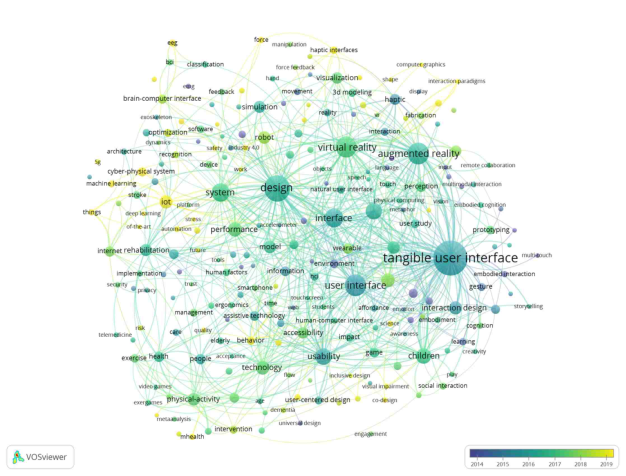
The statistical analysis of the average emergence time of keywords in literature, superimposed on the existing cluster map (see Figure 4), reveals that Cluster #3 Intelligent IoT has keywords appearing predominantly post-2019, indicating it as the current primary research hotspot. Cluster #2 Sensory Simulation is also a significant focus, with many keywords surfacing around 2019, such as EEG, haptic interface, computer graphics, and force.Cluster #1 Physical Interaction Technology shows an average debut in 2015–2016, representing an early research direction. Keywords emerging after 2016 in this cluster include wearable, virtual reality, fabrication, 3D modeling, social interaction, storytelling, embodied cognition, and touch.For Cluster #4 User Behavior Study, the average keyword appearance is in 2017. In 2015–2016, key topics were user-centered design, usability, assistive technology, and care. From 2017–2018, the focus shifted to physical activity, exercise, and health. Notably, since 2019, new research directions have emerged in this cluster, featuring keywords like co-design, visual impairment, behavior, mHealth, risk, and quality.
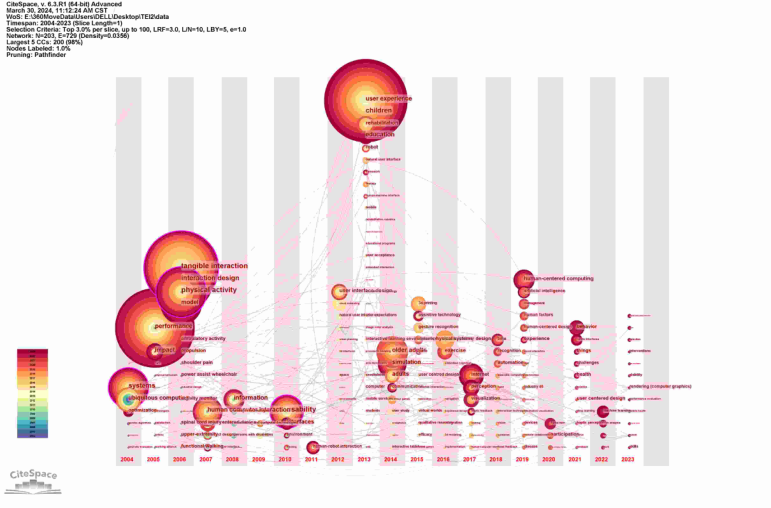
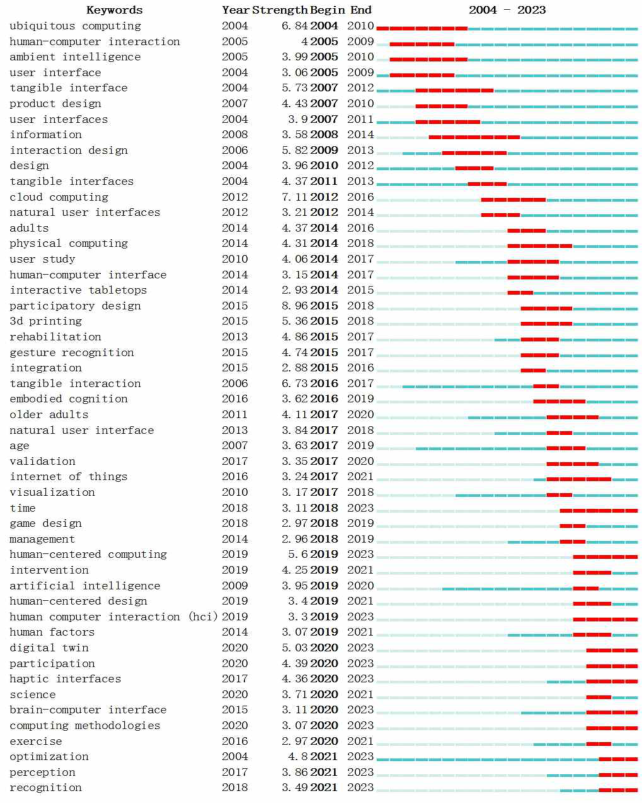
THE EVOLUTION AND TREND OF TUI RESEARCH HOTSPOTS To further investigate and substantiate the leading-edge trends in TUI design research, I applied the CiteSpace software for bibliometric analysis. The timeline view (see Figure 5), illustrates the frequency and earliest occurrence year of keywords within the search scope. This data visualization method assists researchers in effectively discerning historical trends in research themes. Figure 6 maps out the top 50 keywords across different periods in the TUI domain along with their corresponding frequency intensities (see
1010 Yu
Figure 6). Using a gradient color scale, it visually represents the burst strength of keywords and highlights the years they surged in prominence. These “burst keywords” serve not only as indicators of topic popularity but also reveal the progression of past research.
Early TUI research was predominantly focused on foundational theories of tangible interaction, with keywords such as tangible interaction, physical activity, performance, and ubiquitous computing (see Figure 5). Subsequently, the research focus of TUI shifted towards studies targeting specific populations or scenarios, with key keywords such as children, education, user experience, older adults, etc. Indicating that TUI’s application areas have expanded to include education and age appropriate design, with a focus on user experience of specific populations. After 2017, the popular research keywords in the TUI field include the internet, human-centered computing,artificial intelligence,behaviour,machine learning. It can be seen that this field is gradually integrating with cutting-edge artificial intelligence technologies, and the research focus is gradually shifting towards intelligent and personalized interactive experiences.
Figure 5: Keywords time zone view of TUI.
Figure 6 presents the top 50 burst keywords, with darker shades indicating years of significant citation frequency, reflecting evolving research trends. When the top 50 burst keywords are sequenced chronologically, I observe a progression from ubiquitous computing and user interface design to user studies, adults, then brain-computer interfaces, haptic interfaces, and artificial intelligence. By synthesizing insights from the timeline, burst keywords, and co-occurrence cluster maps, future TUI research is projected
Mapping the Evolution of Tangible User Interface 1011
to concentrate on key areas including artificial intelligence, human-centered computing, digital twins, haptic interfaces, human-robot interaction, and the Internet of Things. Research is trending towards increased specificity, with a focus on integrating cutting-edge computing technologies to create more seamless and natural user experiences. Notably, early research topics such as Virtual Reality and Augmented Reality remain central to ongoing and future studies.
Figure 6: Keywords burst term.
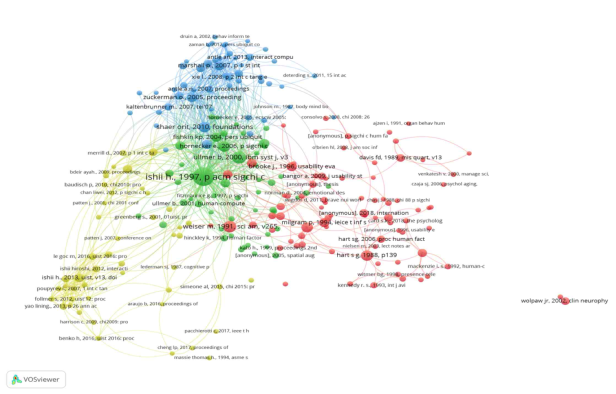
KNOWLEDGE BASE OF TUI A total of 3994 articles cited 98891 valid articles from 65148 academic workers. Some of the references in 3994 articles were cited in pairs, forming a reference co citation network (see Figure 7). The co citation network
1012 Yu
demonstrates the development process of emotional design research at the fundamental theoretical level. Select literature with a citation frequency of no less than 10 from 2004 to 2023 to construct a reference citation network. Using the LLR text mining algorithm, generate a literature co citation cluster consisting of 231 references and 5075 co citation relationships. The node network forms four main clusters: # 1 (green) tangible interaction design theory,# 2 (red) ubiquitous computing, # 3 (blue) tangible interaction in educational cognitive scenarios, # 4 (yellow) deformable interactive interface.
Cluster #1 revolves around a substantial scholarly network anchored by Professor Ishii H.’s 1997 paper “Tangible Bits: Towards Seamless Interfaces between People, Bits and Atoms,” from the MIT Media Lab. Ishii introduced a paradigm linking cyberspace and physical environments through interactive surfaces, tangible objects, and ambient media for environmental awareness, aiming to enrich multi-sensory digital information experiences.Another prominent paper by Professor Brygg Ullmer, “Emerging Frameworks for Tangible User Interfaces” categorizes tangible user interfaces into digital representations, physical controls, and underlying digital models, offering a structured understanding of their composition.Overall, Cluster #1’s research emerged in the field’s early stages, primarily concerned with conceptualizing tangible interaction interfaces and exploring interaction patterns.
Figure 7: Reference co-citation cluster network.
Cluster #2 features Prof. Mark Weiser’s seminal paper, “The Computer for the 21st Century”, where he introduces the concept of Ubiquitous Computing. Weiser advocates for technologies that blend into daily life invisibly, using writing’s evolution as an analogy for information storage and dissemination. He critiques personal computers’ isolationist nature, envisioning a paradigm where technology operates unobtrusively in the background—a concept he dubs Calm Technology. Prof. Ronald T. Azuma’s “A Survey of Augmented Reality” is another highlight, defining AR by its
Mapping the Evolution of Tangible User Interface 1013
three pillars: blending virtual objects with reality, real-time interaction, and 3D registration. AR systems, Azuma explains, merge virtual content into the real world, enabling real-time user interaction. Key AR components, such as display technology, tracking, registration, are discussed, alongside applications in healthcare and manufacturing.Essentially, Cluster #2’s core literature underscores the goal of merging computational power with the environment, making technology integral yet unobtrusive in daily life. It embodies the essence of Ubiquitous Computing and AR: humanizing tech, integrating it naturally, and enriching digital interactions.
Cluster #3’s core literature is primarily comprised of papers by Professors Orit Shaer, Paul Marshall. Shaer’s “Tangible User Interfaces: Past, Present, and Future Directions” explores the potential of TUIs across various application domains including education, entertainment, artistic creation, data visualization, and public space interaction. She also evaluates the long-term impacts of TUIs on learning, collaboration, and social engagement.Marshall’s “Do Tangible Interfaces Enhance Learning?” delves into the application of TUIs in learning environments. While acknowledging advancements in TUI technology and classification, the paper underscores the need for empirical evidence regarding cognitive and social outcomes, especially concerning learning enhancement. Marshall proposes an analytical framework that considers theoretical motivation, learning domains, types of activities, representation integration, distinctions in concreteness and physicality, and the effects of physical objects on learning.
In Cluster #4, Prof. Hayes Raffle’s “Topobo: A Constructive Assembly System with Kinetic Memory” stands out. Topobo is a pioneering 3D construction system enabling the creation of dynamic models like animals or skeletal structures, with the unique feature of programming movement through simple actions like pushing, pulling, or twisting. The system retains these actions and autonomously replicates them, allowing students to rapidly build moving robots, underscoring its educational value as a Tangible User Interface for intuitive learning and concept comprehension.Remarkably, Prof. Hiroshi Ishii’s “InFORM: Dynamic Physical Affordances and Constraints through Shape and Object Actuation”reappears as a focal point in Cluster#3. InFORM, a revolutionary interface that can dynamically adjust its physical shape based on user input or virtual environment states. Utilizing a grid of micro-actuated pins, it can transform into detailed 3D configurations, converting abstract digital information into concrete, touchable forms. This innovation introduces new interaction models applicable in education, design, healthcare, and entertainment.
CONCLUSION
This paper provides a comprehensive review of the literature related to Tangible User Interface research over the past two decades.Data analysis indicates a decline in TUI field publications post-2019. Keyword clustering reveals TUI design encompasses interdisciplinary content, with research categorized into Physical Interaction Tech, Sensory Simulation, Intelligent IoT, and User Behavior Study. Future TUI research will concentrate on AI,
1014 Yu
human-centered computing, digital twins, haptic interfaces, human-robot interaction, and IoT, emphasizing integration with cutting-edge tech for smoother user experiences. Early VR, AR studies remain research priorities. Interdisciplinary collaboration, notably with psychology, ergonomics, and computer science, will pave new paths for TUI’s advancement. In summary, research is advancing toward greater precision, intelligence, and empathy, aiming to create intuitive, versatile interactive experiences while fostering cross-disciplinary partnerships to address complex user needs and tech challenges.
ACKNOWLEDGMENT
This study provides a comprehensive view of the field’s historical development and emerging trends through scientometric analysis. While it holds great potential, there is a risk of overlooking significant yet less prominent contributions. This highlights the need for ongoing research, broader future investigations, and regular updates to incorporate new technological frameworks and perspectives. In terms of data sources, although we selected the most representative core scientific networks as our data source, relying on a single database may introduce bias. Future research should therefore consider supplementing with data from additional databases, such as related publications in other databases, to enhance comprehensiveness and accuracy.
REFERENCES
Bae, S. S., Zheng, C., West, M. E., Do, E. Y. L., Huron, S., & Szafir, D. A.
(2022, April). Making data tangible: A cross-disciplinary design space for data physicalization. In Proceedings of the 2022 CHI Conference on Human Factors in Computing Systems (pp. 1–18). Boas, Y. A. G. V. (2013, August). Overview of virtual reality technologies. In Interactive Multimedia Conference (Vol. 2013, pp. 1–6). Donthu, N., Kumar, S., Mukherjee, D., Pandey, N., & Lim, W. M. (2021). How to
conduct a bibliometric analysis: An overview and guidelines. Journal of business research, 133, 285–296. Follmer, S., Leithinger, D., Olwal, A., Hogge, A., & Ishii, H. (2013, October).
inFORM: dynamic physical affordances and constraints through shape and object actuation. In Uist (Vol. 13, No. 10, pp. 2501–988). Ishii, H. (2008, February). Tangible bits: beyond pixels. In Proceedings of the 2nd international conference on Tangible and embedded interaction (pp. xv-xxv). Li, Y., Liang, M., Preissing, J., Bachl, N., Dutoit, M. M., Weber, T.,... & Hussmann,
H. (2022, February). A meta-analysis of tangible learning studies from the tei conference. In Proceedings of the sixteenth international conference on tangible, embedded, and embodied interaction (pp. 1–17). Marshall, P. (2007, February). Do tangible interfaces enhance learning?. In Proceedings of the 1st international conference on Tangible and embedded interaction (pp. 163–170). Mongeon, P., & Paul-Hus, A. (2016). The journal coverage of Web of Science and
Scopus: a comparative analysis. Scientometrics, 106, 213–228.
Mapping the Evolution of Tangible User Interface 1015
Ninkov, A., Frank, J. R., & Maggio, L. A. (2022). Bibliometrics: methods for studying academic publishing. Perspectives on medical education, 11(3), 173–176. Shaer, O., & Hornecker, E. (2010). Tangible user interfaces: past, present, and future
directions. Foundations and Trends® in Human–Computer Interaction, 3(1–2), 4–137. Tan, H., Sun, J., Wenjia, W., & Zhu, C. (2021). User experience & usability of driving: A bibliometric analysis of 2000-2019. International Journal of Human– Computer Interaction, 37(4), 297–307. Ullmer, B., & Ishii, H. (2000). Emerging frameworks for tangible user interfaces.
IBM systems journal, 39(3.4), 915–931.
LISTED IN THE AHFE DIGITAL BOOKSTORE CATALOGUE
Explore the complete digital volume
Human Factors in Design, Engineering, and Computing
Read this individual research paper free through the original publisher, or explore the full digital proceedings book.
ISBN 978-1-964867-35-9
Explore this ISBN in the AHFE Bookstore ↗Listed in the July 2026 bookstore catalogue; search by ISBN to confirm current availability · Digital book purchase optional