Annalisa Di Roma, Alessandra Scarcelli (2024). Supporting inclusive approach for Autism Spectrum Disorder (ASD) social environment. In: Human Factors in Design, Engineering, and Computing. AHFE Open Access, vol. 159, pp. 1309–1318. https://doi.org/10.54941/ahfe1005698
This article presents some of the results of the ongoing research SensAbility Design based on Design for Well-being and Medical Devices carried out by the authors at the Politecnico di Bari in the areas of product design and interaction design. The research which investigated the field of inclusive design for the design of devices capable of managing emotions in children with Level I Autism Spectrum Disorder. Level 1 autism, also known as mild autism, represents the least severe form within the autism spectrum and is generally characterized by normal or above-normal intelligence and developed language, but may manifest difficulties in several areas, including social communication, social interaction, and repetitive behavior (Cortina, 2015).In the area of social communication, without adequate support, communication deficits cause significant impairments, these individuals may have difficulty understanding and responding to non-verbal social cues, such as facial expressions, tone of voice and body language, have problems initiating and maintaining conversations, especially with unfamiliar people, often speaking in a monotone or overly literal manner. An important aspect relates to theory of mind, i.e., the ability to infer the other person's state of mind and use this information to interpret and predict the behavior of others, which leads to difficulties in recognizing and understanding emotions (Bird et al., 2013), especially complex ones, and interpreting the mind of others, resulting in unsuccessful attempts to make friends and maintain relationships (Howlin et al, 2004).Given this premise, the research in the desk phase has constructed the state of the art with reference to existing devices in the field of inclusivity and autism disorders; in the field phase it conducted a user research based on the co-presence and of 3 designers during the rehabilitation activities carried out within the PerL.A. cooperative and the department of Child Neuropsychiatry of the ASL of Ruvo di Puglia. This aspect, together with the qualitative and quantitative investigation carried out in the user research, contributed to identifying the objectives for the elaboration of the CLEA device and app.The involvement not only of the main users (children with ASD, parents, doctors and therapists) but also the of social welfare associations in order to compare the topic with the challenges of social inclusion (Tosi et al., 2020) has been the specific inclusive approach carried out.The first fase of the design research defined the following objectives: - to support children with autism to manage their emotions; - to enable parents and caregivers to manage and monitor the children's state of mind in real time, through suggestions according to specific needs; - to enable the social welfare network of the ASD children to be aware of issues related to managing emotions. - to promote a new paradigm and social awareness: care by designing and understanding the emotional complexity of ASD in depth. Understanding and supporting the unique needs of people with autism are important to create inclusive and supportive environments where they can thrive; this approach not only improves their quality of life, but also promotes their full participation in society.
This article presents some of the results of the ongoing research SensAbility Design based on Design for Well-being and Medical Devices carried out by the authors at the Politecnico di Bari in the areas of product design and interaction design. The research which investigated the field of inclusive design for the design of devices capable of managing emotions in children with Level I Autism Spectrum Disorder.
Level 1 autism, also known as mild autism, represents the least severe form within the autism spectrum and is generally characterized by normal or above-normal intelligence and developed language, but may manifest difficulties in several areas, including social communication, social interaction, and repetitive behavior (Cortina, 2015).
In the area of social communication, without adequate support, communication deficits cause significant impairments, these individuals may have difficulty understanding and responding to non-verbal social cues, such
as facial expressions, tone of voice and body language, have problems initiating and maintaining conversations, especially with unfamiliar people, often speaking in a monotone or overly literal manner.
An important aspect relates to theory of mind, i.e., the ability to infer the other person’s state of mind and use this information to interpret and predict the behavior of others, which leads to difficulties in recognizing and understanding emotions (Bird et al., 2013), especially complex ones, and interpreting the mind of others, resulting in unsuccessful attempts to make friends and maintain relationships (Howlin et al., 2004).
Given this premise, the research in the desk phase has constructed the state of the art with reference to existing devices in the field of inclusivity and autism disorders; in the field phase it conducted a user research based on the co-presence and of 3 designers during the rehabilitation activities carried out within the PerL.A. cooperative and the department of Child Neuropsychiatry of the ASL of Ruvo di Puglia.
This aspect, together with the qualitative and quantitative investigation carried out in the user research, contributed to identifying the objectives for the elaboration of the CLEA device and app.
The involvement not only of the main users (children with ASD, parents, doctors and therapists) but also the of social welfare associations in order to compare the topic with the challenges of social inclusion (Tosi et al., 2020) has been the specific inclusive approach carried out.
The first fase of the design research defined the following objectives: - to support children with autism to manage their emotions; - to enable parents and caregivers to manage and monitor the children’s state of mind in real time, through suggestions according to specific needs;
- to enable the social welfare network of the ASD children to be aware of issues related to managing emotions.
- to promote a new paradigm and social awareness: care by designing and understanding the emotional complexity of ASD in depth.
Understanding and supporting the unique needs of people with autism are important to create inclusive and supportive environments where they can thrive; this approach not only improves their quality of life, but also promotes their full participation in society.
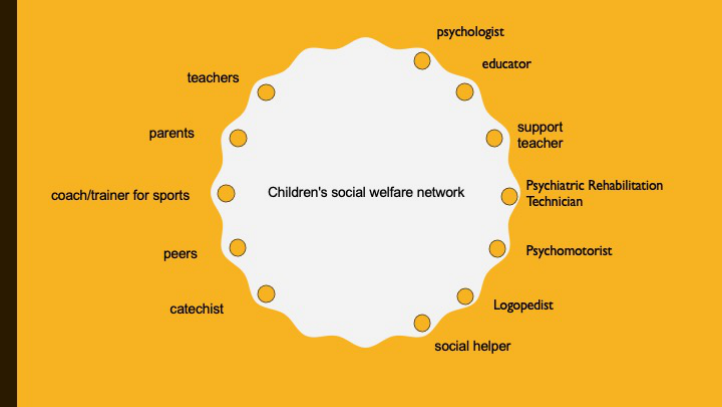
LOGICAL PROBLEM Autism represents a significant challenge both for those directly affected and for society as a whole, the need for adequate support through a well- structured welfare system is crucial to ensure the wellbeing and integration of persons with autism into the community, educating and raising awareness of autism in society is crucial to promote a more inclusive environment. Only by increasing awareness and empathy towards persons with autism will the barriers of isolation and discrimination could be overcome. The importance of a well-coordinated and inclusive social care network cannot be underestimated; in fact, an effective network composed of specialists and non-specialists, where every node is closely connected around the person with autism and his or her family, is fundamental to providing continuous
Supporting Inclusive Approach for Autism Spectrum Disorder (ASD) Social Environment 1311
and targeted support. However, one of the main critical issues is the absence of a standardised protocol for the formation of a social support network, this gap can compromise the overall effectiveness of the support provided, it is therefore essential that research and professional practice focus on the definition of clear guidelines and protocols for the creation and management of support networks, in order to guarantee fair and comprehensive support to each individual with autism and their family.
Figure 1: Children’s social welfare network.
The huge complexity of the care support network for rehabilitation and education takes in consideration a number of subject who have to interface with children by having behaviors that are not necessarily communicated and educated with respect to the dynamics of emotional and functional behavior. At this connection this research placed in the field of medical investigates the role of the emotions in children with Level I Autism Spectrum Disorder, and the need for awareness on the part of the educational and therapeutic support environment.
METHOD
The extreme sensitivity of users required an approach as close as possible to their needs and requirements to design customized solutions.
The method adopted is therefore in the tradition of person-centered studies, in which ‘needs’ are the focus of research and design action, and it is based on human interaction and experience; in particular, in the ASD disorder, this approach focuses on human experience in relation to motor and cognitive disability.
The complexity of the research field also required a multidisciplinary approach, which involved a team of researchers from different disciplinary areas: medical area (clinical and rehabilitation), human sciences area
1312 Roma and Scarcelli
(psychology, pedagogy and sociology), project area (design, computer science, mechanics). This approach is identifiable in Human Centre Design, and it has been taken both in the established procedures of ‘user research’ and in the involvement of users at every stage of the process.
A desk phase, characterized by the study of the state of the art and the analysis of the evidence emerging from the scientific literature, was followed by a field phase, specifically user research conducted in the field, involving associations, schools, operators, professionals and families, which allowed for the observation and listening to children, either directly or mediated. The user research has been carried out both with a quantitative approach and with a qualitative one.
In particular, the qualitative user research has been based on the study of the various activities carried out during the therapies conducted at the Child Neuropsychiatry Department of the Ruvo di Puglia ASL and the Per.La Cooperative in Bari, with the aim of gaining a thorough understanding of the emotional problems they face on a daily basis.
USER RESEARCH In order to create a product that takes into account the special needs of each individual user, it is necessary to involve them throughout the design phase. In this case, it is useful to submit questionnaires to the users, not only to expand their knowledge in the aforementioned research field, but also to understand the problems they face in their daily lives. The analysis of the questionnaire made it possible to understand the various types of autism and age groups of the children, the difficulties faced in the various social contexts, with reference to the problems related to understanding one’s own and others’ emotions, and the solutions implemented by parents and caregivers in managing the moods of the children with whom they are in contact. The survey also made it possible to find out how children with autism react when they express their emotions, which was useful for the final elaboration of the project. Below some of the outcomes.
QUANTITATIVE USER RESEARCH The anonymous survey conducted via Google Forms, entitled: ‘Questionnaire for Children with Autism Spectrum Disorders’, consists of 34 questions. The survey is aimed at children between the ages of 3 and 13 with autism spectrum disorders whose questions focus on their needs and difficulties. These include compulsory multiple-choice questions, optional open-ended questions, questions with the possibility of selecting several options and questions requiring the choice of a value on a linear scale. The questionnaire is divided into two sections: one for therapists and the other for parents. The aim is to explore the daily challenges faced by children with autism spectrum disorders and their carers, for the development of a device that can offer support in both daily activities and therapies. 23 children, mainly male, aged among 3 and 13.
Supporting Inclusive Approach for Autism Spectrum Disorder (ASD) Social Environment 1313
Level of autism. The results show that the sample users have predominantly level 1 autism (50%), followed by level 2 (43.8%) and level 3.
Children’s interests. The results show that the sample users have predominantly interests in technology and electronic devices (14 responses) as opposed to sensory objects.
Situations causing anxiety or stress. The results show that the sampled users have difficulties mainly in managing situations (56.3%) and communication (37.5%), followed by routine changes (43.8%) and the crowded environment (31.3%).
Reaction to anxiety and stress situations. The results show that sample users in stressful situations react with agitated behaviour (62.5%) cover their ears (37.5%) and few retreat to a quiet environment or have no reaction (6.3%).
Difficulties encountered during daily activities. The results show that the sample users have predominantly attention difficulties (62.5%), communication and interaction difficulties (56.3%) and learning difficulties (31.3%).
QUALITATIVE USER RESEARCH The qualitative analysis, which consists of direct interviews with physicians and therapists, is a useful tool for furthering the scientific bases of this study. In particular, the reported interview was conducted with a therapist who works in contact with autistic children. Below a short essay:
How is the choice of practitioners working with the child made?
The therapy process begins with an assessment conducted by the child neuropsychiatrist who identifies the child’s areas of weakness and indicates the most suitable interventions. On the basis of this assessment, the child is referred to the most suitable operators for his or her situation, such as psychologists, psychomotricists, speech therapists, physiotherapists and psychiatric rehabilitation technicians. The choice of practitioners is based exclusively on their specialist skills, and does not consider any particular affinities between therapist and child. During the first month of therapy, a process called ‘pairing’ is implemented, used to establish a relationship of trust and collaboration with the child; the aim is to create a positive bond between child and operator, so that the child sees the operator as a supportive figure and not as a frustrating figure associated with the therapeutic work.
How much time is devoted to therapy and how are treatment cycles structured?
The duration and frequency of therapy vary according to the individual needs of the child. In general, 45-minute sessions, once or twice a week, are recommended. Treatment cycles are typically 30 sessions, with the aim of achieving specific goals. The duration of the treatment cycle can be 6 months or 1 year, depending on the severity of the disorder and the child’s response to
1314 Roma and Scarcelli
therapy. At the end of each cycle, an evaluation is conducted with the parents and therapists to monitor progress and define subsequent goals.
How is the achievement of a therapeutic objective defined?
A therapeutic goal is considered to have been achieved when the child is able to generalise the newly learned skill to contexts other than therapy; this means that the child must be able to use the new skill spontaneously and independently in daily life. To evaluate the achievement of the objectives, it is important to collect feedback from the network of people surrounding the child, such as family members, teachers and therapists.
What is the importance of the support network in the treatment of autism?
The creation of a support network is crucial to the success of autism treatment; this should include all those involved in the child’s life, such as parents, teachers, therapists, social workers and other professionals. It is important that all members of the network work together to achieve the same goals and to ensure a cohesive and supportive environment for the child. Collaboration between different professionals enables the sharing of information, strategies and expertise, thus fostering a holistic approach to treatment.
Is there a specific protocol for involving the network in the treatment of autism?
Although there is no univocal, standardised protocol, I believe it is important that the therapist assumes a coordinating role, facilitating communication and information sharing between the different members of the network; I usually schedule meetings in person with the child’s psychologist and educator.
How are children with autism informed of their condition?
The choice of communicating the diagnosis of autism to children is left to the parents, we aim to make the child understand their strengths and improvement points, so that they can feel prepared to face the challenges that autism can bring.
How are parents of children with autism supported?
Psycho-education is a key element of parental support; it is a process of information and education that aims to help parents understand autism, its characteristics and implications.
DESIGN RESEARCH As a result of the research carried out in the field of level 1 autism, with particular reference to the problems associated with managing moods in children with ASD, the project developed as part of the design research contribute has two distinct outputs, involving two branches of design: product and interaction design. The design process that led to the creation of the “CLEA” (Check and Learn Emotion for Autistic children) device began
Supporting Inclusive Approach for Autism Spectrum Disorder (ASD) Social Environment 1315
with an in-depth observation phase. This phase involved collecting data and feedback from parents and therapists of children with ASD, in order to fully understand the needs and challenges they face on a daily basis in managing the emotions of their little ones (Fage et al., 2019).
To do this, a detailed questionnaire was administered, the results of which revealed crucial information for the purpose of the project: most of the parents highlighted the difficulty in recognising changes in their children’s emotional state at an early stage, while the therapists emphasised the importance of having tools that could provide objective data on children’s physiological signals. This feedback clearly indicated the need for devices that could continuously monitor and analyse physical and emotional parameters, offering caregivers immediate and practical guidance. During the design phase, the internship experience at the Per.L.A. social cooperative specialising in therapy for children with autism was also crucial.
This experience allowed a close look at the techniques used by therapists to manage children’s emotions. Among these techniques were sensory activities and structured games aimed at calming and focusing attention in children. Direct observation of the therapy sessions provided valuable insights into the design of CLEA, ensuring that the integrated functionalities were truly useful and easily applicable in the everyday context.
An interesting point of reference during the design phase was the study of the Tamagotchi, a handheld electronic device from the 1990s, which simulates the keeping of a virtual pet, requiring continuous care and attention from the user. The primary function of the Tamagotchi is to create an emotional bond between the user and the virtual character through regular interactions. This concept was important for the design of the device, as it demonstrated how a device can effectively engage and influence user behaviour through a simple and interactive interface. The idea of using immediate visual notifications, similar to Tamagotchi attention requests, was integrated into CLEA to provide timely feedback to caregivers.
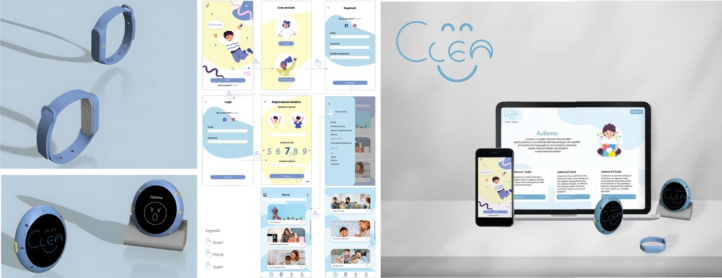
Figure 2: CLEA devices and app.
The design of the CLEA device was further informed by scientific studies on emotion management in children with Autism Spectrum Disorders
1316 Roma and Scarcelli
(Berkoits 2016, Reina 2019, Costescu 2024, Gonzales 2024, Sari 2024). Research has shown that children with ASD have difficulty recognising and regulating their emotions, making early and targeted intervention crucial. Studies on physiological biomarkers such as heart rate, skin conductance and movement patterns have shown that these measures can provide information on an individual’s emotional state. From a physiological point of view, studies have been conducted that have shown how a child with autism can appear calm to those watching him, despite having a high resting heart rate (120 beats per minute). Similarly, electrothermal activity can be very high in these children, as if they were engaged in a physical activity, but without showing signs of sweating or external stress. In this sense, changes in skin conductance provide an essential measure for assessing changes associated with emotions. The combination of these data with machine learning algorithms makes it possible to create accurate emotional profiles, which can be used to better predict and manage emotional reactions.
This is the background to CLEA, a device that aims to support parents and caregivers in managing the moods of children with ASD. CLEA is designed to connected to a wrist band that monitors the child’s vital parameters and, once this data is obtained, displays the child’s emotions on its screen, as well as the actions to be taken. These devices not only offer practical tools for monitoring and managing emotions, but also provide continuous and personalised support, improving the quality of life of autistic children and their families.
In the context of this project, CLEA is a crucial element for monitoring and managing mood in children aged 5 years and over with level 1 autism.
This device, equipped with a display, is designed to receive data from a bracelet with biometric sensors worn by the children, analyse it to determine mood and provide the end user, who may be a parent, teacher or caregiver, with visual cues and practical suggestions on how to manage it. The operation and user interface will be explained in detail below. CLEA consists of a microcontroller connected with an integrated e-sim, which receives data from the wristband. These include body temperature readings, skin conductance and heartbeat. The microcontroller processes this information in real time in order to assess the child’s state of mind, using predefined algorithms that interpret its physiological variations. Once the data has been analysed, the device determines the child’s emotional state. The determination of mood is based on specific thresholds for each parameter measured. For example, a significant increase in heart rate and skin conductance may indicate stress or agitation, while stable levels of these parameters together with movements regularity might suggest a positive mood. These algorithms are the result of extensive research into the correlation between physiological signals and emotional states in high-functioning autistic children. Once the child’s mood has been determined, CLEA shows a smiley face on its display, depending on the emotion felt, and then practical tips on how to intervene.
These suggestions are displayed in the form of simple interfaces: for example, if the child is angry, the device might advise him to take a deep breath, suggest a change of environment or offer a calming activity such as drawing or listening to relaxing music. CLEA and the wristband are also
Supporting Inclusive Approach for Autism Spectrum Disorder (ASD) Social Environment 1317
configured to be connected to an app, designed to offer an additional level of interaction and remote monitoring. The combination of advanced technology for data acquisition and analysis, an intuitive user interface and practical advice for caregivers make this device a valuable tool for improving the quality of life of children with ASD and supporting their caregivers. Studies on wearable technologies (Wearable Technolo gies, WT) have highlighted their potential in monitoring and managing behaviour in children with autism spectrum disorders. Of particular relevance were the experiments conducted by Melissa H. Black on a group of children with ASD between the ages of 5 and 7, demonstrated how the use of heart rate sensors and accelerometers can be effective in monitoring vital parameters and stereotyped or self-injurious behaviour. The results of these investigations suggest that WTs can be useful tools for better understanding the abilities and disabilities of children with ASD (Black, 2020).
CONCLUSION
The presented project has made it possible to explore the topic of emotional management in the context of level 1 autism: it aims to support children in managing their emotions, to provide useful tools for caregivers in facilitating the generalisation of therapeutic skills in daily life and in anger management. A particularly relevant aspect that emerged from the research is the importance of going beyond the mere memorisation of facial expressions, promoting instead greater self-awareness of emotions in autistic children. This aspect, which is often overlooked, is crucial for fostering better social interaction and greater autonomy. Future developments could include prototyping and field experimentation to test what has been designed, by extending the research to other age groups and levels of autism, and further exploring the aspect of emotional self-awareness. The introduction of these devices, in the daily lives of children with ASD, not only makes it possible to improve their quality of life, but to create a community of educated and uneducated people, who can have at their fingertips, all the necessary tools to support children with autism.
ACKNOWLEDGMENT
The present paper is part of the Sens Ability research carried by the authors in the Design_KIND lab at the Politecnico di Bari, together with Russo Margherita, Rutigliani Giulia, Sfasciamuro Francesca and the collaboration of the PerL.A. cooperative and the department of Child Neuropsychiatry of the ASL of Ruvo di Puglia.
REFERENCES
Berkovits, L., Eisenhower, A. & Blacher, J. Emotion Regulation in Young Children with Autism Spectrum Disorders. J Autism Dev Disord 47, 68–79 (2017). https://doi.org/10.1007/s10803-016-2922-2
1318 Roma and Scarcelli
Bird G, Cook R. Mixed emotions: the contribution of alexithymia to the emotional symptoms of autism. Transl Psychiatry. 2013 Jul 23;3(7): e285. DOI: 10.1038/tp.2013.61. PMID: 23880881; PMCID: PMC3731793. Black, H. M., Milbourn B., Nigel T. M. C, McGarry S., Wali F. Armilda S. V. H., Mika L., Sven B., Falkmer T., Girdler S. (2020), The use of wearable technology to measure and support abilities, disabilities and functional skills in autistic youth: a scoping review. Scandinavian Journal of Child and Adolescent Psychiatry and Psychology, Volume 8, (2020): Numero 1. Borgi, M., Cirulli, F., Ferraro, M., Laghi, F., & Venerosi, A. (2017). Modelli
innovativi di welfare: il progetto individuale come strumento di inclusione sociale e lavorativa di persone con autismo. Rapporti ISTISAN, 20/17, Istituto Superiore di Sanità, Roma. Cortina N. (2015), in Desk Reference to the Diagnostic Criteria from DSM. Estratto da Criteri diagnostici. Mini DSM-5 Costescu C., Ro¸san A., David C., Cozma L., Calota A. (2023) The Relation
between Cognitive and Emotional Processes in Children and Adolescents with Neurodevelopmental Disorders—A Meta-Analysis. European Journal of Investigation in Health, Psychology and Education 13:12, pages 2811–2826 Di Roma A., Scarcelli A. (2023). From Play to Game. Smart Toys for Inclusive Physio- Cognitive Therapy. In: Di Roma A., Duarte E. (eds), Developments in Design Research and Practice II Best Papers from the 11th Senses and Sensibility 2021: Designing Next Genera (c) tions. Springer series in Design and Innovation, vol. 31, pp. 200–213, isbn: 978-3-031-32279-2, issn: 2661-8184, DOI: 10.1007/978-3- 031-32280-8_15. Fage C., Consel C., Etchegoyhen K., Amestoy A., Bouvard M., Mazon C., Sauzéon
H., (2019). An emotion regulation app for school inclusion of children with ASD: Design principles and evaluation, Computers & Education, Volume 131, Pages 1–21 ISSN 0360–1315. Howlin P., Cohen S. B. Hadwin J. (2004) Teoria della mente e autismo. Insegnare a comprendere gli stati psichici dell’altro. Trento: Erikson. Sari A- L-, Purwaningsih H., Istiqomah N. (2024), Management Interventions For
Enhancing Emotional Regulation In Children With Autism Spectrum Disorders: Scoping Review, Observasi, vol. 2, no. 2, pp. 70–81, May 2024. Tosi, F., Iacono, E., Brischetto, A., & Serra, A. (2020). Design for Inclusion, Gamification and Learning Experience.
LISTED IN THE AHFE DIGITAL BOOKSTORE CATALOGUE
Explore the complete digital volume
Human Factors in Design, Engineering, and Computing
Read this individual research paper free through the original publisher, or explore the full digital proceedings book.
ISBN 978-1-964867-35-9
Explore this ISBN in the AHFE Bookstore ↗Listed in the July 2026 bookstore catalogue; search by ISBN to confirm current availability · Digital book purchase optional