Annalisa Di Roma, Alessandra Scarcelli (2024). Adaptive fashion experience - A methodological approach for inclusive outerwear dressing. In: Human Factors in Design, Engineering, and Computing. AHFE Open Access, vol. 159, pp. 469–479. https://doi.org/10.54941/ahfe1005613
Today, the extended, hybrid, phygital reality builds new relationships between actors in the fashion industry supply chain and highlights the need to design products and services capable of interpreting the needs associated with physical and virtual interactions with the garment product. The paper proposes some outcomes of the ‘Moda 4.0’ project, mainly aimed at supporting fashion-clothing companies in the digital transition with a sustainable approach to products and processes. In this context, attention has been paid to the issue of the inclusiveness and adaptability of the outerwear, outlining here the opportunities offered by digital in the development of the adaptive design. The paper is structured in a first analytical part, which defines the scenario and identifies the general objectives of the project; a second experimental part, in which the results of the design experimentation of an adaptive outerwear and the wearing experience of a user with reduced mobility are presented.
The extended, hybrid, phygital reality that characterises contemporary society establishes new disciplinary relations and moulds the profession of designer to a new sensitivity, capable of interpreting the needs associated with physical and virtual interactions, and in particular of responding in design terms to the instances of human psycho-perception in the context of virtual fruition of the contents associated with products. If we consider it in the semiotic sense given by Barthes (1967), fashion is nothing more than a linguistic system, endowed with rules and its own grammar, which everyone uses to express themselves and communicate within their social context. This system, traditionally associated with the physical dimension of the garment and the media of the visual field, is today conditioned by the complexity of the phygital, and requires, in its natural tension towards the symbolic valorisation of the cultural meanings associated with communication (Baudrillard, 1970), the definition of new values for the project, capable of managing possible conflicts and opportunities between physicality/materiality and immateriality/virtuality (Mitra, 2003). These represent some of the challenges of the design disciplines, also in relation to the dimension of the so-called post-reality (Pegorari, 2016) that turns
the attention of design towards the development of multimedia content in addition to the products themselves.
In this context, design is called upon to analyse the social changes resulting from the digital transition and to re-evaluate practices, habits and gestures in new or unusual contexts. In particular, the changes concern the cancellation of the spatial dimension, involving environments and artefacts, in the projection into a virtual world that modifies our relationship with things. A relationship that in the fashion sphere is no longer recognisable in the trickle-down theoretical model of trends and fashions (Simmel, 1911), nor in the opposite bubble-up model (Polhemus, 1994). The inclusive dimension par excellence of digital fashion takes space, which is configured in a virtual dimension, devoid of adjectivization of gender and condition. The digital revolution defines contexts in continuous transformation, contaminated, hybrid, globalised, fluid, in which everyone is free to express their uniqueness/diversity. The forms of fruition of fashion-related products have changed because the class of users has changed, they no longer want to be mere spectators but demand to actively participate in the experience. The systems of access to the experience of using garments and their content (from garment information to the history of the garment) have become more open and available, and the experience itself has undergone significant improvements in favour of greater user interaction with the space and products, thanks to platforms on the web and the associated game dynamics, particularly in the Metaverse environment.
However, the state of the art concerning the digital tools that support the creative and management phases of the production process, highlights how recent the relationship between digital technology and fashion is, and how this relationship is mainly aimed at strengthening the image and narrative of each brand.
In this context, it is possible to identify new adaptive dress strategies that meet needs traditionally classified as ‘different’, ‘non-standardised’.
The research on the one hand proposes to assess the nature of the contents associated with fashion products, and on the other tries to identify the unexpressed potential that the digital technology system is capable of expressing in relation to special classes of users, who require careful design that is attentive to their needs.
As Maria Luisa Frisa argues, ‘Fashion today shows that it can tackle fundamental and serious problems, being aware of the responsibility stemming from its visibility and communicative power, being the bearer of values such as the circular economy, inclusion, gender equality, respect for minorities, multi-species.’ (Frisa, 2022, p. 16).
Starting from the highlighted theoretical premises, the paper is structured in two main parts. The first part is analytical, useful for defining the scenario relating to the development of digital fashion and delving into the definition of adaptive clothing. The second part is experimental; an adaptive garment and the dressing experience of a user with reduced mobility are presented.
Adaptive Fashion Experience—A Methodological Approach for Inclusive Outerwear 471
THE DIGITAL TRANSITION FOR THE FASHION SYSTEM Today, all sectors of industrial production, and not only, show, with different approaches and solutions, a growing process of digitisation of the entire system, motivated by various factors: the growth in demand from more educated consumers, mass customisation, e-commerce, and advances in virtual and augmented reality applications. As in the fields of architecture or automotive, the garment manufacturing sector has long since manifested this direction of development, towards the definition of so-called digital fashion. In the fashion system, this phenomenon is framed in the processes of stylistic creation, garment production management processes and communication processes, which have gradually changed their structures by integrating specific digital systems.
The prodromes of the so-called 4.0 revolution in contemporary industry are defined around the end of the 1990s in the technical instrumental sphere of design, opening up the renewal of contemporary production and product standards. In particular, as far as the fashion system is concerned, the area of sports footwear has contributed to the formalisation of the so-called 4.0 standards related both to the advanced automation of production processes and to the development of a new modelling supported both on the creative level and on the level of the manufacturing process and integration of components by digital systems.
In the field of clothing, the first applications date back to 2014 and refer to the integration of advanced techniques of computational design and rapid printing for the production of the Nervous Systems’ Kinematics dress. Through this product we witness the hybridisation of modelling and production techniques, already in use for product and footwear (Di Roma, 2017), to the dress. The current phenomenon of digitised fashion has developed very recently, starting with the development of the first cad platforms dedicated to the virtual realisation of all phases of garment design, production and advanced visualisation. Similarly to what has already occurred in the fields of mechanical design, engineering and architectural design, and product design, applications dedicated to fashion offer support to the garment and accessory development process in which different operators are involved in the various phases, with different skills and competences, and different needs to formalise and return the result of their work.
Only a few years ago, the logic of software platforms dedicated to three-dimensional modelling, photorealistic rendering and the realisation of 4D video simulations, the management of the two-dimensional vector model optimised for output, and process design, did not propose synectic forms: autocad, archicad, rhinoceros, 3dmax, blender, to name a few of the most commercially popular platforms in the construction and product design fields. For these sectors, more recently there has been a specialisation of software platforms, towards greater integration between the various functions and integrated data management (resulting in bim systems, integrated and optimised cad-cam and cae systems, etc.).
472 Di Roma and Scarcelli
Special mention must be made of the development of specialised software for the creation of animations, aimed at solving the need for integration of content on a visual level with high added value. This area of modelling development has also brought great innovation in cad software platforms, which are increasingly able to integrate anthropometry, clothing, upholstered systems (traditionally not easily realised), and more. In particular, there are several innovations within the design software, the most important of which are:
- the implementation of parametric systems; - the integration of anthropomorphic modelling systems (through acquisition, sampling and optimisation with laser scanning); - the development of realistic animations to support movement dynamics, obtained by means of sensors applied to the real body, intended to implement gestures on virtual dummies.
The logic of production-oriented software optimization is now confronted with the need to develop a digital product that is also aimed at its communication, and thus to avoid duplication of models. This implies an increased focus on the development areas of pseudo-aptics, in the quest to define tactile qualities through visual interactions, and avatars, which configure consumer personalization in digital retail, from e-commerce systems to points of sale in the Metaverse. In addition, digital fitting rooms today allow one’s digital self to wear endless combinations of clothes, while maintaining the private character of the physical fitting room. The virtual try-on can simulate the fit of a garment more and more realistically, but also allows one to experiment with unthinkable outfits. The avatar today constitutes a powerful integration tool, as it can be a support in the purchasing dynamics for users with specific needs, e.g. users with motor difficulties, from the elderly to the disabled, to the curvy.
Digital Systems for Design and 3D Modeling In the era of Industry 4.0, the development of solutions for capturing and transforming traditional business modelling into a digital context is a necessity rather than an alternative (Bertola & Teunissen, 2018). In this context, the aim is to transpose existing business models, usually represented in 2D form, into more advanced digital formats, such as 3D paper patterns. This transition not only allows for better data management and manipulation, but also paves the way for a number of advantages in terms of visualisation, analysis and production. The benefits resulting from the implementation of such systems are not limited to simple time optimisation but extend to the ability to combine craftsmanship know-how with the latest technologies, guaranteeing greater precision in the creation of patterns, resulting in guaranteed fit and improved overall aesthetics of garments. In addition, there is a further fundamental element concerning pattern design and the production phase: thanks to the integration of CAD software, the risk of human error is reduced to zero. This results in a higher level of attention to detail and a more accurate and precise handling of garments, which minimises
Adaptive Fashion Experience—A Methodological Approach for Inclusive Outerwear 473
fabric waste. Digital design utilises CAD modelling, 3D modelling and digital assembly technologies, which allow the final product to be quickly previewed and changes to be made, reducing trial and error costs and increasing production efficiency (Baek et al., 2022). In the field of garment modelling, software such as Marvelous Designer, Clo3D, VStitcher and Style 3D stand out for their distinctive features. These software greatly reduce the distance between the once inaccessible 3D digital technology and designers, making it possible for graphic designers and stylists to create 3D models on their own without requiring a large amount of manpower and resources. In fact, they enable designers to quickly complete design, editing and prototyping on the computer, eliminating the cumbersome process of traditional manual drawing and prototyping, saving time and costs. In addition, these software allow designers to create 3D models based on patterns, showing every detail of the garment and visualising dynamic effects through simulated actions. These advantages eliminate errors generated by communication factors in the traditional design process, help designers collaborate better with other departments and suppliers, and enable consumers to better understand the materials and details of garments in a more intuitive way.
Adaptive Clothing The advantages in the digital transition of traditional pattern-making become even more evident in relation to the design and production of customised garments, through processes that allow for the parameterisation of patterns and their adaptability to different scales, of measurement but also of physical condition (Mosleh et al., 2021). Indeed, among the digital fashion outcomes of greatest interest in terms of inclusive design is adaptive clothing, towards a new dimension of adaptability applied to fashion.
Adaptive clothing design is a new and important evolution in the field of clothing design and development, aimed at simplifying the moment of dressing for people with physical limitations, disabilities or general lack of mobility (Poonia, 2020). In particular, in the field of disability and/or geriatric age, this clothing was created to support the specific needs of:
- users with a 50/70% disability who dress themselves or with limited help from third parties;
- users who rely on personnel such as caregivers, healthcare assistants, nurses, etc. to assist them in wearing the garment completely.
The main objective of adaptive clothing is to improve the quality of life of people living with motor impairments (Mehrajerdian, 2020), but also to meet a wide range of consumer needs by combining inclusivity, adaptability and style. Adaptive garments currently have low availability, are mainly found online, and generally propose unconventional shapes.
In adaptive clothing, unusual patterns are complemented by recurring technical aspects. These include, for example, the use of magnets instead of buttons, which allow those who have difficulty using their hands or wear prostheses to button and unbutton garments effortlessly; or hook-and- loop fasteners for shoes, or even zips with magnetic end stops. In addition, there are garments designed to accommodate aids, facilitate access for nurses
474 Di Roma and Scarcelli
to administer periodic therapy, or with a longer back to accommodate wheelchair users.
At present, adaptive clothing undoubtedly represents an added value in the world of fashion, and many companies, online shops and brands, have recently embraced this philosophy and methodology of approach to the garment design and development process. Among the most important names on the international scene, we highlight the work of Tommy Hilfiger (https://uk.tommy.com/tommy-adaptive), the American designer who, since 2016, has produced a new adaptive line every year, in addition to his traditional collections, designed for children and adults with disabilities. Other companies, on the other hand, have emerged specialising exclusively in this area, such as MOS by Alicia De Groot (https://mosbyalicia.com), So Yes (https://so-yes.com), IZ Adaptive (https://izadaptive.com) and Iulia Barton (https://www.iuliabarton.com).
DESIGN RESEARCH The research project Moda 4.0 to which the text refers, carried out by the authors in collaboration with the company Emme Evolution, aims to support the company in the digital transition of the fashion industry, towards the sustainability of products and processes, through the definition of the scenario and context of the development of the garment production system in the digital environment. The aim of the research is to assess the direct and indirect effects of the digital ecosystem on the value of the fashion product.
In particular, the interaction with the company reality of Emme Evolution allowed the acquisition of the processes already in place and the experimentation of innovative approaches. Emme Evolution has a history spanning more than twenty years, and is the owner of several brands that share the same careful design, quality materials and attention to detail. The company’s philosophy has focused production almost exclusively on padded outerwear, particularly parkas and down jackets, for a female audience. This specialisation has enabled the company to develop great expertise in the sector and to achieve recognisability within the international market with its own style. The company’s vision frames the company in that strand of the fashion industry that responsibly evaluates the issues of environmental and social sustainability, addressing innovation processes both on a physical level, of materials and management and production systems, and on an intangible level, of contents and promotion systems through digital. Among the company’s strategies, adaptive clothing plays a relevant role, in the affirmation of inclusive, comfortable and stylish clothing.
Method
The approach adopted in the design experimentation is part of the human centre design methodology, which included the active involvement of the end-user within the entire development process, and the sharing of research with healthcare professionals, such as occupational therapists and physiotherapists, in order to develop customised strategies and ensure a safe and comfortable wearing experience for the individual.
Adaptive Fashion Experience—A Methodological Approach for Inclusive Outerwear 475
After analysing the technical-scientific literature and the state of the art in adative cloting design, the user research phase was essential to understand the users’ needs and formulate initial design hypotheses, which were materialised through prototyping.
The next phase involved the simulation of the experiences of dressing and assistance in dressing. Caregivers or therapists are specialised operators who can provide support and teach specific techniques related to users with disability. In this phase, the prototype is adapted according to ergonomic factors that emerged during testing.
In the final stage, the adapted garments become parametric digital models that can be modified and replicated according to different needs. In some cases, it may be necessary to make modifications to the garments to facilitate access to the upper limbs, for example by adding alternative fastenings or simplified lacing, or by modifying openings or reinforcing them. Indeed, it is important to emphasise that each person with motor disabilities, such as paresis or paralysis of the upper limbs, may have different needs and require individualised approaches.
User Research Adaptive cloting is aimed at users with specific needs, resulting from physical conditions that prevent them from normal clothed activity. These can be temporary or permanent conditions, affecting upper or lower limbs, and can affect both children and adults. This is why it is important to carry out thorough user research.
From a medical point of view, this refers to motor disability, a medical condition that causes difficulties in movement control and muscle coordination. These difficulties can affect a person’s ability to perform simple everyday activities, such as walking, dressing or eating. Specifically, motor disability is assessed on the basis of the type and degree of difficulty, which may relate to the impairment, reduction or inefficiency of considered functions. The motor deficit encompasses different functions related to various motorical skills and abilities. In reality, it includes all the dysfunctions and pathologies that can be linked to the neuro-muscular apparatus and, consequently, concerning the motility of the limbs, the functionality of the respiratory muscles, the regulation of muscle tone, etc. Moreover, motor skills are interconnected and interact continuously to allow any type of movement compatible with the osteo-muscular structure.
A double quantitative survey was carried out for the project, the first one aimed at users with various degrees of motor disability, the second one aimed at healthcare workers, nurses and carers. The questions asked were aimed at understanding the degree of knowledge of adaptive cloting and opinions and needs derived from personal experience.
The first questionnaire was administered via social groups to various associations in the care sector, such as UNITALSI, an Italian voluntary organisation that is part of the National Civil Protection Service. The questionnaire received 127 answers, from which it is clear that there is a lack of information about the existence of adaptive clothing (77%), and above all a lack of use of its products (84%). The data analysis shows that personal
476 Di Roma and Scarcelli
physical condition influences the choice of clothing; in fact, only 31% believe they are not influenced by it. Consequently, 70% of users consider the development of adaptive clothing to be extremely useful. The answers obtained are consistent with the different types of disabilities presented, and from these the users’ lack of autonomy in their own dressing emerges.
The second questionnaire was administered through social groups of different associations, to nurses, healthcare assistant and family carers. These professionals are very important, as they are usually involved in the dressing phase of the patient; during these activities, they have the task of encouraging the autonomy of the individual, through clear instructions and appropriate support.
60 responses were received, distinguished as follows by frequency of assistance to persons with reduced mobility: 45% assist 1 user per day, 32% assist 2–5 users per day, 23% assist 6 or more patients per day. Most of them (83%) know the correct procedures for dressing the patient; however, the same percentage is not able to carry out this activity alone but needs the support of other carers to lift and dress the patient. Just over half are familiar with adaptive clothing design and 59% have recommended its use to users. Many believe that adaptive clothing is a useful solution, both for facilitating the cleanliness of the patient and his or her clothing, and for facilitating patient dressing.
Adaptive Experience Following the analysis of the data that emerged from the user research, the design experimentation was aimed at the development of an adaptive outerwear, addressed to users compromised by hemiplegia (half-body paralysis) or total paralysis of the upper limbs. In the first case, the focus is on facilitating the user’s action of dressing independently, in the other case on facilitating the actions of health workers or caregivers.
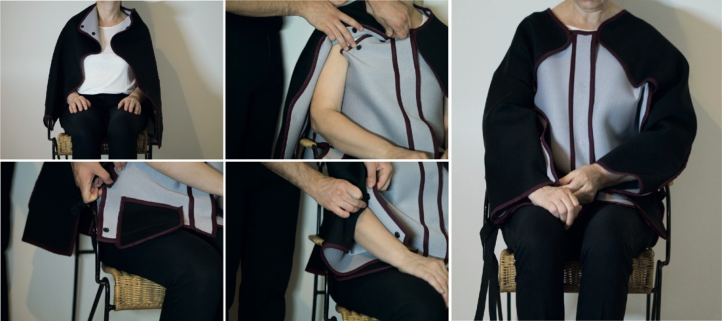
An initial concept was conceived and realised in prototype form with the support of the company’s expertise. The garment consists of two separate parts, corresponding to the front and rear chest area, which can be connected by means of magnetic snaps distributed along the overlap lines. The lumbar area of the back part and the forearm part, from the elbow, of the two sleeves, have double the padding, to facilitate posture in case of prolonged contact with the back and armrests of chairs and wheelchairs. A removable headband allows for autonomous support by locking the head to an armrest of the seat and preventing unintentional movement.
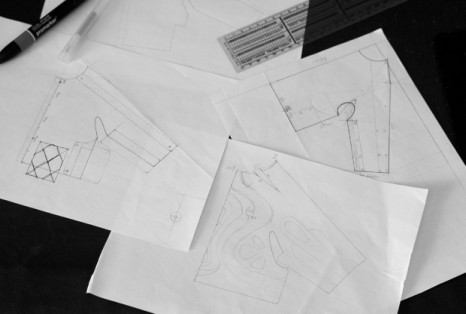
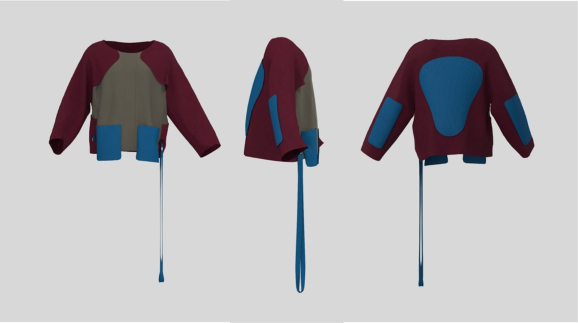
The garment was made to be worn by a model simulating the conditions of paralysis (Fig. 1). The observation of the motor dynamics made it possible to verify and test the functionality of the garment, and to revise it through the production of a second paper pattern (Fig. 2), and subsequent prototype. After replicating the test phase with the new prototype, we proceeded with the development of the data sheet and parametric modelling with digital software (Fig. 3).
Adaptive Fashion Experience—A Methodological Approach for Inclusive Outerwear 477
Figure 1: Photo sequence showing the actions of dressing the prototype of a user with reduced mobility by a health worker.Figure 2: Paper pattern.Figure 3: Front, side and rear views of the three-dimensional digital model of the adaptive garment.
478 Di Roma and Scarcelli
CONCLUSION
Adaptive clothing design is now an established reality in fashion design (Rana et al., 2024), yet in the state of the art there are insufficient companies involved and they offer few diversified solutions, which fail to meet all requirements (Esmail et al., 2021). Adaptive products are very similar to each other, most of the time the design only responds to technical issues, neglecting the significant social value of the final product (Li et al., 2023).
In this contribution, the main research nodes are highlighted, and some project outcomes are presented in synergy with companies in the fashion industry, in order to valorise digital tools at the service of inclusive product design.
The project presented describes an approach that mediates ethical and aesthetic instances, adopting a Human Centre Design methodology, which questions people and the ecosystem that revolves around their daily lives, trying to provide real answers that safeguard their human dignity and well- being. Thanks to quantitative and qualitative surveys carried out on samples of users with motor deficit, caregivers, health workers and nurses, the basic requirements were defined for the design of an adaptive outerwear, which through parametric digital modelling, allows customisation in terms of reproducibility on different sizing and physical conditions, meeting practicality and style requirements in an inclusive manner.
ACKNOWLEDGMENT
The authors would like to acknowledge MODA 4.0. Nuove metodiche scientifiche e tecnologie per la moda ecosostenibile, Research Project founded by FESR 2014-2020. Research assignment for Emme Evolution S.r.l., Martina Franca. Scientific coordinator: A. Di Roma, ArCoD - Politecnico di Bari. Research Team: A. Di Roma, A. Scarcelli, P. Losciale, D. Gambera, L. La Fortuna, G. Di Molfetta, ArCoD Department; M. Fiorentino, A. Messeni Petruzzelli, U. Panniello, M. Ricci, F. Vangi, DMMM Department - Politecnico di Bari.
REFERENCES
Baek, E., Haines, S., Fares, O. H., Huang, Z., Hong, Y., & Lee, S. H. M. (2022).
Defining digital fashion: Reshaping the field via a systematic review. Computers in Human Behavior, 137, 107407. Barthes, R., (1967). Système de la mode, Éd. du Seuil. (trad. it: Sistema della Moda, Einaudi, 1970). Baudrillard, J. (1970). La société de consommation. Ses mythes, ses structures.
Denoël. (trad. it.: La società dei consumi. I suoi miti e le sue strutture. Il Mulino, 2010). Bertola, P. and Teunissen, J. (2018), “Fashion 4.0. Innovating fashion industry through digital transformation”, Research Journal of Textile and Apparel, Vol. 22 No. 4, pp. 352–369. https://doi.org/10.1108/RJTA-03-2018-0023 Di Roma, A. (2017). Footwear design. The paradox of “tailored shoe” in the
contemporary digital manufacturing systems. Design Journal, https://doi.org/10. 1080/14606925.2017.1352780.
Adaptive Fashion Experience—A Methodological Approach for Inclusive Outerwear 479
Esmail, A., Dahan-Oliel, N., Poncet, F., Labbé, D., Rochette, A., Kehayia, E., … Swaine, B. (2021). Fashion industry perceptions of clothing design for persons with a physical disability: the need for building partnerships for future innovation. International Journal of Fashion Design, Technology and Education, 15(1), 77–85. https://doi.org/10.1080/17543266.2021.2004243 Frisa, M. L. (2022). Le forme della moda. Cultura, industria, mercato, comunicazione. il Mulino. Li, M., Zhao, L., & Srinivas, S. (2023). It is about inclusion! Mining online reviews
to understand the needs of adaptive clothing customers. International Journal of Consumer Studies, 47(3), 1157–1172. Mehrajerdian, S. (2020). Adaptive clohing makes dressed easier for the disabled Retrived on 21/04/2020 from, 2020. https://www.iaccess.life/adaptive-clothing-m akes- getting-dressed-easier-for-the-disabled/ Mitra, A. (2003). Cybernetic space: Bringing the virtual and real together. Journal of
Interactive Advertising, 3(2), 1–9. Mosleh S, Abtew MA, Bruniaux P, Tartare G, Xu Y. Developments of Adapted Clothing for Physically Disabled People with Scoliosis Using 3D Geometrical Model. Applied Sciences. 2021; 11(22):10655. https://doi.org/10.3390/ap p112210655 Pegorari D. M. (2016). Umberto Eco e l’onesta finzione. Il romanzo come critica
della post-realtà. Stilo. Polhemus, T. (1994). Street Style. From Sidewalk to catwalk. Thames-Hudson. Poonia, N. (2020). Adaptive clothing for disabled people. Int J Home Sci, 6(2), 238–241. Rana, M. R. I., McBee-Black, K., & Swazan, I. S. (2024). Adaptive apparel for
people with disabilities: A systematic literature review and future research agenda. International Journal of Consumer Studies, 48(3), e13057. https://doi.org/10. 1111/ijcs.13057 Simmel, G. (1911). Die Mode, in Philosophische Kultur. Gesammelte Essais. (trad.
it.: La moda, Mondadori, 1998).
LISTED IN THE AHFE DIGITAL BOOKSTORE CATALOGUE
Explore the complete digital volume
Human Factors in Design, Engineering, and Computing
Read this individual research paper free through the original publisher, or explore the full digital proceedings book.
ISBN 978-1-964867-35-9
Explore this ISBN in the AHFE Bookstore ↗Listed in the July 2026 bookstore catalogue; search by ISBN to confirm current availability · Digital book purchase optional