Zhuang Li, Haiyan Han (2023). Comparative analysis of scientometric-based interface design research. In: Intelligent Human Systems Integration (IHSI 2023): Integrating People and Intelligent Systems. AHFE Open Access, vol. 69, pp. 837–847. https://doi.org/10.54941/ahfe1002908
In order to analyze the current situation and cutting-edge trends of interface design research in Chinese and international academia, as well as the respective research characteristics and paradigm differences between Chinese and foreign academia. VOSviewer and CiteSpace metrological visualization software were integrated to visualize and analyze the literature related to interface design research included in CNKI and Web of Science databases in terms of keyword co-occurrence, keyword clustering , keyword highlighting and highly cited literature by drawing knowledge maps. The results of the study show that the Chinese academic research on interface design focuses on the topics of graphical user interface, human-computer interaction, user experience, and usability, while the international academic research focuses on usability evaluation, intelligent user interface, adaptive user interface and augmented reality, etc. In terms of future research trends, the Chinese academic community focuses on user experience, eye tracking, visual design and other directions, while the international academic community starts to explore the direction of natural interaction from physical interaction, focusing on user experience, gesture recognition, natural user interface and other directions. In terms of research paradigms, the differences between Chinese and international academics are more significant, Chinese academics focus on qualitative research, while international academics focus on quantitative empirical research.
The user interface (UI) is the medium through which the information betw- een human and machine interacts (Lu 2008). Interface design generally refers to the overall design activity of the user interface in terms of human- machine interaction, operation logic, and interface aesthetics. Throughout the development of interface design, it has gone through three major stages: Command-Line Interface (CLI) - Graphic User Interface (GUI) - Natural User Interface (NUI). From Command-Line Interface to Natural User Interface, the interface design tends to be more and more humanized, naturalized and efficient, with more emphasis on user experience while pursuing operational efficiency (Luo et al. 2008). After more than half a century of development, interface design has gradually shifted from a single physical interaction form
to an unconscious interaction form that integrates both physical and virtual, and more and more scholars have started to conduct interface design rese- arch from user cognition, psychology and behavior (Guo et al. 2020; Yan et al. 2020); the field of interface design has also accumulated a large num- ber of literature results. On the one hand, compared with the international academic community, Chinese interface design research started late, so it is necessary to further compare and summarize the research progress and cur- rent situation in China and abroad, and it is beneficial to further expand the connotation and extension of Chinese interface design research by learning from the advanced experience and methods of the international academic community and finding Chinese research characteristics at the same time. On the other hand, as an interdisciplinary field involving computer science, psychology, cognitive science, ergonomics, graphics and art design, interface design has a complex and diversified knowledge structure, and quantitative analysis of various literature with the help of scientific bibliometric methods can help to systematically explore the potential laws and information in the literature. Therefore, this paper compares and analyzes the current status of interface design research in Chinese and foreign academia by answering the following three questions through bibliometric analysis: (1) What is the literature output of interface design research in Chinese and foreign academia and its research dynamics? (2) Are there any differences in the focus of Chinese and foreign scholars in specific studies, and what are the research hotspots and research trends in Chinese and foreign academia? (3) Are there any differences in the high impact literature and research paradigms between Chinese and foreign scholars in interface design research?
RESEARCH DESIGN China National Knowledge Infrastructure (CNKI) and the international authoritative database Web of Science (WOS) were selected as the main lite- rature data sources for the study of Chinese and foreign interface design. In terms of international research, the Web of Science core collection database was searched, the search term was set as “User Interface Design”, the search term field was restricted to “title”, and the literature search The search was conducted in the Web of Science core collection database, setting the search term as “User Interface Design”, the search term field limit as “title”, and set- ting the literature search type as “article” and “proceeding papers”, and the time dimension as 1992-2021, and a total of 1424 valid records were obtai- ned. In terms of Chinese studies, in the CNKI search interface, set the subject as “interface design”, the document type as “academic journal”, and the year period as 1992-2021. In order to ensure the reliability of the data, the sou- rces of journals in CNKI were limited to Peking University Core, EI, CSSCI, CSCD and SCI, and a total of 2682 relevant articles were retrieved. The data were screened and de-duplicated to eliminate irrelevant and duplicate litera- ture, and to ensure that the data could cover the main results of interface
Comparative Analysis of Scientometric-Based Interface Design Research 839
design research in China and the international academic community as far as possible.
In order to more comprehensively explore the characteristics and trends of Chinese and foreign interface design research, this paper adopts a combina- tion of quantitative and qualitative research methods and uses the advantages of CiteSpace and VOSviewer literature visualization analysis tools (Wang et al. 2017), through keyword co-occurrence clustering, keyword high density Emergence, high-impact article analysis and other indicators comprehensi- vely explore the knowledge structure and hotspot distribution of Chinese and foreign interface design research, and further compare the similarities and dif- ferences of Chinese and foreign academic interface design research hotspots, development trends, and research paradigms. CiteSpace, a knowledge graph visualization and analysis tool developed by Chaomei Chen’s team, is widely used in bibliometric-related research (Chen 2006). VOSviewer, developed by Van Eck and Waltman, allows for the relational construction and visual analysis of bibliographic knowledge units (Vaneck and Waltman 2010).
VISUAL ANALYSIS OF INTERFACE DESIGN RESEARCH TEXT RESULTS Analysis of Publication Trends in Research Literature
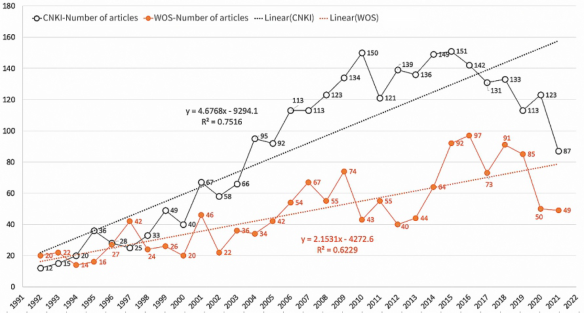
In order to grasp the temporal pattern and development trend of the literature output of interface design research in Chinese and international academia as a whole, we extracted the relevant literature from CNKI and WOS databases to obtain Figure 1. This shows that interface design research is a popular rese- arch direction in both Chinese and foreign academia. The literature output of interface design research in the period of 1992–2009 was relatively stable with a fast growth rate, and then began to decline from 2007 to 2012, and then began to rise again in 2013, reaching a peak in 2016 (97 articles/year) and then continued to decline. The trend line (R2 = 0.6229) constructed from
Figure 1: Statistical chart of the number of domestic and foreign interface design literature.
840 Li and Han
the WOS literature output data predicts that the literature output of inter- face design research will keep growing internationally in the future, but the magnitude is small; for Chinese research, the literature output grew steadily from 1992 to 2010, and the number of publications gradually stabilized from 2011, but the growth rate was relatively slow, and the overall output was rela- tively flat, and the trend started to rebound from 2013 to The overall output has been relatively flat, with a rebounding trend from 2013 to a peak in 2015 (151 articles/year), but a certain downward trend in the last two years. The total output of CNKI literature combined with the trend line shows that the increase in the number of literature output in China is relatively flat and may decline in the future.
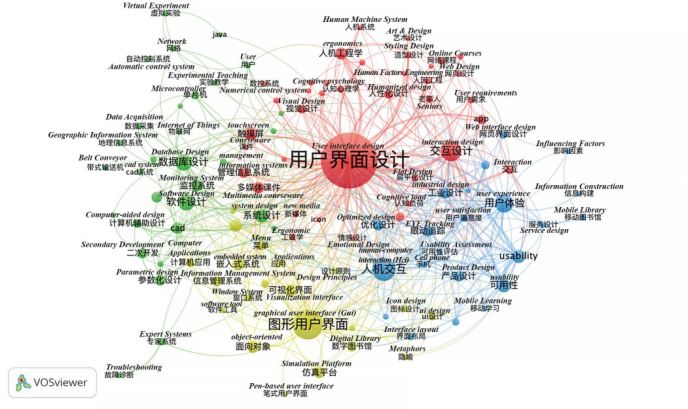
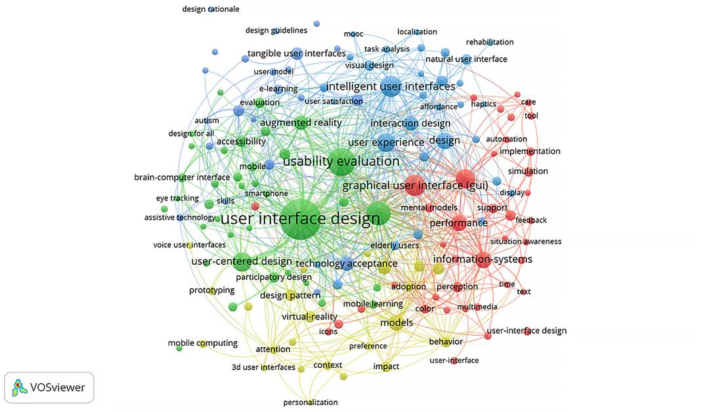
Analysis of Research Hotspots and Cutting-Edge Trends Research Hotspot Analysis By running VOSviewer, we finally obtained the list of Chinese and foreign interface design research keywords (see Table 1) and the keyword cluste- ring co-occurrence map (see Fig. 2 and Fig. 3). Among them, the keyword co-occurrence map of Chinese research has 113 nodes and 505 links; the keyword co-occurrence map of international research has 154 nodes and 2730 links. From Table 1 and Figures 2 and 3, it can be seen that there are both simi- larities and differences between the research hotspots in the field of interface design in China and in the international academic community. In order to better grasp the characteristics and research differences between Chinese and
Table 1. Keyword frequency distribution of interface design research literature included in CNKI and WOS.
Table available in the original PDF paper.
Rank CNKI Frequency Web of science Frequency
209 usability evaluation 113
1 user interface design 437 user interface design 283 2 graphical user interface (Gui)
83
3 human-computer interaction (Hci)
105 human-computer interaction (Hci)
62
4 interaction design 78 graphical user interface (Gui)
5 user experience 72 intelligent user interfaces 62 6 Database Design 66 system design 49 7 Software Design 66 user-centered design 47 8 system design 53 user experience 46 9 usability 52 design 35 10 touchscreen 42 information-systems 34 11 ergonomics 37 models 32 12 Visualization interface 36 performance 30 13 embedded system 35 augmented reality 25 14 Control System 33 interaction design 24 15 object-oriented 30 technology acceptance 24
Comparative Analysis of Scientometric-Based Interface Design Research 841
Figure 2: CNKI included interface design research keyword co-occurrence mapping.Figure 3: WOS included interface design research keyword co-occurrence mapping.
foreign interface design research, this paper will compare and analyze the research hotspots in China and international academia in terms of similarities and differences.
Similarities: First, Chinese and foreign academics are relatively consistent in research themes, and four main clusters have been formed in terms of keyword clustering, namely: #1 user research and interaction design, #2 graphic interface design, #3 computer-aided design, and #4 user experie- nce and usability evaluation. Secondly, both Chinese and foreign interface design studies attach importance to usability testing and evaluation to ensure
842 Li and Han
that interface design solutions are easy for users to understand, learn, and use, and their common keywords are usability, human factors ergonomics, eye tracking, etc.; thirdly, both Chinese and foreign interface design studies attach importance to human-computer interface research to understand the operation logic relationship between human-computer interaction, and their correlation keywords include human-computer interaction, interaction interface design, and Fourth, both Chinese and foreign interface design stu- dies attach importance to user research, emphasizing user-centered design in specific studies, reflecting a strong inclusive perspective, and their com- mon keywords include user experience, humanized design, the elderly, user satisfaction, etc.; Fifth, both Chinese and foreign interface design studies attach importance to the use of graphical methods for computer user interface design, attaching importance to the visual perception-based graphical inter- face to improve the efficiency of users’ visual target search, and their common keywords are graphical user interface, visualization, icon design, etc.
Heterogeneity: First, Chinese interface design research focuses more on the use of computer-aided technology for system development and design of interfaces, data analysis and graphic image processing. The key words include plc, matlab, computer-aided design, cad system, etc.; second, Chinese research focuses more on user interface and interaction design research in the field of industrial design, and the key words include industrial design, product design, styling design, etc.; third, Chinese interface design research is more traditional in interaction design, and is more inclined to the traditional and most simple and convenient physical human-computer interaction method of Third, Chinese interface design research is more traditional in terms of interaction design, and is more oriented toward the development and design of the simplest and most convenient physical human-computer interaction, with keywords such as touch screen.
From the perspective of international research: First, the international aca- demic community has paid more attention to the exploration and research of cutting-edge and advanced natural interaction methods, and the inter- face design has started to develop from tangible graphical user interface to adaptive user interface, which has changed from emphasizing physical inte- raction to emphasizing natural interaction with the ability to adapt to users’ information needs in order to enhance system stability. The key words include 3d user interface, natural user interface, brain- computer interface, adaptive user interface, etc. Secondly, the international academic community pays more attention to the combination of interface design and digital technology, emphasizing the restoration of interface digital information through virtual digital technology or enhancing the dynamism, realism and visualization of interface digital information, and at the same time, mobilizing the enthusi- asm of user interaction and improving the effectiveness of user experience of human-computer interaction so as to promote the efficient dissemination of resource information. The key words include virtual reality, augmented reality, etc. Thirdly, the international academic community focuses on the intrinsic relationship between interface design and system data processing, and mainly discusses how to design more reasonable user interfaces through
Comparative Analysis of Scientometric-Based Interface Design Research 843
reasonable system architecture and data model, with key words including System, Model, Interface, etc.
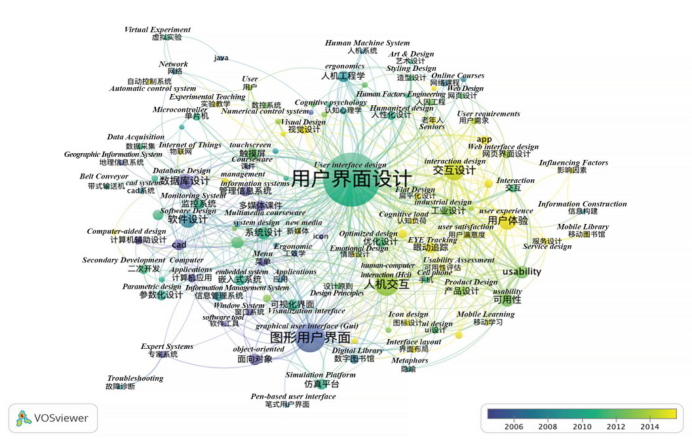
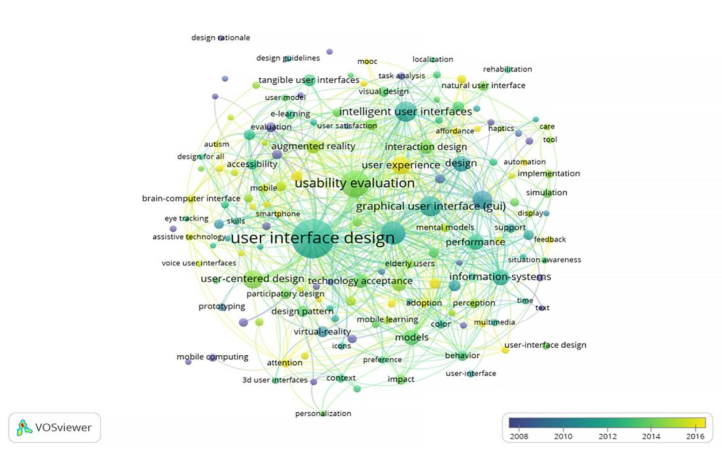
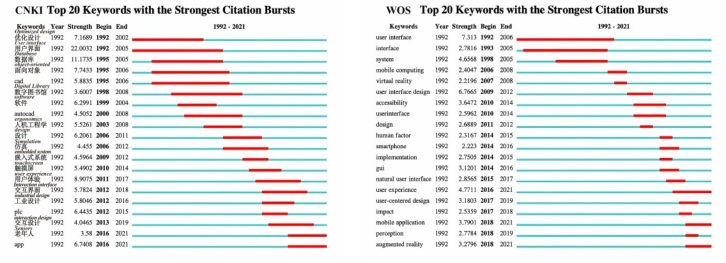
Analysis of Research Frontier Trends In order to further study the respective frontier themes and development trends of interface design in Chinese and international academia, this section uses the VOSviewer keyword clustering index to statistically analyze the ave- rage occurrence time of keywords in WOS and CNKI literature respectively, and superimpose them on the original clustering graph to obtain Figure 4 and Figure 5. In order to ensure the rigor of the study, we used CiteSpace to determine the development trend of interface design research in China and abroad based on the frequency change of key co-cited papers combined with time-keyword clustering, as shown in Figure 6. Figure 6 shows the top 20 keywords in interface design research in China and abroad, and the darker part of the figure indicates the years in which the frequency of keywords cited in the papers is relatively prominent, reflecting the changing trend of research.
Combining Figure 4 and Figure 6, it can be seen that Chinese interface design research hotspots are divided into three obvious intervals. From the keyword evolution of the three intervals, the research content transitions from early user interface design to user experience, interaction design, and service design and presents a strong inclusive perspective, which is consistent with the results of the time-keyword clustering chart. A comprehensive analy- sis of the time-keyword clustering diagram and the high-density emergent words shows that the future research contents of Chinese academia focus on user experience, eye tracking, visual design, elderly, interaction design, service design, etc. The international research trends can also be roughly divided into 3 development intervals, as shown in Fig. 5 and Fig. 6, the keyw- ords also present a strong inclusive perspective. In addition, topics such as
Figure 4: CNKI Data Keyword-Time Overlay Clustering Mapping.
844 Li and Han
Figure 5: WOS Data Keyword-Time Overlay Clustering Mapping.Figure 6: CNKI & WOS data BURST keywords high density emergence.
eye-tracking, which is the frontier research direction in Chinese academia, is in the early stage of research in the international academia, which is also the difference between Chinese and foreign academia in the research frontier. Combining Figure 5 and Figure 6, the future research focus of the interna- tional community will be on user experience, feedback, gesture recognition, natural user interface, user- centered design, and decision making. The rese- arch content shows a shift from physical interaction to natural interaction, and the research topics are more cutting-edge than those in China, and the research perspectives also show strong diversity.
Analysis of High-Impact Literature In order to better analyze and grasp the differences and similarities in research perspectives and research paradigms of interface design research in Chinese
Comparative Analysis of Scientometric-Based Interface Design Research 845
and foreign academia, 15 high-impact classics were selected from each of the relevant literature within the search area, ranked according to the total number of citations, to further explore the characteristics and focus of each. In terms of research paradigms, the differences between Chinese and foreign interface design research are significant, which is consistent with the results presented by keyword clustering. The highly cited literature in Chinese aca- demia mainly adopts qualitative research methods such as literature research method, case study method, and logical deduction method, while focusing on research in conjunction with design practice work. For example, Yang and Wang (2007), starting from the user’s emotional experience, relied on the pri- nciples of perceptual engineering and combined with specific cases to provide an in-depth explanation of how to better design human-computer interaction interfaces; Tan et al. (2012), based on complex human-vehicle interaction situations, analyzed the design problems of multi-channel display and natu- ral interaction modes in automotive human-computer interfaces for display and control, and verified the application through design cases; Pan (2008) reviewed the development process of human-computer interaction interface design, while analyzing new technologies and phenomena with case studies, and clarified that natural interaction interface design will definitely become a new hot spot in human-computer interaction interface design research; Si et al. (2015) proposed specific design specifications for interface design to bet- ter adapt the information presentation of mobile learning resources through literature review and case studies.
The highly cited literature of WOS is mainly based on empirical resea- rch methods, while focusing on a combination of literature analysis and case studies to investigate interface design in a qualitative and quantitative way. For example, Jaspers et al. (2004) conducted a related study by developing a cognitive task model of user interface input reflecting physicians’ task beha- viors, combined with an expert evaluation experiment of the model; Vincent Cho et al. (2009) proposed a theoretical model to assess the impact of percei- ved user interface design on the intention of continued use of self-paced e-learning tools and found that perceived usefulness and user satisfaction were two important predictors of continued use intention through user expe- riments; Medhi et al. (2011) to evaluate and improve the usability of user mobile interfaces through user experiments combined with case studies; Niel- sen (1993), the “father of usability testing”, discusses usability metrics in depth through four typical cases in user interface design, and emphasizes that the main purpose of usability evaluation in real-world projects is usabi- lity problem insight and specific strategies for interface design improvement; Najjar (1998) discussed the principles of educational multimedia user inter- face design through literature studies as well as case studies based on research findings in psychology, computer science, instructional design, and graphic design.
In general, in terms of research content, the highly cited literature in both Chinese and foreign academia focuses on multimedia user interface research. In terms of differences, the Chinese literature focuses on user experience, human-computer interaction, interface interaction methods, and multimedia, but also begins to explore the application implications of natural
846 Li and Han
interactive interfaces, while the international literature focuses on usability testing, interface design usability, ease of use, and user satisfaction. In terms of the differences in research paradigms, Chinese academics mainly focus on qualitative research methods such as literature research, case study analy- sis, and logical deduction, but such qualitative research methods have low reproducibility, difficulty in summarizing the deep-seated causes of problems, and are highly subjective in nature; while the international academic com- munity mainly uses empirical research methods, through quantitative user experiments As well as the model research method to carry out research on interface design, and at the same time pay attention to the combination of qualitative and quantitative. Through comparison, it can be found that the combination of qualitative and quantitative research methods is showing great potential, which can effectively avoid the limitations brought by a single research paradigm, and the results of both can corroborate each other, which often leads to more comprehensive and reliable research conclusions, which also has certain significance for the follow-up research of interface design in Chinese and foreign academia.
CONCLUSION
There is still a lot of room for development of Chinese interface design resea- rch in the future. The development of interface design is constantly evolving, and in terms of research themes, attention can be paid to more cutting-edge technologies and research themes, such as: natural interaction interface, ada- ptive interface, multi-channel interaction, unconscious design, etc. Attention should be paid to the kernel needs of interface design from the cognitive and psychological needs of users, so as to provide some new ideas for the subsequ- ent research of Chinese interface design, in order to promote the innovation and development of Chinese interface design. Interface design is a compre- hensive embodiment of human-computer interaction, interaction logic and visual attributes, often a single discipline knowledge can not fully solve its design complexity, in the research paradigm, we can also pay more attention to interdisciplinary cross-fertilization, break the disciplinary barriers, bro- aden the research horizon, especially the synthesis of psychology, computer science, ergonomics, design and other disciplines knowledge base, while focu- sing on the combination of qualitative and quantitative research process, so as to continuously improve the level of Chinese and foreign interface design research.
REFERENCES
Chen, C. (2006). CiteSpace II: Detecting and visualizing emerging trends and transient patterns in scientific literature. Journal of the American Society for information Science and Technology, 57(3), 359–377. Cho V, Cheng T C E, Lai W M J. (2009). The role of perceived user-interface design in
continued usage intention of self-paced e-learning tools. Computers & Education, 53(2), 216–227.
Comparative Analysis of Scientometric-Based Interface Design Research 847
GUO Yu-song, GONG Xiao-dong, CHEN Wang. (2020). Construction Method of Mental Model Based on Situation Awareness Elements. Industrial & Engineer Design, 2(05): 1–9. Jaspers M W M, Steen T, Van Den Bos C, et al. (2004). The think aloud method:
a guide to user interface design. International journal of medical informatics, 73(11-12), 781–795. LU Xiao-bo. (2008). The New Direction of the Development of Information Society Design Discipline: Information Design. Zhuangshi, (S1): 130–134. LUO Shi-jian, ZHU Shang-shang, SUN Shou-qian. (2008). Human-machine inter-
face design. Medhi I, Patnaik S, Brunskill E, et al. (2011). Designing mobile interfaces for novice and low-literacy users. ACM Transactions on Computer-Human Interaction (TOCHI), 18(1), 1–28. Najjar L J. (1998). Principles of educational multimedia user interface design. Human
factors, 40(2), 311–323. Nielsen J. (1993). Iterative user-interface design. Computer, 26(11), 32-41. PAN Yong-liang. (2008). The Naturalness Tendency in the Design of Human- Computer Interface. Zhuangshi, (6): 130–131. SI Guo-dong, ZHAO Yu, ZHAO Peng. (2015). Research on The Interface Design
Pattern of Mobile Learning Resources. E-Education Research, 36(2): 71–76. TAN Hao, ZHAO Dan-hua, ZHAO Jiang-hong. (2012). Research on Automotive Human Machine Interface Design Based on Complex Interaction Context. Packa- ging Engineering, 33(18): 26–30. VANECK N J, WALTMAN L. (2010). Software survey: VOSviewer, a computer
program for bibliometric mapping. Scientometrics, 84(2), 523–538. WANG Xi, XIN Xiang-yang, Craig M. Vogel. (2017). Evolutionary Paths, Hotspots and Frontier Bibliometric Analysis of Knowledge Visualization. Library, (7): 40–45. YAN Biao, WU Xiao-li, TANG Kai-yuan. (2020). Color Coding of Intelligent Vehi-
cle Interactive Interface Based on Visual Behavior. Industrial & Engineer Design, 2(06): 111–115. YANG Ming-lang, WANG Hong. (2007). Emotional Analysis of Man-machine Interaction Interface Design. Packaging Engineering, 28(11): 11–13.
LISTED IN THE AHFE DIGITAL BOOKSTORE CATALOGUE
Explore the complete digital volume
Intelligent Human Systems Integration (IHSI 2023): Integrating People and Intelligent Systems
Read this individual research paper free through the original publisher, or explore the full digital proceedings book.
ISBN 978-1-958651-45-2
Explore this ISBN in the AHFE Bookstore ↗Listed in the July 2026 bookstore catalogue; search by ISBN to confirm current availability · Digital book purchase optional