Jiejun Dai, Yi Fan Chen, Cheng Qian, Mengrun He, Feiran Sun, Suwen Liu (2024). Research progress, hotspots, and trends analysis of sustainable landscape design based on bibliometrics. In: Human Factors in Design, Engineering, and Computing. AHFE Open Access, vol. 159, pp. 1662–1672. https://doi.org/10.54941/ahfe1005734
In order to systematically understand the research characteristics of sustainable landscape design in the international scope, grasp the current research hotspots of sustainable landscape design, and analyze the future development trend according to the current research hotspots. Taking Web of Science as the source of literature data retrieval, VOSviewe and CiteSpace were comprehensively used to conduct scientific literature metrology and draw the knowledge map from the aspects of annual output distribution, country, research institution, author, keyword clustering and reference co-citation of literature within the scope of retrieval. Visualization and analysis of research context. The results show that the annual number of publications and the overall trend of literature within the scope of search are increasing, and China and the United States are in the leading position in the research field, and the research hotspots mainly focus on: urban landscape design, ecological protection design, theoretical methods and design evaluation.
Sustainable Landscape Design is a design direction that arose in the 1980s. In English, sustainable landscape design is generally referred to as “sustainable landscape design”. In essence, sustainable landscape design is a regenerative design based on the self-renewal ability of natural systems. It includes how to minimize the damage and interference to natural systems and how to restore the destroyed natural capacity as much as possible (Lyle, 1996). In recent years, the concept of sustainability has been applied more and more widely in landscape design. After more than 30 years of accumulation, a large number of literature results have been produced in this field, and the knowledge structure is complex and diversified. Relying only on traditional
Research Progress, Hotspots, and Trends Analysis of Sustainable Landscape Design 1663
literature summary and analysis, it is difficult to objectively study the changes and development direction of hot spots in this field. In order to more comprehensively analyze and grasp the research status, research hotspots and development trends of sustainable landscape design, the literature search in the research uses Web of Science (WOS) database as the data source, and uses VOSviewe and CiteSpace to visually present and analyze the existing literature. And then provide reference for further study.
RESEARCH DESIGN Sources of Data
As high-quality papers are subject to rigorous review and scrutiny by peers as well as journals, the study of high-quality papers is representative of their disciplines. Web of Science (WOS), as the world’s top paper database, has a higher authority, so the following study chooses to search in the Web of Science core ensemble database, with the searching strategy of TS = ((Sustainable AND (Landscape design OR Landscape architecture design)), with SSCI-Expanded, SCI-Expanded, A&HCI, CPCI-S and CPCI-S in WOS. Sustainable) AND (Landscape design OR Landscape architecture design)), with SSCI, SCI-Expanded, A&HCI, CPCI-S and CPCI-SSH in WOS as the index sources. In order to make the literature coverage more comprehensive, the search time was set as full year (from 1900 to December 2023). The retrieved documents were not culled at a later stage in order to avoid interdisciplinary loss of literature. The resulting documents were output as plain text files in txt format, with the output condition of “full records and cited references”, and the interfering documents with off- topic and missing fields were excluded, and after de-emphasis, 1,150 valid documents were finally obtained to be used for further quantitative analyses.
Research Methodology Currently the mainstream bibliometric software has VOSviewer, CiteSpace and R language, etc. In this study, VOSviewer, CiteSpace and other software are used, as well as through the scientific bibliometric method and the visualisation of the knowledge structure to obtain more comprehensive data. Through bibliometrics, the literature data of sustainable landscape design can be more objective and the analysis of literature can be more systematic. 1969 Pritchard firstly proposed the bibliometric research method, bibliometric analysis is a kind of quantitative research method, which analyses the information of the thing and the potential law on the basis of obtaining a large amount of literature data. VOSviewer is a software developed by Van Eck and Waltman to analyse the literature data. and Waltman developed software for metrological mapping and visualisation of literature (Vaneck and Waltman, 2010), and CiteSpace from Chaomei Chen’s team at Drexel University can be used for visual analysis of citations (Chen, 2006).
LITERATURE MEASUREMENT RESULTS AND ANALYSES OF SUSTAINABLE LANDSCAPE DESIGN Analysis of Hotspots and Cutting-Edge Trends in Sustainable Landscape Design Research
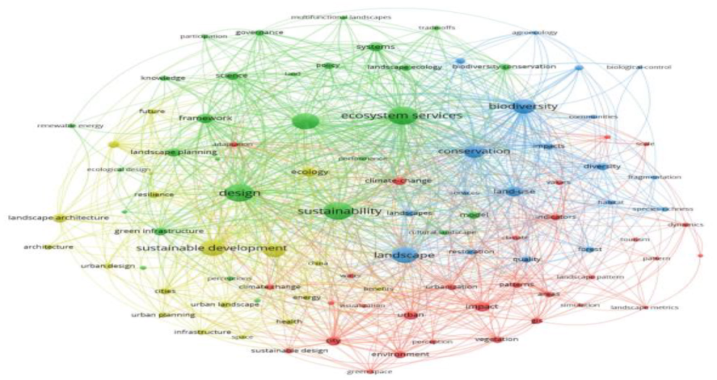
Keywords are the authors’ high level summary of the content of the article, and in order to be able to more intuitively observe the hotspots of sustainable landscape design research, the high-frequency co-occurring keywords of the literature were analysed. Vosviewer was used to calculate and analyse 1150 pieces of literature within the search range, which contained a total of 4991 keywords, and the threshold was set to 12, and the co-occurring clusters formed by 96 keywords were obtained after screening and merging the keywords with the same or similar meanings (Fig. 1). The same kind is divided into 4 blocks of colour, different colours represent different clusters, and those with the same colour belong to the same cluster, with a total of 4 main clusters (Clusters). From the analysis of the data results, the hot research topics of sustainable landscape design can be divided into four main categories: #1 urban sustainable landscape design, #2 rural ecological conservation design, #3 theoretical methods and #4 design evaluation.
Cluster #1 - Urban Landscape Design contains a total of 19 cluster members, mainly containing the keywords Sustainable Development, Landscape Design, Cities, Landscape Architecture and Infrastructure. Due to the need for urban planning and management, Burgess first proposed the “concentric circles model” in 1925, which analyses the relationship between urban space and social space (Park and Burgess, 2019). Mumford believed that the city is the centre of social activity, and that all elements should be centred around this centre of activity, and he believed that people’s urban experience is related to their cultural qualities. experience of the city was related to its cultural qualities, while the natural environment was considered to be of secondary importance (Luccarelli, 1997). It was not until the publication of John Brinckerhoff Jockson’s The almost perfect town in 1952 that the concept of the ‘urban landscape’ was considered to be truly articulated (Jackson, 1952), and it was in 1967 that McHarg first introduced ecology into urban landscape planning. In 1967, McHarg first introduced ecology into urban landscape planning, and he believed that ecology provided an indispensable foundation for landscape design and regional planning, and would have a profound impact on urban planning and architecture now and in the future. A truly outstanding landscape architect is a bridge between the natural sciences and the planning and design professions, as well as the owner of the most insightful view of the natural world offered by science or art. The term “urban design” was first coined in the 1950s, but was introduced as a formal concept in Turkey in the 1970s (Krieger, 2009). As people’s demand for aesthetics and visual effects gradually increased, Urban Landscape was created, but both public and residential landscapes are an important part of the urban fabric and form of existence, therefore, urban landscape design is an important part of urban design. Urban landscape is composed of open space and green space in the environment, it is not independent of the surrounding buildings and structures alone, but a kind
Research Progress, Hotspots, and Trends Analysis of Sustainable Landscape Design 1665
of identity card of the city. Urban landscape design in the development of the city mainly has the following advantages: the protection of environmental ecology, reflecting the aesthetic value, to a certain extent, improve the social benefits of the city (Rowley, 1994).
Cluster #2 - Rural Ecological Conservation Design contains a total of 19 cluster members, mainly Landscape, Biodiversity, Conservation, Countryside, Restoration. The term “ecological conservation” was first evolved from “environmental protection” by American biologist Rachel Carson, and Hansen published the first article on rural ecological landscapes in 2005”. Effects of exurban development on biodiversity: patterns, mechanisms, and research needs” is the beginning of this research (Hansen et al. 2005). Rural ecological landscape is the foundation of ecological conservation, and from the perspective of ecological development, rural ecological landscape is the combination of natural landscape and cultural landscape. Biological diversity is a system of biological, landscape and cultural interactions under the joint action of various elements of the landscape. The ecological landscape of the countryside provides important ecological services for the human living environment, and at the same time, the integration of landscape aesthetics can not only entertain and relax (Chapin et al. 2000), but also play a vital role in ecological restoration and biodiversity protection, which generally reflects the design principle of “human-centred”. The research and construction of rural ecological landscape is a big trend, ecological landscape main research content for the landscape structure, landscape function, landscape change, landscape ecological classification, landscape ecological evaluation and landscape ecological planning. Landscape ecological classification for landscape planning and design basis, followed by landscape planning and design of the environment on the basis of a full analysis of landscape structure, landscape function, landscape culture and characteristics, and put forward the most conducive to the ecological advantages of the design scheme. Its purpose is to achieve optimal use of the activity space within the landscape in the dimensions of time and space, and landscape ecological evaluation is the judgement and evaluation of the overall design (Wu et al. 2014). Cluster #3 - The theoretical approach contains a total of 28 cluster members, mainly including Ecosystem Services, Design, Framework, Landscape Ecology, Knowledge. The clustering reflects that sustainable landscape design is not only concerned with design objects such as urban and rural residential environments, but also with supplementing and updating ecological landscape knowledge. The establishment of a framework and design decision-making system for sustainable landscape design demonstrates the intersectionality and diversity of disciplinary knowledge. In order to improve the knowledge push of sustainable landscape design, scholars can use some necessary platforms to push it more conveniently to design researchers, which can greatly improve the efficiency of designers in the design practice stage of knowledge acquisition and application. The concept of sustainable landscape design and the scope of design objects are also gradually expanding, from macro to micro, from natural landscape to
landscape design materials all emphasise and practice the principle of “sustainability”.
Cluster #4 - Design Assessment contains 30 cluster members that focus on the keywords Impact, Landscape Metrics, Patterns, Model, Scale, Value, and Quality. Among these high-frequency keywords, most of them belong to the assessment criteria in the sustainable landscape design system, such as climate change, land use change, and adaptability. In the assessment method, the focus is on the quantitative method to determine the emotional intention of the user population. The most common method used in the process of extracting the user’s attitude and intention is to adopt Likert scale, and comprehensively use factor analysis, cluster analysis and other methods to reduce the dimensionality of the results obtained, from which the representative data are extracted. Combining the characteristics of these high-frequency words, the research hotspot in Cluster 4 can be described as: based on the evaluation indexes, using a series of quantitative assessment methods and tools, statistically analysing people’s responses to the perceived quality and adaptability of the environment, so as to further adjust the design and updating of the assessment programme.
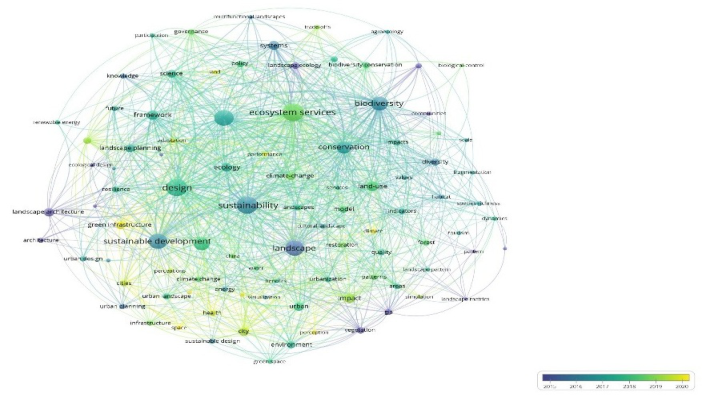
In order to further study the current hot topics and trends in sustainable landscape design, the average time of occurrence of keywords was then enumerated and analysed, and then superimposed on the original cluster diagram (Figure 2). From the research hotspots included in the four clusters in the figure we can find that the overall time of the keywords in cluster #1 - urban landscape design is the closest to the present, and it is the cutting- edge theme of the current research in the field of sustainable landscape design; secondly, the cluster #3 - Design Knowledge is also a current research focus area; Cluster #2 - Rural Ecological Landscape Design as a whole has an average time that occurs prior to 2015, indicating that the
Research Progress, Hotspots, and Trends Analysis of Sustainable Landscape Design 1667
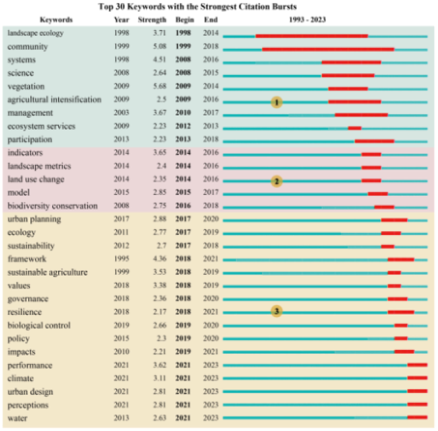
discipline is an early research hotspot in the field. In the overall network of clusters, keywords with an average time later than 2019 onwards include City, Health, Green Infrastructur, Cultural Landscape, Architecture and Future. In order to further explore and validate the hotspots and trends of sustainable landscape design research, CiteSpace’s Burst Term mapping (Figure 3) was comprehensively used in the study. Figure 5 lists the Top30 keywords in terms of bursting intensity, in which the red part indicates the years in which the keywords of the articles are cited relatively more frequently, which can clearly reflect the trend of research changes. Sorting the Top30 emergent keywords according to the order of the year, it can be seen from the figure that the research hotspots are divided into 3 intervals; from the keywords in the 3 intervals, it can be seen that the research content shows a trend of change from rural to urban, and from single to multi- dimensional, which is also consistent with the results of the analyses of the time-keyword clustering. The keywords that appear in the last three years and continue to change until 2023 are Climate, Urban Design, Perceptions, and Water. Comprehensive analysis of the time-keyword clustering diagram and Burst Term can be understood that Landscape ecology belongs to the main keywords of research content fever, so the research hotspot lasts longer, and most of the subkeywords derived from the main keywords last shorter, so the future research of sustainable landscape design will be more and more convergent to Refinement, from the macro direction of ecological sustainability, gradually to the climate, air, water micro small cuts for the design object, more prominent to the human perception as the focus of the design, in addition to the integration of cross-disciplinary will be more and more intense.
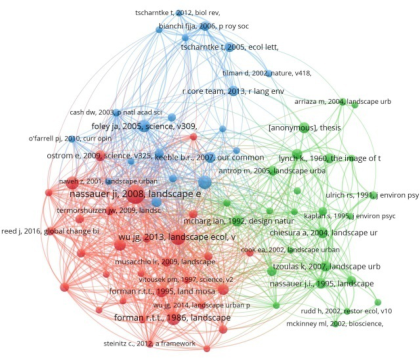
Theoretical Foundations of Sustainable Landscape Design Research In order to present a clearer picture of the evolution of the basic theories of sustainable landscape design research, the co-citation relationship formed by pairwise citation of the literature within the search scope is used to construct the co-citation clustering co-occurrence network. According to the statistics of VOSviewer, there are 1150 documents within the search scope, and a total of 46,566 references were cited. References that were cited no less than 10 times in 1998–2023 were extracted to construct the reference co-citation co-presentation network (Fig. 4), and through LLR (text mining algorithm), three main clusters were generated: cluster #1 (in blue) formed the clustering network of rural ecological landscapes with scholars such as Prof. RUDOLF S DE GROOT from Wageningen University; cluster #2 (in green) formed a clustering network of rural ecological landscapes with Cluster #2 (green) is a clustering network of urban ecological landscapes formed by Prof. Per Bolund, Stockholm University; Cluster #3 (red) is a clustering network of tools and methods for sustainable landscape design formed by TERMORSHUIZEN J W, Wageningen University.
In Cluster #1, the article “Function-analysis and Valuation As a Tool to Assess Land Use Conflicts in Planning for Sustainable, Multi-Functional Landscapes” represents a relatively large co-citation network, with 1,289 citations (as of December 2023) in Google Scholar. In “Function-analysis and Valuation As a Tool to Assess Land Use Conflicts in Planning for Sustainable, Multi-Functional Landscapes”, Professor RUDOLF S DE GROOT proposed for the first time an ecological framework for natural and semi-natural landscapes based on the relationship between landscape coordination and resource requirements, and summarised the three steps: functional analysis, functional valuation and conflict analysis, and gave some conclusions and
Research Progress, Hotspots, and Trends Analysis of Sustainable Landscape Design 1669
recommendations for more sustainable landscape use and maintenance of “natural resources” (De Groot, 2006). In addition, the rest of the clusters can attract a wide range of attention, such as Professor RICHARD T. T. FORMAN’s article published in Landscape Ecology in 1995, which describes some ecological principles of landscapes and regions, and classifies the principles into four groups, namely, landscapes and regions, patches and corridors, and mosaics and apps, in order to help solve socio-ecological landscape problems (Forman, 1995). Scholar PAUL, equal to the article ‘Science for Action at the Local Landscape Scale’ published in Landscape ecology in 2013, has also attracted widespread attention in the academic community, which takes human culture and behaviour as an entry point for interdisciplinary cross-fertilisation research with other disciplines, leading to the belief that Three research themes need to be focused on: firstly local landscapes as a link between disciplines as well as a collaborative exchange with the countryside; secondly, interdisciplinarity to achieve sustainability; and finally scientific knowledge influencing landscape policy and change. In addition, the article “Ecological Networks: a Spatial Concept for Multi-actor Planning of Sustainable Landscapes” published by Prof PAUL OPDAM of Wageningen University in 2006 also has a high citation rate, in this article PAUL In this article, Prof OPDAM first introduced the concept of “ecological networks”and paved the way for the integration of biodiversity conservation into the foundation of sustainable landscape development, and argued that the theoretical and empirical knowledge of ecological networks can provide a reliable framework for the structural design of landscapes (Opdam et al, 2006). In cluster #2, Professor Per Bolund of Stockholm University, whose 1999 article “Ecosystem Services in Urban Areas” has been cited 1626 times in Web of Science, is at the centre of the citation cooccurrence network. Per Bolund argues that as time passes and modernisation accelerates, the establishment of ecosystem services in urban landscapes is particularly important, and defines ‘ecosystem services’ as the benefits that humans derive from ecosystems. The article discusses six regionally relevant services such as air, climate, recreational and cultural values, and concludes that ecosystem services have a significant impact on the quality of urban development (Bolund and Hunhammar, 1999). Secondly, also cited with high frequency in this cluster is Professor Sarah T Lovell’s 2013 article ‘Supplying Urban Ecosystem Services Through Multifunctional Green Infrastructure in the United States’ An article which summarises the provision of ecosystem services for cities through participatory planning for multifunctional green facilities, and presents opportunities to develop urban green infrastructure and promote sustainable and ecological health in cities, and consider urban ecological landscapes in terms of resilient design, and finally assess cities in terms of biodiversity, microclimate, carbon sequestration culture and recreation to stimulate a city-level green facility transformation (Lovell and Taylor, 2013). The rest of the more frequently cited ones are Landscape Approaches: a State-of-the-Art Review published by Professor BAS ART in 2017, which argues that urban landscape approaches are motivated by nature conservation, landscape restoration, etc., elucidates the
interdisciplinary partnership of these landscape approaches and establishes an interdisciplinary T-type The article argues that the urban landscape approach is motivated by nature conservation and landscape restoration, clarifies the interdisciplinary partnership of these landscape approaches, and establishes an interdisciplinary T-model to explain and analyse them. In the end, the application examples of landscape governance and landscape capacity framework are discussed. In an article published in LANDSCAPE AND URBAN PLANNING in 2012, Professor JI NASSAUER pointed out that “landscape” refers to both the concept of human influence on geospace and the physical area. This paper explains “urban ecological landscape design”, and puts forward the relevant principles of urban ecological design with landscape as a comprehensive medium, and uses the relevant principles to influence its inherent characteristics on sustainability.
In Cluster #3, Prof Termorshuizen J W, Wageningen University, in his 2009 publication Landscape Services as A Bridge Between Landscape Ecology and Sustainable Development, argues that landscape ecology is the sustainable landscape development The scientific basis for how landscape comparisons are made is explained. The article also discusses the conditions that must be met for the science of landscape ecology to provide valid knowledge for landscape development: the estimated value component, and encourages scientists from different disciplines to collaborate in building a common knowledge base suitable for cross-disciplinary use, and then proposes and refines a structural-functional-value-chain knowledge framework for expanding the value of pattern-processes in landscape ecological design research. model-process paradigm of value in research (Termorshuizen and Opdam, 2009). Other key scholars in the clustering are Botequilha-Leitao, who in his 2002 publication Applying Landscape Ecological Concepts and Metrics in Sustainable Landscape Planning, mentioned that we have become increasingly aware that Landscape planning and development globally needs to be more sustainable, therefore ecological knowledge is essential and needs to be supplemented with new knowledge to effectively apply sustainable principles and concepts in landscape planning. The article establishes a framework for sustainable landscape planning and design, applies landscape knowledge, explores the potential role of quantitative landscape metrics as ecological indicators, and finally draws out a sustainable landscape planning and design perspective consisting of a horizontal perspective and a vertical perspective (Leitao and Ahern, 2002). Scholars Termorshuizen, Jolande W et al. also defined “ecologically sustainable landscapes” in “Incorporating Ecological Sustainability into Landscape Planning”published in 2007, and developed the concept of “ecologically sustainable landscapes” which can be used as an indicator of ecological sustainability and developed tools that can measure how ecological sustainability is incorporated into landscape planning, which argues that space and pattern play a key role in biodiversity conservation, and experimentally recognised the method as a guide and assessment method for sustainable landscape planning and design. The development and refinement of the sustainable landscape research methodology by the highly cited literature in this cluster sheds much light on subsequent research.
Research Progress, Hotspots, and Trends Analysis of Sustainable Landscape Design 1671
Figure 4: Cluster network with co cited references.
CONCLUSION
Sustainable landscape design research has generally shown an upward trend over time, but the annual production of literature has grown more slowly. In the 37 years of development, there are not many highly productive countries, regions, institutions and scholars, and the research is also mostly intra- institutional and distributed in a fragmented manner. Through the analysis of keywords, it can be seen that the research of sustainable landscape design is relatively broad, and the authorship can be divided into four broad clusters: #1 urban landscape design, #2 ecological conservation design, #3 theoretical methods and #4 design evaluation. These clusters together constitute the research hotspots and research themes of sustainable landscape design, from macro to micro, from environment to individual, reflecting the “human- centred” refinement of the design, overall protection of the environment and ecology, reflecting the aesthetic value, and to a certain extent, improve the benefits of all aspects of society. From the time-keyword clustering and keyword emergence, it can be seen that the future research of sustainable landscape design will tend to be more and more refined and human-centred design focus. The total cited network of references can be analysed to show that sustainable landscape design is relatively mature after a long period of development, and has produced a batch of classical literature to form 3 mainstream theoretical systems, which have played an important role in promoting the generation and development of sustainable landscape design research.
REFERENCES
Bolund P, Hunhammar S. Ecosystem services in urban areas[J]. Ecological economics, 1999, 29(2): 293–301. Chapin Iii F S, Zavaleta E S, Eviner V T, et al. Consequences of changing
Chen C. CiteSpace II: Detecting and Visualizing Emerging Trends and Transient Patterns In Scientific literature[J]. Journal of the American Society for Information Science and Technology, 2006, 57(3): 359-377. De Groot R. Function-analysis and valuation as a tool to assess land use conflicts
in planning for sustainable, multi-functional landscapes[J]. Landscape and urban planning, 2006, 75(3-4): 175–186. Forman R T T. Some general principles of landscape and regional ecology[J].
Landscape ecology, 1995, 10: 133–142. Hansen A J, Knight R L, Marzluff J M, et al. Effects of exurban development on biodiversity: patterns, mechanisms, and research needs[J]. Ecological applications, 2005, 15(6): 1893–1905. Jackson J B. The almost perfect town[J]. The City Reader, 1952: 164–71. Krieger A. Where and how does urban design happen[J]. Urban design, 2009:
113–130. Leitao A B, Ahern J. Applying landscape ecological concepts and metrics in sustainable landscape planning[J]. Landscape and urban planning, 2002, 59(2): 65–93. Lovell S T, Taylor J R. Supplying urban ecosystem services through multifunctional
green infrastructure in the United States[J]. Landscape ecology, 2013, 28: 1447–1463. Luccarelli M. Lewis Mumford and the ecological region: The politics of planning[M]. Guilford Press, 1997. Lyle J T. Regenerative design for sustainable development[M]. John Wiley & Sons,
1996. Opdam P, Steingröver E, Van Rooij S. Ecological networks: A spatial concept for multi-actor planning of sustainable landscapes[J]. Landscape and urban planning, 2006, 75(3-4): 322–332. Park R E, Burgess E W. The city[M]. University of Chicago Press, 2019. Rowley A. Definitions of urban design: The nature and concerns of urban design[J].
Planning Practice and Research, 1994, 9(3): 179–197. Termorshuizen J W, Opdam P. Landscape services as a bridge between landscape ecology and sustainable development[J]. Landscape ecology, 2009, 24: 1037–1052. Vaneck N J, Waltman L. Software Survey: VOSviewer, a Computer Program for
Bibliometric Mapping[J]. Scientometrics, 2010, 84(2): 523–538. Wu Hao, Zhang Jianfeng, Chen Guangcai, Wang Qingbing, Wang Li, Zhang Ying.
Biodiversity conservation strategies in the process of rural landscape construction. Jiangsu Agricultural Science, 2014, 12(8): 345–348.
LISTED IN THE AHFE DIGITAL BOOKSTORE CATALOGUE
Explore the complete digital volume
Human Factors in Design, Engineering, and Computing
Read this individual research paper free through the original publisher, or explore the full digital proceedings book.
ISBN 978-1-964867-35-9
Explore this ISBN in the AHFE Bookstore ↗Listed in the July 2026 bookstore catalogue; search by ISBN to confirm current availability · Digital book purchase optional