Mingzhu Li, Ying Ni (2023). Bibliometric Analysis of Research on Persuasive Technology in the Past Decade: A Web of Science-Based Study. In: Emerging Technologies and Future of Work. AHFE Open Access, vol. 117, pp. 233–242. https://doi.org/10.54941/ahfe1004423
In recent years, research in persuasion technology has matured and captured the attention of numerous experts and scholars. In this article, we analyze 1,714 papers from the Web of Science Core Collection database using CiteSpace software, systematically review the theoretical development, hot topics, and research frontiers of persuasion research, and propose future research directions. We summarize the contributions of three authors who have excelled in the field of persuasion and their significant achievements through the co- authorship knowledge graph. Additionally, we concentrate on four major areas of persuasive technology application: exercise and health, sustainability, education, and business, by filtering and categorizing keywords. We also identify research frontiers in persuasive technology through burst keyword analysis. We discovered that the foundational theory of persuasion is well-established and has been widely applied across various domains. Particularly, research in the domains of exercise and health has emerged as a significant area deserving of further investigation. Furthermore, recent developments in persuasion research have centered on exploring the influencing factors of persuasion, encompassing intrinsic aspects that represent user perspectives and extrinsic elements reflecting the impact of the Internet. Therefore, we encourage researchers to delve deeper into these aspects.
The concept of persuasion originally emerged in psychology and found its way into the field of computer science in the late 1990s (Fogg, 1997). Its pri- mary focus is utilizing computers and information technology to influence attitudes and behaviors (Fogg, 2002). The significant increase in academic research contributed to the development of the Fogg Behavior Model (FBM), which analyzes the generation of behaviors through motivation, ability, and trigger (Fogg, 2009a). Cialdini (2001) identified the six fundamental princi- ples of persuasion, which include liking, reciprocity, social proof, consistency, authority and scarcity. The Persuasive Systems Design Model (PSD) was subsequently introduced as a framework for designing persuasive systems, featuring four categories and 28 effective strategies (Oinas-Kukkonen and Harjumaa, 2009). As foundational knowledge continues to expand, per- suasive technology has expanded into numerous domains, such as health,
exercise, and ecological consumption, garnering increased attention. There- fore, this paper seeks to cluster research on persuasion within the Web of Science (WOS) Core Collection database by bibliometric analysis. By employing bibliometric analysis through CiteSpace, we generate a scien- tific knowledge graph of the persuasion field, displaying recent findings in a user-friendly manner. This will facilitate the organization of the theoretical knowledge system of persuasion and enable researchers to comprehend the field’s current status and noteworthy accomplishments.
Research Method and Data Source CiteSpace 6.1.R6 was used for bibliometric analysis, utilizing data from the WOS Core Collection database to create a scientific knowl- edge graph and reveal the development process and structural relation- ships of knowledge. The search criteria were as follows: TS=(persuasive design) OR TS=(persuasive technology) OR TS=(Persuasive strategies) OR TS=(personalized persuasion). The search covered the period from January 1, 2012, to December 31, 2022, resulting in a total of 3,050 literature records. The selected literature types for this study included articles, pro- ceedings papers, and reviews. Since the focus of this research is mainly on the application domains of persuasive technology, unrelated literature was filtered out by reviewing titles, abstracts, and keywords. This process led to a total of 1,714 relevant research papers on persuasion.
Basic Characteristics of the Literature Through analyzing the relevant literature in the WOS Core Collection database, we investigated the temporal trends in the number of publications in the field of persuasion. From 2016 onwards, there has been a significant increase in publications, peaking at 219 in 2019. Since then, the publica- tion count has remained stable, indicating a sustained scholarly interest in persuasion research over the past decade.
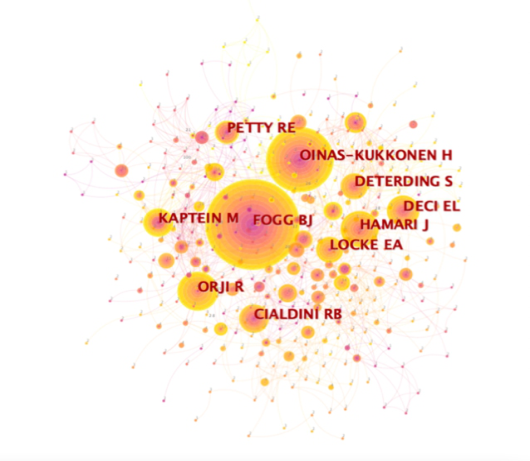
Core Authors and Research Achievements The co-authorship knowledge graph in persuasion research was generated using CiteSpace software (see Figure 1). The graph demonstrates a dense network of connections, signifying the active engagement of authors in persuasive technology research. This dynamic network has enabled produc- tive collaborations and mutual connections among authors. The persuasive technology research community has nurtured effective multidirectional com- munication, interactive collaborations, and interconnected relationships, fostering a strong exchange of knowledge and information. These interac- tions play a significant role in the continuous progress and development of the persuasive technology field.
Fogg BJ, Oinas-Kukkonen H, and Orji R are prominent scholars who have made significant contributions to persuasion research, inspiring other researchers in the field. Fogg introduced the concept of persuasive technology, defining it as an information system designed to change people’s attitudes or
Bibliometric Analysis of Research on Persuasive Technology 235
behaviors. He proposed the use of computer systems to persuade users, out- lining three approaches: tool, medium, and social actor. He then established the Persuasive Technology Lab, wrote books on persuasive technology, out- lined specific steps, and created the well-known Fogg Behavioral Model (see Table 1).
Figure 1: Co-authorship knowledge graph in persuasion research (Generated in CiteS- pace).Table 1. Timeline of Fogg’s persuasion research.
Table available in the original PDF paper.
Year Main Contributions 1997 Fogg established the Persuasive Technology Lab at Stanford University. 1997 Fogg (1997) introduced Captology, which refers to the application of persuasive technology in the field of computer research. 2002 Fogg (2002) published Persuasive Technology: using Computers to Change What We Think and Do, proposing a definition of persuasive technology. 2009 Fogg (2009a) proposed the Fogg Behavior Model, which describes the three elements necessary for behavior change: motivation, ability, and trigger. 2009 Fogg (2009b) outlined the eight steps to designing for persuasion. 2010 Fogg and Hreha (2010) initiated the Behavior Wizard project and developed the Fogg Behavior Grid. 2017 Fogg changed the Fogg Behavior Model by replacing the term Trigger with Prompt, forming the B=MAP Behavior Model. 2019 Fogg (2019) published Tiny Habits: The Small Changes That Change Everything.
Oinas-Kukkonen et al. (2009) defined an emerging information system as a behavior change support system that applies persuasive technology concepts.
236 Li and Ni
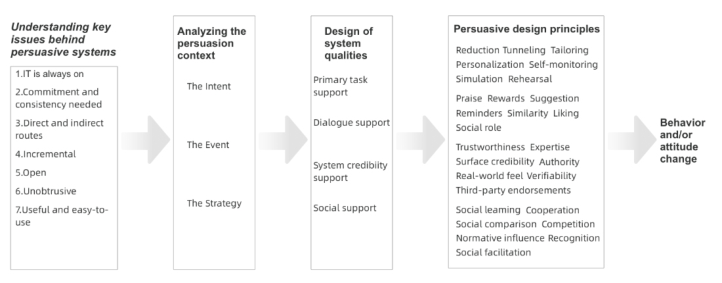
These systems can be websites, mobile applications, or other interactive information systems. Oinas-Kukkonen also proposed the Persuasive Systems Design (PSD) model, which is a comprehensive theoretical framework for persuasion. The PSD model categorizes 28 specific strategies into four main modules, based on their intended impact on system design goals. It has been widely used for designing and evaluating intention-based behavior change systems (Halttu and Oinas-Kukkonen, 2017) (see Figure 2).
Figure 2: Persuasive systems design model (Adapted from Oinas-Kukkonen and Harjumaa, 2009).
Orji R et al. (2012) introduced four additional variables to expand the existing persuasive model in the health domain. They tested and compared the effectiveness of the expanded model with the original model in promot- ing healthy eating behaviors. Orji R focuses on researching gamification in persuasive interventions and commonly utilizes personalized persuasive strategies tailored to individual users. They design personalized interventions for different types of players (Orji, Nacke and Di Marco, 2017). In-depth investigations are conducted across various research domains to explore the limitations of one-size-fits-all persuasive strategies. Personalized persuasive strategies are then designed based on individual factors.
Research Hot Topics Scholars have established the theoretical foundation for persuasive technol- ogy research and conducted extensive studies on its application in relevant industries. By filtering and categorizing keywords (see Table 2), we identified and summarized the four major themes explored by scholars in persuasive technology research.
The first category of this research focuses on exercise and health, encom- passing keywords such as physical activity (2013), health (2014), healthy eating (2014), health communication (2014), mobile health (2015), smok- ing (2016), and mental health (2016). Evolving lifestyles have led to an increased concern over unhealthy behaviors, making it imperative to shift lifestyle patterns and promote healthier living. The World Health Organiza- tion has outlined four key areas for healthy lifestyles: balanced diet, regular
Bibliometric Analysis of Research on Persuasive Technology 237
exercise, abstaining from smoking or excessive drinking, and maintaining mental well-being. Consequently, research in this field has seen a steady rise in response to the growing importance placed on individual health. The time- line of research in exercise and health has transitioned from broader topics, such as physical activities and general health, to more specific areas, such as addressing unhealthy behaviors like smoking and focusing on mental health within the context of health promotion. This research has delved into various aspects, including technological design, research methods, and motivational factors. The advancement of digital technologies has opened doors for digital interventions that promote healthy behaviors, offering greater potential for embracing healthier lifestyles. (Lentferink et al. 2017) conducted a study on interventions for automatic healthy lifestyles using self-tracking and digital support technology. The study evaluated the impact, usability, and compli- ance of these interventions, ultimately enhancing the effectiveness of health interventions.
Table 2. Research hot topics related keywords.
Table available in the original PDF paper.
Category Keyword Year Frequency Degree Centrality Exercise and Health physical activity 2013 54 20 health 2014 57 16 healthy eating 2014 2 6 health communication 2014 14 10 mobile health 2015 5 6 smoking 2016 6 6 mental health 2016 13 12 Sustainability energy conservation 2012 6 7 donation 2013 2 2 carbon footprint 2013 1 3 climate change 2016 21 18 green 2020 3 7 Education adolescent student 2020 1 1 learning disabled student 2012 2 3 college student 2012 4 8 student 2014 10 11 education 2014 12 18 higher education 2016 2 2 health education 2016 2 2 entertainment education 2019 8 8 Business consumer 2015 16 18 consumer behavior 2019 2 4 food advertising 2021 2 6
The second category focuses on sustainability, incorporating keywords such as energy conservation (2012), donation (2013), carbon footprint (2013), climate change (2016), and green (2020). The urgency of the climate crisis, including melting glaciers, global warming, and widespread disasters, has made environmental sustainability a critical global concern. With the implementation of sustainable development policies by various countries, the integration of persuasion and sustainability has emerged as a prominent topic in persuasion research. In traditional persuasion research, the effectiveness of persuasion is typically evaluated through experiments conducted over one to
238 Li and Ni
two months, and sometimes up to three to six months. However, when it comes to promoting sustainable behaviors such as transportation choices, purchasing habits, and water and electricity usage, these decisions often vary with seasonal factors. This indicates that short-term measurements may not accurately capture the effectiveness of persuasion in promoting sustainable behaviors. (Anagnostopoulou et al., 2020) emphasized the significance of considering seasonality as a crucial factor in cultivating sustainable habits.
The third category explores education, covering keywords like ado- lescent student (2010), learning disabled student (2012), college student (2012), student (2014), education (2014), higher education (2016), health education (2016), and entertainment education (2019). Online education has gained popularity with the rise of the internet, further accelerated by the COVID-19 pandemic in early 2020. The integration of education with other domains, such as health education and environmental educa- tion, creates mutual enhancements. Applying persuasive design in educa- tion enhances students’ learning continuity and motivation, providing an improved learning experience. Educational interventions, often incorporating gamification, captivate students’ attention and encourage positive learning behaviors. (Elaish et al., 2019) developed a mobile gaming application that utilizes gamified learning to enhance students’ motivation in learning English vocabulary. This study emphasizes the potential of persuasive strategies within gamification and offers valuable insights for designing game-based interventions.
The fourth category focuses on business-related aspects, with keywords such as consumer (2015), consumer behavior (2019), and food advertising (2021). The rise of the internet has made online shopping a prevalent con- sumer behavior. However, challenges persist, including the lack of appeal in the online shopping experience and consumer concerns. Persuasive technol- ogy can help attract consumers and address these shopping-related concerns. As a result, persuasive design in the business domain has garnered significant attention. (Ali et al. 2017) demonstrated the effectiveness and feasibility of persuasive design in the business domain by enhancing social support ele- ments and improving the persuasive utility of the recommendation system in Malaysia.
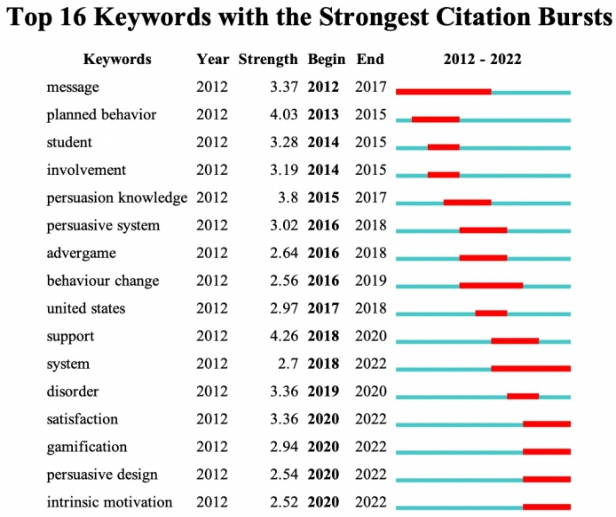
Research Frontiers With CiteSpace, we performed a quantitative analysis of keywords to study their emergence over time. Burst keywords provide a clear representation of academic frontiers. The top 16 burst keywords in persuasive studies (see Figure 3) reveals three distinct stages of bursts.
During the first stage (2012-2014), the burst keywords included message, planned behavior, student, and involvement. This stage primarily focused on fundamental elements of persuasion research, such as message framing and planned behavior representation, with a particular emphasis on exper- imental studies involving student participants. Information played a crucial role in persuasion, and varying its delivery methods effectively influenced users’ behavioral attitudes. Gallagher (2016) discovered that different modes of information delivery can impact the effectiveness of persuasion, despite conveying the same basic information.
Bibliometric Analysis of Research on Persuasive Technology 239
Figure 3: Top 16 burst keywords in persuasion research (Generated in CiteSpace).
During the second stage (2015-2017), the burst keywords in persua- sive research included persuasion knowledge, persuasive system, advergame, behavior change, and United States. This stage focused on refining and advancing persuasion theory, primarily led by American researchers. The study of persuasion emerged in the late 1990s and gained academic attention in 2005. By 2015, there was a significant body of research on persuasion, with continuous improvement in models such as FBM, behavior grid, per- suasive technology functional model, and PSD. During this stage, researchers conducted systematic reviews and examinations of previous knowledge and systems in persuasion research. They identified limitations and made fur- ther advancements in the field. For example, (Orji et al., 2017) explored the effectiveness of social influence-related strategies through a large-scale qualitative and quantitative study involving 1768 participants. Adjustments were made to these strategies, and guidelines for their implementation were proposed to enhance persuasive effectiveness. Additionally, (Matthews et al. 2016) utilized existing persuasion system design models as an analytical framework to review articles on mobile applications for health behavior. The study revealed a substantial body of literature supporting task support, dialogue support tasks, and social support, but limited research on system credibility. Consequently, the study focused on investigating the credibility of system information to improve persuasion systems for health-related mobile applications.
During the third stage (2018-2020) of persuasive research, burst keywords included support, system, disorder, satisfaction, gamification, persuasive design, and intrinsic motivation. In this current stage, persuasion theory has undergone extensive and in-depth research. Factors influencing persuasion
240 Li and Ni
have been subdivided, with a focus on studying intrinsic factors related to users and external factors related to the internet and environmental influ- ences. The integration of emerging research has injected new vitality into persuasion. Regarding external research, stimulation of behavior has been achieved through persuasive technologies such as computer support sys- tems, social support systems, and perceptual systems. In terms of intrinsic research, emphasis has been placed on user psychology and utilizing gam- ification to alter users’ attitudes based on their intrinsic motivation. Xi and Hamari (2019) explored gamification factors in the context of intrin- sic research and validated how different gamification features satisfy various dimensions of intrinsic needs. The study found a positive correlation between immersion-related gamification features and self-need fulfillment, confirming the positive role of gamification factors in influencing intrinsic motivation in persuasion.
CONCLUSION
Persuasion research has gained global attention as a means of intentionally influencing attitudes and behaviors, leading to significant academic progress. In this study, we conducted a bibliometric analysis of 1,714 research articles on persuasion from the WOS Core Collection database, covering the period from 2012 to 2022. The findings can be summarized as follows: 1) In terms of publication trends, persuasive research underwent an exploratory phase from 2012 to 2015, followed by a substantial growth period from 2016 to 2019, and eventually stabilized from 2020 to 2022. 2) Highly cited literature in persuasive research predominantly emerged between 2014 and 2018. Influ- ential authors like Fogg BJ, Oinas-Kukkonen H, and Orji R played critical roles in defining persuasion, establishing foundational theories and models, and conducting practical research in various domains, especially in health. They employed techniques such as gamification and personalization to delve deeper into the realm of persuasion. 3) Persuasive research has made sig- nificant contributions in four primary thematic areas: exercise and health, sustainability, education, and business. While concentrating on these core domains is expected to produce valuable results, applying persuasion theo- ries to other fields offers potential for innovative accomplishments. 4) An analysis of the frontiers in persuasive research reveals an initial exploration of fundamental knowledge and essential elements, followed by a compre- hensive review and consolidation of knowledge and systems in the field to address identified limitations. Furthermore, the differentiation between external physical factors and internal psychological factors in persuasive research has enriched the comprehension of influencing factors. To further enhance the depth and specificity of persuasive research, future studies should meticulously explore and investigate specific domains or issues.
ACKNOWLEDGMENT
This work is supported by the Research Project of Philosophy and Social Sci- ence Research in Colleges and Universities in Jiangsu Province, China (Grant No. 2022SJYB2209). We wish to thank the anonymous reviewers of this article for their constructive comments.
Bibliometric Analysis of Research on Persuasive Technology 241
REFERENCES
Ali, S. B. (2017). “Propose an Enhanced Social Support for B2C Persuasive Recommendation System in Malaysia”, 2017 6th ICT International Student Project Conference (ICT-ISPC), Johor, Malaysia. Anagnostopoulou, E., Urbanˇciˇc, J., Bothos, E. et al. (2020). From Mobility Patterns
to Behavioural Change: Leveraging Travel Behaviour and Personality Profiles to Nudge for Sustainable Transportation, Journal of Intelligent Information Systems Volume 54. Cialdini, R. B. (2001). The Science of Persuasion, Scientific American Volume 284, No. 2. Elaish, M. M., Ghani, N. A., Shuib, L. et al. (2019). Development of a Mobile Game
Application to Boost Students’ Motivation in Learning English Vocabulary, IEEE access Volume 7. Fogg, B. J. (1997). “Captology: The Study of Computers as Persuasive Technologies”, CHI 97 Conference Summary on Human Factors in Computing Systems, New York, NY. Fogg, B. J. (2002). Persuasive Technology: Using Computers to Change What We
Think and Do, UBIQUITY Volume 2002 No. December. Fogg, B. J. (2009a). “A Behavior Model for Persuasive Design”, Proceedings of the 4th International Conference on Persuasive Technology, New York, NY. Fogg, B. J. (2009b). “Creating Persuasive Technologies: An Eight-Step Design Pro-
cess”, Proceedings of the 4th International Conference on Persuasive Technology, New York, NY. Fogg, B. J. and Hreha, J. (2010). “Behavior Wizard: A Method for Matching Target Behaviors with Solutions”, Persuasive Technology: 5th International Conference, Berlin, Heidelberg. Fogg, B. J. (2019). Tiny Habits: The Small Changes That Change Everything. Eamon
Dolan Books. Gallagher, K. M. (2016). Helping Older Adults Sustain Their Physical Therapy Gains: A Theory-Based Intervention to Promote Adherence to Home Exercise Following Rehabilitation, Journal of Geriatric Physical Therapy Volume 39, No. 1. Halttu, K. and Oinas-Kukkonen, H. (2017). Persuading to Reflect: Role of Reflection
and Insight in Persuasive Systems Design for Physical Health, Human-Computer Interaction Volume 32, No. 5–6. Lentferink, A. J., Oldenhuis, H. K., de Groot, M. et al. (2017). Key Components in eHealth Interventions Combining Self-Tracking and Persuasive eCoaching to Promote a Healthier Lifestyle: A Scoping Review, Journal of Medical Internet Research Volume 19, No. 8. Matthews, J., Win, K. T., Oinas-Kukkonen, H. et al. (2016). Persuasive Technology
in Mobile Applications Promoting Physical Activity: A Systematic Review. Journal of Medical Systems Volume 40. Oinas-Kukkonen, H. and Harjumaa, M. (2009). Persuasive Systems Design: Key Issues, Process Model, and System Features, Communications of the Association for Information Systems Volume 24, No. 1. Orji, R., Vassileva, J. and Mandryk, R. (2012). Towards an Effective Health Interven-
tions Design: An Extension of the Health Belief Model, Online Journal of Public Health Informatics Volume 4, No. 3. Orji, R., Nacke, L. E. and Di Marco, C. (2017) “Towards personality-driven persuasive health games and gamified systems”, Proceedings of the 2017 CHI Conference on Human Factors in Computing Systems, New York, NY.
242 Li and Ni
Orji, R., Mandryk, R. L. and Vassileva, J. (2017). Improving the Efficacy of Games for Change Using Personalization Models, ACM Transactions On Computer- Human Interaction (TOCHI) Volume 24, No. 5. Xi, N. and Hamari, J. (2019). Does Gamification Satisfy Needs? A Study on
the Relationship Between Gamification Features and Intrinsic Need Satisfaction. International Journal of Information Management Volume 46.
LISTED IN THE AHFE DIGITAL BOOKSTORE CATALOGUE
Explore the complete digital volume
Emerging Technologies and Future of Work
Read this individual research paper free through the original publisher, or explore the full digital proceedings book.
ISBN 978-1-958651-93-3
Explore this ISBN in the AHFE Bookstore ↗Listed in the July 2026 bookstore catalogue; search by ISBN to confirm current availability · Digital book purchase optional