Xie Shiyang, Zhou Fang, Xiaorui Yang, Zhen Wang, Yao Hao Yang, Bingqing Tang (2026). Elevator Installation in Old Residential Communities (EIOC): Towards Sustainable Urban Renewal. In: Human Factors in Architecture, Sustainable Urban Planning and Infrastructure. AHFE Open Access, vol. 229, pp. 149–159. https://doi.org/10.54941/ahfe1007963
The renovation of old residential neighborhoods is a key component of China’s urban renewal agenda, and elevator installation has emerged as an urgent need to improve older adults’ quality of life and promote sustainable community renewal. However, the rate of elevator installation remains relatively low. Therefore, this paper systematically reviewed relevant papers from CNKI and WoS, and adopted a bibliometrics study to identify the underlying issues and the research progress. The result shows there is a significant growth in EIOC research since 2020, focusing on the following five directions: (1) policy and governance; (2) finance and operations; (3) planning and design; (4) legal aspects; (5) construction and engineering. Research on EIOC is highly interdisciplinary. Future research with a truly interdisciplinary lens is needed. Advancing this integrated knowledge is paramount for transforming EIOC from a technical retrofit into a cornerstone of sustainable, age-friendly, and socially resilient urban communities, a core concern for the sustainable urban renewal agenda.
The majority of residential buildings built before 2000 lack elevators. While these residential buildings are aging, the demographic structure of these communities has increasingly aged. Elevator installation has become an urgent necessity to improve the quality of life of the residents, especially the elderly.
The development of EIOC has gone through three stages: initial exploration (2008–2014), advancement (2015–2017) , and nationwide promotion (2018– present) (Dong et al., 2019; Qi, 2024). In 1999, the Code for Design of Residential Buildings required elevators to be installed in residential buildings with seven floors or more for the first time, a small number of residents therefore started to apply for EIOC. In 2008, Guangdong Province issued its local EIOC policy document (Li and Wang, 2021), which was the earliest in China. In 2015, the central government first clarified that the Residential Special Maintenance Funds would be open for EIOC. Several provinces and
cities soon followed and issued related policies, for example: Sichuan Province in 2015, Zhejiang Province, the city of Lanzhou in Gansu Province (2016). In recent years, EIOC has played an critical role in the urban renewal agenda, and it was included in the State Council’s Government Work Reports for three consecutive years from 2018 to 2020, and was repeatedly mentioned in subsequent national-level policy documents(Li and Wang, 2021). Different cities have introduced incentive policies, for example, Shanghai subsidizes 40% of EIOC costs (up to a maximum of RMB 280, 000 per elevator), Guangzhou provides a subsidy of RMB 100, 000 per eligible elevator.
However, the actual implementation rate of EIOC remains relatively low. According to statistics from the Ministry of Housing and Urban- Rural Development, approximately 170, 000 old residential communities nationwide require renovation, with a potential demand of about 2 million elevators. But as of the end of October 2023, only about 100, 000 EIOC projects had been completed nationwide, representing a completion rate of merely 5% (Zhang, 2025). At the city level, Beijing completed its first EIOC project seven years after relevant policies were introduced (Liu, 2024). In Zhengzhou, only 624 elevators had been installed in 2022, with a completion rate of less than 1% (Chen, 2023). These data indicate that, despite the intensive rollout of policies, EIOC continues to face practical challenges such as slow progress and low success rates. This suggests that EIOC is not merely a technical or financial issue, but a highly complex systemic challenge. Overall, existing literature has provided many valuable insights, yet interdisciplinary research on this topic remains insufficient. To comprehensively capture research progress and hotspot issues in this field, this study employs bibliometric methods via CiteSpace to analyze EIOC- related journal articles from the Web of Science Core Collection and major databases of China National Knowledge Infrastructure (CNKI). On this basis, the paper systematically summarizes the major research themes and perspectives in the EIOC field, reflects on the limitations of existing studies, and proposes directions for future research.
RESEARCH METHODS AND DATA SOURCES This study adopts a scientific bibliometric method to systematically retrieve and organize bibliographic data, reveal the knowledge structure of existing research in this field, and conduct visualized analyses of the literature using bibliometric software. Compared with traditional narrative literature reviews that rely primarily on textual description, this method represents the relationships among publications within a discipline or research field as scientific knowledge maps, which not only helps trace the developmental trajectory of prior studies but also facilitates the identification of future research trends and directions (Song et al., 2020), thereby providing a systematic overview and reference for scholars in this field.
This study uses journal articles related to Elevator Installation in Old Communities (EIOC) indexed in the Web of Science Core Collection and major databases of China National Knowledge Infrastructure (CNKI) as its data sources.
Table 1: Literature search details.
Table available in the original PDF paper.
Database Search Query No. of Records
92
CNKI KY = (Old Community + Old Residential Quarter +Existing Residential Building) AND (Elevator + Lift) AND (Installation + Retrofit Installation) “Elevator Installation in Old Communities” 7
Equation reproduced from the original PDF.
315
(KY = renovation of old residential communities) AND (KY = elevator installation)
12
WOS ((TS = old community) OR (TS=aging residential)) AND ((TS=elevator installation) OR TS = (lift retrofit*)) “old community” AND “elevator installation” 10
76
((((TS = retrofit*)OR(TS = install*)OR(TS = add*)) AND((TS=elevator)OR(TS=lift))AND(TS = Old communit*))) old community NEAR/5 elevator installation 1
After removing records with missing field information and duplicate entries, a total of 256 articles closely related to the theme of EIOC were retained. These articles were exported in the “full records and cited references” format as TXT files and subsequently imported into CiteSpace6.3. R1 for further analysis.
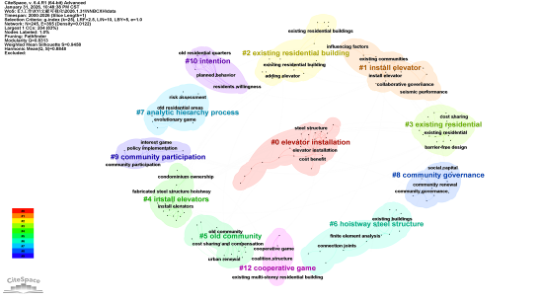
Analysis of Research Hotspots The keyword clustering results indicate that EIOC research exhibits a pronounced interdisciplinary character, with different thematic clusters intersecting across multiple disciplinary domains. Specifically, several clusters focus on engineering and structural safety issues related to elevator installation, such as steel-structure hoistways, finite element analysis, and seismic performance, reflecting perspectives from engineering and architectural disciplines. Meanwhile, research themes concerning cost sharing, collaborative governance, community renewal, and social capital primarily draw on perspectives from public policy, social governance, and economics. In addition, clusters centered on residents’ willingness, the Theory of Planned Behavior, game-theoretic analysis, and community participation further highlight the relevance of behavioral science and institutional analysis in EIOC studies. Overall, the clustering structure shown in Figure 1 demonstrates that EIOC is not a single technical or policy issue, but rather a typical complex problem integrating engineering solutions, legal institutions, public governance, and social behavior.
Figure 1: EIOC keyword co-occurrence clustering.
MAIN RESEARCH DIRECTIONS IN THE FIELD OF EIOC The main research directions in the field of EIOC in recent years can be summarized as follows: (1) policy and governance; (2) legal aspects; (3) finance and operations; (4) planning and design; (5) construction and engineering.
Policy and Governance EIOC has gradually become an important topic in the study of public policy and community governance. Existing studies have mainly examined EIOC from the perspectives of public participation, governance structures, and policy implementation, forming a relatively systematic analytical framework.
From the perspective of public participation, relevant studies focus on residents’ willingness to participate in the implementation of EIOC, their behavioral patterns, and the influencing factors. Dong et al. (2019) discovered that residents’ willingness to participate is influenced by factors such as economic conditions, floor level, neighborhood relations, and expected benefits. Liu (2023) argued that information transparency, policy fairness, and institutional completeness significantly affect residents’ level of participation, among which the positive effects of policy attitudes toward residents and perceived behavioral control are the most pronounced. Meanwhile, Li (2021) pointed out that free-rider problems and divergent interests constitute core obstacles to effective collective action among residents, and that coordination between official policies and community rules is a key prerequisite for the sustainable advancement of EIOC.
Regarding governance structures and actor interactions, scholars generally regard EIOC as a typical case of multi-actor consultative governance. From a community governance perspective, Fang et al. (2024) argued that the smooth advancement of EIOC depends on whether a stable, multi- stakeholder participatory governance model can be established at the community level. Based on collaborative governance theory and the SFIC model, Zhang (2024) found that the success or failure of negotiations depends neither on the number of participating actors nor on spontaneous resident negotiations, but rather on government-led coordination. Based on
Elevator Installation in Old Residential Communities (EIOC) 153 an empirical study grounded in group theory, Zhang (2019) further indicates that residents on different floors inherently differ in cost-sharing and benefit distribution, making it necessary for the government to coordinate and guide these differences through specific institutional designs.
In terms of policy implementation research, existing literature primarily adopts local case studies to examine the difficulties encountered in the practical implementation of EIOC policies and their underlying causes. Based on the multiple streams framework, Lin (2024) argues that the institutionalization of EIOC policies results from the combined effects of aging pressures, the maturity of policy solutions, and political support, actively promoted by grassroots policy actors such as community organizations. Using qualitative comparative analysis (QCA), Zhu (2024) further finds that the effective implementation of EIOC policies depends on the proportion of elderly households within elevator-installation units and community environmental characteristics. Drawing on the Smith policy implementation model, Chen (2025) points out that although EIOC policy design is rational to a certain extent, implementation outcomes often deviate from expectations due to insufficient interdepartmental coordination, high target-group heterogeneity, and institutional environmental constraints.
Legal Aspects As an institutional practice aimed at addressing public welfare demands, the effective implementation of EIOC largely depends on the clarity and operability of its legal framework. Existing studies suggest that recurrent disputes over voting procedures, neighboring rights, and compensation and cost-sharing arrangements stem primarily from structural misalignment between the principled provisions of the Civil Code and their localized enforcement (Wan, 2025). In particular, substantial regional divergence persists with regard to the scope of property owners’ voting rights, voting mechanisms, and procedural safeguards, with some local authorities continuing to apply outdated norms, thereby undermining the uniform application of higher-level legislation (Gao and Gong, 2022). Moreover, the absence of mandatory requirements for prior notification, public disclosure, and consultation further increases the risk of conflict in practice (Wan, 2025). At the level of neighboring rights protection, elevator installation inevitably generates adverse effects on adjacent residents’ living conditions—such as daylight access and ventilation—as well as on property-related interests. Judicial practice has generally addressed such impacts through the principle of reasonable tolerance (Huang, 2022). However, in the absence of unified standards defining the limits of such tolerance and clear, operable compensation rules, and given the latent and long-term nature of the associated losses, the legitimate rights and interests of lower-floor property owners are often inadequately protected in practice. The absence of standardized cost-sharing mechanisms frequently gives rise to disputes among residents (Wan, 2025). At the same time, responsibility for post-installation maintenance is often unclear, a problem that is particularly acute in older residential communities lacking professional property management, thereby increasing the long-term
governance risks associated with EIOC (Zeng and Li, 2022). In response to these challenges, future legal measures entail refining judicial interpretations to unify rules on voting scope and compensation standards, strengthening procedural requirements such as mandatory prior notification and information disclosure, and integrating technical optimization with multi- party consultation mechanisms (Chen and Zhang, 2018), thereby promoting a more coordinated and sustainable governance model for elevator installation in existing residential communities.
Finance and Operations In the field of management science, research on EIOC primarily focuses on three aspects: cost-sharing models, analysis of influencing factors, and the construction of game theory models. The prevailing cost-sharing model largely follows a “Activity-Based Costing and Equal Proportional Mark-Up” approach, which lacks differentiation in accounting for high common costs in elevator usage. Li et al. (2024) and Guo et al. (2019) empirically demonstrate that “fair cost-sharing plan” serves as the most leveraged policy instrument, underscoring the critical role of equitable distribution. Based on the Demand Allocation model and Lagrangian duality theory, Liu et al. (2022) proposed the theory of Price-Directed Cost Sharing and Demand Allocation. Additionally, Parcu et al. (2023) innovatively introduced the permission-Shapley value, offering a quantifiable tool for cost allocation and compensation which is fair, cross-subsidy free, and dropout- proof. Integrating the cost allocation mechanism with systematic fusion optimization algorithms (Moafi et al., 2023) further balances economy, equity, and stability. Regarding the investigation and analysis of influencing factors in EIOC, Singal et al. (2022) developed a Markov chain-based user behavior model. By incorporating the counterfactual adjusted Shapley value (CASV), they established a theoretically grounded attribution framework to enhance stakeholder participation and optimize budget allocation through scientifically evaluating each decision-maker’s contribution to eventual elevator usage. The tripartite cooperative game involving the government, community residents, and elevator enterprises can be aptly characterized by the almost diminishing marginal contributions (ADMC) model (Leng et al., 2021). Furthermore, Li et al. (2025) extended the single-stage installation game into a four-stage evolutionary game model, providing further theoretical support for elevator retrofitting initiatives.
Planning and Design Existing studies in the Planning and Design dimension primarily focus on urban and community spatial renewal, architectural and environmental space design, as well as elevator spatial layout and scheme design.
From the perspective of community and urban spatial renewal, existing research has explored macro planning strategies and the effects of city-level renewal on public spaces. Based on Lefebvre’s theory of the “production of space,” Lv et al. (2024) pointed out that elevator retrofitting reshapes both physical form and the social-value structure of community space. With GIS- based spatiotemporal analysis, Dai et al. (2022) identified obvious spatial
Elevator Installation in Old Residential Communities (EIOC) 155 diffusion effects in EIOC decision-making, where retrofitting projects within a 500-meter radius positively promote adoption in nearby communities. Multi-case studies have also verified that community self-organization and implicit compensation measures, such as additional gardens and usable spaces, help improve implementation feasibility (Zhou et al., 2025).
At the architectural and environmental design level, existing studies emphasize the impacts of elevator layout on existing buildings and surrounding spatial environments, as well as age-friendly design considerations from the perspective of older adults. Research suggests that EIOC implementation requires the reorganization of circulation systems, compensation for reduced green space through vertical greening, and the provision of anti-slip handrails and gentle ramps (Liu et al., 2022). Xu (2025) further proposes that elevators added to adjacent buildings should be located on the same side, with external corridor access minimizing structural interference, while Wang et al. (2020) emphasize compatibility between elevator appearance and regional architectural characteristics.
At the level of elevator spatial layout and scheme design, Sun (2022) argued that level-access entrance schemes significantly improve safety and convenience for older adults and enable barrier-free access via ramps, although such schemes are often constrained in practice by existing corridor dimensions and construction conditions. Through analyses of key components such as elevator shafts and corridors, Chen (2025) compared elevator installation modes, findings indicate that wall-mounted elevators have limited impacts on lower-floor daylighting but are constrained in load capacity and shaft dimensions, while corridor-bridge types are more cost- effective but may affect circulation spaces within residential communities.
However, existing studies still exhibit limitations, as most rely on single- case analyses and lack systematic comparisons across different cities and spatial types. Some studies have proposed stair-climbing devices and other alternatives as supplements under spatially constrained EIOC conditions, yet such explorations remain limited and lack systematic comparison and evaluation. Future research should further advance this field through multi- scale and multi-method integrated approaches.
Construction and Engineering Research on the engineering and technological aspects of EIOC has gradually formed a systematic framework encompassing structural design, seismic and wind resistance performance, construction technology, and safety monitoring, as well as operation and maintenance. Structural design focuses on achieving a balance between safety, compatibility with existing structures, and economic feasibility, with representative approaches including modular steel structure shafts, prefabricated reinforced concrete systems, and connection technologies aimed at minimizing structural interference, such as weak connections and sliding supports (Xiong and Chen, 2020).With respect to seismic and wind resistance performance, existing studies primarily address potential safety risks associated with alterations to the structural system through innovations in structural connections, including prefabricated shear wall technologies (Zhang, 2024). At the same time, empirical evidence suggests that different installation forms of EIOC have limited impact on the dynamic response of
existing building structures and added elevator shafts, thereby supporting the overall structural safety of such installations (Si, 2025).
Given the constraints of narrow construction sites, complex surrounding environments, and low-disturbance requirements, construction technologies for EIOC have increasingly favored hanging structural systems, particularly in steel shaft applications for older buildings (Liu et al., 2023). In addition, growing attention has been paid to full-life-cycle risk management, including high-precision settlement and inclination monitoring based on satellite navigation technologies and strengthened quality control, which together enhance the long-term safety and reliability of EIOC projects (Huang and Wei, 2025).
CONCLUSION
Existing studies generally agree that EIOC has become an important livelihood issue for addressing population aging and sustainable urban renewal in existing communities. However, its overall implementation performance has lagged significantly behind policy expectations and remains at an early stage of development. Although current EIOC research exhibits strong interdisciplinary characteristics, dialogue and integration across disciplines remain insufficient, and a unified analytical framework capable of explaining the structural causes of slow EIOC implementation has yet to be established. At the policy and legal levels, the existing institutional framework still contains significant gaps: specific rules for differentiated cost-sharing and post-installation maintenance responsibilities remain unclear, and legal lag constitutes one of the deep-rooted constraints on EIOC advancement, compounded by the absence of safeguard mechanisms. Moreover, policy orientations are often ambiguous, remaining largely at the level of encouragement while lacking mandatory enforcement and effective promotion mechanisms. Government leadership remains a critical factor in translating projects into implementation. At the level of implementing actors and management, many old residential communities lack professional property management entities and designated organizations responsible for elevator installation and subsequent operation and maintenance. At the same time, unclear divisions of responsibility and ambiguous administrative procedures among government departments have led to pass-the-buck phenomena. In planning and design research, ideal level-access schemes are often difficult to realize due to constraints such as limited building space, disputes over cost-sharing, and inadequate supervision of subsidy funds, while systematic empirical comparisons remain insufficient. At the engineering and technical level, EIOC has developed a relatively mature technical system; nevertheless, technical feasibility does not necessarily translate into social feasibility. Future EIOC research urgently needs to move toward an integrated, problem-oriented, and multidisciplinary research trajectory, situating EIOC within a broader framework of sustainable urban renewal and community governance.
ACKNOWLEDGMENT
The authors would like to acknowledge the support from the Fundamental Research Funds for the Central Universities (2024WKYXQN071).
REFERENCES
Chen, D., Li, C., Gong, R. and Jin, E. (2025). Elevator selection methodology for existing residential buildings oriented toward living quality improvement. Sustainability. 17(7), p. 3225. Chen, G.H. and Zhang, L.Y. (2018). Study on the Voting Rights of Owners in
the Context of Adding Elevators to Existing Residential Buildings. Public Administration & Law. (5), pp. 123–128. Chen, X. (2023). Research on Elevator Retrofit for Old Residential Buildings and Relevant Environmental & Spatial Design Strategies in the Context of Urban Renewal. Master thesis, Zhengzhou: North China University of Water Resources and Electric Power. Dai, X., Li, Z., Ma, L. and Jin, J. (2022). The spatio-temporal pattern and spatial
effect of installation of lifts in old residential buildings: evidence from Hangzhou in China. Land. 11(9), p. 1600. Dong, C., Wang, J.H., Xu, Z.H, Cao, N, and Qiu,Y (2019). Analysis and Reflections on the Significant Factors Influencing Residents’ Willingness to Participate in Elevator Installation in Existing Residential Buildings. Jushe. (16), pp. 159–160. Fang, K., Wu, Y. and Jiao, L. (2024). Community governance in age-friendly
community regeneration—a case study on installing elevators in old residential buildings. Buildings. 14(1), pp. 125–140. Feng, S., Liang, Y., Zhang, P. and Chen, J. (2022). Journal of Physics Conference Series. 2196(1), pp. 012013–012013. Gao, Z.Q. and Gong, Z.Y. (2022). Application on the Regulation of Co-determination
From Civil Code for Adding Elevator. China Elevator. 33(2), pp. 16–19, 24. Guo, B., Zhang, L. and Li, Y. (2019). Research on the path of residents’ willingness to upgrade by installing elevators in old residential quarters based on safety precautions. Safety Science. 118, pp. 389–396. Huang,C.H. (2016). Research on the Dilemmas and Solutions of Collective Action in
Elevator Installation in Existing Residential Buildings in Quanzhou City. Master thesis, Quanzhou: Huaqiao University. Huang, H.Y. and Wei, L.P. (2025). Research on Settlement Monitoring Technology for Elevator Steel Structure ShaftInstallation Based on BDS. MECHANICAL & ELECTRICAL ENGINEERING TECHNOLOGY. 54(10), pp.122–126. Huang, L.Y. (2022). Civil Law Dogmatic Analysis of Adding Elevators to Existing
Residential Buildings. Local Legislation Journal. 7(6), pp. 72–89. Leng, M., Luo, C. and Liang, L. (2021). Multiplayer allocations in the presence of diminishing marginal contributions: cooperative game analysis and applications in management science. Management Science. 67(5), pp. 2891–2903. Li, D.Q. and W,Y. (2021). Research on the Impact of the Unit’s ‘Invisible Presence’ on
Community Collective Action ——A Case Study of Elevator Installation in Old Residential Quarters in Guangzhou City. Journal of Public Management. 18(4), pp. 93–104, 172. Li, Q., Zhang, Q., Shen, Y. and Zhang, X. (2025). Uncovering the dynamic decisionmaking behaviours of multiple stakeholders in the community public infrastructure. Journal of Engineering, Design and Technology. 23(5), pp. 1501–1518. Li, Y., Zheng, W. and Zhou, Q. (2024). RETRACTED ARTICLE: knowledge-
driven urban innovation: dynamics of elevator installation in aging residential communities. Journal of the Knowledge Economy. 16(2), pp. 6315–6359.
Lin, H. and Lin, C.L. (2024). Agenda Setting for Adding Elevators in Dual Aging Communities Based on the Theory of Multiple Source Flows:Taking the Installation of Elevators in C Old Community of Kunshan City as an Example. Science Technology and Industry. 24(13), pp. 10–18. Liu, H., Yu, Y., Benjaafar, S. and Wang, H. (2022). Price-directed cost sharing and
demand allocation among service providers with multiple demand sources and multiple facilities. Manufacturing & Service Operations Management. 24(1), pp. 647–663. Liu, J.Y (2024). Study on Cost Sharing of Elevator Installation in Old Residential Areas from the Perspective of Residential Value Changes.[Online] Master’s Thesis, Xi’an: Xi’an University of Architecture and Technology. [Accessed 10 December 2025]. Available from: https://doi.org/10.27393/d.cnki.gxazu.2023.000915. Liu, L.X., Cao, G.L., and Chen,G.H. (2023). Several Designs to Improve the
Construction Efficiency of Elevator Modular Steel Structure Shaft. China Elevator. China Elevator. 34(5), pp. 83–84, 88. Liu,Y (2023). Research on the Influencing Factors of Residents’ Willingness to Install Elevators in Old Communities. China Elevator. 34(6), pp. 69–73. Liu,Y.B., Zhou,Y.H., and Zhu, N. (2022). A study on the suitable ageing of adding
elevators in old residential districts based on the perspective of elderly. Shanxi Architecture. 48(16), pp. 41–44. Lv, J.Y., Gan, T., and Ye, L. (2024). Neighborhood Regeneration:Spatial Production and the Reshaping of Community——A Case Study of Elevator Installation in G Community in Shanghai. The Journal of Shanghai Administration Institute. 25(2), pp. 68–82. Moafi, M., Ardeshiri, R.R., Mudiyanselage, M.W., Marzband, M., Abusorrah,
A., Rawa, M. and Guerrero, J.M. (2023). Optimal coalition formation and maximum profit allocation for distributed energy resources in smart grids based on cooperative game theory. International Journal of Electrical Power & Energy Systems. 144, p. 108492. Parcu, P.L., Brennan, T.J. and Glass, V. (eds). (2023). The postal and delivery contribution in hard times [Online]. Cham: Springer. [Accessed 5 February 2026]. Available from: https://library.usi.edu/record/1461354. Qiyun, H. n.d. (2024) Study on the legal protection mechanism for adding elevators
to older districts. Master thesis,Huazhong University of Science and Technology. Si,C.X. (2025). Study on Wind-resistant and SeismicPerformance of Post-Installed Elevator Shaftof Existing Buildings.[Online] Master thesis, Mianyang: Southwest University of Science and Technology. [Accessed 17 December 2025]. Available from: https://doi.org/10.27415/d.cnki.gxngc.2024.001473. Singal, R. and Besbes, O. n.d. Shapley meets uniform: an axiomatic framework for
attribution in online advertising. Song, Y., Wang, J., Ge, Y. and Xu, C. (2020). An optimal parameters-based geographical detector model enhances geographic characteristics of explanatory variables for spatial heterogeneity analysis: cases with different types of spatial data. GIScience & Remote Sensing. 57(5), pp. 593–610. Sun, M.H. (2022). Research on the Design of Elevator Installation in Old Residential
Quarters ——A Case Study of Shanghai. China Housing Facilities. (3), pp. 46–48. Wan, Q. (2025). Research on the Protection of the Rights and Interestsof Low-rise Owners in the Installation of Elevators inOld Residential. Master thesis, Yueyang: Hunan Institute of Science and Technolog. Wang, J.Y., Hu, Z.Y., and Li, R.R. (2020). Study on the Scheme Design of Installing
Elevator to the Old Urban Residence Under the Background of Aging Population. Urbanism and Architecture. 17(6), pp. 56–58, 61.
Elevator Installation in Old Residential Communities (EIOC) 159 Xiong, H.F. and Chen, R.S. (2020). Analysis on problems about structural design of
elevator adding of existing multi-storied residential buildings. Building Structure. 50(S1), pp. 848–851. Xu,Q. ((2025)). Elevator Addition Design for Existing Residential Building in Urban Waterfront Area:Taking the Riverside Area of Hebei Peninsula in Liuzhou City as an Example. Urban Architecture Space. 32(9), pp. 87–91. Zeng,Y.L. and Li,Y.X. (2022). Improving Voting Rules for Owners When Installing
Elevators in Existing Residential Buildings. People’s Judicature. (28), pp. 32–37. Zhang, P. (2024). Research on the Mechanism of Multi-stakeholder Consultation and Co-governance in the Renovation of Old Communities ——A Case Study of Elevator Installation.[Online] Master’s Thesis, Chengdu: Southwest Jiaotong University. [Accessed 10 December 2025]. Available from: https://doi. org/10.27414/d.cnki.gxnju.2022.000525. Zhang, W.J. (2019). Analysis of the Problems in Additional Elevator Installation in
Existing Multi-storey Residential Buildings in Shanghai ——An Empirical Study Based on Group Theory. Management Observer. (23), pp. 61–62. Zhang,Y.F. (2024). Study on the seismic performance of corrugated pipethroughhole grouted shear wall and its use inelevator.[Online] Master thesis, Hangzhou: Zhejiang Sci-Tech University. [Accessed 17 December 2025]. Available from: https://doi.org/10.27786/d.cnki.gzjlg.2023.001240. Zhang,Y.R (2025). Research on the Dilemmas and Countermeasures in the
Implementation of the Policy for Elevator Installation in Existing Residential Buildings.[Online] Master’s Thesis, Party School of the CPC Shandong Provincial Committee. [Accessed 22 October 2025]. Available from: https://doi. org/10.27793/d.cnki.gsdsw.2025.000021. Zhou, Q., Wang, S. and Wang J. (2025)al Clarity, Scene Interactivity, and Narrative Quality. Buildings. 15(2), p. 253.
LISTED IN THE AHFE DIGITAL BOOKSTORE CATALOGUE
Explore the complete digital volume
Human Factors in Architecture, Sustainable Urban Planning and Infrastructure
Read this individual research paper free through the original publisher, or explore the full digital proceedings book.
ISBN 979-8-950676-05-5
Explore this ISBN in the AHFE Bookstore ↗Listed in the July 2026 bookstore catalogue; search by ISBN to confirm current availability · Digital book purchase optional