Junhui Sun (2023). Application Status and Progress of Analytic Hierarchy Process in Design Research: Bibliometric Analysis Based on Citespace. In: Usability and User Experience. AHFE Open Access, vol. 110, pp. 482–490. https://doi.org/10.54941/ahfe1003223
Background:Analytical Hierarchy Process (AHP) refers to the hierarchical process of the complex decision-making system and the transformation of multi-factor decision-making into multi-level single-factor problems. In recent years, the application of AHP in Design Research (referred to as AHP-DR) has attracted more and more attention. As a result, a large amount of research literature with diverse knowledge structures and a visible interdisciplinary nature has been produced. But it is hard to reflect the actual application situation of AHP-DR only through the summary and analysis of the traditional literature review method. Based on this, this paper uses the relevant literature collected in the Web of Science database as the data source, visualizes the knowledge structure of the retrieval data through scientific bibliometrics and comprehensively analyzes the research situation and development trend of AHP-DR.Objectives:This paper mainly researches the application of AHP-DR by answering the following three questions: (1) Which countries, institutions and scholars are the application subjects of AHP-DR? (2) What are the hotspot research topics of AHP-DR? What are the future frontier trends? (3) What are the topics and paradigms of AHP-DR high-impact literature research?Methods:This paper uses the methods of bibliometrics and information visualization. To obtain more rigorous and comprehensive data indicators, VOSviewer and CiteSpace (two pieces of bibliometric visualization software) were used to draw a map of scientific knowledge such as cooperative countries co-occurrence network, keywords co-occurrence clustering network and reference co-citation clustering network so as to conduct an empirical analysis on the retrieved data. In this paper, the Web of Science database is selected to retrieve the journal and paper data related to AHP-DR. In order to ensure the authority and research value of literature data, only SCI, SSCI and A&HCI were selected as the search source, with TS=(("Analytic Hierarchy Proces" OR "AHP") AND ("design")) as the search criteria and an unlimited time span. Finally, 1403 retrieved papers published from 2015 to 2022 were exported as TXT files in the format of "fully recorded and cited references" to generate a visual knowledge map for quantitative analysis.Results:(1) The paper output related to AHP-DR shows an overall upward trend, with University Politecn Valencia, Istanbul Technical University and Islamic Azad University as the primary output institutions. In addition, cooperative research among scholars is not close, and sporadic cooperation among institutions is the main research type. This is also the current situation of AHP-DR research. (2) Nowadays, the research hotspots of AHP-DR include fuzzy ahp, selection, management, decision-making, optimization and sustainability, which are mainly applied to "evaluation and decision-making" problems. The combination of AHP and other methods mainly involves topsis, fuzzy topsis and MCDM, etc, making AHP bear an interdisciplinary attribute. (3) At present, a bulk of influential and highly-cited literature on AHP-DR has been generated. They constitute the classic cases and knowledge base of the application of AHP-DR and provide a research basis for the subsequent application of AHP.Conclusion:With the accelerated process of design research and more detailed research fields, it is still a long way to go to explore a suitable way for AHP-DR to be applied in the design field.
Analytical Hierarchy Process (AHP) was made by Saaty in the early 1970s to help the United States department of defense to solve “how to according to the size of each industrial sector’s contribution to the national welfare and electric power distribution” problem when a multi-objective decision- making method is proposed (Saaty, 1980). In this method, various factors in complex problems are divided into levels to form an ordered level, and then the comparative matrix of elements between each layer is obtained through expert investigation method, and the importance of elements of each layer is analyzed mathematically to determine the importance of elements to the target (Liu et al., 1984). In the field of design, there are a large number of multi-objective evaluation objects with no clear structural characteristics, such as “design needs” and “user satisfaction”, and the results obtained only by subjective evaluation often make people suspicious (Luyao et al., 2022).
Application Status and Progress of Analytic Hierarchy Process in Design Research 483
Therefore, in recent years, the application of AHP in design research (AHP- DR) has attracted more and more attention, and produced a large number of research literature. However, due to the diverse structure of design knowledge and strong interdisciplinary, it is difficult to reflect the application of AHP in the whole design field only through the traditional review method. Based on this, this paper uses the relevant literature collected in Web of Science data- base as the data source, visualizes the knowledge structure of the retrieved data through scientific bibliometrics, and makes a comprehensive analysis to obtain the research status and future development trend of AHP-DR, so as to provide reference for the subsequent research.
The main purpose of this paper is to answer the three aspects of AHP-DR: Fistly, who is the application subject of AHP-DR, and which countries, insti- tutions and scholars are studying this field? And what are the hot research topics of AHP-DR and what are the future frontier trends? Lastly, what is the research theme and research paradigm of AHP-DR high-impact literature?
RESEARCH METHODS AND DATA SOURCES In this paper, Web of Science core database is selected to retrieve AHP-DR journal paper data. Set the search formula TS=((“Analytic Hierarchy Process “or “AHP”) and (“design”)) in the advanced search interface. In order to ensure the comprehensiveness of the data, no selection time range was set. After eliminating missing field information and duplicate data, 2476 papers published from 2015 to 2022 were obtained, and the papers were exported as txt files in the format of “full records and cited references”, which was used to generate visual knowledge map for quantitative analysis. In this paper, the VOSviewer and CiteSpace, two bibliometric visualization software, are comprehensively used to conduct empirical analysis on the retrieved data, so as to obtain more rigorous and comprehensive data indicators. VOSviewer has advanced graphical presentation capabilities that are suitable for large- scale data targeting of the focus and hot spots of research topics. CiteSpace intuitively shows the development trend and evolution process of a certain discipline or research topic in a specific period (Van Eck et al., 2010, Liu Jia et al., 2020). In recent years, these two software have been widely used in bibliometric analysis (Hassan Ali, 2022).
AHP-DR BIBLIOMETRIC RESULTS AND ANALYSIS Analysis of the Number of Papers Issued by AHP-DR
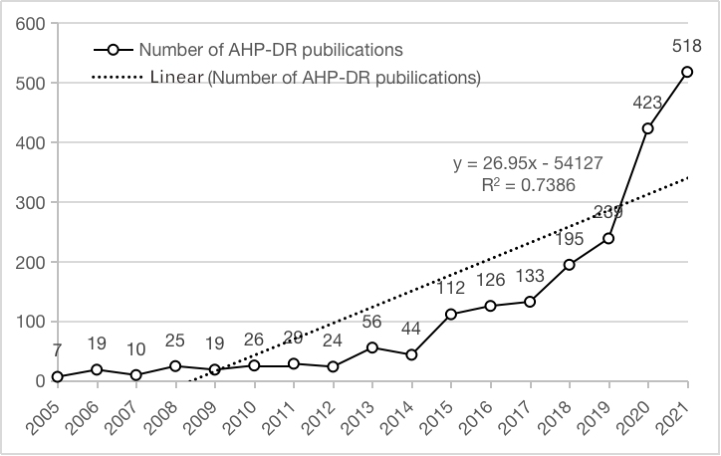
The statistical rule of academic literature output over time is an important method to measure the development trend of research topics and can effecti- vely evaluate the research trends of this discipline. After the retrieved data is cleaned and de-duplicated, field extraction is carried out to get Figure 1 (since 2022 is not a full year, the maximum year is selected as 2021). The first literature within the scope of search was published in 2005. Combined with the publication curve and trend line of AHP-DR, it can be seen that the literature output shows an overall rising trend, and has a rapid rising development trend in the past five years. It can be seen that scholars in the
484 Sun and Qin
Figure 1: A distribution map of the annual publication volume of AHP-DR.
design field are more and more inclined to apply AHP to carry out relevant research. The development of AHP-DR has roughly experienced three stages: initial stage, development stage and prosperity stage. The period from 2005 to 2013 was the initial stage of this field, and the average annual number of publications was about 23, with a slow growth rate. From 2013 to 2017, the development period of this field, literature output began to accelerate signi- ficantly, and the average annual output reached 94 articles. From 2017 to 2021, this field entered a flourishing period, with an average annual output of 301 articles and a peak of 523 articles in 2021. It can be seen that AHP will still be a key research topic in the design field in the future.
Research Institutions and Distribution of Productive Authors A total of 2,627 research institutions around the world have conducted AHP- DR research from 2005 to 2021. According to the literature output statistics of publishing institutions, Islamic Azad University (Iran) ranked the first with 56 publications. They were followed by University of Tehran (Iran/34 articles), National Institutes of Technology (India/31 articles), Abu Dhabi University (UAE/30 articles), and Istanbul Technical University (Turkey/29 articles), Indian Institute of Technology (India/28 articles), Universidad Poli- técnica de Valencia (Spain/27 articles), Hong Kong Polytechnic University (Hong Kong/23 articles), Tarbiat Modares University (Iran/21 papers), Uni- versiti Teknologi Malaysia (Malaysia/19 articles). Among these institutions, 3 are from Iran and 2 are from India. It can be seen that AHP-DR research institutions are mainly concentrated in Asia. In addition, inter-institutional cooperation is not close, showing strong regional characteristics, mainly between domestic and regional institutions.
Application Status and Progress of Analytic Hierarchy Process in Design Research 485
Authors are the smallest unit of literature output and direct contributors to the AHP-DR research field. By studying co-citation of authors, we can find the active scholars in this field in the world. Through data statistics, it is found that Hussain Matloub has published the most papers, ranking the first among 20 papers within the retrieval range. It was followed by Yepes Victor (12 articles), Govindan Kannan (11 articles), Khan Raees Ahmad (11 arti- cles) and Luthra Sunil (11 articles). Among the high-yield authors, Govindan Kannan has the highest number of citations, with 11 publications and 821 citations. He is considered as a representative in the field of AHP-DR rese- arch. The top 3 scholars in terms of citation frequency are Awasthi Anjali, Pradhan Biswajeet and Govindan Kannan. In addition, collaborative studies among scholars are not close, and mainly focus on inter-institutional regional cooperation, which is also the current research status of AHP-DR.
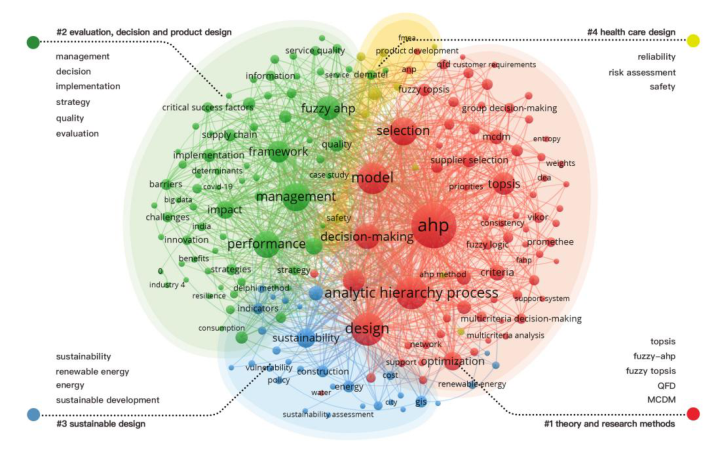
Analysis of Research Hotspots Keywords in literature are highly abstractions of the author’s research results, which usually include research objects, research perspectives and research methods, etc. Keywords co-occurring frequently reflect the research hotspot of AHP-DR for a long time. A total of 10011 keywords were included in 2476 literatures within the search scope. The keyword co-occurrence frequ- ency was set as 12 by running Vosviewer, and the keyword co-occurrence cluster formed by 239 keywords after the synonym was screened and merged was shown in Figure 2. Keywords of the same color in the figure are the same cluster, forming four major Clusters, which are #1 (red) — theory and resea- rch methods, #2 (green) — evaluation, decision and product design, #3 (blue) — sustainable design, and #4 (yellow) — health care design. According to the
analysis results of high-frequency keywords, the application of AHP in the field of design is mainly distributed in the research topics of decision-making and evaluation, which is consistent with the core function of AHP. In the use of analytic hierarchy process, it is often used in conjunction with Topsis, QFD, MCDM, etc. Figure 2 shows that the application of AHP-DR mainly focuses on risk management, goal programming, project management, etc. The research objects are relatively diverse, including traditional manufactu- ring industry, product design, and emerging industry 4.0, machine learning, and artificial neural network.
From the perspective of comprehensive clustering subnetworks, Cluster #1 — theory and research methods: A total of 83 clustering members, including fuzzy-ahp, fuzzy topsis, QFD, multi-criteria decision making (MCDM) and other keywords. In AHP-DR research, scholars tend to combine other specific methods and models in specific research according to actual research needs. Such as in the clustering of topsis, quality function deployment (QFD), the analytic network process (ANP), etc. At the same time, in addition to the use of other method models, the keywords such as Fuzzy-logic and Fuzzy-AHP in the co-occurrence clustering network reflect the improvement of the tra- ditional evaluation model. The use of other methods to innovate the analytic hierarchy process reflects the continuous innovation of the scholars in the field of design in methods and scenarios. Cluster #2 — evaluation decision and product design: There are 78 cluster members, including management, decision, implementation, strategy, quality, evaluation, satisfaction and other keywords. The clustering reflects the core function of AHP’s “evaluation decision”, that is, it is used to determine the weight value or priority of each evaluation index, establish the evaluation system, and provide the basis for the subsequent decision. For example, when answering the question “whether museum cultural and creative products are worth buying”, consumers often make a comprehensive comparison of commodity prices, processing techno- logy, design level, functional characteristics and other factors, which restrict and influence each other. The AHP can obtain the priority of each element of each level and design products to meet the needs of consumers. Cluster #3 — Sustainable design: There are 66 cluster members, mainly including sustainability, energy, renewable energy, sustainable development and other keywords. This cluster mainly uses analytic hierarchy process to evaluate the feasibility of sustainable design. In specific design, scholars use analytic hie- rarchy process to build an evaluation system to judge the effect of sustainable design and the effectiveness of the scheme, so as to ensure the effectiveness and rationality of sustainable design. Cluster #4 — Health care design: A total of 12 cluster members, mainly including safety, risk assessment, relia- bility and other keywords. Health care design is the latest research hotspot of AHP-DR, which mainly uses analytic hierarchy process to determine user needs in health care design, builds hierarchical model, and determines impor- tant design indicators through weight calculation to guide design practice, reflecting the user-centered design. Nowadays, more and more health produ- cts have put forward relevant design schemes based on user needs and human factors, so as to solve related problems in the field of health management. It is a new trend in recent years to combine the analytic hierarchy process with
Application Status and Progress of Analytic Hierarchy Process in Design Research 487
the current medical information technology. It includes the design and appli- cation of health behavior intervention in middle-aged and elderly people, the detection of patients’ daily behavior activities, self-management of cancer pain, public health issues, etc.
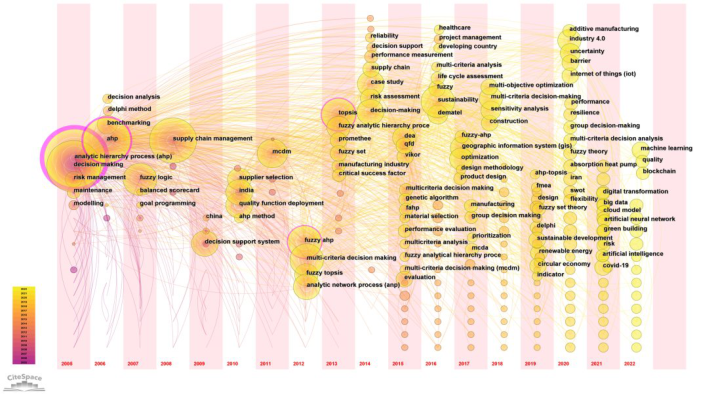
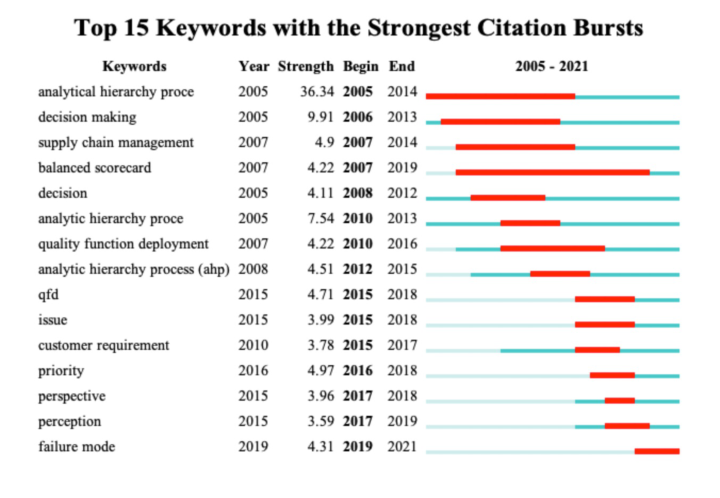
The Evolution of Research Hotspots In order to further study the frontier topics and development trend of AHP-DR research, the average occurrence time of keywords is analyzed sta- tistically, and the keyword co-current view (timezone view) is obtained, as shown in Figure 3, which directly reflects the topic evolution of AHP-DR and the development trend of keywords in each time period within the search scope. Figure 4 lists the Top15 keywords with emergent intensity, in which the dark part represents the years in which the keyword citation frequency is relatively prominent, reflecting the research trend. These methods are all analysis indexes with time dimension introduced into keywords, and the two can obtain more objective and accurate results by mutual corroboration and reference.
Combining with the Burst keyword high density outburst and the evolution trend of time zone map, it can be seen that the research hotspots of AHP- DR are divided into three obvious sections. Judging from the evolution of keywords in the three sections, the early AHP-DR studies from 2005 to 2010 focused on the core function of AHP “evaluation and decision” (Min Peng, 2014, Haiyong Shen, 2021). It can be seen from the high-frequency keywords that the design objects in this period are mainly goal programming, supply chain management and risk management. From 2011 to 2020, there are a total of 1381 literatures related to AHP-DR, and high-frequency keywords are the most intensive, reflecting that this period is the golden age of AHP application in the field of design. From high-frequency keywords, it can be
Figure 3: keywords timezone view of AHP-DR.
488 Sun and Qin
Figure 4: Keywords Burst Term.
seen that the research perspective and focus gradually shift to the improve- ment and innovation of research methods. In specific application research, Scholars have combined AHP with QFD, fuzzy theory, etc., and realized the perfection, improvement and innovation of AHP. At the same time, the appli- cation scenarios of the AHP were also diversified, which extended to health care, sustainable design and other fields. There are mainly fuzzy AHP, fuzzy topsis, ANP, topsis, QFD and MCDM. From 2021 to 2022, AHP-DR resea- rch will show more obvious innovation in application scenarios and methods. Scholars will combine AHP with more methods, which reflects strong inter- disciplinary integration characteristics. In terms of the research object, it presents a change trend from a single field to a multi-modal and high comple- xity direction. The keywords in this area are artificial intelligence, sustainable development and healthcare.
Combined with the distribution trend of high-frequency keywords in Burst high density burst and time zone diagram, it can be predicted that there will be substantial innovations in the application scenarios and methods of AHP in the future, which will make it more intelligent. The application of AHP in the future will focus on big data, digital transformation, machine learning, additive manufacturing, industry4.0.
High Impact literature Analysis According to statistics, a total of 101,121 valid references from 66,857 sch- olars were cited in 2,476 literatures within the search scope. Because some references are cited in pairs, a co-citation relationship is formed, and the whole reference collection forms a co-citation network. From 2005 to 2022, references with citation frequency of no less than 20 were extracted to build
Application Status and Progress of Analytic Hierarchy Process in Design Research 489
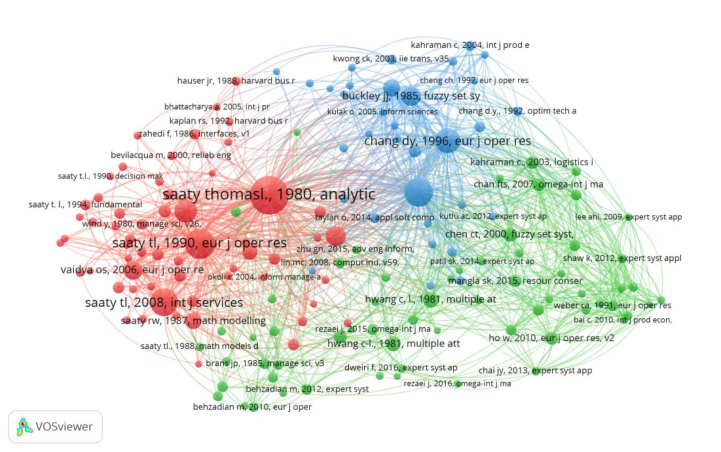
a co-citation network. The LLR text mining algorithm was used to generate a co-citation cluster consisting of 157 references and 15,916 co-citation rela- tionships, as shown in Figure 5. The clustering network shows the authors and publication time of literatures with citation frequency of not less than 20, and many nodes form three main clusters: #1 (red) — the study of the princi- ple of analytic Hierarchy process; #2 (blue) — Combining analytic Hierarchy Process with other theoretical models and methods to improve the traditio- nal evaluation model; #3 (green)—Research on the application of Analytic Hierarchy Process in practice.
CONCLUSION
AHP-DR research shows an overall rising trend in literature output, and has a rapid growth trend in recent 5 years. Asian institutions represented by Islamic Azad University, University of Tehran and National Institutes of Technology are the main institutions applying AHP in the global design field. Authors such as Govindan Kannan, Awasthi Anjali and Pradhan Biswajeet rank among the top authors in the world in the number of published articles and citations, and are considered as the core authors in the field of AHPS-DR.
Through keyword clustering, it can be seen that the research content of AHP-DR is comprehensive and diversified, and its application is mainly distributed in the problems of “evaluation and decision”. Research hotspots can be divided into 4 categories: theory and research methods, evaluation and decision making and product design, sustainable design, and health and medical design. It is often used in conjunction with QFD and Topsis in spe- cific research. The improvement of methods is mainly the model integration innovation based on the improvement of evaluation system, such as fuzzy- AHP, fuzzy-logic, etc. There are three phases in the research hotspot. The
490 Sun and Qin
early AHP-DR research from 2005 to 2010 focused on the core function of AHP “evaluation and decision”, established the evaluation system through AHP, and determined the weight value of the design object.2011-2020 is the golden period of AHP-DR research, with the research perspective and focus gradually shifting to the improvement and innovation of research methods, and the application scenarios are diversified. From 2021 to 2022, AHP-DR research will be more obvious in application scenarios and method innova- tion, and will be used in combination with more methods, reflecting strong interdisciplinary integration characteristics. Combined with the Burst high density burst and the distribution trend of high-frequency keywords in the timely area map, it can be predicted that future research will focus on bigdata, digital transformation and machine learning.
Through the analysis of highly cited literature of AHP-DR, it can be found that the research paradigm can be roughly divided into three categories. The first category is the research on the principle of AHP itself. The second type is the study of improving the traditional evaluation model by combining AHP with other theoretical models and methods. The third is the application of analytic hierarchy process in practice. Its research focuses on design evalua- tion, design decision, QFD, TOPSI and so on. Highly cited literature plays an important role in promoting the development of the follow-up researches on AHP-DR.
With the accelerated process of design research and more detailed research fields, it is still a long way to go to explore a suitable way for AHP-DR to be applied in the design field.
ACKNOWLEDGMENT
The authors would like to acknowledge.
REFERENCES
Haiyong Shen, Zixuan Chen. (2021). Analysis of the application of emotional theory in commodity design—taking nendo’s works as an example. DESIGN Volume 34 No. 21. Hassan Ali. (2022). A systematic bibliometric analysis of the analytic hierarchy pro-
cess from 1980 to 2020. INTERNATIONAL JOURNAL OF BIBLIOMETRICS IN BUSINESS AND MANAGEMENT Volume 2 No. 2. Liu, B., Xu, S., & Zhao, H. (1984). Analytic hierarchy process—A tool for planning decision. SYSTEMS ENGINEERING No. 2. Liu Jia, Zimeng Li, Yue Cheng. (2020). Bibliometric analyze on oral caring based on
Citespace soft ware. JOURNAL OF NURSES TRAINING Volume 35 No. 8. Luyao Wang, Yuhui Zhou, Yongchun Li. (2022). Museum Cultural and Creative Design Based on Analytic Hierarchy Process. PACKAGING ENGINEERING Volume 43 No. 18. Min Peng. (2014). Retractable Furniture Design for Small Family House. PACKA-
GING ENGINEERING Volume 35 No. 12. Saaty, T. L. (1980). The Analytic Hierarchy Process: Planning, Priority Setting, Resources Allocation. Mcgraw-Hill, New York. Van Eck, N., & Waltman, L. (2010). Software survey: VOSviewer, a computer
program for bibliometric mapping. SCIENTOMETRICS Volume 84 No. 2.
LISTED IN THE AHFE DIGITAL BOOKSTORE CATALOGUE
Explore the complete digital volume
Usability and User Experience
Read this individual research paper free through the original publisher, or explore the full digital proceedings book.
ISBN 978-1-958651-86-5
Explore this ISBN in the AHFE Bookstore ↗Listed in the July 2026 bookstore catalogue; search by ISBN to confirm current availability · Digital book purchase optional