Jie Gao, Yilin Yang, Ke Zeng, Haining Wang (2026). Quantifying Mouse Grip Comfort: A Multi-Level Human Factors Evaluation Framework. In: Human Factors and Ergonomics In Design. AHFE Open Access, vol. 210, pp. 204–210. https://doi.org/10.54941/ahfe1007441
As a ubiquitous human-computer interaction tool, the computer mouse requires rigorous ergonomic design to support performance and reduce upper-limb musculoskeletal risk during prolonged use. However, current comfort assessments remain fragmented and seldom translate multidimensional perceptions into empirically weighted design priorities. This study proposes a human factors evaluation framework that combines qualitative indicator elicitation, exploratory factor analysis (EFA), and the analytic hierarchy process (AHP) to quantify mouse grip comfort. An initial pool of more than 70 descriptors was compiled from literature, user interviews, and online reviews, and an importance screening survey (N = 157) reduced these to 12 core descriptors. A second survey (N = 106) provided data suitable for EFA (KMO = 0.69), yielding four latent dimensions (Dynamic Maneuverability, Muscular Load, Static Support, and Tactile Softness) that explained 60.93% of the variance. These dimensions defined the criteria level of a three-level hierarchy (goal, criteria, and indicators), and AHP weights were derived from pairwise comparisons provided by 32 experts. Dynamic maneuverability received the highest criteria weight (0.3933), and lateral grip stability had the largest composite weight among 19 operational indicators (0.1182). A case study with three representative commercial mice further demonstrated the framework’s utility for benchmarking and design prioritization. Dynamic maneuverability was most strongly associated with overall comfort (Spearman’s rho = 0.71) based on Borg CR-10 ratings. The framework provides a structured pathway for comfort-oriented mouse design and supports future integration with objective measures such as EMG, pressure distribution, and movement smoothness.
Among input devices that translate physical hand actions into digital control, the computer mouse remains widely used in office and gaming contexts (Lourenço et al., 2022). With the expansion of digital workflows and esports participation, cumulative mouse use is increasing, making grip experience a critical determinant of perceived usability and operational efficiency (DiFrancisco-Donoghue et al., 2019).
Because mouse use involves prolonged and repetitive hand contact, a mouse’s ergonomic compatibility, particularly its geometry, size, and mass, Received February 7, 2026; Revised April 2, 2026; Accepted April 21, 2026; Available online July 20, 2026
Quantifying Mouse Grip Comfort 205 can influence upper-limb musculoskeletal loading and related symptoms (Hasan et al., 2017; Chen et al., 2012). Recent evidence also suggests that mouse characteristics such as connection type can affect muscle activity, performance, and device preference during intensive use (Wang et al., 2023), and differences among common mouse types may be reflected in discomfort and usability outcomes (Oveisi et al., 2024).
Despite frequent use of the term comfort in product design, translating grip comfort into measurable and design-actionable metrics remains challenging. Comfort is multidimensional and integrates physical sensations, aesthetic appraisal, and context-dependent expectations (Dumur et al., 2004). In the comfort-discomfort model proposed by Vink and Hallbeck (2012), comfort is treated as a positive psychophysiological state arising from the interaction between the user, product characteristics, and environment. Objective measures such as posture, pressure, and electromyography can complement subjective ratings, but there is no consensus on a standardized structure for comfort assessment (de Looze et al., 2003).
Mouse ergonomics studies often rely on ad hoc questionnaires or single- item ratings. For example, evaluations have compared flat, angled, and vertical mice with respect to wrist posture, performance, and preference (Odell and Johnson, 2015), and haptic prototypes have been assessed using subjective perceptual matching for surface-material cues (Strese et al., 2019). However, the constituent dimensions of grip comfort are not consistently defined, and the relative importance of different perceptual aspects is rarely quantified, limiting the ability to prioritize design interventions.
To address this gap, we develop a multi-level framework that integrates exploratory factor analysis (EFA) to derive an empirically grounded comfort structure and the analytic hierarchy process (AHP) to quantify indicator priorities (Saaty, 1990). The study aims to (1) construct a descriptor-based comfort structure for mouse grip comfort, (2) compute weights for criteria and operational indicators, and (3) demonstrate applicability through a comparative case study of commercial mice.
METHODOLOGY
Initial Construction and Screening of Evaluation Indicators Establishment of the initial descriptor pool. To capture the breadth of mouse grip comfort, we compiled descriptors from ergonomics literature on pointing devices, online product reviews, and semi-structured interviews with frequent mouse users. The resulting pool comprised 72 candidate descriptors covering perceived comfort, performance, and localized physical sensations.
User perception-based screening. An online survey (N = 157) asked participants to rate the importance of each descriptor for overall grip comfort on a 5-point scale (1 = not important, 5 = very important). Descriptors with a mean score below 3.5 or with high semantic redundancy were removed, yielding 12 core descriptors for subsequent structural analysis.
Factor Analysis To derive latent dimensions, a second survey (N = 106) collected ratings for the 12 descriptors. The Kaiser-Meyer-Olkin measure was 0.69 and Bartlett’s test of sphericity was significant (p < 0.001), supporting factorability. Principal axis factoring with varimax rotation was performed. Items were interpreted based on primary loadings of at least 0.40, and cross-loadings were reviewed to ensure each descriptor aligned with a single dominant dimension. Factors were retained based on eigenvalues greater than 1 and scree inspection, resulting in four latent dimensions that explained 60.93% of the variance. These dimensions were subsequently used as the criteria level in the AHP hierarchy.
1. Dynamic maneuverability: Reflects perceived controllability during rapid cursor movements and direction changes, including stability, responsiveness, and flexibility. 2. Static support: Captures perceived fit and support during sustained grip, including palm and finger support and perceived stability in stationary use. 3. Muscular load: Represents perceived localized tension or fatigue during use, including discomfort in the palm, fingers, and wrist during prolonged operation. 4. Tactile softness: Describes perceived skin-friendliness and compliance of the contact surfaces, including material softness and non-oppressive shape features.
Table 1: Rotated factor loadings and communalities (h²) for the 12 mouse grip comfort descriptors.
Softness Sensation 0.085 −0.065 0.215 0.843 0.769 Correlations among factor scores were small (|r| < 0.30), indicating adequate discriminant separation among dimensions.
Quantifying Mouse Grip Comfort 207 Analytic Hierarchy Process
Building on the 12 core descriptors, we operationalized the four EFA-derived dimensions into 19 measurable indicators to support design translation and benchmarking. The analytic hierarchy process (AHP) was used to derive local and composite weights for criteria and indicators (Saaty, 1990).
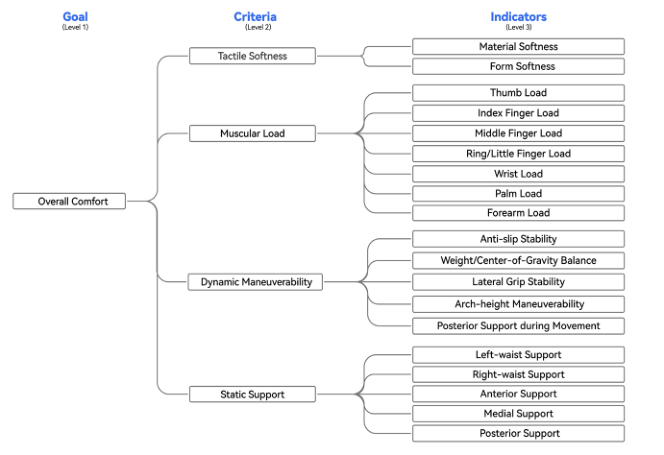
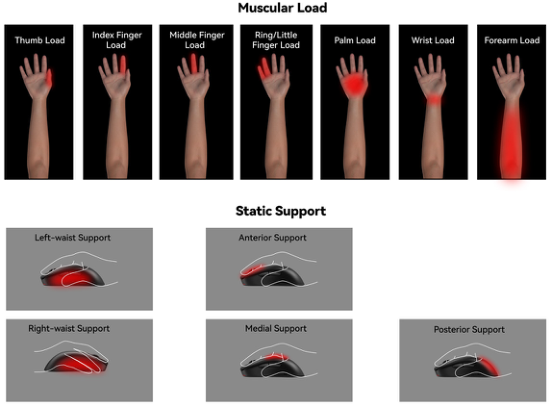
Hierarchy model development. We defined the goal as mouse grip comfort, the criteria level as the four EFA-derived criteria, and the indicator level as 19 operational indicators. The hierarchy is shown in Figure 1, and the regional subdivisions for criteria are illustrated in Figure 2.
Figure 1: The hierarchical structure for evaluating mouse grip comfort.Figure 2: Schematic illustration of regional subdivisions for muscular load and static support.
The criteria level is defined as follows:
1. Tactile softness: Holistic perception of skin-friendly materials and non- oppressive geometries, including perceived softness of materials and roundedness of form. 2. Muscular load: Localized tension or fatigue induced by prolonged use, subdivided into palm, finger, and wrist-related sensations. 3. Dynamic maneuverability: Stability and responsiveness during rapid movement, aiming, and directional corrections, including cursor control stability and movement smoothness. 4. Static support: Adequacy of support across hand regions during sustained grip, including support at the palm and finger contact areas.
Pairwise comparison matrices. Thirty-two experts (9 mouse designers, 8 ergonomics researchers, and 15 experienced users) completed pairwise comparisons using Saaty’s 1-9 scale to judge the relative importance of indicators within each level (Saaty, 1990).
Consistency check. For each comparison matrix, we computed the principal eigenvalue (λmax) and derived the consistency index (CI) and consistency ratio (CR): CI = (λmax − n) / (n − 1); CR = CI / RI, where n is the order of the matrix and RI is the random index. Matrices with CR < 0.10 were accepted as consistent. All comparison matrices satisfied the consistency criterion (CR < 0.10).
Priority weights were obtained from normalized eigenvectors for each matrix and aggregated across levels to compute composite weights for all indicators (Table 2).
Table 2: Local and composite weights of the indicators for mouse grip comfort derived from the Analytic Hierarchy Process (AHP).
Table available in the original PDF paper.
Criteria Weight Indicators Local Weight Composite Weight Tactile Softness 0.1299 Material Softness 0.3075 0.0399
Form Softness 0.6925 0.0900 Muscular Load 0.2813 Thumb Load 0.1063 0.0299
Index Finger Load 0.1727 0.0486 Middle Finger Load 0.1110 0.0312
Criteria Weight Indicators Local Weight Composite Weight Static Support 0.1955 Left-waist Support 0.2080 0.0407
Right-waist Support 0.1374 0.0269 Anterior Support 0.2282 0.0446
Medial Support 0.1958 0.0383 Posterior Support 0.2306 0.0451
RESULTS
To evaluate the applicability of the AHP-based framework, we conducted a comparative case study using three representative commercial mice (M650, MX Master 3S, and GPW 4). Participants completed standardized tasks and rated overall comfort and all indicators using the Borg CR-10 scale (Borg, 1998). The cohort was divided into two groups: Group A (n = 30) evaluated M650 and MX Master 3S in a within-subject design, and Group B (n = 30) evaluated GPW 4.
Group A: Participants sequentially evaluated M650 and MX Master 3S. Group B: Participants evaluated GPW 4. Nine participants took part in both groups, resulting in 51 unique participants and 90 total evaluations (30 per mouse). This hybrid design improved comparability across mice while reducing between-participant variability for two of the three devices.
All analyses were conducted in R (version 4.5.1; R Core Team, 2025). Spearman’s rank correlation indicated that dynamic maneuverability had the strongest association with overall comfort (rho = 0.71), supporting its role as the primary design priority identified by AHP.
CONCLUSION
This study developed a structured evaluation framework for mouse grip comfort by combining descriptor elicitation, exploratory factor analysis, and the analytic hierarchy process. EFA yielded four criteria, and AHP quantified their relative priorities, identifying dynamic maneuverability as the most influential criterion and lateral grip stability as the highest-weighted operational indicator.
The case study demonstrated that the framework can benchmark commercial mice and highlight design drivers of overall comfort. Future work should integrate objective measures such as EMG, contact pressure, and motion smoothness, and validate the framework across broader user groups and task contexts.
ACKNOWLEDGMENT
The authors would like to express their gratitude to the staff of the Anthropometry and Wearables Design Lab at Hunan University for their
technical support and for providing the experimental facilities. Special thanks are given to the participants involved in this study.
REFERENCES
Borg, G. (1998). Borg’s perceived exertion and pain scales. Champaign, IL: Human Kinetics. Chen, H.-M., Lee, C.-S., & Cheng, C.-H. (2012). The weight of computer mouse
affects the wrist motion and forearm muscle activity during fast operation speed task. European Journal of Applied Physiology, 112(6), 2205–2212. de Looze, M. P., Kuijt-Evers, L. F. M., & van Dieën, J. (2003). Sitting comfort and discomfort and the relationships with objective measures. Ergonomics, 46(10), 985–997. DiFrancisco-Donoghue, J., Balentine, J., Schmidt, G., & Zwibel, H. (2019). Managing
the health of the eSport athlete: an integrated health management model. BMJ Open Sport & Exercise Medicine, 5(1), e000467. Dumur, E., Barnard, Y., & Boy, G. (2004) “Designing for comfort”, in: Human factors in design, de Waard, D., Brookhuis, K. A., & Weikert, C. M. (Eds.). pp. 111–127. Maastricht, The Netherlands: Shaker Publishing. Hasan, T., Firdous, M., & Johny, C. D. (2017). Case study on mouse geometry to
enhance the human performance and comfort during online survey task. American Journal of Mechanics and Applications, 5(2), 8–14. Kaiser, H. F. (1960). The application of electronic computers to factor analysis.
Educational and Psychological Measurement, 20(1), 141–151. Lourenço, M. L., Pitarma, R. A., & Coelho, D. A. (2022). A design contribution to ergonomic PC mice development. International Journal of Environmental Research and Public Health, 19(13), 8126. Odell, D., & Johnson, P. (2015). Evaluation of flat, angled, and vertical computer
mice and their effects on wrist posture, pointing performance, and preference. Work, 52(2), 245–253. Oveisi, E., Khanlari, P., & Ebrahimzadeh-Afrouzi, M. (2024). Carpal tunnel syndrome severity, hand discomfort, and usability among three types of computer mouse. Work, 77(3), 873–882. R Core Team. (2025). R: A language and environment for statistical computing.
Vienna, Austria: R Foundation for Statistical Computing. Saaty, T. L. (1990). How to make a decision: the analytic hierarchy process. European Journal of Operational Research, 48(1), 9–26. Strese, M., Hassen, R., Noll, A., & Steinbach, E. (2019). A tactile computer mouse
for the display of surface material properties. IEEE Transactions on Haptics, 12(1), 18–33. Vink, P., & Hallbeck, S. (2012). Editorial: Comfort and discomfort studies demonstrate the need for a new model. Applied Ergonomics, 43(2), 271–276. Wang, M., Li, G., Arippa, F., Barr, A., Xue, Y., & Harris-Adamson, C. (2023). The
effects of mouse weight and connection type on performance, muscle activity, and preferences among professional gamers. International Journal of Industrial Ergonomics, 97, 103493.
LISTED IN THE AHFE DIGITAL BOOKSTORE CATALOGUE
Explore the complete digital volume
Human Factors and Ergonomics In Design
Read this individual research paper free through the original publisher, or explore the full digital proceedings book.
ISBN 978-1-964867-86-1
Explore this ISBN in the AHFE Bookstore ↗Listed in the July 2026 bookstore catalogue; search by ISBN to confirm current availability · Digital book purchase optional