Zhekai Cai (2026). A Mixed Reality Intervention Framework for Learning Ceramic Throwing Skills: Task Analysis, Human Factors Design Logic, and KANO-AHP Functional Priority. In: Human Factors in Communication of Design. AHFE Open Access, vol. 216, pp. 67–78. https://doi.org/10.54941/ahfe1007625
Publisher statistics will load when you open Metrics.
AHFE OPEN ACCESS OPEN ACCESS CONFERENCE PROCEEDINGS PAPER
A Mixed Reality Intervention Framework for Learning Ceramic Throwing Skills: Task Analysis, Human Factors Design Logic, and KANO-AHP Functional Priority.
Ceramic throwing is an embodied skill that demands high precision and is constrained by strict timing sequences. Novice learners commonly exhibit systematic biases in three key areas: judging the clay's state, coordinating force application with both hands, and controlling geometric shapes, leading to irreversible failures such as off-centering, uncontrolled wall thickness, and collapsed pieces. This paper focuses on ceramic skill learning as the core research subject, advancing the study in three stages: First, we systematically decompose the throwing process, clarifying key subtasks and quantifiable operational indicators. Second, from a human factors engineering perspective, we propose a design logic for MR intervention, centered around minimal visual obstruction, phased information density, and interpretable error correction feedback, forming an initial functional item pool (R1–R8). Finally, based on a small-scale user study (n=16), we employ the KANO model to identify demand types and calculate the satisfaction/dissatisfaction coefficient (CS+/CS−). Weights are determined using the Analytic Hierarchy Process (AHP) under four criteria: learning efficiency, operational quality, cognitive load, and safety (CR=0.017). By merging these two sets of results, we produce a prioritized function table with specific numerical values. The priority ranking is as follows: R1>R3>R6>R4≈R2>R5>R8>R7, which is used to define the MVP development scope for the MR prototype.
The challenge in learning ceramic throwing lies not in memorizing operational steps, but in stabilizing the continuous cycle of “sensation- judgment-application of force”. Learners must simultaneously achieve symmetrical force application with both hands, distribute pressure evenly between fingers and the base of the palm, and dynamically assess the moisture content and plasticity of the clay, all within a rotating reference frame. Any deviation in center or imbalance in wall thickness can lead to collapse or irreversible deformation within seconds. The acquisition of this skill mirrors the procedural learning described by embodied cognition, where the body is
68 Cai part of the information processing, rather than the one-way transmission of symbolic knowledge (Wilson, 2002).
In traditional learning settings, throwing training typically occurs within a community of practice that encompasses “tools, materials, master demonstrations, and immediate error correction”. Learners gradually internalize movement rhythms and anticipate failures through hands-on experience and immediate feedback from mentors (Lave & Wenger, 1991). However, the efficiency of this teaching method is limited by both the intergenerational transmission and available resources: on one hand, the number of successors is dwindling; on the other, significant material wastage and repeated failures during the novice phase incur high costs in trial and error.
The positioning of mixed reality (MR) within the reality-virtual continuum enables it to superimpose prompts and error correction feedback coupled with the task phase during real material operations, thus providing an interactive foundation for procedural skill learning through “learning by doing “ (Milgram & Kishino, 1994). Existing evidence indicates that training with visual feedback can significantly reduce the time required for beginners to craft pottery billets (Chiang et al., 2018). The overall effectiveness of MR in vocational skills training also demonstrates a positive trend (Bödding et al., 2025). However, the design of process-oriented MR has long grappled with issues of “function stacking and unclear priorities,” primarily due to the absence of upfront analysis based on learners’ actual needs. This leads to challenges in system design and makes it difficult to focus research and development (R&D) resources.
To address these issues, this paper proposes the following three research questions: First, how can we model the key subtasks, actions, and cognitive loads involved in throwing and forming? What are the corresponding quantifiable indicators? Second, under the constraints of human factors engineering, how should MR allocate information density, feedback modes, and safety mechanisms? Third, which MR functionalities should be prioritized for implementation during the prototype development phase? In this paper, we employ KANO and AHP as decision-making tools, aiming to generate a prioritized function list with specific values. This approach addresses the structural shortcomings of “having a framework but no conclusions” commonly found in the conceptual phase.
METHODS
The research path is divided into three interconnected stages: (1) Perform hierarchical task decomposition for throwing and forming, and establish a key performance index system; (2) Under the constraints of human factors, summarize the design principles of MR intervention to form a pool of functional items; (3) Conduct small-scale user research, utilize KANO and AHP to conduct quantitative analysis of functional items, and ultimately prioritize the outputs.
TASK ANALYSIS Based on the main task of “throwing and forming (straight tube/bowl type)” and combined with the standard ceramic teaching process, a hierarchical task decomposition is constructed, covering mud kneading and exhaust, centering, opening and bottom expanding, elevating and thickness control, closing and shaping, and footwall (see Table 1). At each key node, action requirements, main cognitive load, and quantifiable key performance indicators (KPIs) are synchronously marked.
Table 1: Key sub-tasks and performance indicators of throwing and forming.
Table available in the original PDF paper.
Steps Sub-Tasks and Key
Main Cognitive Load Key Mistakes/
Points of Operation
Risks
KPI (Measurement Method) Residual bubbles and uneven water content
Assessing the dryness, wetness, and uniformity of the mud material
Exhaust adequacy; Moisture consistency rating
S1 Mud kneading and degassing: ensuring even moisture content and removing air bubbles S2 Plate attaching and sticking: securing the mud mass in place Evaluating the reliability of adhesion
Slip frequency; Re-adhesion frequency
Mud slip leads to error amplification throughout the process
S3 Centering: reducing eccentricity to a manageable threshold
Eccentricity → uneven thickness → collapse of the blank
Centering duration; Eccentricity; Rework frequency
Online error correction; Observing deflection; Adjusting the direction of force application Estimating the bottom thickness and center position
S4 Opening and expanding the base: establishing the thickness of the base and the internal cavity
Base thickness (measured with a caliper); Penetration rate; Opening diameter deviation
S5 Elevating and thickness control: segmented lifting to manage the wall thickness
Simultaneously monitoring wall thickness, verticality, and moisture content
Wall thickness uniformity (multi- point SD); Profile deviation
Localized excessive thinning → collapse of the blank; ripples and skewing Risk prediction; Lubrication amount control
S6 Closing and shaping: stabilizing the mouth rim and controlling the edge strength
Mouth edge collapse; instability of the thin wall
Edge roundness; Edge thickness; Number of crack/ collapse incidents
Determining the appropriate time for footwall
S7 Footwall cutting: completing the separation and transfer process
Tangent deflection → uneven bottom surface
Footwall success rate; Flatness of the bottom surface
70 Cai The identification of task steps and high-risk nodes is based on the content induction of ceramic teaching literature and standard course scripts (Chiang et al., 2018).
The conversion logic between the above KPI indicators and MR visual feedback is as follows: Centering time and eccentricity are measured by collecting the contour of the green body in real time through an RGB-D camera. The radial deviation is calculated and overlaid on the surface of the green body as a color gradient heat map. When the deviation exceeds the threshold, the frame is highlighted and a short prompt sound is triggered. Wall thickness uniformity is assessed by outputting a thickness distribution map through a multi-point thickness estimation model. During the elevating stage, dangerous areas are marked with transparent color blocks. The failure rate and rework times serve as background statistical indicators for adaptively adjusting the prompt density (corresponding to R5 function). The above transformation adheres to the design constraint of “deviation can be located and correction can be implemented”, avoiding situations where only an alarm is issued without providing operational suggestions.
HUMAN FACTORS DESIGN LOGIC FOR MR INTERVENTION Based on task analysis and human factors engineering literature, this paper proposes three core design constraints for MR intervention.
First, minimize occlusion and reduce visual search cost. Visual cues should not obscure critical operation areas of hands and bodies, and minimize menu levels and visual jumps, aligning with recent XR interface research on the cognitive bottlenecks of “occlusion” and “inefficient visual search” (Jeffri & Rambli, 2021).
Second, phased information density. Only enhance prompt intensity at high-risk nodes (S3, S5, S6), maintaining low interference in low-risk stages; gradually reduce cue density as learners’ abilities improve to avoid the adverse cognitive load caused by “excessive cues” (Baashar et al., 2022).
Third, interpretable feedback and safety priority. Error correction feedback should pinpoint the error source and offer actionable corrective measures, rather than merely issuing an alarm; activate threshold warnings and suspension mechanisms during high-risk operations (such as rapid elevating and thin-wall closing), prioritizing safety as a fundamental functional attribute.
Based on these constraints, this paper identifies eight functional items (R1–R8) to form the initial item pool: phased process guidance (R1), key action visualization (R2), real-time error correction feedback (R3), review and comparison (R4), adjustable cue density (R5), material mechanism and safety instructions (R6), cultural context embedding (R7), and work records and learning archives (R8).
USER RESEARCH DESIGN: KANO AND AHP To transform functional items into prioritized rankings with numerical values, a preliminary user study was designed. The sample consisted of n=16 beginners with no more than two pottery-throwing experiences.
A Mixed Reality Intervention Framework for Learning Ceramic Throwing Skills 71 The KANO model utilizes a classic dual-question structure, posing functional and anti-functional questions (with a 5-point response scale) for each function, classifying them based on the Kano evaluation matrix (M/O/ A/I/Q), and calculating the satisfaction coefficient (CS+) and dissatisfaction coefficient (CS−). The formulas are CS+=(A+O)/(A+O+M+I) and CS−=− (O+M)/(A+O+M+I), respectively (Sauerwein et al., 1996).
In the AHP phase, six teachers/advanced learners were invited to conduct pairwise comparisons of the five criteria. The Saaty principal eigenvector method was employed to determine weights, and the consistency ratio (CR) was used to assess judgment quality, with a threshold of CR<0.10 considered acceptable (Saaty, 1977).
RESULT
KANO REQUIREMENTS CLASSIFICATION AND CS COEFFICIENT
Table 2 presents the KANO classification frequencies and satisfaction/ dissatisfaction coefficients (n = 16) for 8 functions.
Table 2: KANO classification frequency and satisfaction/dissatisfaction coefficient (n = 16).
Table available in the original PDF paper.
Requirements Function
A O M I CS+ |CS−| Average
Description
Primary Category
Importance M 1 5 10 0 0.375 0.938 4.44
R1 Phased process guidance
O 3 10 0 3 0.812 0.625 4.19
R2 Visualization guidance for key actions
O 1 11 4 0 0.750 0.938 4.69
R3 Real-time error correction feedback
O 5 8 0 3 0.812 0.500 4.12
R4 Review and operation comparison
O 2 7 0 6 0.600 0.467 3.62
R5 Prompt density and adjustable difficulty
M 0 4 12 0 0.250 1.000 4.00
R6 Material mechanism and safety tips
A 8 2 0 5 0.667 0.133 2.94
R7 Cultural context embedding
A 7 3 0 6 0.625 0.188 3.12
Equation reproduced from the original PDF.
The results show that R1 “phased process guidance” and R6 “material mechanism and safety tips” are both mandatory (M): the risk of dissatisfaction
72 Cai due to the absence of both is |CS−|=0.938 and 1.000, respectively, indicating that the absence of these two functions will have a significant negative impact on the user experience, regardless of the degree of completion of other functions. R3 “real-time error correction feedback” is one-dimensional (O), with high satisfaction improvement potential (CS+=0.750) and high risk of absence (|CS−|=0.938), making it a core driver on the performance axis. R7 and R8 belong to the attractive type (A), and their direct contribution to skill learning is weaker than that of error correction and process scaffolding. They can be utilized for motivation enhancement once the basic functions are stable.
AHP CRITERIA WEIGHTS AND CONSISTENCY CHECKS
Table 3 shows the pairwise comparison judgment matrices of the five criteria, and Table 4 presents the weight vectors and consistency tests.
Table 3: Judgment matrix of AHP criterion layer.
Table available in the original PDF paper.
Learning efficiency
Operational quality
Cognitive load
Safety and loss
migration/ review 1 1/3 1/2 1 2
Learning efficiency
3 1 2 2 3
Operational quality Cognitive load 2 1/2 1 1 2
Safety and loss 1 1/2 1 1 2 1/2 1/3 1/2 1/2 1 Migration and review
Table 4: AHP criteria weights and consistency checks.
Table available in the original PDF paper.
Criteria Weight λmax CI CR
0.369 5.0748 0.0187 0.017
Operational quality Cognitive load 0.209 — — —
Safety and loss 0.180 — — —
0.147 — — —
Learning efficiency
0.096 — — —
Migration and review The criterion weight results reveal that “operational quality” holds the highest weight (0.369), indicating that minimizing geometric deviation and preventing blank collapse are the primary training objectives for beginners. “Cognitive load” (0.209) and “safety and loss” (0.180) follow closely behind, suggesting that beginners find it challenging to manage a significant amount of information while simultaneously controlling their movements. Additionally, mud loss and operational safety are significant constraints in teaching scenarios that cannot be overlooked. “Migration and review” has the lowest
A Mixed Reality Intervention Framework for Learning Ceramic Throwing Skills 73 weight (0.096), indicating that for novice learners, improving immediate operational quality takes precedence over consolidating subsequent skill transfer.
INTEGRATING KANO AND AHP FOR FUNCTION PRIORITY RANKING The comprehensive priority ranking adopts the following fusion rules: Based on the importance determined by AHP, it combines the KANO type coefficients (M = 1.15, O = 1.00, A = 0.90) and satisfaction/dissatisfaction coefficients for weighted correction, and finally outputs after normalization. The category coefficients draw inspiration from Matzler and Hinterhuber (1998) as well as Tontini (2007)’s approaches to handling differentiated weights for KANO demand types. These are set by the paper, utilizing a decision logic heuristic of “first bottom line, then performance, and finally charm”. The robustness of coefficient changes on prioritization will be confirmed through sensitivity analysis in the subsequent real data validation phase (Violante and Vezzetti, 2017).
Table 5: Comprehensive priority ranking of functions.
Table available in the original PDF paper.
KANO AHP
Ranking ID Function Description
Importance
CS+ |CS−| Comprehensive Priority M 0.1693 0.375 0.938 0.1897
1 R1 Phased process guidance
O 0.1663 0.750 0.938 0.1804
2 R3 Real- time error correction feedback
M 0.1312 0.250 1.000 0.1442
3 R6 Material mechanism and safety tips
O 0.1416 0.812 0.500 0.1379
4 R4 Review and operation comparison
O 0.1362 0.812 0.625 0.1376
5 R2 Visualization guidance for key actions
O 0.1288 0.600 0.467 0.1161
6 R5 Prompt density and adjustable difficulty
A 0.0792 0.625 0.188 0.0590
7 R8 Work records and study archives
A 0.0475 0.667 0.133 0.0352
8 R7 Cultural context embedding
KANO AHP
Ranking ID Function description
Importance
CS+ |CS−| Comprehensive priority
74 Cai Based on the priority results, R1 (0.1897) and R3 (0.1804) jointly form the core of the MVP - providing process guidance to ensure novices do not get lost in the basic steps, and real-time error correction that shortens the error convergence loop from “teacher correction in a few minutes” to immediate response during operation. R6 (0.1442), as a mandatory requirement with a dissatisfaction coefficient reaching 1.000, should be implemented synchronously with R1 and cannot be omitted. R4 and R2, with similar values (0.1379 and 0.1376), are one-dimensional performance requirements that can serve as the first iteration targets after the MVP. R7 and R8, with the lowest priority, are suitable for motivation maintenance and continuous learning once the foundation is stable.
MR CONCEPTUAL SYSTEM FRAMEWORK Based on the prioritization results, this paper divides the functional modules of the MR concept system into three levels, aligning directly with the prioritization.
The first level (MVP base) encompasses process support (R1) and a security mechanism (R6). The former organizes step-by-step prompts using a stage script, offering risk reminders and suggestions for next steps at three high-risk nodes: centering (S3), elevating (S5), and closing (S6); the latter integrates material mechanisms (base thickness, moisture content, friction) with operational safety specifications at corresponding task nodes, triggering threshold warnings and suspension mechanisms during high-risk operations. Both are essential requirements, and their absence will directly compromise the novice experience.
The second level (performance axis) comprises real-time error correction (R3), action visualization (R2), and review comparison (R4). R3 offers deviation heat maps and actionable error correction prompts at S3–S6 high- risk nodes, forming an immediate closed loop of “deviation identification → corrective action”; R2 provides hand trajectory and rhythm guidance without obstructing key operational areas; R4 offers operation playback and template comparison after each stage, transforming individual mistakes into repeatable improvement opportunities. Together, these three elements constitute a comprehensive learning loop of “on-site guidance – process error correction – post-operation reflection”. Addressing the issues of attention loss and weakened tactile perception among beginners, the system implements two strategies: Firstly, prompt content is only activated when the deviation exceeds the threshold, remaining silent in non-high-risk stages to prevent continuous visual stimulation from occupying cognitive resources that should be allocated to hand perception. Secondly, during the S3 centering and S5 elevating stages, the system prioritizes guiding learners to perceive changes in mud resistance through voice prompts, with visual feedback serving solely as a supplementary means of error correction after a deviation occurs, rather than the primary learning channel (Wilson, 2002).
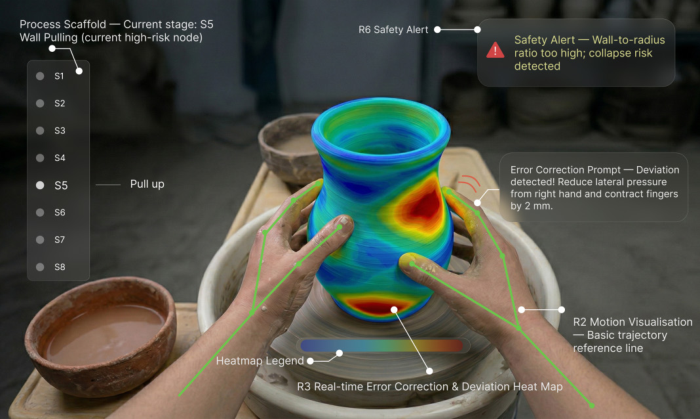
Figure 1 illustrates the specific implementation of the aforementioned design logic within the MR interface, using the elevating stage (S5) as an example: the R1 process support on the left displays the current task stage
A Mixed Reality Intervention Framework for Learning Ceramic Throwing Skills 75 in real time, highlighting S5 as a high-risk node; the R3 deviation heat map is superimposed on the green body surface (red indicates high deviation areas, blue indicates low deviation areas, with a color scale legend shown at the bottom); the right error correction prompt panel becomes active after the deviation trigger threshold is reached, providing executable corrective actions; the R2 green trajectory line offers a reference for hand movements; and the R6 safety warning pops up in the upper right corner when the wall thickness/radius ratio becomes too high. Each module number (R1–R6) corresponds to the KANO classification in Table 2 and the comprehensive priority ranking in Table 5; the task phase number (S5) corresponds to the pottery throwing task decomposition in Table 1.
Figure 1: Interface prototype of the MR ceramic throwing system: deviation heat map and real-time error correction feedback during the S5 elevating stage.
EVALUATION SCHEME To verify the practical effect of MR intervention on pottery throwing skill learning, it is suggested to adopt a mixed experimental design consisting of a control group and pre- and post-tests. The independent variable is the teaching method (MR system guidance vs. traditional video/demonstration teaching), with groups being independent of each other. The dependent variables are divided into objective performance indicators and subjective experience indicators. The former includes completion time, centering time, geometric deviation, failure rate, and rework frequency, while the latter encompasses NASA-TLX workload score and SUS usability score. Novices were randomly assigned to two groups: the control group received traditional video/demonstration teaching, while the experimental group was guided by the MR system process. Before the project is implemented, the Wizard-of-Oz method can be used to simulate the prompt logic of R1 and R3 to verify
Objective indicators cover the key KPIs identified in the task analysis: completion time (overall and phased), centering time, geometric deviation (wall thickness uniformity, contour, and target template deviation), failure rate (blank collapse/irreparable), and the number of reworks and teacher interventions. Subjective indicators utilize NASA-TLX to assess overall workload and its dimensions (Sulistiyo & Vitasari, 2024), SUS to evaluate usability (Mol et al., 2020), and measure willingness to continue using with 1-2 questions. The effect boundary that requires attention is as follows: in low complexity steps, overly strong MR cues may increase cognitive load rather than reduce it due to information redundancy (Baashar et al., 2022). Therefore, the assessment should record the NASA-TLX of high/low-risk nodes in sections to identify the varying effects of cue density across different subtasks, and provide an empirical basis for the iteration parameters of R5 (with adjustable cue density).
DISCUSSION AND CONCLUSION The contributions of this paper are focused on three levels. Firstly, in terms of the research object, starting from the task decomposition of throwing and forming, a quantifiable subtask and KPI system are provided, directly linking system design to the practical challenges of ceramic art operations, rather than being a general framework that can be substituted by any other process. Secondly, at the design level, three constraint principles for MR intervention are proposed from the perspective of human factors engineering, incorporating “minimum occlusion, phased information density, and interpretable error correction” into the design logic of functional items. Thirdly, at the method level, KANO and AHP serve as auxiliary tools to provide a complete closed- loop numerical decision-making process: KANO identifies the bottom line of demand and quantifies satisfaction/dissatisfaction potential, while AHP provides multi-criteria weights through consistency testing, ultimately outputting a functional priority table that can be recalculated and verified (R1 > R3 > R6 > R4 ≈ R2 > R5 > R8 > R7). This solves the structural issue of “the method chain being complete but inconclusive”.
There are four limitations in this study. Firstly, the sample size is limited (n = 16) and all participants are beginners with no more than two experiences in pottery throwing. The use of convenient sampling restricts the external validity of the results. Future research should expand the sample size to over 40 participants and include learners of varying proficiency levels to enhance the universality of the prioritization conclusions. Secondly, risk nodes differ across various schools and material formulations in pottery throwing. The current task decomposition primarily focuses on straight cylinders and bowls, covering a limited scope. In future research, it is essential to incorporate user data from more vessel types and process scenarios to further validate the robustness of function priorities. Thirdly, AR/MR exhibits a boundary condition of “negative effect” in low-complexity tasks (Baashar et al., 2022).
A Mixed Reality Intervention Framework for Learning Ceramic Throwing Skills 77 The KANO and AHP data in this study have not yet distinguished the demand differences between high- and low-complexity subtasks, indicating that further refinement and iteration are needed in the subsequent prototype verification stage. Fourthly, the measurement of whether MR intervention disrupts beginners’ tactile perception remains indirect, primarily relying on the subjective self-assessment of NASA-TLX, which fails to directly capture the proportion of attention allocated between visual and tactile channels. The acquisition of pottery throwing skills heavily relies on the continuous perception of mud resistance and humidity through the hands. If visual cues persistently dominate, learners may become dependent on MR feedback, hindering the internalization of hand sensations (Wilson, 2002). Future research should incorporate eye tracking or a dual-task paradigm to more directly and objectively measure attention allocation.
Overall, the framework of “task analysis - human factors design logic - KANO/AHP priority” presented in this paper serves as a preliminary demonstration tool for process-oriented MR training systems prior to prototype development. Under resource constraints, it clarifies which functions are essential, which constitute the core performance, and which can be expanded later. This enables the prototype development to shift from focusing on “as many functions as possible” to “prioritization based on demand evidence”.
ACKNOWLEDGMENT
The author would like to thank the supervisor for their guidance and support throughout this research.
REFERENCES
Baashar, Y., Alkawsi, G., Ahmad, W.N.W., Alhussian, H., Alwadain, A., Capretz, L.F., Babiker, A. and Alghail, A. (2022) ‘Effectiveness of using augmented reality for training in the medical professions: meta-analysis’, JMIR Serious Games, 10(3), e32715. Bödding, R., Schriek, S.A. and Maier, G.W. (2025) ‘A systematic review and meta-
analysis of mixed reality in vocational education and training: examining behavioral, cognitive, and affective training outcomes and possible moderators’, Virtual Reality, 29, p. 44. Chiang, P.-Y., Chang, H.-Y. and Chang, Y.-J. (2018) ‘PotteryGo: a virtual pottery making training system’, IEEE Computer Graphics and Applications, 38(2), pp. 74–88. Jeffri, N.F.S. and Rambli, D.R.A. (2021) ‘A review of augmented reality systems and
their effects on mental workload and task performance’, Heliyon, 7(3), e06277. Kano, N., Seraku, N., Takahashi, F. and Tsuji, S. (1984) ‘Attractive quality and must-be quality’, Hinshitsu (Quality, the Journal of the Japanese Society for Quality Control), 14(2), pp. 147–156. Lave, J. and Wenger, E. (1991) Situated Learning: Legitimate Peripheral Participation.
Cambridge: Cambridge University Press. Matzler, K. and Hinterhuber, H.H. (1998) ‘How to make product development projects more successful by integrating Kano’s model of customer satisfaction
78 Cai into quality function deployment’, Technovation, 18(1), pp. 25–38. Milgram, P. and Kishino, F. (1994) ‘A taxonomy of mixed reality visual displays’,
IEICE Transactions on Information and Systems, E77-D(12), pp. 1321–1329. Mol, M., van Schaik, A., Dozeman, E., Ruwaard, J., Vis, C., Mijnarends, D.M. and Riper, H. (2020) ‘Dimensionality of the System Usability Scale among professionals using internet-based interventions for depression: a confirmatory factor analysis’, BMC Psychiatry, 20, p. 218. Saaty, T.L. (1977) ‘A scaling method for priorities in hierarchical structures’, Journal
of Mathematical Psychology, 15(3), pp. 234–281. Sauerwein, E., Bailom, F., Matzler, K. and Hinterhuber, H.H. (1996) ‘The Kano model: how to delight your customers’, in Proceedings of the International Working Seminar on Production Economics. Innsbruck, Austria, February 1996, pp. 313–327. Sulistiyo, W. and Vitasari, P. (2024) ‘Analysis of operators’ mental workload using
the NASA-TLX method at PT XYZ’, Jurnal Rekayasa Sistem Industri, 13(2), pp. 45–52. Tontini, G. (2007) ‘Integrating the Kano model and QFD for designing new products’, Total Quality Management & Business Excellence, 18(6), pp. 599–612. Violante, M.G. and Vezzetti, E. (2017) ‘Kano qualitative vs quantitative approaches:
an assessment framework for products attributes analysis’, Computers in Industry, 86, pp. 15–25. Wilson, M. (2002) ‘Six views of embodied cognition’, Psychonomic Bulletin & Review, 9(4), pp. 625–636.
LISTED IN THE AHFE DIGITAL BOOKSTORE CATALOGUE
Explore the complete digital volume
Human Factors in Communication of Design
Read this individual research paper free through the original publisher, or explore the full digital proceedings book.
ISBN 978-1-964867-92-2
Explore this ISBN in the AHFE Bookstore ↗Listed in the July 2026 bookstore catalogue; search by ISBN to confirm current availability · Digital book purchase optional