Matthias Kammermeyer, Patricia Gödri, Tobias Dapolonia, Florian Maier, Johannes Wanner (2025). Empowering process engineers with natural user interfaces for incident analysis and documentation – A case study in battery cell manufacturing. In: Human Aspects of Advanced Manufacturing, Production Management and Process Control. AHFE Open Access, vol. 184, pp. 144–153. https://doi.org/10.54941/ahfe1006749
Driving process innovation and ensuring the product quality to reduce scrap rates are among the key objectives for a process engineer in battery cell manufacturing. Since unresolved product quality incidents often lead to a higher scrap rate, thorough analysis and documentation are required. However, the root cause analysis of product quality issues is often complicated by the lack of systematic documentation and its associated data. This deficit points to an urgent need for a user-friendly interface that facilitates efficient data collection and analysis. In this case study we propose the development of an application providing a user interface tailored for the challenging working conditions in battery cell manufacturing, such as the use of multi-layered gloves, face masks, noisy environments, and the limitation on space for input devices in cell assembly and formation. Focus groups and contextual interviews were conducted to gather insights from users to help design the initial version of the user interface. Due to an usability inspection, areas for improvement as well as features that already had a positive impact were identified. Further iterative testing and evaluation methods such as RITE (Rapid Iterative Testing and Evaluation) were applied to conduct user studies, which allowed for continuous feedback to ensure that the application delivered on user requirements and usability standards. In this context, we investigated the usability of natural user interfaces (NUIs) on mobile devices and integrated technologies such as speech-to-text input and image attachment to optimise the analysis and documentation of incidents. The results demonstrate a significant improvement in operational efficiency. With the proposed solution, the duration of the documentation and analysis process is can be reduced by 20% to 50%. Moreover, it enhances the overall user experience by addressing the industry-specific challenges of battery cell manufacturing. In addition, the solution minimises the barriers for documenting incidents. It serves as a starting point for further detailed user studies with a commercial battery manufacturer. This improvement not only confirms the effectiveness of NUIs in enhancing data collection and analysis in battery manufacturing environments but also highlights the potential for broader applications in similar industrial settings.
Empowering Process Engineers With Natural User Interfaces for Incident Analysis 145
INTRODUCTION
Batteries are essential in enabling the transition from fossil fuels to renewable energy in both the transportation and power sectors, supporting the EU’s Green Deal goal of reducing greenhouse gas emissions by 55% by 2030 (EU Commission). While production capacities are being scaled up to meet the increasing the demand in the marked, battery cell products and manufacturing processes are still under development to improve the product quality, overall productivity, competitiveness and sustainability of the battery cell manufacturing operations. A key goal is to improve quality while reducing manufacturing costs (Birke et al., n.d.).
Several studies highlight the high scrap rate, numbered in a low double- digit percentage range, as a primary cost driver (Accenture & Fraunhofer, FFB Whitepaper). Missing knowledge about cause effect relationships are evident in the high scrap rates and is also reflected in the very long start-up phases leading up to series production (VDMA). To address this, the battery production roadmap 2030 proposes the implementation and usage of digitalization and industry 4.0 (I4.0) solutions to automate and better understand the interdependencies along the process chain (VDMA). Battery cell manufacturers and associated partners are therefore intensively researching and developing solutions in the fields of quality control and the related implementation of metrology, machine vision, traceability and automation solutions. The vast development of machine learning (ML) and artificial intelligence (AI) in recent years is opening new possibilities in all domains enabling large data processing. According to the digital transformation principle (Thomas Bauernhansl, 2018) value proposition can be created when process data is not only collected, but also aggregated, evaluated and actions automated. In this highly digitalized and constantly changing environment however, the human factor and particularly the role process engineer plays a pivotal role in improving product and process quality. According to Kornas et al., “their domain knowledge … is a key to solve incidents and the underlying root-cause-analysis”. Due to technical or monetary constraints, incidents are often observed but not physically measured. Particularly here, the documentation and tracking of incidents and the related collection of contextual data is a fundamental procedure in quality management and among the daily tasks of a process engineer (Masing Handbook Quality Management, 2014).
Despite this high importance, documentation is usually not very popular and often neglected. In contrast, about 5 billion users are documenting their lives and massively uploading an exponentially increasing amount of data on social media platforms. Natural User Interfaces (NUI) realized in form of apps running on mobile devices using image and speech capturing such as global network connectivity are enabling multi-modal, ad-hoc contextual data collection anywhere and anytime.
In this paper we, as a Fraunhofer IPA research team, are approaching a research question, formulated within the Project DigiBattPro4.0:
“How can the procedure for product and process related incident documentation and root-cause-analysis in a battery cell manufacturing environment be improved using natural user interfaces?”
METHODOLOGY
The development process is based on user-centred-design referencing ISO 9241–210 and combined with methods of User Experience (UX) and design thinking which are bringing interface builders and users more closely together (Pfeiffer et al., 2016). The research was executed within two consecutive six- month sprints in an agile scrum adaption. By using the method design-sprint, the team was able to analyse, design, develop and test a prototype within a real environment in two weeks. Process engineers in field of cell assembly and cell finishing from the Fraunhofer IPA centre of digitalized battery manufacturing (ZDB) where interviewed and giving input about their pains, gains and daily activities by using the UX tools “Persona” and “User Journey Map”. Further, the analysis was deepened through a survey including experts from various organizations. Finally, a minimum viable product (MVP) in form of a mobile device app was designed, implemented and tested in a real battery manufacturing environment.
ANALYSIS This analysis aims to better understand the complexities of battery cell manufacturing, focussing on the production process with the three main process steps of electrode manufacturing, cell assembly and cell finishing. The key environmental factors that determine product quality and longevity, i.e. stability, are humidity, temperature and cleanliness. It also provides insights into the real-world operational protocols for process engineers, including cleanroom standards and how engineers communicate to manage the risks of contamination and product failure.
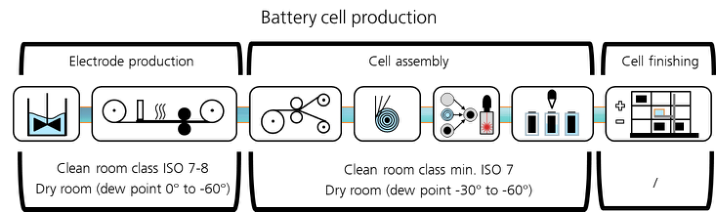
Environment The process chain of battery cell manufacturing is divided into three major process steps electrode production, cell assembly and cell finishing (VDMA, PEM, RWTH). Conditioning parameters such as humidity, temperature and cleanliness are fundamental to production processes and set individual requirements on each process step. In electrode production and cell assembly, maintaining environmental conditions and the appropriate clean room class and dew point is essential for a stable production process. Particles and moisture affect the battery cell quality influencing capacity and battery life (Kwade et al., 2018). Protective and cleanroom-appropriate clothing, such as lab coats, double-layered gloves, overshoes, and hairnets, are required for persons in the work area, also called shopfloor.
Process engineers change clothes in an airlock, that is separating the shopfloor from the surrounding facility. To avoid moisture influences, the number of people is reduced to a minimum and the tools brought in should be paperless. The following procedures depend on the specific process step
Empowering Process Engineers With Natural User Interfaces for Incident Analysis 147
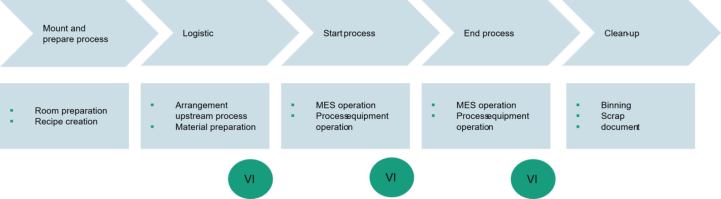
within the process chain and on the specific task of the process engineer. However, the activities of a process engineer related to a process step can be put in an abstract form as shown in the User Journey Map in Figure 2.
Figure 1: Battery cell production environment based on VDMA, PEM, RWTH Aachen.Figure 2: User journey map.
The main activities are arranged in the top layer and related actions in the middle layer and additionally points where process engineers perform Visual Inspections (VI) on demand. Mounting and preparing the process is also partly performed remotely if the process equipment is hooked up in the IT infrastructure of production system. Individual checks and room preparation is done in the process area. Arrangements with the team and up-stream process assigned co-workers must be made to ensure that the correct amount and type of material is at the right place at the right time. Especially in lab- and pilot lines where intralogistics processes are not fully automated, team communication is essential to synchronize the interfaces and information. In contrast to a fully automated giga-factory, process engineers are often manually operating the process equipment to start and end the process. Depending on the level of integration of process equipment into the production system, MES/MOM related tasks must be performed e.g. to assign the specific battery cell or WPC with a process. Manufacturing Execution Systems (MES) and Manufacturing Operations Management (MOM) including microservices are used as comprehensive solutions including quality management, production planning and real time monitoring (Siemens). In many cases VI is performed manually and incidents related to product and material occur frequently here, whereas incidents related to process equipment usually occur during the process
execution e.g. in form of equipment error or device malfunction. In cases of incidents the interviewed experts mentioned a missing interface for incident documentation and tracking.
Human Machine Interfaces (HMI) and mainly Graphical User Interfaces (GUI) are provided to interact with individual machines and systems of the production system whereas the physical input and output devices are mainly realized by touch panels, or less frequently keyboards and mouses. As an output of persona method, the usage of touch input devices in combination with double layered gloves is prone to errors. Also, the limited space in the shopfloor must be considered. Due to the increasing number of sensors, devices and data, the production systems are getting more complex and challenges for user interfaces are identified in the context of I4.0 (Pfeiffer et al., 2016). Consequently, classic HMI and GUI designs tend to be overloaded, and users are spending time exploring and searching for functions and content, differing greatly from manufacturer to manufacturer. Moreover, machines are not able to capture ad-hoc data outside of their built-in sensors.
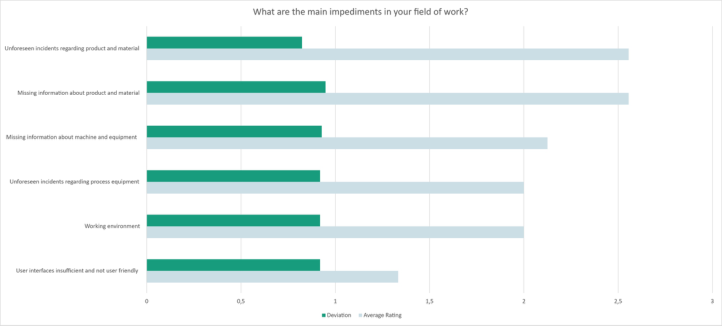
Survey A survey with 19 questions was conducted among process engineers in battery cell manufacturing, receiving responses from 10 participants. All worked in cell assembly, nearly 50% also in cell finishing, and around 20% in electrode production. Half had 1 to 3 years of experience, while the other half had over 3 years. Respondents rated various work impediments on a scale from 0 to 4, with “Unforeseen incidents regarding product and material” and “Missing information about product and material” scoring the highest at 2.55 points (see Figure 4).
Figure 3: Survey results - impediments in field of work.
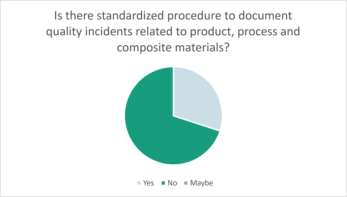
Most respondents reported a lack of documentation procedures and tools (see Figure 5). Regarding time effort in an 8-hour day, participants noted that documentation and root cause analysis took about 5% to 20% of their time,
Empowering Process Engineers With Natural User Interfaces for Incident Analysis 149
with some estimating potential time savings of 20% to 50% using natural user interfaces like speech and image capturing. While these estimates are rough, they suggest significant potential benefits for an application that is capable to capture and track contextual information about incidents, process and material information.
Figure 4: Survey results – procedure and tool for documentation.Figure 5: Domain model.
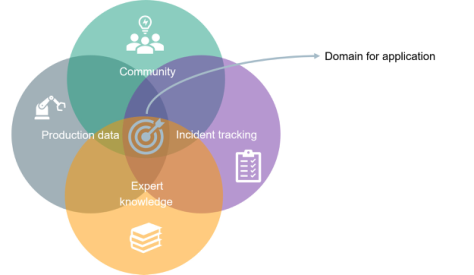
SOLUTION APPROACH Extracted from the analysis and building upon the “Framework for data- and expert driven analysis” (Kornas et al., n.d.) the solution approach focuses on an area that interfaces with four data-driven domains.
Production data: including production equipment, MOM/MES, and microservices.
Expert knowledge database: including information and specification about process and material such as cause-effect-relations (CER).
Incident tracking: including open and archived issues, open points, workarounds and solution description.
Community: including team communication and collaboration platforms.
By extending the model by the domains incident tracking and community data as shown in Figure 7, the insufficient data collection from production equipment e.g. in an ramp-up phase can be compensated or extended by
ad-hoc data from community and incident tracking repositories. While domain repositories are usually individually accessible by GUI and stationary terminals, this approach proposes a user-centered interface, provided on a mobile device for individual users to capture, aggregate and return information.
Requirements By the given input from the user journey, incident tracking and communication features are the base for the designed MVP including functional requirements as listed in
Table 1: Requirements.
Table available in the original PDF paper.
RQ001 Create incidents related to battery ID and process ID RQ002 Scan code of battery, process and material to avoid keyboard input RQ003 Capture and attach photos related to incident RQ004 Attach description using speech to text function RQ005 List all active and archived incidents RQ006 Filter active and archived incidents RQ007 Show activity stream displaying activities from all connected co-workers and systems RQ008 Assign incidents and notify co-workers
An important finding from the survey was the lack of standards and documentation reported by the respondents. According to Masing’s Handbook for quality management (Masing Handbook Quality Management, 2014) documentation is an essential requirements for quality management (QM). Among the observed difficulties of quality related documentation in execution in the field are:
Creation and continuous updates of information is time consuming and binding human resources.
Standards are not transparent for users.
Documentation is seen as a “chore” rather than an opportunity for improvement.
These difficulties can be overcome by providing UX-designed software applications for documentation accessible for and accepted by all users in an organization.
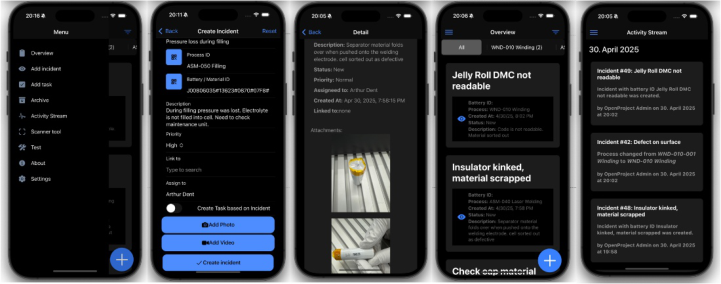
Development and Testing The MVP was developed as a mobile app using Angular Ionic, enabling platform-independent functionality for iOS, Android, and web-based devices. It utilized a common open-source issue and project tracking application as its backend, hosted on a cloud server. As shown in Fig. 8, the “create incident” dialog allows users to gather all relevant context information. Code scans via an ML-based process plugin simplify the capture of battery and process IDs. Native speech-to-text functions enable detailed incident descriptions. Users can retrieve and modify incidents from the backend, with filtering
Empowering Process Engineers With Natural User Interfaces for Incident Analysis 151
capabilities for targeted searches across recorded incidents. The “Activity Stream” aggregates all activities from other users and systems.
Figure 6: Screenshots from mobile app MVP.
User Study Alongside the development process, a heuristic usability inspection was performed, yielding a report that highlighted key areas for improvement in the prototype application (Hartson und Pyla, 2019b). After implementing these enhancements, a user study was conducted with 6 participants experienced in battery cell assembly, taking place in their actual workplaces. The study featured specific tasks to assess the application’s effectiveness in real-life scenarios. Using the Rapid Iterative Testing and Evaluation (RITE) method, multiple test iterations provided continuous user feedback (Hartson und Pyla, 2019a). The goal was to ensure the application was intuitive and optimized for use in clean and dry rooms by the assembly team.
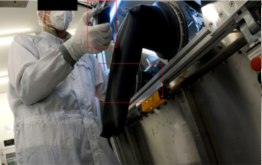
Quantitative data, such as task completion times and error click rates, were collected along with qualitative insights from the UEQ Short Questionnaire and follow-up interviews. GoPro cameras recorded video and audio to unobtrusively observe participants as they navigated tasks in real time.
Figure 7: Study observation.
This setup offered valuable insights into users’ facial expressions, gestures, and verbal feedback during interactions. Additionally, screen-sharing technology allowed direct observation of participants’ interactions with the
application interface. This dual approach enabled the research team to gather qualitative data on user behaviour, pinpoint areas of confusion, and assess the user interface’s effectiveness. However, limitations included the small number of participants; while they were experts and actual end-users, the limited dataset could affect the results.
CONCLUSION
This case study shows that NUI-based applications for incident documentation and root cause analysis in battery cell manufacturing can enhance operational efficiency. Our user-centered design research led to a mobile app that features speech-to-text input, image and video annotation, and code scanning, catering to the challenges faced by process engineers in dynamic dry room environments requiring effective team communication and incident tracking.
Process engineers reported potential time savings of 20% to 50% for documentation during an 8-hour shift with NUI software. Testing in a real manufacturing setting demonstrated significant improvements in documentation and organization. Usability study metrics indicated a decrease in error clicks: creating an incident dropped from 16 to 1 clicks (93.75% reduction), editing from 4 to 0 (100% reduction), and task creation from 20 to 2 (90% reduction). However, results are based on a limited participant pool, affecting statistical significance.
These findings highlight significant enhancements in user interaction with the application, supporting its role in streamlining documentation and improving usability in demanding environments. Combining production with expert knowledge, such as LLM-based data evaluation, could lead to a more robust system functioning as a virtual assistant for process engineers. Such a powerful LLM solution for error report analysis was developed within DigiBattPro4.0 (Grigorjan et al., 2024).
The results lay the groundwork for further comprehensive user studies in partnership with commercial battery manufacturers, aimed at understanding their specific needs in serial production contexts.
ACKNOWLEDGMENT
This research was conducted within the project’s scope DigiBattPro 4.0 – BMBF 03XP0374C. We gratefully acknowledge the financial support of the Federal Ministry of Education and Research Germany. Thank you, team battery, cleanroom and digi-tools, for the support. The survey was conducted with MS Forms, Application developed with angular ionic and capacitor. Thank you Scandit for providing the scanner plugin. For evaluation and rephrasing we were using the AI assistant FhGenie.
REFERENCES
Accenture & Fraunhofer. FFB Whitepaper: The Power of Digitalization in Battery Cell Manufacturing.
Empowering Process Engineers With Natural User Interfaces for Incident Analysis 153
Birke, Kai Peter; Weeber, Max; Oberle, Michael (Hg.): Handbook on smart battery cell manufacturing. The Power of Digitalization. EU Commission: Green deal fit for 55 - making transport sustainable for all. Online
verfügbar unter https://commission.europa.eu/strategy-and-policy/priorities- 2019-2024/european-green-deal/delivering-european-green-deal_en#making -transport-sustainable-for-all. Grigorjan et al. 2024 (Hg.): ARCI Proceedings 2024 Winter Conference. Enhancing Error Report Analysis in Industry: Evaluating Large Language Models and Traditional NLP for Text Clustering. Kornas, Thomas; Daub, Rudiger; Karamat, Muhammad Zeeshan; Thiede, Sebastian; Herrmann, Christoph: Data-and Expert-Driven Analysis of Cause- Effect Relationships in the Production of Lithium-Ion Batteries. In:, S. 380–385. Kwade, Arno; Haselrieder, Wolfgang; Leithoff, Ruben; Modlinger, Armin; Dietrich,
Franz; Droeder, Klaus (2018): Current status and challenges for automotive battery production technologies. In: Nat Energy 3 (4), S. 290–300. doi: 10.1038/ s41560-018-0130-3. Masing Handbook Quality Management (2014). 6, überarbeitete Aufl. München, Wien: Hanser (Hanser eLibrary). Pfeiffer, Thies; Hellmers, Jens; Schon, Eva-Maria; Thomaschewski, Jorg (2016):
Empowering User Interfaces for Industrie 4.0. In: Proc. IEEE 104 (5), S. 986–996. doi: 10.1109/JPROC.2015.2508640. Siemens: MOM - Manufacturing Operations Management. Online verfügbar unter https://www.sw.siemens.com/en-US/technology/manufacturing-operations- management-mom/. Thomas Bauernhansl (2018): Die digitale Transformation. Wie werden wir morgen leben und arbeiten? Online verfügbar unter https://publica.fraunhofer.de/entities/ publication/0503dc38-d778-4d10-8d7f-f5a6e00935f3/details. VDMA: Roadmap Batterie-Produktionsmittel 2030 - Update 2023. Online verfügbar
unter https://vdma.org/batterieproduktionsmittel. VDMA, PEM, RWTH: Production Process Of A Lithium-Ion Battery Cell.
LISTED IN THE AHFE DIGITAL BOOKSTORE CATALOGUE
Explore the complete digital volume
Human Aspects of Advanced Manufacturing, Production Management and Process Control
Read this individual research paper free through the original publisher, or explore the full digital proceedings book.
ISBN 978-1-964867-60-1
Explore this ISBN in the AHFE Bookstore ↗Listed in the July 2026 bookstore catalogue; search by ISBN to confirm current availability · Digital book purchase optional