Lu Wang, Jun Zhang, Jinzhuo Liu (2026). AI Smart Glasses Product Design Analysis: A System Dynamics Perspective. In: Interdisciplinary Practice in Industrial Design. AHFE Open Access, vol. 222, pp. 276–283. https://doi.org/10.54941/ahfe1007766
To identify design breakthroughs for AI glasses, this study categorizes core elements and influences logic using System Dynamics. Analyzing literature from CNKI and Web of Science (2015-2025) via Bibliometrics, KJ Method, and case studies, the research identifies four core topics.A System Dynamics model was constructed to simulate design evolution, revealing five subsystems, four causal loops, and four key characteristics. This builds a closed-loop analysis framework that clarifies the dynamic mechanisms of AI glasses, providing a theoretical and methodological foundation for innovation.
Rapid AI breakthroughs are reshaping smart glasses (Zhang et al., 2025), which focus on daily scenario adaptation through independent systems, distinguishing them from immersive MR/VR.Integrating algorithms, optics, and hardware creates a complex system where deep coupling makes balanced design difficult (Li, 2025), necessitating a holistic perspective to avoid system imbalance. This paper combines the qualitative analysis of causal loop diagrams in system dynamics with Bibliometrics to analyze the logic of AI glasses design, exploring element mechanisms and summarized evolutionary laws to provide a theoretical framework and actionable guidelines (Wu & Zhang, 2020).
AI GLASSES AND SYSTEM DYNAMICS Development Status of AI Glasses
AI glasses have evolved from fragmented functional devices like Ray-Ban Stories into integrated systems like Oakley Meta HSTN, leveraging AI to bridge hardware and software for collaborative assistance. As a central hub, AI drives technical cross-coupling and holistic integrity, shifting focus from individual function optimization to comprehensive system coordination. This complexity demands a shift from “function superposition” to “systemic construction.” Introducing System Dynamics is essential to decompose
AI Smart Glasses Product Design Analysis: A System Dynamics Perspective 277 technical mechanisms and ensure implementable design solutions.In scenarios where core elements are difficult to quantify, qualitative analysis can also be conducted based on causal loop diagrams. For instance, Zhao constructed a causal loop model to qualitatively analyze the impact of artificial intelligence on the healthcare service design ecosystem involving multiple stakeholders (Zhao, 2025).
System Dynamics and Product System Design Research System Dynamics (SD), proposed by Forrester in 1970 (Forrester, 1970), is a systems engineering method for analyzing complex dynamic systems. It integrates quantitative simulation with qualitative causal feedback diagrams to decompose linkages between system structure and behavior (Zhang et al., 2010).
SD has established mature cross-disciplinary paradigms, effectively modeling complex correlations in macro-economics (Meadows et al., 1972), urban planning (Shepherd, 2014), and sustainable development (Poornima et al., 2025). Recently, SD has entered design via an “element-model-strategy” path. Li Shuangji extracted emotional elements to quantify development strategies for tourism products (Yu et al., 2025). Chavy-Macdonald integrated technical features with user needs to derive adaptive design goals for product architecture (Chavy-Macdonald et al., 2019). SD adapts to AI glasses by decomposing multi-module interweaving through a systemic perspective. It integrates technical, interactive, and scenario requirements into actionable characteristics, directly supporting the identification of design elements and internal mechanisms within the AI glasses ecosystem.
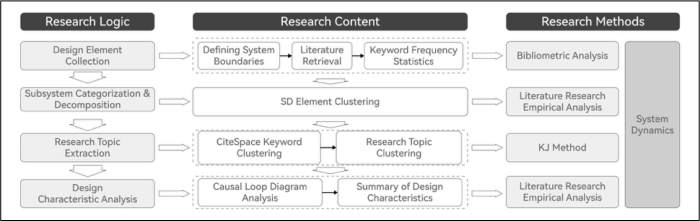
System Dynamics Research Process This study follows a three-stage process: element sorting, topic refinement, and characteristic analysis. Using the causal loop diagram of System Dynamics (SD) as the core framework and Bibliometrics for validation, the research defines system boundaries (Shepherd, 2014), identifies topics via keyword clustering and the KJ Method, and constructs causal feedback loops to visualize subsystem patterns (see Figure 1).
Figure 1: Research pathways of system dynamics.
ANALYSIS OF RESEARCH FOCI ON AI GLASSES Data Sources and System Boundaries
The study’s spatial boundary centers on the device, including hardware, software, and scenarios. Temporally, AI glasses evolved in three stages: initial focus on power and HCI, followed by consumer/professional tracks and social assistance (Lin et al., 2020), and finally achieving a multi-modal, active interaction ecosystem by 2025 (Yang et al., 2025).
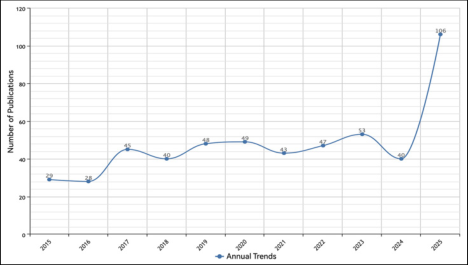
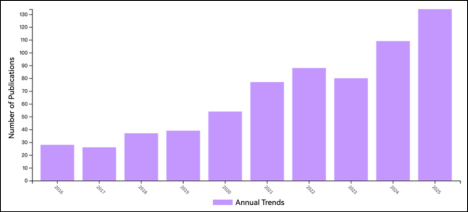
Extraction of AI Glasses Design Elements and Prominent Research Topics To extract design elements, this study conducted a bibliometric search (2015– 2025) on CNKI and WOS. Following the “goals-relationships-elements” framework, the search strategy was structured into three modules: “Technical Support,” “Product Carrier,” and “Core Elements,” aligned with the five- subsystem logic. After screening, 540 CNKI and 637 WOS articles were retrieved, showing an explosive growth trend since 2023 (see Figure 2 & Figure 3).
Figure 2: The number of CNKI publications from 2015 to 2025.Figure 3: The number of WOS publications from 2015 to 2025.
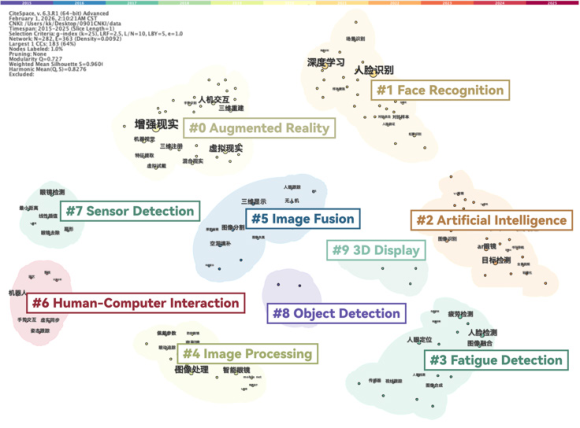
CiteSpace was utilized for keyword co-occurrence and clustering analysis. The Chinese literature yielded 10 clusters (Q=0.727, S=0.9606)(see Figure 4),
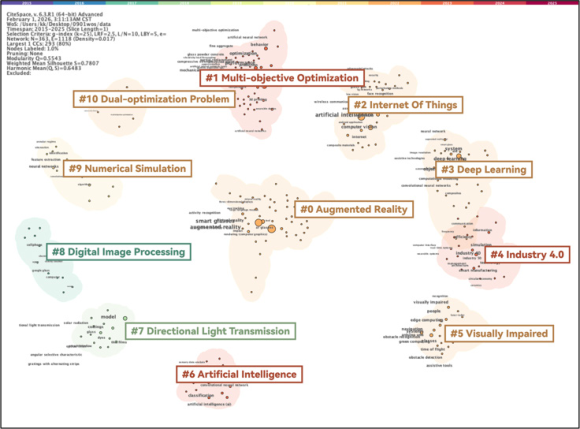
AI Smart Glasses Product Design Analysis: A System Dynamics Perspective 279 while English literature produced 12 clusters (Q=0.5543, S=0.7807) (see Figure 5), both indicating significant and reliable structures.
Figure 4: The result of CNKI literature clustering.Figure 5: The result of WOS literature clustering.
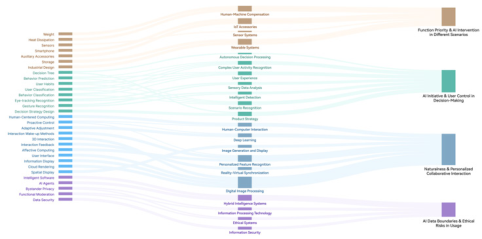
Finally, using the KJ Method to integrate these 22 clusters, four primary research topics were refined (see Figure 6): 1) Function Priority and AI Intervention Levels in Scenarios; 2) AI Initiative in Decision-making vs. User Control; 3) Interaction Naturalness and Personalized Collaboration; and 4) Data Boundaries and Ethical Risks.
Figure 6: The results of information processed by citespace clustering and KJ method.
Hot Research Topics on AI Glasses Function Priority & Degree of AI Intervention in Different Scenarios: This topic stems from the contradiction between hardware integration and wearing comfort during functional iteration. As AI glasses expand from single-function devices to multi-scenario terminals, the accumulation of hardware modules challenges the physical limits of wearable comfort. Consequently, academic focus has shifted toward the trade-off logic of scenario-based design (Huang et al., 2022), exploring how to prioritize AI-native services versus basic functions across diverse scenarios to avoid experience degradation caused by functional redundancy (Kim et al., 2021).
Reflection of AI Initiative in Decision-Making & User Control Rights: With the advancement of generative AI, the distribution of decision-making power has become a critical research issue. The ability of AI to independently recognize behaviors and trigger services simplifies operations but blurs decision boundaries. Current research hotspots revolve around defining the reasonable scope of AI autonomy—balancing proactive service delivery with user dominance—while addressing potential risks such as weakened user control and the need for decision transparency in high-stakes scenarios (Liu et al., 2015).
Naturalness of Interaction & Personalized Collaborative Experience: This topic identifies the paradigm shift in human-computer interaction from “convenience” to “naturalness.” As multi-modal methods like voice and gesture mature, traditional touch-based interaction no longer suffices for complex scenarios. Research focus has converged on how AI can facilitate multi-modal coordination and leverage sensor data to transition interaction from generalized feedback to personalized, adaptive experiences that align with individual user habits and physiological traits (Lu et al., 2023).
AI Data Boundaries & Ethical Risks in the Usage Process: The tension between extensive data collection and privacy protection defines this research dimension. Since AI functions rely on large-scale biometric and behavioral data, the risk of algorithmic bias and data leakage has become prominent. Academic attention is now centered on defining data collection boundaries under the “minimum necessary” principle and exploring how interaction design can empower users with better transparency and authorization control to mitigate ethical dilemmas.
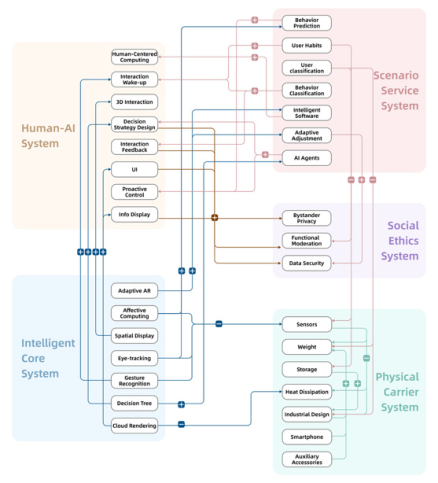
DISCUSSION ON SYSTEM DYNAMICS OF AI GLASSES Grounded in the “elements-relationships-goals” framework, this study constructs a Causal Loop Diagram (see Figure 7) to map the AI glasses ecosystem. The model illustrates how technological breakthroughs drive multi-modal interaction and intelligent core iterations, while revealing the inherent coupling between hardware configuration, device weight, and wearing comfort. It further links scenario needs with hardware design to balance basic modules and AI-native functions. Conversely, the system defines how data risks and user acceptance impose necessary constraints on functional expansion, ensuring systemic equilibrium through privacy mechanisms. Collectively, these linkages reveal the “perception-decision- execution” workflow and the dynamic evolution laws of the product system.
Figure 7: The results of information processed by citespace clustering and KJ method.
SYSTEM DYNAMICS DESIGN CHARACTERISTICS AND TRENDS Characteristic 1: Scenario-Adaptive Design Based on Distributed Architecture
AI glasses utilize a distributed architecture to resolve the conflict between hardware integration and wearing comfort. By shifting heavy computing loads to collaborative devices or the cloud—following the “edge-minimalism, cloud-reconstruction” principle—the glasses function as front-end nodes for basic interaction and data collection. This “edge-device-cloud” linkage allows for dynamic balancing between basic and AI-native functions, ensuring devices remain lightweight while leveraging cross-device collaboration to meet high-load functional demands.
Characteristic 2: Progressive AI Decision-Making Authority Allocation Mechanism To balance AI initiative with user control, design focus has shifted toward a human-AI collaborative decision-making closed-loop. This mechanism adaptively allocates autonomy based on scenario risks: granting AI higher authority for low-risk, routine operations while employing multi-sensor verification and hierarchical information display for high-stakes decisions. By retaining user options at the interaction level and iterating based on behavioral feedback, the system ensures both operational efficiency and decision transparency.
Characteristic 3: Intent-Driven Multimodal Collaborative Natural Interaction The interaction paradigm is shifting from “application-centered” to “user intent-centered” through multimodal collaboration. Leveraging AI agents and sensor data mining, the system breaks down functional fragmentation to create coherent service flows. Input methods like voice and gesture are optimized based on scenario interference, while output methods provide intuitive feedback. Through intent prediction and dynamic adaptation, interaction evolves from passive generalized responses to proactive, personalized experiences.
Characteristic 4: Hierarchical Management of Privacy Protection and Interaction Explicitness Addressing ethical risks requires a hierarchical data management system paired with transparent interaction ethics. Following the “minimum necessary” principle, sensitive biometric data is strictly restricted and encrypted, while low-sensitivity data is managed for efficiency. At the interaction level, a “user-bystander-device” collaborative mechanism ensures transparency through explicit indicators and intuitive notifications, balancing user rights with social ethical norms.
CONCLUSION
This study integrates System Dynamics and Bibliometrics to decompose the AI glasses system. By defining five subsystems and four topics, it reveals the causal linkages between technology, hardware, users, and ethics. This yields four core design characteristics—providing a development framework for the industry.
Future research should shift from qualitative analysis to quantitative simulation to verify causal loops. Additionally, deepening adaptation studies for segmented scenarios and special groups will enhance design universality.
ACKNOWLEDGMENT
The authors would like to acknowledge SDEF Sustainable Innovation Lab for providing academic support to this research and express sincere gratitude to Mr. Jun Zhang for his valuable suggestions on the manuscript.
REFERENCES
Chavy-Macdonald, M. A., Oizumi, K., Kishita, Y. and Aoyama, K. (2019). A System Dynamics and Scenarios Framework for Architecting Product Design Goals for Changeability. IEEE Systems Journal, 13(2), 1957–1968. Forrester, J. W. (1970). Urban dynamics. Industrial Management Review, 11(3),
67–86. Huang, X. F., Tu, L. Z. and Zhang, Y. H., et al. (2022). Influence of glasses weight and nose pads design on wearing comfort. Journal of Machine Design, 39(06), 141–148. Kim, Y. M., Bahn, S. and Yun, M. H. (2021). Wearing comfort and perceived
heaviness of smart glasses. Human Factors and Ergonomics in Manufacturing & Service Industries, 31(5), 445–576. Li, Y. (2025). AI When will the current boom in the eyewear market become a distant dream? (China Consumer News), 2025-03-07(003). Lin, T. H., Huang, L. A., Hannaford, B., Tran, C., Raiti, J., Zaragoza, R., Feng, T.,
Wagner, L. and James, J. (2020). Empathics System: Application of Emotion Analysis AI through Smart Glasses. 13th ACM International Conference on Pervasive Technologies Related to Assistive Environments, pp. 253–256. Liu, Y., Eisingerich, A. B., Auh, S., Merlo, O. and Chun, H. E. H. (2015). Service Firm Performance Transparency: How, When, and Why Does It Pay Off? Journal of Service Research, 18(4), 451–467. Lu, F., Xu, Y., Xu, X., Jones, B. and Malamed, L. (2023). Exploring the Impact
of User and System Factors on Human-AI Interactions in Head-Worn Displays. 2023 IEEE International Symposium on Mixed and Augmented Reality. Meadows, D. H., Meadows, D. L., Randers, J. and Behrens, W. W. (1972). The Limits to Growth. Universe Books. Poornima, P. U., Dhineshkumar, K., Kumar, C. K., Sumana, S., Sundari, M. V. R.,
Sivaraman, P., Shuaib, M. and Rajaram, A. (2025). Optimising rooftop photovoltaic adoption in urban landscapes: A system dynamics approach for sustainable energy transitions. Biomedical Signal Processing and Control, 100(Part B), 107071. Shepherd, S.P. (2014). A review of system dynamics models applied in transportation. Transportmetrica B: Transport Dynamics, 2, 105–83. Wu, Q. and Zhang, C. J. (2020). A Paradigm Shift in Design Driven by AI. Artificial
Intelligence in HCI, pp. 167–176. Yang, J., Liu, S., Guo, H., Dong, Y., Zhang, X., Zhang, S., Wang, P., Zhou, Z., Xie, B. and Wang, Z., et al. (2025). EgoLife: Towards Egocentric Life Assistant. Proceedings of the IEEE/CVF Conference on Computer Vision and Pattern Recognition (CVPR), pp. 28885–28900. Yu, L., Chen, G. Q. and Li, S. J., et al. (2025). Dynamic Development Strategies of
Tourism Culturaland Creative Products Based on Emotional Cognitionof Youth Groups . Packaging Engineering, 46(08), 164–178. Zhang, B., Yu, Z. H. and Sun, Q., et al. (2010). An introduction to system dynamics and a review of related software. Environment and Sustainable Development, 35(02),pp.1–4. Zhang, L. S., Wang, Y. D. and Ling, X. L. (2025). Research Status and Development
Trends of Smart Wearable Products. Journal of Textile Science and Engineering, 42(02), pp. 51–62. Zhao, C. (2025). AI-Empowered Healthcare Service Design: Theoretical Framework and Practical Validation. decorate, (10), pp.12–22.
LISTED IN THE AHFE DIGITAL BOOKSTORE CATALOGUE
Explore the complete digital volume
Interdisciplinary Practice in Industrial Design
Read this individual research paper free through the original publisher, or explore the full digital proceedings book.
ISBN 978-1-964867-98-4
Explore this ISBN in the AHFE Bookstore ↗Listed in the July 2026 bookstore catalogue; search by ISBN to confirm current availability · Digital book purchase optional