Lu Wang (2024). Digital Technology:As a Manner of Sustainable Transformation for Stakeholders in Cultural Inheritance. In: Intelligent Human Systems Integration (IHSI 2024): Integrating People and Intelligent Systems. AHFE Open Access, vol. 119, pp. 830–840. https://doi.org/10.54941/ahfe1004548
Digital technology has changed the traditional “oral teaching” environment in Chinese culture and has become an important means to promote cultural inheritance. Researchers are more focused on digital cultural protection and development to facilitate professionals' use of cultural resources and attract the general public’s attention to culture. While people are been treated as objects and only become passive recipients of digital cultural products. However, people are considered as the core of Chinese cultural inheritance and the key is to let more public become inheritors. Digital technology needs to consider how to facilitate the transformation of people. Through literature research, this study has analyzed different stakeholders of Chinese cultural inheritance. And using Bakhtin's theory of “dialogue”, the transforming paths of different stakeholders have been built. Based on the transforming path and case studies, the stakeholders’ transforming strategy by digital technology has been constructed. In this way, this study has provided a holistic perspective on using digital technology to promote cultural inheritance.
With the development of industrial civilization, the natural and social envi- ronment on which Chinese cultural heritage depends is increasingly eroded and compressed. At the same time, the Internet and other means of infor- mation dissemination have increased conflicts between Chinese and foreign cultures, further destroying the balance of inheritance and development of local cultural heritage (Xin, 2014). Cultural heritage as cultural identity and sovereignty is constantly disappearing, and the sustainable inheritance of cul- ture is becoming increasingly important. China has emphasized the important role of digital technology in protecting and inheriting Chinese traditional culture in the recent National Development Policy Report.
The technological revolution has changed the “oral teaching” way of traditional Chinese cultural inheritance. In particular, digital technologies represented by virtual reality technology (VR), augmented reality technology (AR), mixed reality technology (MR), 3D modeling technology, etc., have become an important means for the inheritance and protection of traditional Chinese culture (Xiaona, La and Yingqing, 2019). Moreover, the digital rev- olution with the theme of “culture” is also unfolding globally. Since the 50s
Digital Technology: As a Manner of Sustainable Transformation for Stakeholders 831
of the 20th century, developed countries have begun to pay attention to the integration between cultural inheritance and digital technology. In 1992, the United Nations Educational Scientific and Cultural Organization (UNESCO) launched the “Memory of the World” project to promote the transmission and protection of cultural heritage worldwide. And in 2003, it also formu- lated the “Charter for Digital Heritage”, which proposes “digitalization” to provide more opportunities for the transmitting, creating, exchanging, and sharing of human knowledge. With the vigorous development of digital tech- nology, countries worldwide have transformed cultural resources into digital assets on a large scale, realizing another unprecedented “media transfer” in human history. Similar to the “media transfer”that occurred in the digital cul- tural revolution, the focus of cultural inheritance is also a kind of “transfer”. But this “transfer” is more temporal and spatial; that is, with the changes of the times, the culture is transferred from the past into the contemporary or future to achieve cultural inheritance.
The research in the field of digital cultural inheritance mainly focuses on the digital protection and digital development of culture. In terms of digital protection of culture, they focus on using digital information collection, dig- ital archiving, digital reconstruction, and other technical means to achieve digital records restore cultural resources, and retain “digital assets” for sci- entific research and display (Zhang et al., 2022; Ting and Siqi, 2021). In the research of on the digital development of culture, they discuss using digital technology to artistically process traditional culture increase diverse interac- tion, and expand the dissemination and application in real life (Wu et al., 2018; Qingfu, 2006). From the perspective of cultural subjects, existing studies have provided a more comprehensive application of digital technology from the material and form of traditional culture. And digital cultural products facilitate profes- sional research and attract the general public’s attention to a certain extent. However, in the process of these studies, no matter professionals nor the gen- eral public, the importance of human beings has been seriously put backward, which have become testers or passive recipients of digital cultural products, rather than active participants and inheritors. The key to cultural inheritance is to cultivate more inheritors. And digital technology not only needs to pro- vide research convenience for professionals and attract more public to be interested in traditional culture but also needs to consider how to gradually enable more none professional people to become real inheritors. The goal of this study is to construct a stakeholders’ transforming strategy by digital tech- nology in Chinese cultural perspectives, in order to provide new applications of digital technology in the field of cultural inheritance.
DIFFERENT STAKEHOLDERS IN CULTURAL INHERITANCE In Chinese, “Cultural inheritance”is a kind of “teaching”behavior instead of the process of “learning” or “receiving” in Western perspectives. It needs to emphasize that human beings are the main body of all cultures, the creators and inheritors of culture, and the essence of cultural inheritance is the inher- itance of people (Xuebing, 2007). Chinese cultural inheritance pays more
832 Wang
attention to active cultural continuation, which is the reproduction of culture, not just the inheritance that remains unchanged (Haiou, 2021). Therefore, from the Chinese cultural perspective, achieving sustainable cultural inheri- tance involves a variety of stakeholders. The traditional way of inheritance in Chinese culture mainly adopts “oral teaching” between masters and appren- tices. Masters are generally called “inheritors”, which refers to individuals or groups with cultural traditions, specific skills, and recognized authority; apprentices, on the other hand, are called “trainees” or “learners”. They are individuals or groups that have the opportunity to become new “inheritors” by learning and mastering certain skills and knowledge of specific cultures (Qingfu, 2006). However, in the context of contemporary culture, with the development of modern technology and communication media, the scope of stakeholders of cultural inheritance has gradually broken the restrictions of the region, blood, mentor-apprentice relationship, etc. That is to say, more and more people could have opportunities to understand and learn traditional culture and the scope of inheritance is gradually expanding.
Lu (2018) found that the cultural inheritance of contemporary Peking Opera is related to three stakeholders: audiences or the public who may know or come into contact with Peking Opera; “Ticket lovers” or amateurs who have a passion for watching and understanding Peking Opera; professionals who engaged in Peking Opera cultural research, education, performance, and other related activities. Fuxiang (2012) also pointed out that social institu- tions such as the government, scholars, social functional departments, and commercial capital also play an important role in cultural protection and inheritance. At the same time, it is also important to pay attention to “other” voices from ordinary people. Yihong and Kun (2022) also found that the dilemma of inheriting intangible culture in contemporary China is not only related to the inter-generational rupture of the inheritors but also to the lack of recognition of the audience.
Therefore, the stakeholders related to Chinese cultural inheritance can be divided into three categories: first, social institutions, including government departments, business organizations, etc.; second, non-professionals, includ- ing the public and amateur; third, professionals, including trainees who are learning traditional culture and inheritors who could teach trainees. Since this study focuses on the sustainable inheritance of people, professionals, and non-professionals are the main stakeholders in this study, and social institutions as supporting resources are not included.
THE TRANSFORMING PATH OF STAKEHOLDERS These stakeholders are not independent of each other. Researchers found that there are transforming relationships between different stakeholders. Qingfu (2006) pointed out that the apprentices are the inheritors of the future. Lu (2018) proposed that the sustainable inheritance of people can be achieved through the formation of a transformational relationship between the public, amateurs, and professionals. In other words, stakeholders can transform from the public into amateurs, then trainees, and ultimately into inheritors, achieving people’s inheritance. This stakeholders’ transformation
Digital Technology: As a Manner of Sustainable Transformation for Stakeholders 833
process is a bottom-up cultural inheritance, involving equal interaction between non-professionals and professionals. It could let the public and amateurs also have the position or rights to present their attitudes and aes- thetics towards the traditional culture instead of passive acceptance of the cultural product created by professionals. Trainees could also have their own creations, not only could just follow the skills and guidance from professionals.
The famous literary scholar and semioticist Bakhtin Michael called equal interaction as “dialogue”. “Dialogue” is a literary form or a manner of com- munication, mainly used to emphasize that the self and the other are equal and independent, and there is no distinction between subject and object. Bakhtin used “dialogue” to distinguish the stylistic or interactive form of “monologue”, which emphasizes the priority of the self as a subject, while the other often exists as an object such as an audience or listener. He believed that human life itself is dialogue; dialogue relationship not only exists between “self” and “others”, but also exists in “self” to “self”, and through dialogue can help individuals constantly discover and improve themselves (Bakhtin, 1988, pp. 343–350). Therefore, cultural inheritance should also be trans- formed from the “monologue inheritance” of professionals to the “dialogue inheritance” between professionals and non-professionals, so as to form a bottom-up active inheritance path. In other words, dialogue can become a way of cultural inheritance, and culture itself exists as a topic and is the con- tent of cultural inheritance. Through the formation of equal dialogue between professionals and non-professionals, cultural exchange and discussion could increase, and cultural development and inheritance could be revitalized.
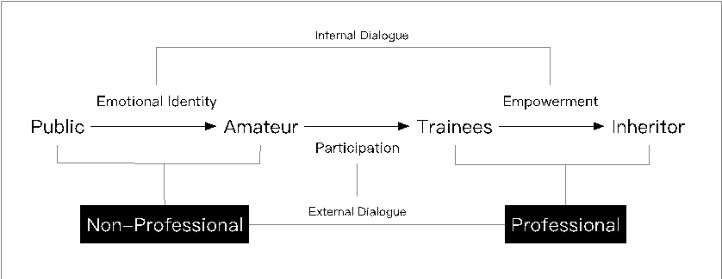
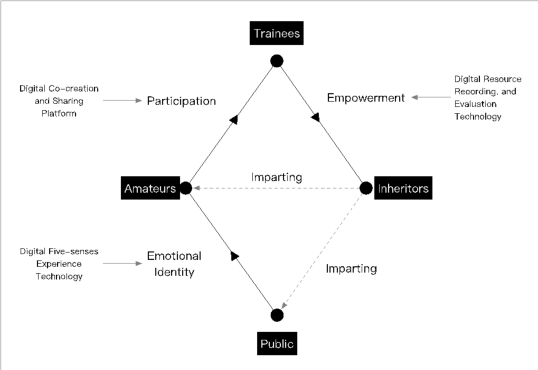
Therefore, the transformation from amateurs to inheritors could also be regarded as the self-growth of the individual. The professionals could be regarded as a relatively perfect “self”, and the non-professional could be treated as a relatively imperfect “self”. While the two kinds of “self” are also as “others” between themselves. In this way, the whole process of trans- forming stakeholders could be separated into two paths: one is the internal dialogue, and another is the external dialogue. The internal dialogue means self to self interaction, which includes the public transforming into amateurs, and trainees transforming into inheritors. The external dialogue means self to others’ interaction, which includes the amateurs transforming into trainees. In particular, the internal dialogue between the public and amateurs needs an emotional identity. Because traditional culture often exists as a cultural or information symbol for the public, and they often need coding and decoding to understand (Yihong and Kun, 2022). However, due to the different coding systems, there is a certain distance between the general public and the cul- ture, forming a dilemma similar to the “adversarial decoding” proposed by the British scholar Stuart Hall. Therefore, the path of transformation from the public into amateurs is to let them build emotional identification when interacting with the culture. Because only in this way, they could generate interest and affection and will have the possibility of being transformed into amateurs.
Amateurs who have established an emotional identity with traditional cul- ture need a platform to interact with professionals so that they can be seen by
834 Wang
professionals and improve their knowledge of culture. Therefore, the exter- nal dialogue for amateurs is participation in relevant cultural activities rather than being satisfied with the initial perception and experience of culture. While for trainees, not only need inheritors’ guidance but also require equal communication and opportunities for creation. Because they are no longer selected for objective reasons such as blood and region, but more because of their own enthusiasm and hobby towards culture. At the same time, Chinese traditional culture has high standards for trainees and the process of becom- ing inheritors. They not only need to inherit the original traditional cultural knowledge and skills but also form the ability to innovate cultural recon- struction (Yuan, 2007). So the trainees have to be empowered by inheritors and they also need to be empowered by themselves. The transforming path of stakeholders in cultural inheritance see Figure 1.
Figure 1: The transforming path of stakeholders in cultural inheritance.
THE STRATEGY OF TRANSFORMING OF STAKEHOLDERS BY DIGITAL TECHNOLOGY Digital Technology Enables Five-Senses Experience to Transform the Public Into Amateurs
Cultural heritage has an aesthetic nature similar to that of works of art, and the emotional identity generated by the public when appreciating cultural products is essentially empathy for the artistic beauty conveyed by the cul- tural products. Dewey once pointed out that the audience’s appreciation of the artwork has a process of “recreation”, which will make the artwork acquire a new aesthetic quality, and this aesthetic quality is an aesthetic experience for the audience (Dewey, 2005, pp. 36–42). The formation of aesthetic experience comes from people’s five senses because people’s percep- tions of the surroundings are often achieved by sight, hearing, touch, smell, and taste. When cultural heritage is an environment that can be experienced, the interaction with the five senses ultimately determines people’s emotional identification with cultural heritage.
The use of digital technology can enrich the multi-sensory interactive expe- rience of people and cultural heritage. With the use of hardware technologies
Digital Technology: As a Manner of Sustainable Transformation for Stakeholders 835
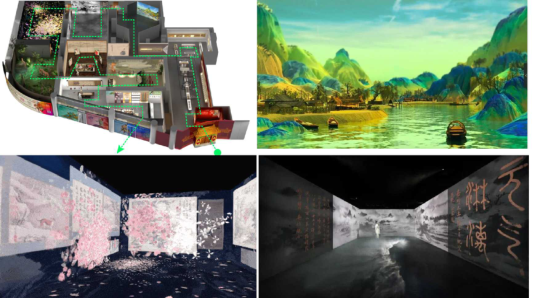
such as light, electricity, and sound, as well as the latest virtual reality, aug- mented reality, three-dimensional modeling, and other software technologies, digital technologies could break the limitations of time, space, and geogra- phy, create immersive interactive scenes, and mobilize the five senses of the general public, which make people feel like they are in the era of the culture, and let them have aesthetic experience of virtual or real presence (Huixia, 2022). Visually, digital technology can expand the user’s experience perspective, such as watching multi-angle cultural heritage shapes, and invisible cultural elements, and produce a visual experience close to the real presence. For example, the Forbidden City’s “Shiqu Baoji”painting digital technology exhi- bition, it designed seven different experience scenes according to the content of the selected classic paintings. In different scenes, they used large digital stereoscopic image technology, AR, MR, holographic multimedia technol- ogy, AI, etc., to reconstruct the characters and scenarios of paintings to let the audience experience three-dimensional, dynamic, and magnified paint- ings. And it can be digitally extended with the space screen and reproduced in the real physical environment. The audience could also enter the painting through the virtual character, which lets the audience feel real existence in the environment of the painting (see Figure 2).
Figure 2: The real visual experience in the “Shiqu Baoji” painting digital technology exhibition.
In terms of hearing, digital technology can simulate the sound of the envi- ronment or scene in the cultural product or use technology to record the sound information of intangible cultural heritage, to increase the experi- ence of auditory presence. In terms of sense of touch, digital technology can provide tactile alternatives to the interaction between people and cultural heritage so that non-touchable cultural heritage can be touched and non- interactive can be interactive. For example, Zhejiang University cooperated with the Yungang Grotto Research Institute to use laser 3D scanning and 3D printing technology to produce the world’s first one-to-one replica of the grotto model. This model is applied in the museum exhibition, allowing the audience to touch the real cave texture and shape, increasing their tactile
836 Wang
experience of culture and making the aesthetic perception more embodied. The digital experience of smell and taste is still in the experimental stage. The main application path is to stimulate the user’s nerve center through dig- ital devices to simulate the perception of smell and taste to increase people’s immersive sense of the environment. Through digital technology, the public could create diverse experiences through different senses, making their per- ception of cultural heritage richer and complete, producing a more extreme aesthetic experience and emotional identity.
Digital Co-Creating and Sharing Platform Promote the Amateurs Transforming Into Trainees In digital culture, co-creation, and sharing have become important ways to promote participation among different stakeholders. When the general public becomes users of digital cultural products, their identity has changed; they are no longer passive standers who only accept technological achievements but become participants who actively propose new needs (Pengju and Yicong, 2022). Co-creation and sharing focus on the participation of both parties, which require amateurs and professionals to provide different resources. Dig- ital technologies, such as digital information collection, blockchain, AI, and network media, can be used without space, material, and skills restrictions so that amateurs and professionals can upload and download digital cultural products at any time. In this way, digital technologies have shortened the space and distance between amateurs and professionals, providing amateurs with opportunities for consultation, cooperation, and display at any time.
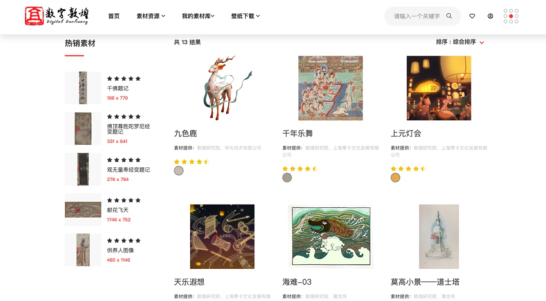
For example, based on blockchain technology, the Dunhuang Academy and Tencent jointly produced the “Digital Dunhuang Open Material Library” for Dunhuang culture lovers and creators. This digital library provides murals and Tibetan scripture cave documents of six important caves, including 6,500 high-definition digital resources, such as mural elements and art photography, as well as a co-creation and sharing platform. Amateurs of Dunhuang culture can not only browse and download the digital content of cave murals at any time to gain depth understanding of the cultural symbols but can also use open Dunhuang cultural materials combined with their own skills for recre- ation. These recreated products could also obtain official evaluation through upload. The selected works can be digitally protected by copyright protection, displayed, and sold on the platform, promoting co-creation between ama- teurs and professionals, and innovating applications of traditional culture (see Figure 3).
Digital Cultural Resources Recording and Evaluation Technology Promote the Trainees Transforming Into Inheritors Unlike the external dialogue between amateurs and professionals, internal dialogue is based on a common situation without cognitive biases, and it focuses more on efficiency. The improvement of the efficiency of dialogue between trainees and inheritors relates to two factors: first, the authentic- ity of cultural information taught by the inheritors themselves; and second, the trainees’ acceptance of knowledge and learning ability. “Authenticity”
Digital Technology: As a Manner of Sustainable Transformation for Stakeholders 837
refers to original, authentic, not replicated, faithful, and not hypocritical characteristics. The “authenticity” of culture means that the form and con- tent contained in traditional culture can be recorded and passed on to its own appearance to the greatest extent (Yisan and Lin, 2003).
Figure 3: The co-creation and sharing platform in the digital Dunhuang website.
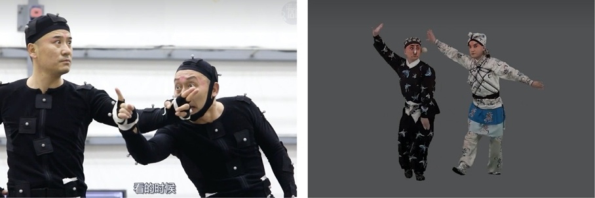
At present, digital technology plays an important role in the training of cultural inheritors in China. Through digital information collection, 3D scanning, digital imaging, virtual reality, digital modeling rendering, and other technical means, the professional has built digital authentic cultural information-sharing teaching resources, and quantitative evaluation mech- anisms for trainees. For example, the Dunhuang Digital Research Institute has recorded the style of Dunhuang murals to the greatest extent through 3D laser scanning technology and established a database of Dunhuang cul- tural documents by using online network technology, to open sharing of Dunhuang cultural resources in China and the world (Jinshi, 2009). The researchers and trainees can not only access the most authentic Dunhuang cultural information but also enable future researchers to continue to obtain original cultural resources without being limited by the erosion of the natural beauty of murals. Ruian City, Zhejiang Province, has established a system for assessing and training non-genetic inheritors by using the online application “Finding Intangible Cultural Heritage Inheritors”. Through “quantitative points and master scoring”, the trainees need to finish online learning and offline participation, and then they can choose inheritors for further study, and when they reach the relevant scores, they can become real inheritors. Digital technology can also empower traditional inheritors to reflect on and improve their existing skills and become innovative inheritors. In the “Digi- tal Peking Opera” project, the professional performing artists of the Peking Opera Art Troupe could watch their own actions, facial expressions, and performing steps through face capture, digital scanning, virtual reality, and real-time rendering models technologies. In this way, the performers could reflect on the quality of one’s own performance from the dual perspectives
838 Wang
of the performer and the audience, which promotes the improvement of their own performance skills (see Figure 4).
Figure 4: The digital record process of Peking Opera performers’ actions.
The Stakeholders’ Transforming Strategy by Digital Technology Through the above analysis, it can be seen that digital technology has played a key role in promoting transformation for stakeholders in cultural inheritance. The general public could immersive cultural experience through five-sense digital technology to establish emotional identity to transform into amateurs. The digital technology could also provide a co-creation and sharing platform for amateurs to participate with professionals to transform into trainees. And it could also help inheritors build digital cultural resources recording, quan- titative evaluation for trainees, and let them being empowered by inheritors and self to transform into inheritors.
It should be pointed out that although the strategies of different transform- ing paths are different, the digital cultural products produced in this process can benefit all stakeholders. The digital five-sense technology not only gives the public an immersive experience but could also inspire amateurs and pro- fessionals to have new ideas about traditional cultural development. At the same time, the digital co-creation and sharing platform not only benefits amateurs, but also gives opportunities to the public to let them understand traditional culture deeply, and it could also let professionals gain more feed- back from non-professionals. While digital resources, qualitative evaluations, and reflection could also be used by the public and amateurs, as a more pro- fessional way to interact with traditional culture and inheritors, not only let traditional culture as a way of entertainment. In this way, amateurs and the public could be guided by inheritors as well(see Figure 5).
CONCLUSION
This article mainly focuses on the importance of digital technology in the process of cultural inheritance and has built a stakeholders’ sustainable trans- forming strategy by digital technology. This strategy gives guidance on how to use different digital technologies to help different stakeholders transform from the public to inheritors to realize sustainable cultural inheritance. The significance of this strategy is to use digital technology not only as a tool for creating cultural products but also as an important manner or trigger
Digital Technology: As a Manner of Sustainable Transformation for Stakeholders 839
for promoting stakeholders’ transformation from the whole. It brings peo- ple to become active users or the main purpose of the technology in cultural inheritance instead of passive acceptors. However, due to the current exces- sive emphasis on culture itself and economic benefits in the field of cultural heritage, and ignoring people’s needs, there are still some issues in the appli- cation of digital technology in promoting sustainable inheritance. Firstly, digital cultural products are homogenized and of poor quality, leading to aes- thetic fatigue among the general public. Secondly, specialized digital cultural platforms are independent of each other, with limited resources, and not con- ducive to cross-platform interaction and sharing. Therefore, it is necessary to enhance the aesthetic experience quality of digital cultural products, to bridge the resource and co-creation barriers of different specialized cultural digital platforms as much as possible, and to give copyright protection to different stakeholders. In order to make digital technology truly become a medium for people’s sustainable transformation in cultural inheritance, rather than a digital hindrance.
Figure 5: The stakeholders’ transforming strategy by digital technology.
ACKNOWLEDGMENT
The author would like to thank Junqing Wei for the case study suggestions, and Jiayou for language helping.
REFERENCES
Bakhtin, M. (1988) Problems of Dostoevsky’s poetics. Translated from the Russian by Emerson, C. Minnesota: The University of Minnesota Press. Dewey, J. (2005) Art as experience. New York: Penguin Group. Fuxiang, L. (2012) ‘Conservation of intangible cultural heritage in the context of
dialogue theory’, Journal of Sichuan Institute of Education, 28(04), pp. 51–55.
840 Wang
Haiou, Z. (2021) ‘The protection of China’s intangible cultural heritage is remarkable’, People’s Daily, 12 June, p. 8. Huixia, C. (2022) ‘Research on immersive experience design of the museum in the
era of digital cultural tourism: A case study of China Grand Canal Museum in Yangzhou’, Cultural Relics Identification and Appreciation, 13, pp. 46–49. Jinshi, F. (2009) ‘Application of digital technology in the protection and display of Dunhuang grottoes’, Dunhuang Research, 06, pp. 1–3. Lu, W. (2018) “Beijing Opera Cultural Heritage: A Service Design Perspective”,
proceedings of the Tenth Annual Symposium of the International Conference on Cross-Cultural Design. Las Vegas, NV. Pengju, W. Yicong, Z. (2022) ‘The value co-creation of the digital cultural economy’, Jiangxi Social Sciences, 42(07), pp. 156–167, 208. Qingfu, Q. (2006) ‘On the inheritance and inheritors in the protection of intangible
cultural heritage’, Northwest Ethnic Studies, 03, pp. 114–123, 199. Ting, S. Siqi, C. (2021) ‘Application of VR technology in the digital inheritance of Grand Canal culture’, Electronic Technology and Software Engineering, 06, pp. 132–133. Wu, X. et al. (2018) “Digital Inheritance of the Traditional Dulong Culture in
Yunnan based on Gesture Interaction”, proceedings of the Second Annual Sympo- sium of the International Conference on Mechatronics and Intelligent Robotics, Kunming, Yunnan. Xiaona, M. La, T. and Yingqing, Xu. (2019) ‘Current situation of digital development of intangible cultural heritage’, Science in China: Information Science, 49(02), pp. 121–142. Xin, P. (2014) ‘The practical dilemma and innovation strategy of traditional culture
inheritance in the new media era’, Jiangxi Social Sciences, 34(12), pp. 233–238. Xuebin, A. (2007) ‘The historical value and contemporary habitat of national culture inheritors’, Journal of Yunnan University (Philosophy and Social Sciences), (06), pp. 18–22. Yihong, Z. Kun, S. (2022) ‘The obstruction of intangible cultural heritage inheri-
tance and the application of metaverse immersive scenes’, Jiangxi Social Sciences, 42(08), pp. 180–189. Yisan, R. Lin, L. (2003) ‘The principle of the authenticity of cultural heritage protection’, Journal of Tongji University (Social Science Edition), 02, pp. 1–5. Yuan, Li. (2007) ‘Concerns about the protection of inheritors of intangible cultural
heritage’, Exploration and Controversy, 07, pp. 66–68. Zhang, L. et al. (2022) ‘Master Su: The sustainable development of Su embroidery based on digital technology’, Sustainability, 14(12), pp. 70–94.
LISTED IN THE AHFE DIGITAL BOOKSTORE CATALOGUE
Explore the complete digital volume
Intelligent Human Systems Integration (IHSI 2024): Integrating People and Intelligent Systems
Read this individual research paper free through the original publisher, or explore the full digital proceedings book.
ISBN 978-1-958651-95-7
Explore this ISBN in the AHFE Bookstore ↗Listed in the July 2026 bookstore catalogue; search by ISBN to confirm current availability · Digital book purchase optional