Jiang Hui, Eakachat Joneurairatana (2024). Teaching Reform Practice Empowered by Digital Technology in Local Intangible Cultural Heritage Aesthetic Education Courses. In: Human Factors in Communication of Design. AHFE Open Access, vol. 136, pp. 103–113. https://doi.org/10.54941/ahfe1004973
The local non-heritage aesthetic education course is an important way to inherit and innovate the non-heritage culture. In the present time when digital technology promotes the development of the society, based on the organic combination of teaching concepts of design theory, professional skills and digital technology practice, we put forward the teaching reform of the local non-heritage aesthetic education course, improve the teaching system on the basis of the integration and structural optimization of the course content, enrich the means of teaching, and explore a new mode of teaching the course, so as to let the students better self-improvement in digital growth and cultivate talents for the digital era.
Intangible cultural heritage, as an important part of China’s national cultural heritage, is a living cultural resource centered on human beings, an important carrier of regional culture and spiritual qualities, and a valuable resource for carrying out aesthetic education teaching work in the new era. As a base for cultivating vocational skills talents, Chinese higher vocational colleges and universities, building local intangible cultural heritage aesthetic educa- tion courses is not only an important way to inherit and innovate intangible cultural heritage, but also an important way to set off a new climax of China’s socialist cultural construction, firm up cultural self-confidence, and promote cultural development.
The creation and development of digital technology has become an impor- tant driving force for profound economic and social changes, and vocational education, which is closely related to economic and social development, has also undergone significant changes, entering the era of rapid digital devel- opment, and the new form of “digital technology + vocational education” is gradually taking shape. The introduction of the Action Plan for Improv- ing the Quality and Excellence of Vocational Education (2020–2023) further
clarifies the need to satisfy the diversified learning needs of students, vigor- ously promotes the new form of “digital +” education, and pushes forward the change and innovation of education and teaching. Therefore, for the local intangible heritage aesthetic education courses, in the case of digi- tal empowerment course teaching transformation, to promote innovation through integration, to build a highly innovative and creative digital teaching mode will become the main performance and development trend of aes- thetic education teaching in higher vocational colleges and universities at this stage.
LITERATURE REVIEW
The Current Situation of Research Related to Digital Teaching of Intangible Cultural Heritage in China For the study of intangible cultural heritage, Chinese scholars’ research results are more fruitful, and constantly strive to explore and seek the direction and strategy of the development of digital education, the current research mainly focuses on the construction and application of digital teach- ing resources and the digital application of intangible heritage, about which there are mainly the following relevant research.
Research on promoting the construction of digital teaching resources in higher vocational colleges and universities. Some studies believe that teach- ers should be encouraged to conduct teaching research on digital resource construction and application, based on resource development (Zhang, 2022); others need to strengthen the application of digital teaching resources, and must promote the deep integration of digital technology and the teaching process (Tan, 2017).
Relevant studies on the issue of the digital foundation of intangible her- itage. There is a study that proposes the important role of digital technology in the protection of intangible heritage (Huang, 2018); there is also a study that believes that in the teaching of intangible heritage, the integration of modern educational technology and teaching needs to be strengthened, and that the means of displaying intangible heritage utilized in the classroom are relatively single (Li, 2020).
Exploratory research on the integration of local intangible heritage cul- ture into the aesthetic education of colleges and universities. One study proposes that the integration of local intangible heritage cultural elements is an innovative path for the deep integration of China’s outstanding tra- ditional culture and aesthetic education in colleges and universities, which is of great significance for the youth of the new era to strengthen cultural self-confidence, pass on the spirit of the nation and cultivate aesthetic inter- est (Tang, 2023); This research points out the rich aesthetic implication in intangible cultural heritage, and the design and practice of the aesthetic value and living inheritance of intangible cultural elements are conducive to the enhancement of the aesthetic scrutiny ability of contemporary society (Ca, 2022).
Teaching Reform Practice Empowered by Digital Technology 105
Current Status of Research Related to Digitalized Aesthetic Education Teaching in Other Countries Around the World From the perspective of literature research, the study on the use of mod- ern technical means to protect intangible heritage has started very early in the international arena. In the mid-1980s, Fielding Raymond conducted an in-depth analysis and introduction of film special effects from various per- spectives, such as creation techniques and design methods, in the course of his research on film and television lenses. In 1992, Besl proposed a mod- elling and analysis method for multiple images, using the analysis method of 3D geometric models to complete the stereoscopic analysis of multiple images. In 2000, Marc Levoy et al. carried out a study on the digitisation of the Michelangelo project. In 2000, Marc Levoy et al. conducted a study on the digital Michelangelo project, which was the first study of cultural heritage using digital technology, including data acquisition, digital process- ing, restoration, reproduction and display. The study played a key role in promoting the digitisation of cultural heritage, and also provided effective guidance for subsequent studies. In 2007, Pavlidis et al. proposed that the digital preservation of cultural heritage is a multidimensional and complex process, which generally consists of three phases. They analysed and com- pared the digital preservation of cultural heritage and the digital preservation of common entities, and elaborated the characteristics and common methods of digital preservation of cultural heritage. In 2009, Javier Gomez-Lahoz et al. researched on the types of digital acquisition of cultural heritage and the con- struction of its scenes, and designed and developed a flexible, easy-to-use and low-cost 3D digitisation system.
In addition, major countries in the world have gradually raised the digi- tisation of education to the level of national strategies and incorporated it into their national digital development goals. The United States, as an early adopter of education digitisation, attaches great importance to the role of technology in education compared with other countries, having launched five rounds of national education technology plans and released the Horizon Report 2022: Teaching and Learning Edition. In terms of strategic focus, the United Kingdom attaches more importance to reconfigurable learning space, diversified teaching and learning modes and multiple guarantees of data secu- rity; South Korea attaches more importance to building digital platforms, digitally empowered teaching and learning and digital evaluation; Singapore attaches more importance to improving the digital skills of teachers, pro- moting the construction of digital curricula and the application of digital assessment, and has continued to put forward a national-level strategy for the digitalisation of education since the 1990s, the Reliance on university aes- thetic education programme materials is relatively small. Countries are also protecting their cultural heritage and traditional culture to varying degrees, and many experts are speaking out in different fields in different times, while the degree of promotion of digital education varies for various rea- sons, but there is very little research into aesthetic education programmes in schools.
106 Jiang and Joneurairatana
By combing through the implementation of teaching policies adapted to the digital era in various countries, conducting research on the use of dig- ital media technology in the classroom and teaching practice, as well as exploratory research on the construction and application of digital teach- ing resources in China’s higher vocational colleges and universities and the digital application of non-legacy heritage, we find that digital teaching has become an important part of the pedagogical reform of the countries around the world, and that in the case where the traditional education can no longer satisfy the needs of the digital growth of the students, and the The traditional education can no longer meet the needs of students’ digital growth, and can- not meet the cultivation of people in the digital era, so digital teaching is needed to promote the development of education, so that students can better obtain self-improvement in digital growth, and cultivate talents for the digital era. Similarly, for local intangible heritage aesthetic education courses, incor- porating digital means is a flexible, personalized, convenient and efficient teaching method, using online platforms, digital resources, network teach- ing and other ways to make the promotion of intangible heritage culture more popular, and at the same time provide more innovative teaching and dissemination methods.
RESEARCH FRAMEWORK AND METHODOLOGY Research Objectives
Based on the relevant research results and teaching practice, this paper focuses on the research of “digital technology empowers the teaching reform practice of local intangible cultural heritage aesthetic education courses” and sets three objectives: To study the necessity of digital intangible cultural heritage aesthetic edu- cation teaching and to improve the quality of intangible cultural heritage aesthetic education teaching.
To construct a feasible application mode of digital technology in local intangible cultural heritage aesthetic education courses, to solve the deficien- cies of the existing teaching mode and to improve the teaching content and methods.
To put forward teaching reform strategies and suggestions for digital technology-enabled local intangible cultural heritage aesthetic education courses, and to promote the sustained promotion and stable development of aesthetic education teaching reforms with a long-term development goal in mind.
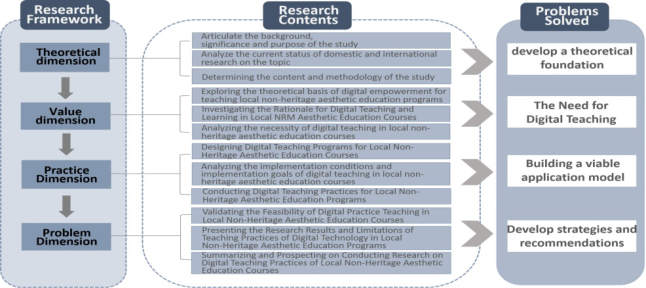
Research Ideas This research originates from the long-term concern about the real problem of intangible heritage protection and inheritance, and takes the reflection on the organic integration and mutual development of local intangible heritage cultural heritage protection and inheritance and college aesthetic education class as the entry point, intends to select the typical and representative intan- gible heritage and aesthetic education teaching and integration of the Wu
Teaching Reform Practice Empowered by Digital Technology 107
culture region as the research object in a typical situation, and puts forward the empirical problems and then enters the theoretical level of the compilation and integration, and summarizes and extracts the research discoveries in the gradual and progressive explanatory In a gradual and progressive explana- tory cycle, we summarize and refine the research findings and respond to a series of research questions, from which we explore the interactive process, co-creative mechanism and its impact effect of digital technology-enabled local aesthetic education courses, with a view to providing possible refer- ences and practical guidance for the high-quality fusion of local NRL culture and professional development of art students in colleges and universities.
Figure 1: Thesis research ideas.
Methods
Combined with the specific research reality of “digital technology and the teaching reform of local intangible heritage aesthetic education courses”, this study chooses the orientation of case study, combining data collection method, qualitative research method, comparative analysis method and other methods to understand the research object in a planned and systematic way, and to analyze, synthesize, compare and summarize the research information.
Scope of the Study This study takes a Chinese higher vocational college as a case study, observes and understands in depth the situation of the school’s local intangible her- itage aesthetic education course offerings, the situation of digitalization and local intangible heritage aesthetic education course teaching, analyzes the phenomenon, finds the problems, and then looks for the ideas and methods of the teaching reform of digitization and local intangible heritage aesthetic edu- cation courses to help the students learn the local intangible heritage aesthetic education courses in a more efficient way.
Data Collection Method Research tools The researcher used a variety of data collection tools to collect information about school teachers and students before and after digital teaching of the
108 Jiang and Joneurairatana
local intangible heritage aesthetic education curriculum. These tools included information sheets and interview questionnaires for teachers and students in schools, both in paper form and electronically scanned via QR codes.
Suitable questionnaires were designed around the research questions, and a comprehensive analysis was conducted based on the observations and inter- views to adjust and optimize the questionnaire design, sample questionnaires, and analyze the collected questionnaire data to find out the factors affecting the combination of digital technology and the teaching of local INTANGI- BLE HERITAGE aesthetic education courses, and to provide a basis for the construction of a framework model suitable for the combination of digitiza- tion and the teaching of local INTANGIBLE HERITAGE aesthetic education courses.
Questionnaire contents 1. Questionnaire for students taking local intangible heritage aesthetic edu- cation courses, including interest in the current status of the course, satisfaction, demand, and so on. 2. A questionnaire for teachers of local intangible heritage aesthetic educa- tion courses, containing the importance of the course, teaching condi- tions, their own development, etc. 3. An evaluation form for assessing group awareness and sample group satisfaction of activities before and after digital teaching.
Qualitative Research The researcher is mainly engaged in the teaching of local intangible heritage arts and crafts courses, and has long been concerned about and actively par- ticipated in the combination of digitization and local intangible heritage arts and crafts teaching carried out by the school, which provides a guarantee for the researcher to enter into the research site of the cultural courses to carry out investigations and research on the corresponding courses. Taking the Chinese higher vocational college where the researcher works as the background, and taking the course of “Wu Di Intangible Heritage Arts and Crafts” as a sam- ple, the researcher has adopted a variety of different ways of collecting and organizing data. Based on this, an in-depth study and analysis of digital intan- gible heritage teaching is completed, conclusions and theories are developed, and an interpretive understanding of the application and meaning construc- tion of digital intangible heritage teaching is gained, in order to explore the feasibility of digitization in the teaching of local intangible heritage aesthetic education courses.
Comparative analysis method is used to analyze the digital unfolding of INTANGIBLE HERITAGE in teaching and learning in terms of preparation for teaching, classroom feedback, and teaching outcomes.
RESULTS AND DISCUSSION
In this section, the results of the teacher-student interview questionnaire will be analyzed and discussed, not to mention the current status of teaching in the school curriculum, teaching reform ideas, and content practice.
Teaching Reform Practice Empowered by Digital Technology 109
Faculty and Student Interview Questionnaire Analysis and Discussion Analysis of Student Questionnaire The student questionnaire mainly investigated the satisfaction level of 107 students (3 classes) with the course content, teaching environment, and teach- ing methods of “Wu Di Intangible Heritage Arts and Crafts”. The results of the questionnaire show that students’ satisfaction with the teaching content is generally high, while their satisfaction with the teaching environment and teaching methods needs to be improved.
Table 1. Statistical table of students’ satisfaction with the program.
Table available in the original PDF paper.
Satisfactory General Unsatisfactory total Number Percent Number Percent Number Percent Number Percent 32 29.9 57 53.3 18 16.8 107 100
Teacher Questionnaire Analysis The teachers’ questionnaire mainly investigates the teachers’ satisfaction with the course content, teaching environment and teaching methods of “Wu Di Intangible Heritage Arts and Crafts”. The results of the questionnaire show that teachers’ satisfaction with the course content is generally high, while their satisfaction with the teaching environment and teaching methods needs to be improved.
110 Jiang and Joneurairatana
In the teachers’ interview surveys, investigations and analyses of the prac- ticality of the curriculum, the mode of delivery, and the use of new media showed that some teachers had obvious deficiencies in technological compe- tence, instructional design, and awareness of updating, and that the lack of relevant training and support might have led to teachers’ uneasiness or lack of confidence in digital technology, and their lack of the ability to use the technology to track students’ progress and to provide personalised feedback. Addressing these shortcomings requires schools to provide ongoing support and training to help teachers improve their ability to use digital technologies and to encourage them to continually innovate and improve their teaching practices. At the same time, teachers also need to be self-learning and actively seek relevant knowledge and skills to adapt to the development of digital teaching and learning.
Problem Analysis of the Teaching Reform of Local Intangible Heritage Aesthetic Education Courses by Digital Technology A comprehensive analysis of the answers to the multiple-choice and question- and-answer questions in the above questionnaire survey shows that there are some problems in the teaching of digital technology in the local intangible heritage aesthetic education courses in schools, which need to be reformed.
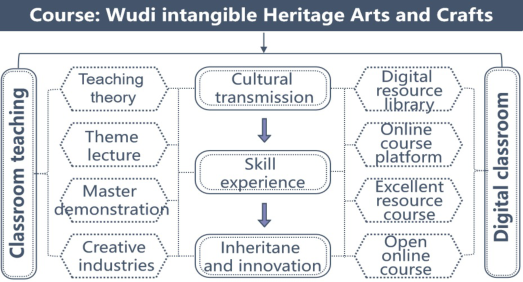
General Idea of Digital Teaching Reform In view of the existing problems in the local intangible heritage arts and crafts courses, increase the professional design and practical training on the basis of the existing theoretical teaching, give full play to the advantages of the relevant resources and technology in the digital era, integrate into the teach- ing system, reform the course teaching content structure, teaching concepts, teaching methods, teaching evaluation, etc., so as to form a composite talent cultivation system that is adapted to the requirements of the digital era and conforms to the development trend of the industry.
Figure 2: Sample teaching reforms for digital courses.
Teaching Reform Practice Empowered by Digital Technology 111
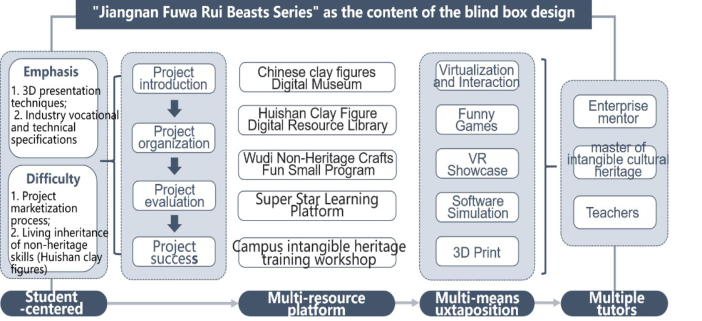
Digital Teaching Reform Content and Practice Taking the blind box design of “Jiangnan Fuwa Rui Beasts Series” in “Wu Di Intangible Heritage Arts and Crafts” as the content, we help students complete the learning objectives through digital technology.
Figure 3: Sample digital instructional design.Figure 4: Sample course digital resources.
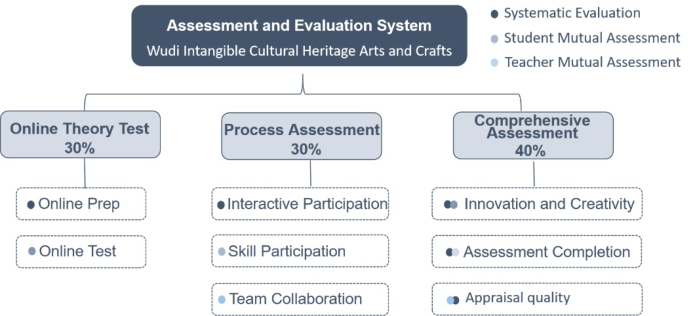
Digital Assessment and Evaluation System Improving the teaching strategy of local intangible heritage aesthetic edu- cation courses in schools means taking the initiative to explore the deeper and higher-level application of digital technology in teaching, improving the teaching method, changing the teaching structure, and promoting the cur- riculum change.The course makes full use of digital means, enriches the classroom teaching form, strengthens the weight of process assessment (par- ticipation + perception), improves the average attendance rate of students,
112 Jiang and Joneurairatana
classroom activity, establishes the evaluation mechanism for the effectiveness of digital learning, continuously improves the teaching practice, and pro- motes the achievement of the teaching objectives; and adopts the “dual-line” evaluation method of online and offline, theory and practice.
Figure 5: Sample course digital assessment.
The Basic Principle of Digital Technology to Local Intangible Heritage Aesthetic Education Curriculum Reform Digital technology plays an important role in the curriculum reform of local intangible cultural heritage. Through integrating resources, providing interactive experience, personalized support and promoting exchanges and cooperation, digital technology promotes the inheritance and development of intangible cultural heritage and enrichis the form and content of aesthetic education.
CONCLUSION
With the wide application of artificial intelligence, digital technology and other technologies in education, the pace of smart campus construction is getting faster and faster, and the construction of integrated and intelli- gent teaching, management and service platforms is becoming more and more an important task in the modernization and development of Chi- nese higher education.In the future, Chinese universities should continue to pay more attention to the reform and development of educational digiti- zation.The teaching reform of local intangible heritage aesthetic education courses empowered by digital technology advocated by this institute is a positive attempt to build an intelligent education, management and service platform for colleges and universities.
ACKNOWLEDGMENT
This research was facilitated by the Doctor of Philosophy Program in Design at the Faculty of Decorative Arts, Silpakorn University. We sincerely thank
Teaching Reform Practice Empowered by Digital Technology 113
Prof. Dr. Eakachat Joneurairatana and other professors who provided valu- able guidance during our research. This research was supported by the Higher Education Teaching and Learning Reform Research Project (General), Jiangsu Province, 2023, under Grant No. 2023JSJG549.
REFERENCES
Cai Zheng, Xu Zheng, Gui Xin. The value of aesthetic education and inheritance practice of local non-legacy Wanzai Nuo culture [J]. Silk Screen Printing. 2022, (16), 23–28. He Jiangyang, Zhang Hongping, Wang Liulei. Exploration on the way of regional
culture integrating into the construction of aesthetic education in colleges and universities-taking Nanjing as an example [J]. Popular Literature and Art, 2021(21):144–145, 148. Jia Tong, Gu Xiaoqing. Comparative study of education informatization strategy - an international comparison based on five countries: the United States, the United Kingdom, Australia, Japan and New Zealand [J]. Research on Electrochemical Education, 2018, 39(07): 121–128. Liu Wei, Song Reeds, Huang Jiali. Influencing factors and mechanism of teacher
trainees’ willingness to use online teaching--A survey based on teacher trainees in 13 universities [J]. China Higher Education Research, 2021(8): 48–55. Ng’Ambi D, Bozalek V. Editorial: Massive open online courses (MOOCs): Disrupting teaching and learning practices in higher education[J]. British Journal of Educational Technology, 2015, 46(3):451–454. Pan Tianbo. Chinese koanology: history, logic and form [J]. Research on Ethnic Arts,
2019(4): 91–98. Reigeluth, C. M, Beatty, B. J, &Myera, R. (Eda). (2016). Instructional-Design Theories and Models, Volume IV: The Learner-Centered Paradigm of Education [M]. New York. Doubleday. Tan Zhichao. Open Digital Teaching Resources Construction in Higher Vocational
Colleges and Universities Based on Cloud Computing [J]. Journal of Hunan Mass Communication Vocational and Technical College. 2017, 17(06), 102–106. Tang GQ, Lei YX. Exploratory Study on the Integration of Local Non-legacy Culture into Aesthetic Education in Colleges and Universities--Based on the Examination of Linwu Local Opera [J]. China Ethnic Expo. 2023, (09), 94–98. U. S. Department of Education, Office of Educational Technology. E-learning:
Putting a world-class education at the fingertips of all children [EB/OL]. http://www2.ed.gov/about/offices/list/os/technology/reports/elearning.html,2017- 02-18 Wang Dan, Zhang Yu. Research on the Protection of Intangible Cultural Heritage Inheritors under Age Structure-Based on the Perspective of Quantitative Analysis [J]. Journal of Qinghai University for Nationalities, 2022(1): 12–15. Wang Yichuan. Aesthetics and aesthetic education [M]. Beijing: Central Radio and
Television University Press, 2008:90. Zhai Yun, Jiang Minjuan, Wang Weiling. Theoretical Explanation and Operation Mechanism of Digital Transformation in China [J]. E-government, 2021(6): 67–84. Zhang Zhiqiang. Digital storage and management of library documents[J]. Culture
Industry, 2023(33), 123–126. Zhong Weidi. Data-driven assessment of core literacy: Origin, dilemma and breakthrough [J]. China Electronic Education, 2022(12): 35–43.
LISTED IN THE AHFE DIGITAL BOOKSTORE CATALOGUE
Explore the complete digital volume
Human Factors in Communication of Design
Read this individual research paper free through the original publisher, or explore the full digital proceedings book.
ISBN 978-1-964867-12-0
Explore this ISBN in the AHFE Bookstore ↗Listed in the July 2026 bookstore catalogue; search by ISBN to confirm current availability · Digital book purchase optional