Xiaoyu Guo, Yuyang Jiang, Yawei Hao (2024). Visual Pictures and Digital Technologies in the Digital Anthropocene: Development, Analysis, and Critical Reflection. In: Human Factors in Communication of Design. AHFE Open Access, vol. 136, pp. 29–38. https://doi.org/10.54941/ahfe1004966
This paper explores the favorable effects of visual pictures and digital technology, while critically reflecting on visual pictures and digital technology to warn humans of potential threats we may confront in the Digital Anthropocene. We cite W.J.T. Mitchell’s theory of the “pictorial turn” and Don Ihde’s phenomenology of technology to explore the development of visual pictures and the relationship between humans and visual pictures and technology, respectively. Our study focused on the visual pictures and application of digital technologies through pertinent literature and case studies. Based on these explorations, we advanced a novel viewpoint termed “non-anthropocentric intelligent technology-oriented design,” aiming to reveal the subject-object relationship between humans and technologies and how humans can escape the hegemonic control of digital beings. The current research indicates that with the support of digital technologies, visual pictures are characterized by multidimensionality, diversity, and temporally-spatially adaptability. Immersive design, formed by the deep integration of visual pictures and technologies, brings humans a more abundant visual experience. In addition, AI-assisted design also unleashes humans’ creativity and improves efficiency. Nevertheless, as the transmission of the era of “the mimetic domain” from “the picture domain” intensifies the digital gap, excessive visual pictures impose high visual pressure and cognitive crisis on humans. AI-assisted design also replaces low-quality labor and restructures design teams. However, the subject-object relation between humans and visual pictures and technologies is gradually blurring in the progress of digitization. Maintaining humanity amid the digital wave of visual pictures and technologies is to maintain humans’ free will and adhere to ethical principles in design. One crucial future direction is to explore the ethical dimensions of digital picture production and the intricate relationship between digital technologies and human embodiment.
in various visual forms. Aristotle believes that vision is the most important thing for human beings, and they are the most important discourse system for humans to gain visual experience and perceive the world. The transition from tactile to visual occurs when the eye replaces the hand in the hierarchy of senses when we learn to trust visual pictures rather than the objects they represent. Pictures are the unity of materiality and spirituality. The material support is the condition for the survival of the image (Martinengo, 2015), and spirituality reflects human cognitive levels, world views, and values in different cultural contexts.
Current research has made significant progress in the application of digital technology in visual pictures and the concept of the Anthropocene. However, there are significant differences in the critical reflection of digital technology and visual pictures. Therefore, this study introduces the concept of “Anthro- pocene” and analyses the development and crisis of visual pictures that are driven by digital technology. The objective of this research is to examine not only the favorable aspects of contemporary visual pictures and digital technology, but also to warn people to treat digital technology and digital pictures objectively and pay attention to the subjective and objective relation- ships between humans, technology, and pictures. In the first part, we briefly summarize the relevant literature research on visual pictures and the Digi- tal Anthropocene. In the second part, we explore the current development and threats of visual pictures and technology in the Digital Anthropocene through case analysis. The third part combines the literature review and case studies to reflect on human factors in the Digital Anthropocene and proposes a new theory to reflect on design ethics between humans, visual pictures, and technology. The fourth part introduces the research results and future work.
Literature Review
We live in a world of excess image (Molesworth, 2003). Historically, our contemporary life is filled with numerous forms of images and pictures from the past to the present. Images show the image of society and community (Zanker, 1998). Before the integration of the world and the formation of the capitalist world market, all ethnic groups in the world were in a state of relative isolation. Most ethnic groups were limited to small settlements in specific areas for production and life. However, people still needed to use images to record events for simple communication. Most of the visual images in this period were recorded simply and intuitively. For example, the Oracle Bone Inscriptions in the Shang Dynasty of China have the characteristics of intuitiveness and realism as pictorial characters and are recorded through media such as tortoise shells and animal bones. Since then, the communi- cation media of written information gradually developed into media such as bronzes, rocks, bamboo slips, and so on. It was not until the invention of engraving and printing during the Tang Dynasty that image information could be transmitted with the help of paper, an efficient and economical medium. Technology has become an important factor in promoting the spread of images. On the other hand, in Western countries, in the early days, handwriting was also recorded on media such as clay, pottery shards, papyrus, and vellum. It was not until the invention of movable metal type
Visual Pictures and Digital Technologies in the Digital Anthropocene 31
printing by Johannes Gutenberg in the mid-15th century that the traditional way of recording images was changed.
With the completion of the First Industrial Revolution, visual pictures and technology ushered in revolutionary development. The increasingly frequent activities of human production and life, commerce and trade, and social interactions have put forward new requirements for image expression. The liberation of productivity and technology has also created new visual picture styles and expressions. The world’s first photograph was captured by Joseph Nicéphore Niépce in the 19th century and changed the way of recording and carrying images. Pictures can be more impactful than words, and photogra- phy is a great vessel that students and adults can utilize it to vocalize what they deem important in society (Ballenger, 2014). With the popularization of technology and the gradually expanding market demand, photography has gained a decisive position and created a new chapter in the history of art and design. The information technology revolution has once again unleashed an explosion of visual images, and the way humans understand and record the world has also shifted from language to images. Mitchell (1995) points out that it does seem clear that another shift in what philosophers talk about is happening, and that once again a complexly related transformation is occur- ring in other disciplines of the human sciences and the sphere of public culture (Mitchell, 1995). And he called this shift “the Pictorial Turn”. The proposal of this theory reflects scholars’ reflection on the narrative way of the cultural context at that time. The author reckons that “the Pictorial Turn” is not a return to naive mimesis, copy or correspondence theories of representation, or a renewed metaphysics of pictorial “presence”: it is rather a postlinguis- tic, postsemiotic rediscovery of a picture as a complex interplay between visuality, apparatus, institutions, discourse, bodies, and figurality (Mitchell, 1995). Bertolini (2015)also proposes that within the realm of visual culture studies, art, and images have been the object of critical and theoretical inves- tigations leading to the shared acknowledgment of the contemporary era as the moment of an “Iconic Turn” (“ikonische Wende,” as Gottfried Boehm says) or a “Pictorial Turn,”(Bertolini, 2015). The author hypothesizes about the connection between the idea of a turning point and the concept of cri- sis and investigates the relationship between the “Pictorial Turn” and the project of “critical iconology” or critique of visual culture. The research gap lies in the need for a critical approach to understanding the implications of the “Pictorial Turn” in the broader context of visual culture and reality representation.
Mitchell’s “Pictorial Theory”illustrates that pictures have mastered human visual hegemony. Gombrich (1972) points out we are bombarded with pic- tures from morning till night (Gombrich, 1972). In a contemporary society where image generation technology is highly developed, with the progress of science and technology and the further popularization of computers (Wang, 2018), we receive a variety of images produced by digital devices every day, and the current research pays attention to the relationship between digi- tal images and human interaction, cognition, experience, and so on. Isgro et al. (2004) focus on a study in the field of 3D image processing, partic- ularly immersive telecommunications like video conferencing and television
on human interactions. Chakraborty, Cheng, and Javed propose a unified framework called 3D Visual Proxemics Analysis (VPA3D), for detecting and classifying people’s interactions from a single image. (Chakraborty, Cheng, and Javed, 2013). This research focuses on how to accurately identify human 3D interactive behaviors from a single image and broadens related research in the field of image and human interaction. Tong (2021) investigates the function of omnidirectional vision sensors in capturing characteristic details of the surrounding environment for image design and using omnidirectional visual sensors to enhance the human sensory experience. Moreover, with the development of immersive design in recent years, visual pictures have also affected human cognition and emotions through different media and forms. It not only enriches the human visual experience but also gives visual pictures a new life. VR is a technology with many interactive possibilities, especially in an immersive approach related to 3D images and sound, but also with the possibility of encompassing other human senses and perceptive chan- nels (Rubio-Tamayo et al., 2017). Meanwhile, Marcolin et al. (2021) also point out that virtual reality (VR), from its beginnings, aimed at stimulating all human senses: not just the visual channel (Marcolin et al., 2021). These studies examine how VR evokes specific emotions.
The explosive development of science and technology in the field of visual design and human activities at the beginning of the 21st century not only resulted in an outpouring of pictures but also had a significant impact on the earth system. Because human activities have also grown to become significant geological forces, for instance through land use changes, deforestation, and fossil fuel burning, it is justified to assign the term “Anthropocene”to the cur- rent geological epoch (Crutzen, 2006). Crutzen (2006) proposes the concept of the Anthropocene and emphasizes its geological and environmental influ- ence, but this study does not involve the digital technologies in this epoch. Subsequently, Zalasiewicz et al. (2010) point out that the term “Anthro- pocene” has been widely used since people gradually became aware of the effect of their activities on the geological environment. Steffen et al. (2011) provide a historical account of the Anthropocene’s development as a scien- tific concept. However, the above literature lacks research exploring the role of digital technology in the Anthropocene.
Based on the examination of the environmental changes of the earth, Mirzoeff (2014) analyzes different kinds of artworks and visual cultural phe- nomena to reflect on the Anthropocene. In addition, this research not only delves into how people perceive their influence on ecological health but also draws attention to the significance of this perception in the existing envi- ronmental crisis. In 2015, some artists and critics started to pay attention to the function of design, art, and pictures in the Anthropocene. As pointed out by Anderson (2015), the long-term impacts of technology and modern- ization can be studied through design and art. Apart from that, this research mainly discusses how critical, conceptual, and speculative design can improve public perception of environmental problems and underscores the responsi- bility of artists in the digital era. Beyond that, the term Digital Anthropocene is adopted to uncover the role of digitalization in the associations between mankind and the ecology context. By exploring the impact of digital tech- nology on society and culture, McLean (2020) redefines human identity in
Visual Pictures and Digital Technologies in the Digital Anthropocene 33
the digital era and examines the methodology and research areas of the Dig- ital Anthropocene as well as how the world is changed by digitalization. At the same time, based on the previous research, Creutzig et al. (2022) claim that digitalization has speeded up the development of human society and will significantly influence the future progress. In the same vein, Nakicenovic (2019) argues that the digitalization has altered and accelerated humanity’s influence on social issues such as energy consumption, resource distribution, employment market, and social interaction, and will greatly determine the Anthropocene’s future road. All in all, these studies have offered unique per- spectives for examining the development and crisis of visual pictures and technology in the Digital Anthropocene.
Case Study Based on previous research, we selected some representative cases centered around human interaction and human experience to dialectically analyze the development and threats of visual pictures and technologies.
Visual Pictures and Human Interaction
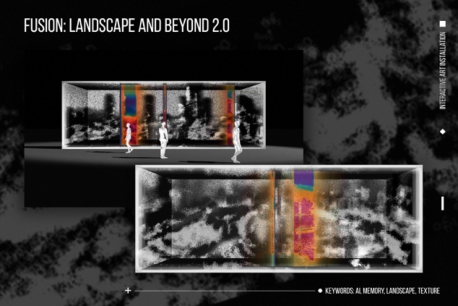
1. Fusion: Landscape and Beyond 2.0 by Mingyong Cheng, Xuexi Dang, and Zetao Yu.
Fusion: Landscape and Beyond 2.0 (Cheng, Dang, and Yu, 2023), as shown in Figure 1, is an interactive art installation that uses AI-generated digital visual pictures to present our relationship with urban and natural landscapes. Viewers move through the installation to trigger AI to gener- ate real-time changing pictures, showing multiple views of urban landscapes and natural scenery. The installation combines the aesthetics of traditional Chinese landscape painting with the Chinese philosophy of the harmony between humans and nature. The project emphasizes the symbiotic relation- ship between humans, AI, and the natural world, using a self-fine-tuned Stable Diffusion model and real-time visualization system to create visual pictures with the aesthetics of Chinese landscape painting.
Figure 1: Fusion: landscape and beyond 2.0 by Mingyong Cheng, Xuexi Dang, and Zetao Yu (image from: mingyongcheng.com).
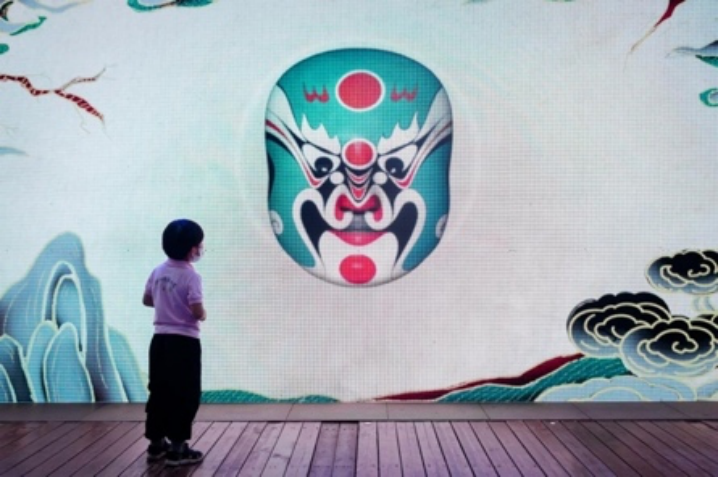
2. The Impression of Cities: Xi’an by Data Driven Life In today’s cultural communication application scenarios, audiences increasingly need a good live experience (Zhang and Guo, 2022). Data Driven Life (2022), a team of recent graduates in design informatics, has designed a digital visual interactive installation, The Impression of Cities: Xi’an, which is located in Xi’an, China. The installation combines aesthetic aspects of traditional Qinqiang culture with new media and includes three interactive parts to improve the interactive experience through visual pictures and digi- tal technology. With the support of digital technology, visual pictures related to Qinqing culture show the characteristics of multidimensionality, diversity, and temporally-spatially adaptability. Audiences can interact with the screen by moving closer to it. Their arm movements are captured by radar and drive the screen to produce surprising paint to give the feeling of facial coloring. The visual pictures and digital technology in this installation not only give digital life to traditional Chinese culture but also enhance the live experience and emotional resonance of viewers.
Figure 2: The impression of cities: Xi’an by data driven life (image from: designinfor- matics.org).
Immersive Design and Human Experience
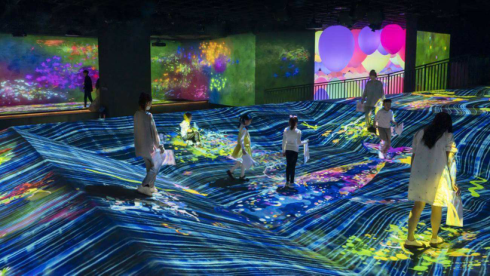
3. Future Park by teamLab Immersive design no longer relies solely on visual pictures to stimulate human experience but integrates multiple senses to restore the scene to the audience, realizing the transformation of design from “the picture domain”to “the mimetic domain”. The art group teamLab (2022) is known for its digital art installations that often blend digital pictures, technology, nature, and art in immersive experiences. Future Park, which includes light effects, sound, and dynamic images, refreshes the human sensory experience and changes
Visual Pictures and Digital Technologies in the Digital Anthropocene 35
visitors’ experience to interact with exhibits and immerse in the future cities’ digital landscape that stimulates the human imagination and creativity. How- ever, we must realize that the more images will surround us on all sides, the less, paradoxically, we will in fact see with your own eyes (Chmielecki, 2015). The excessive number of visual pictures inevitably puts pressure on human vision. Therefore, pictures will also promote the change of technology. We rely on different digital devices and media to save and display pictures to help humans remember and store them, the externalization of the human brain is also happening at this moment. In this situation, we will probably need to use an increasing number of prostheses of sight, i.e., “vision machines” -visual and digital media set for this purpose (Chmielecki, 2015).
Figure 3: Future park by teamLab (image from: teamlab.art).
CRITICAL REFLECTIONS ON HUMAN FACTORS AND DESIGN ETHICS AIGC and Commercial Design Crisis
Recent advances in artificial intelligence (AI) offer opportunities for inte- grating AI into human design teams (Zhang et al., 2021). The emergence and development of AI technology have changed the production methods and efficiency of pictures. The collaborative work of the sophisticated lan- guage model ChatGPT and Midjourney can greatly improve the efficiency of designers, break down technical barriers, and provide design inspiration. Nevertheless, the emergence of AIGC has also impacted employment in com- mercial design—the release of Midjourney in 2022 marks the decline of traditional picture production methods. AI drawing has the characteristics of high automation, high efficiency, high precision, high scalability, and a high degree of customization. By analyzing natural language and commands, it can instantly complete personalized pictures, thus reintegrating the design team and eliminating low-quality labor to a certain extent.
Non-Anthropocentric Intelligent Technology-Oriented Design There is no doubt that our current design activities and picture production work are already highly conditioned by technology. Based on reflecting on the relationship between humans and technology, Ihde (1995) proposed the
philosophy of technology, believing that “technology” plays an important role in the process of human perception and cognition of the world, and that human perception is not directly related to the world. Instead of creating a connection, we establish an indirect connection through the intermediary system of “technology”. Nonetheless, AIGC can master all human knowl- edge bases, which has obviously exceeded the human ability to store and apply knowledge and technology. The visual pictures generated based on this model have shown a non-human-centered trend. Consequently, based on the above cases and discussions, technology no longer plays the role of an inter- mediary, but wraps humans in it, enabling communication and interaction between human senses and the world. We termed this trend or phenomenon “Non-anthropocentric Intelligent Technology-oriented Design”. It is not only important to focus on what shrinks in an age where the work of art can be reproduced by technological means is its aura (Benjamin, 2008), but also on the disappearance of “humanity” in the Digital Anthropocene, in a non-anthropocentric technology-wrapped world, we need to overcome the worship of AI, virtual dependence, and technical dependence.
CONCLUSION
We introduce relevant studies of the Anthropocene to analyze the devel- opment and threats of visual pictures and technology in the digital age and propose a new theory of “Non-anthropocentric Intelligent Technology- oriented Design” through literature analysis and a few case analyses. Future work will focus on improving and corroborating this theory and combining this theory with a discussion of human factors and design ethics in the Digital Anthropocene.
ACKNOWLEDGMENT
Guo would like to express deep and sincere gratitude to Jiang and Hao.
REFERENCES
Acemoglu D., Bai X., Creutzig F., et al., 2022. ‘Digitalization and the Anthropocene’, Annual review of environment and resources, 47, pp. 479–509. Available at: https: //doi.org/10.1146/annurev-environ-120920-100056. Anderson K., 2015. ‘Ethics, ecology, and the future: Art and design face the
Anthropocene’, ACM SIGGRAPH Art Papers, pp. 338–347. Ballenger H. B., 2014. ‘Photography: a communication tool’. Available at: https: //doi.org/10.57709/5516930. Bertolini M., 2015. ‘The “Pictorial Turn” as Crisis and the Necessity of a Critique
of Visual Culture’, Philos. Study, 5, pp. 121–130. Available at: https://doi.org/10. 17265/2159-5313/2015.03.001. Chakraborty I., Cheng H., Javed O., 2013. ‘3d visual proxemics: Recognizing human interactions in 3d from a single image’, Proceedings of the IEEE Conference on Computer Vision and Pattern Recognition, pp. 3406–3413. Chen, K., Xu, J., Xue, X. and Zheng, R., 2022. The Impression of Cities: Xi’an.
Available at: [Accessed 22 January 2024]. https://www.designinformatics.org/ne ws/di-graduates-exciting-new-installation-in-xian-china/?highlight=Qinqiang
Visual Pictures and Digital Technologies in the Digital Anthropocene 37
Cheng, M., Dang, X. and Yu, Z., 2023. Fusion: Landscape and Beyond 2.0. Available at: [Accessed 22 January 2024]. https://www.mingyongcheng.com/projects/fusio n-landscape-and-beyond-2-0 Chmielecki K., 2015. ‘From visual culture to visual communication. The pictorial
and iconic turn in contemporary culture’, Art Inquiry, (17), pp. 93–114. Crutzen P.J., 2006. ‘The “Anthropocene”‘, Earth system science in the Anthropocene, Berlin, Heidelberg: Springer Berlin Heidelberg, pp. 13–18. Freedberg D., 2013. The power of images: Studies in the history and theory of
response. University of Chicago Press. Gombrich E. H., 1972. ‘The visual image’, Scientific American, 227(3), pp. 82–97. Isgro F., Trucco E., Kauff P., et al., 2004. ‘Three-dimensional image processing in the future of immersive media’, IEEE Transactions on Circuits and Systems for Video Technology, 14(3), pp. 288–303. Available at: https://doi.org/10.1109/TC SVT.2004.823389. Ihde D., 1995. ‘Philosophy of technology, 1975–1995’, Society for Philosophy and
Technology Quarterly Electronic Journal, 1(1/2), pp. 8–12. Available at: https: //doi.org/10.5840/techne199511/24. Marcolin F. et al., 2021. ‘Affective Virtual Reality: How to Design Artificial Experiences Impacting Human Emotions’, IEEE Computer Graphics and Applications, 41(6), pp. 171–178. Available at: https://doi.org/10.1109/MCG.2021.3115015. McLean J., 2020. ‘Feeling the digital Anthropocene’, Changing Digital Geographies:
Technologies, Environments and People, pp. 159–175. Available at: https://doi.or g/10.1007/978-3-030-28307-0_8. Mirzoeff N., 2014. ‘Visualizing the Anthropocene’, Public Culture, 26(2), pp. 213–232. Available at: https://doi.org/10.1215/08992363-2392039. Mitchell W. J. T., Mitchell W. J. T., 1995. Picture theory: Essays on verbal and visual representation. University of Chicago Press. Molesworth C., 2003. ‘How to live in an image world: The strategies of memory’,
Salmagundi, (139/140), pp. 16–25. Nakicenovic N., 2019. TWI2050—the world in 2050. The digital revolution and sustainable development: opportunities and challenges. Rep., World 2050 Initiat., Laxenburg, Austria. Rubio-Tamayo J. L., Gertrudix Barrio M., García García F., 2017. ‘Immersive envi-
ronments and virtual reality: Systematic review and advances in communication, interaction and simulation’, Multimodal technologies and interaction, 1(4), 21. Available at: https://doi.org/10.3390/mti1040021. teamLab, 2022. Future Park. Available at: [Accessed 22 January 2024]. https://ww w.teamlab.art/e/futurepark-cfuturecity/ Tong Z., 2021. ‘Image sensory experience of artistic design based on the role of
omnidirectional vision sensors’, Journal of Sensors, 2021, pp. 1-10. Available at: https://doi.org/10.1155/2021/7166142. Walter Benjamin., 2008. The Work of Art in the Age of Mechanical Reproduction.
Penguin Books, Great Ideas. Wang X., 2018. ‘A Review of Image Recognition Technology’, 2018 2nd International Conference on Artificial Intelligence: Technologies and Applications (ICAITA 2018). Atlantis Press, pp. 24–28. Zalasiewicz J., Williams M., Steffen W., et al., 2010. ‘The new world of the
Anthropocene’, Available at: https://doi.org/10.1021/es903118j. Zanker P., 1988. The power of images in the age of Augustus. University of Michigan Press.
Zhang G., Raina A., Cagan J., et al., 2021. ‘A cautionary tale about the impact of AI on human design teams’, Design Studies, 72, 100990. Available at: https: //doi.org/10.1016/j.destud.2021.100990. Zhang J., Guo J., 2022. ‘Application of Traditional Chinese Elements in Visual
Communication Design Based on Somatosensory Interaction Parameterisation’, Scientific Programming. Available at: https://doi.org/10.1155/2022/6875192.
LISTED IN THE AHFE DIGITAL BOOKSTORE CATALOGUE
Explore the complete digital volume
Human Factors in Communication of Design
Read this individual research paper free through the original publisher, or explore the full digital proceedings book.
ISBN 978-1-964867-12-0
Explore this ISBN in the AHFE Bookstore ↗Listed in the July 2026 bookstore catalogue; search by ISBN to confirm current availability · Digital book purchase optional