Min Zhou, Shuang Liang, Peian Yao, Stefano Follesa (2022). New craft design in the digital age. In: Intelligent Human Systems Integration (IHSI 2022): Integrating People and Intelligent Systems. AHFE Open Access, vol. 22. https://doi.org/10.54941/ahfe1001072
Craft design has gone through different contexts, and the craftsmanship in the new age is different from that in the industrial age. By analyzing the evolution and new scenario of craft design, the paper summarizes the trend of new craft design. The evolution of craft design shows the following trends: 1) the output diversified to satisfy the new needs due to technological advancement, including the material object, experience, service, and digital content. 2) the responsibility shifts from product design to activity design. 3) the boundaries are blurred; more and more industries, disciplines and people are participating in craft design. This paper believes that the new craft design has two directions: one points to the craftsmanship itself (tangible-intermediate-intangible structure); the other points to the various relationships with other disciplines, environment, and society.
Industrial civilization has dramatically enriched the human material world, freed human beings from heavy physical labor, and improved the living standards of the
Intelligent Human Systems Integration (IHSI 2022): Integrating People and Intelligent Systems https://openaccess.cms-conferences.org/#/publications/book/978-1-7923-8988-7 entire human world. However, industrial civilization has also brought a series of problems, such as waste and shortage of resources, environmental degradation, unhealthy consumption concepts, and threats to tradition and regional culture. Today's manufacturing industry mainly has two production modes, industrial and craft production. The design has become an essential link in global industrial production. At the same time, many practices have proved that design intervention is an effective means of revitalizing craftsmanship. Industrial and craft production are two different cultures requiring different design methods and design or creative behaviors. Moreover, the new craft design in the digital age shows different trends from the past. Analyzing possible development directions will contribute to the protection of craftsmanship.
CRAFT DESIGN IN THE INDUSTRIAL AGE Industrial Design (Negative artisan, craftsmanship as inspiration)
In the industrial design discussed here, artisans are negative, they do not participate in design or production; craftsmanship exists as the designer's inspiration. The industrial design process presents a linear state in the inspiration-design ideas- visualization-prototype-realization-disseminate-sales stage. In general, in the inspiration-design ideas-visualization stage, the evidence of craftsmanship is mainly from digital archives or written information. Modern designers usually use different digital tools to present their ideas in the design stage, such as rhinoceros, 3D modeling, and CAD. The use of these tools can help designers express themselves clearly. Sometimes, traditional design methods, for example, hand-painting, are still effective. In the prototype stage, 3D printing, additive layer manufacturing technology, rapid prototyping and other technologies are often used. Then, in the realization stage, digital manufacturing technology, including flexible manufacturing, engraving machine, CNC, ERP system, etc., enables the company to produce products efficiently. In addition, the use of digital technology in the stages of promotion, transportation and sales allows products to reach users quickly.
Craft Design (Active artisan) With the cooperation of designers and artisans, both design and craftsmanship may become a key factor for a country and a region to win in the manufacturing industry. The practice has proved that the combination of craftsmanship and design may not give up industrial production. The design needs to face new challenges: redesigning crafts according to modern lifestyles, aesthetic requirements, cultural pursuits, and even combining industrial and craft production methods. Based on flexible manufacturing techniques, just as Kettley (2005) described: craftspeople are able to produce beyond the human scale, and designers are able to economically justify producing unique pieces.
Intelligent Human Systems Integration (IHSI 2022): Integrating People and Intelligent Systems https://openaccess.cms-conferences.org/#/publications/book/978-1-7923-8988-7
Transforming traditional craft culture into contemporary design language requires the collaboration of artisans and designers. Artisans convey the tacit knowledge of traditional craftsmanship to designers, showing the effective way of traditional creation, which broadens designers' horizons to understand and acquire new design methods, interdisciplinary knowledge, and innovative methods. Collective creativity is highlighted in the collaboration of design and craftsmanship.
Sanders and Stappers (2008) put forward an important concept, named "fuzzy front end", which is the early stage of collective creation. In the fuzzy front end, all participants work together to formulate a clear strategy, clarify, and choose the following development route. In this stage, different knowledge will collide; the purpose is to find problems and opportunities and determine the final idea of the product. Then, traditional or digital design tools, such as hand-painting, 3D modelling, etc., will help designers and artisans to understand each other. While in industrial design (Negative artisan, craftsmanship as inspiration), similar work may be done by designers or researchers, without participation of artisan, design knowledge plays a leading role.
Sometimes, design absorbs the aesthetics of craftsmanship while neglecting the rights of artisans and tacit knowledge of the traditional craftsmanship (Porro, 2018). This problem may also exist in the process of craft design (active artisan), or it may appear in participatory design, co-design, or even co-creation. Multi-party strength and interdisciplinary knowledge will help solve diversified and complex problems. However, it needs to be emphasized that the relationship among designers, other stakeholders and participants is equal, not design-oriented, nor design center (Zou & Liu, 2019).
NEW CRAFT DESIGN IN THE DIGITAL AGE Tony Fry believes that design, especially future design, has two methodological directions: one direction points to oneself (such as physical and mental health, thinking, and spiritual practice), and the other points to the various relationships with others in the world (Fry, 2009; Zhu 2018). The same trend exists in craft design. Craftsmanship may have different characteristics in different regions and countries, but it generally refers to making objects with hands or tools (either purely manual or partly manual) during the interaction between humans and the environment. Production with hands or tools points to the craftsmanship itself, while the interaction with the environment points to the relationship among craftsmanship, other disciplinaries, the environment, and society.
The Trend of New Craft Design in the Digital Age: Back to the Craftsmanship Itself
Intelligent Human Systems Integration (IHSI 2022): Integrating People and Intelligent Systems https://openaccess.cms-conferences.org/#/publications/book/978-1-7923-8988-7
The Connotation of Craftsmanship and Analysis in the Tangible Level Traditional craftsmanship is part of traditional culture, so the analysis of cultural connotations is also suitable for craftsmanship. The TCPs (Traditional Cultural Properties) were elaborated into tangible and intangible categories by UNESCO (Ahmad, 2006). Similarly, Siu (2005) described it as an Outer-intermediate-inner leveled structure. The craftsmanship should also conform to the tangible- intermediate-intangible levelled structure (see Figure 1). The tangible level contains crafts, traditional patterns, etc. The intermediate level contains the process, history, etc. The core layer represents the parts that are difficult to express directly, including craft culture, traditional lifestyle, the spirit, etc.
Tangible Visible and touchable: crafts, traditional patterns and so on Intermediate Behaviors, activities, language: History, process, story telling
Intangible
Non-touchable and invisible: The inner culture and spirit that can be felt unconsciously
Figure 1. Tangible-intermediate-intangible levelled structure model of craftsmanship
Figure available in the original PDF paper.
(Rework from Siu, 2005).
Craftsmanship is a type of practical art from a physical perspective. Artisans use engraving, carving, weaving, and other skills to create objects using local resources and materials. The producers' aesthetic, cultural, spiritual, emotional, and other characteristics can be found in their creative efforts. On the tangible level, the new craft design emphasizes the use of new materials and new technology. There are numerous examples of material and technology innovation (Abel et al. 2014; YUAN et al. 2015). Biomaterials, for example, allow goods to be grown rather than made. Furthermore, digital technologies, such as 3D printing, save materials while producing components that are difficult to produce by hand, and we may improve the performance of these components using physical or chemical methods.
Intermediate Level:Makerspace as an Example The practical functions of crafts may become less critical in the future, but their artistic and non-utilitarian characteristics will be magnified. These characteristics will provide new opportunities for the revival of craftsmanship. The intermediate level of craftsmanship, which is non-touchable but visible and can be heard, includes activities and processes. Hands-on process and production activities are an essential part of the materialization of handwork, and it is also a process full of fun. Everyone has hands-on ability, and many activities or phenomena now reflect that people are
Intelligent Human Systems Integration (IHSI 2022): Integrating People and Intelligent Systems https://openaccess.cms-conferences.org/#/publications/book/978-1-7923-8988-7 beginning to enjoy hands-on fun, for example, the maker movement, which is sometimes known as new craftsmanship.
Maker space is where makers communicate, share, and implement their design, generally providing venues and essential tools. There are various maker space forms, including university laboratories, school libraries, coffee shops, community activity centers, or even a small space shared by an individual, a balcony, garage, garden, etc. Completely different from traditional manual production, makers are concerned about the fun of the design and production process, the realization of their creativity, and the sense of accomplishment and value. Makerspaces are available all over the world, in the United States, Europe, Asia, etc.
Intangible Level:A New Scenario The core factors of craftsmanship are challenging to be display, but digital technology may show some traditional lifestyles and life concepts to a certain extent. In this part, we need to analyze a new scenario about digital dissemination of traditional skills.
People, particularly the younger generation, are attracted to traditional lifestyles and slow production methods due to their fast-paced lives. The fan economy is thriving as young people, including youngsters, spend more and more time online. On the other hand, some Internet celebrities do not have adequate directing abilities, and some countries have already begun to rectify the entertainment circle and Internet celebrity culture. Maintenance of the net-work ecology is also necessary for proper guiding, in addition to effective macro-control and intervention. The digital dissemination of ICH, which includes the craftsmanship, may open up new possibilities. In China, the marriage of craftsmanship and Internet communication is not uncommon. For example, most national ICH is disseminated on the Douyin (Chinese Tik Tok) platform.
Furthermore, the Internet has also given individuals the opportunity to give a voice. For example, Li Ziqi, a Chinese Internet celebrity. Her videos involve dyeing, weaving, winemaking, ancient papermaking and other craft skills, and are popular among the young generation. These videos attract the attention of many netizens, both domestic and overseas. The Internet makes it possible for every individual to contribute to ICH dissemination, which is a new opportunity to develop traditional culture and will cause spontaneous protective behavior.
Craftsmanship or ICH have entered people's digital daily lives more and more frequently and will eventually return to people's daily lives in the real world. Over time, this may trigger a digital transformation that encompasses the entire society.
The Trend of New Craft Design in the Digital Age: Interdisciplinary Cooperation Activities about Craft Empowerment
Intelligent Human Systems Integration (IHSI 2022): Integrating People and Intelligent Systems https://openaccess.cms-conferences.org/#/publications/book/978-1-7923-8988-7
The economic and cultural value of craftsmanship has been emphasized. In addition, the social value of craft skills is being redefined. Craftsmanship has become a source of inspiration for social innovation and a vital resource to promote society's sustainability.
In modern society, interdisciplinary cooperation has become an essential method for knowledge creation, transfer, design innovation, and value creation (Bathelt et al. 2004). Through digital technology, interdisciplinary design provides new opportunities for innovation. Designers can put forward new ideas based on theories and experiences in various fields, use digital technology to empower craft communities and create conditions for social innovation. We should use various digital technologies to enhance the social capital of craft communities, rural communities, and disadvantaged groups, and promote the sustainability of society, economy, culture, and the environment. For example, based on craft skills and digital technologies such as online sales networks and online training networks, rural left- behind women, disabled people, or other rural or even social surplus labor can be connected to the market economy to promote rural revitalization and social fairness.
Take Yu's crocheting in Zhumadian, China, as an example. Yu's crocheting originated in the late Qing Dynasty and has a history of more than 100 years. One of the main contributions of Yu's crocheting is connecting the local surplus labor force with the economic market. Since 2014, Yu's company has established long-term cooperative relations with many foreign trade companies. Furthermore, the company enhances employability by training local and even nationwide left-behind mothers, disabled people, and other surplus labor. In general, Yu's company has built employment channels with brands and related platforms for such groups through crocheting skills, contributing to poverty alleviation and rural revitalization while promoting social inclusiveness, social equity, and gender equality.
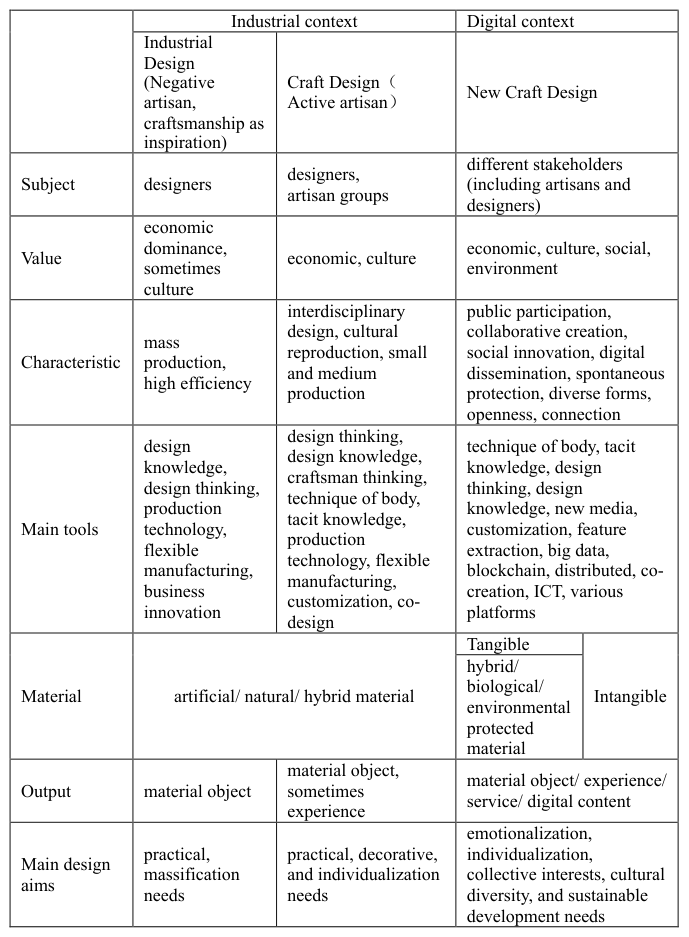
THE EVOLUTION OF THE CRAFT DESIGN Different craft designs have different features, from industrial design (Negative artisan, craftsmanship as inspiration) to craft design (Active artisan) and new craft design. The research compares these craft designs from subject, value, characteristic, main tools, material, output, and design aim (see Table 1). The evolution of craft design shows the following trends:
1) The material pursuit has transformed to the spiritual pursuit, and the output diversified to satisfy the new needs due to technological advancement, including the material object, experience, service, and digital content.
2) The role of design is becoming increasingly important—the responsibility shifts from product design to activity design.
3) The boundaries are blurred, and more and more industries, disciplines and people
Intelligent Human Systems Integration (IHSI 2022): Integrating People and Intelligent Systems https://openaccess.cms-conferences.org/#/publications/book/978-1-7923-8988-7 are participating in the process of craft design and protection.
Table 1: The Evolution of the Craft Design
Intelligent Human Systems Integration (IHSI 2022): Integrating People and Intelligent Systems https://openaccess.cms-conferences.org/#/publications/book/978-1-7923-8988-7
CONCLUSION
New craft design has two development directions. One points to the craftsmanship itself, while the other points to the relationship with other disciplines, the environment, and society. The tangible, intermediate, and intangible levels interact with each other. The change in one level will cause the change in other levels. For example, the digital return of craftsmanship will eventually lead to the return and revitalization in the real world. Moreover, interactions with other industries and the participation of more stakeholders will bring more inspiration or opportunities and contribute to the sustainability of craftsmanship. At the same time, craftsmanship as a resource will also contribute to overall sustainability.
ACKNOWLEDGMENTS
China Scholarship Council funds the research (201907820013). The authors would like to express their gratitude to the people who participated in the research and the China Scholarship Council.
REFERENCES
Abel, A. K., Congdon, A., Chieza, N., Lee, J., Martinez, L., Ribul, M., & Rouillon, M.
(2014). Industry Pioneers. [online]. Available from: http://eprints.hud.ac.uk/id/eprint/25479/2/Industry%20Pioneers.pdf [accessed 3 February 2022]. Ahmad, Yahaya. (2006). The scope and definitions of heritage: from tangible to intangible.
International journal of heritage studies, 12.3, pp.292-300. Bathelt, H., Malmberg, A., & Maskell, P. (2004). Clusters and knowledge: local buzz, global pipelines and the process of knowledge creation. Progress in human geography, 28(1), pp.31-56. Fry, T. (2009). Design futuring. University of New South Wales Press, Sydney, pp.71-77. Kettley, S. (2005). Crafts praxis as a design resource. Crossing design boundaries, pp.545-549. Porro K. (2018). Seeking Truth in Terrazzo: Digital Practices and Traditional Crafts. The
Journal of Modern Craft, 11(3), pp.219-231. Sanders, E. B. N., & Stappers, P. J. (2008). Co-creation and the new landscapes of design. Codesign, 4(1), pp.5-18. Siu, K. W. M. (2005). Culture and design: A new burial concept in a densely populated
metropolitan area. Design Issues, 21(2), pp.79-89. YUAN, P. F., Jiashuang, S. U. N., Hyde, M. E. N. G., & Shuyi, H. U. A. N. G. (2015). Research on Digital Ceramic Craftsmanship. Time+ Architecture, 06. Zhu, Y.F. (2018). Consciousness from the Practice of Handicraft Ethics to Design Ethics.
Journal of Nanjing Arts Institute (Fine Arts & Design). (03), pp.68-71+209. Zou, J.P., Liu, Z. S. (2019). Research on Design for Social Innovation of Low-Aged Retired Women in Cities: A Case Study of Modern Handcraft Products Design. Art & Design. (09), pp.110-113.
Intelligent Human Systems Integration (IHSI 2022): Integrating People and Intelligent Systems https://openaccess.cms-conferences.org/#/publications/book/978-1-7923-8988-7
LISTED IN THE AHFE DIGITAL BOOKSTORE CATALOGUE
Explore the complete digital volume
Intelligent Human Systems Integration (IHSI 2022): Integrating People and Intelligent Systems
Read this individual research paper free through the original publisher, or explore the full digital proceedings book.
ISBN 978-1-7923-8988-7
Explore this ISBN in the AHFE Bookstore ↗Listed in the July 2026 bookstore catalogue; search by ISBN to confirm current availability · Digital book purchase optional