Yu Ming Sun, Shi Yuan, Peng Ji, Peng Shiyao, Shi Lei Su (2026). An Intelligent Generative Design Method for Peking Opera–Inspired Locomotive Liveries under Cultural and Engineering Constraints. In: Interdisciplinary Practice in Industrial Design. AHFE Open Access, vol. 222, pp. 284–293. https://doi.org/10.54941/ahfe1007767
Locomotive livery design serves as a vital carrier of cultural identity; however, traditional design workflows exhibit low efficiency, and general AI-generated schemes often lack engineering feasibility due to excessive pattern and color redundancy. This study, taking Peking Opera facial patterns as a representative case, proposes an intelligent generative design method that coordinates cultural expression with engineering constraints. By constructing an element translation strategy based on element complexity, color complexity, and their synergistic "combined matrix" for LoRA-based model training, the results confirm that the combined matrix approach effectively balances cultural identifiability, visual order, and engineering implementability. Verified through expert Fuzzy Comprehensive Evaluation (FCE), this framework provides an efficient methodology for the culture-oriented design of industrial equipment under engineering constraints.
With the continuous advancement of the global rail transit industry, rolling stock has evolved beyond mere transportation to become a vital carrier of national cultural identity. As a critical component of vehicle appearance, livery design directly influences a product’s recognition and aesthetic acceptance in the international market. Integrating traditional Chinese culture into livery design is a concrete manifestation of cultural confidence within the field of industrial design (Deng et al., 2024). However, current domestic locomotive livery design faces several practical challenges: the application of cultural elements often remains superficial; the design process relies heavily on manual sketching and individual experience, leading to low efficiency and prolonged development cycles; and as large-scale engineering equipment, locomotive livery must account for practical constraints such as spraying techniques, maintenance costs, and operating environments.
The rapid evolution of Generative Artificial Intelligence (AIGC) provides new possibilities for efficient design generation. Nevertheless, when addressing locomotive livery tasks that involve both cultural attributes and engineering constraints, existing general AI workflows often exhibit issues Received February 7, 2026; Revised April 6, 2026; Accepted April 21, 2026; Available online July 20, 2026
An Intelligent Generative Design Method for Peking Opera–Inspired Locomotive Liveries 285 such as excessive visual complexity and insufficient engineering feasibility (Gao et al., 2024). Therefore, establishing an effective bridge between cultural expression and technical implementation has become a critical research priority for enhancing the international competitiveness of China’s rail transit equipment.
To address these issues, this study proposes an intelligent generation method for locomotive livery oriented toward cultural fusion. Taking Peking Opera elements as a case study, the research first generates livery schemes through conventional AI workflows to analyze the limitations of existing processes (Shen et al., 2024). Subsequently, improvements are implemented in three dimensions: first, optimizing input image quality to enhance generation performance; second, constructing a structured cultural element dataset based on a matrix-style translation strategy involving color quantity, element complexity, and their combinations; and third, determining the optimal translation method through comparative experiments. On this basis, full-vehicle livery schemes are generated and validated using the Expert Fuzzy Comprehensive Evaluation method. Ultimately, this research explores a design path that coordinates cultural expression with engineering constraints, providing methodological support for the application of AIGC in the field of heavy industrial equipment.
RELATED WORK
To date, generative artificial intelligence technologies represented by Latent Diffusion Models (LDMs) have demonstrated remarkable potential for iterative scheme generation and creative stimulation in the design field (Rombach et al., 2022). In particular, the combination of diffusion models represented by Stable Diffusion and lightweight fine-tuning techniques such as Low-Rank Adaptation (LoRA) has provided new tools for improving generation efficiency in industrial design. At present, AI-generated design research in the field of transportation equipment has mainly focused on passenger vehicles. For example, in the front-end design stage, researchers have utilized deep generative models such as DCG-GAN to achieve automated generation and appearance optimization of automotive design concepts (Ghasemi et al., 2024; Huang, 2023). These methods are also capable of rapidly transforming hand-drawn sketches into high-quality rendering schemes, thereby shortening development and iteration cycles (Radhakrishnan et al., 2018).
However, compared with the relatively systematic application of AI in the passenger vehicle domain (Mohamad & Alfuraih, 2024), research on AI generation for large-scale engineering equipment such as rail transportation vehicles is still at an early stage. First, when dealing with design elements characterized by complex geometric structures and deep cultural semantics, existing models are often limited by the scope of training data, resulting in loss of visual detail or semantic deviation of cultural symbols, which makes it difficult to achieve accurate representation of traditional cultural aesthetics (Liu & Huang, 2026; Yu et al., 2025). Second, industrial livery design must comply with explicit process constraints, such as limitations on color quantity
and pattern complexity. However, most current AIGC workflows prioritize visual presentation effects and lack prior control over livery process feasibility, which leads to generated schemes that are overly fragmented or structurally disordered and therefore difficult to implement in actual production (Zhu et al., 2025; Zhu & Xiang, 2025). Due to the inherent complexity and strict engineering constraints of large-scale equipment, AI-based design models developed for passenger vehicles are difficult to directly transfer, resulting in a clear research gap in this domain. Therefore, constructing a design generation method that can systematically integrate cultural characteristics with engineering constraints has become a key scientific issue that needs to be addressed in the field of large-scale equipment.
ANALYSIS OF EXISTING AI-GENERATED DESIGN METHODS Experiments Based on Existing General AIGC Image Generation Methods
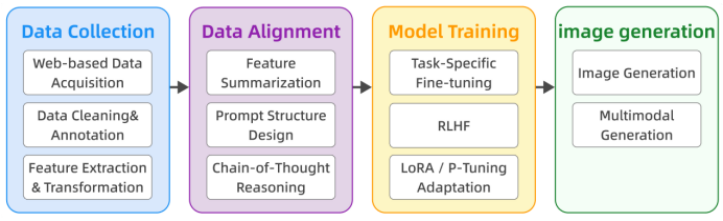
The current standard AIGC image generation workflow primarily consists of four core stages: data collection and preprocessing, data annotation, model training, and solution generation. These stages proceed sequentially and are tightly interconnected, forming a comprehensive and coherent technical framework. Following this universal workflow, the research team generated locomotive paint schemes incorporating elements of Peking Opera facial makeup. The specific process is as follows: First, the team employed Python scripts to collect 100 high-resolution images of Peking Opera facial makeup. These images were then center-cropped and rescaled to ensure uniform standardization to a resolution of 768 × 768 pixels. Next, using a predefined structured prompt syntax, each image was annotated to decompose the painted patterns into semantic units recognizable by the algorithm. This process ensured that the model could effectively capture the compositional logic of Peking Opera elements during the subsequent generation phase. During model training, Stable Diffusion XL was adopted as the backbone network. The processed Peking Opera dataset underwent parameter fine- tuning through a LoRA layer, enabling efficient transfer and preservation of stylistic features while minimizing computational resource consumption. Concurrently, the ControlNet module constrained the generated patterns to strictly conform to the geometric topology of the locomotive surface. Ultimately, the trained model generated the final paint scheme.
Figure 1: Demonstration of the existing AI generation process.
An Intelligent Generative Design Method for Peking Opera–Inspired Locomotive Liveries 287 Analysis of Experimental Results Based on Existing General AIGC Image Generation Methods
Based on the aforementioned universal AI generation workflow, this graduate student generated a series of locomotive livery designs themed around Peking Opera culture, with the results shown in Figure 2. This section systematically analyzes the generated outcomes from both visual expression and engineering feasibility perspectives, aiming to provide a foundation for subsequent methodological improvements.
The current generation scheme has preliminarily achieved the visual translation of Peking Opera cultural elements, preserving the core characteristics of facial makeup artistry in terms of color combinations and pattern structures. However, from an engineering application perspective, the generated designs exhibit significant limitations. Specifically, the patterns generated on the locomotive surfaces are overly complex, featuring overlapping colors, intricate lines, and dense textures. This substantially increases the difficulty of the actual spraying process. Such designs not only increase paint consumption and extend construction timelines but also raise post-maintenance costs, thereby failing to meet the engineering specifications and production requirements for locomotive painting. These results indicate that existing general-purpose AI generation workflows still demonstrate insufficient adaptability when applied to highly engineering-constrained domains such as locomotive painting.
Figure 2: Scheme generation based on the existing AI workflow.
An Improved Method Based on Existing General AIGC Image Generation Methods Addressing the limitations of current general AI-driven generation workflows, this study systematically analyzes and identifies core issues across two key dimensions: color quantity and element composition. Excessive color complexity increases the difficulty of the spray coating process, while overly intricate element structures reduce engineering feasibility. Consequently,
this paper adopts color complexity and element complexity as primary optimization entry points. By enhancing the quality of dataset inputs and designing comparative experiments, the study investigates how different translation strategies influence the effectiveness of coating scheme generation.
EXPERIMENTS BASED ON THE IMPROVED METHOD Three comparative experimental schemes were established in this study: a generation method based on variations in element complexity, a generation method based on variations in element color complexity, and a generation method based on combined variations in element color and complexity. To ensure the validity and comparability of the experiments, the base model, sampling strategy, and prompt structure were kept consistent across all experimental groups, while only the translation strategy applied to the training dataset was altered. By systematically comparing the outputs of the three experimental schemes, the effectiveness of different generation strategies in balancing cultural expression and engineering feasibility was evaluated, thereby constructing an intelligent generation pathway suitable for locomotive livery design.
Typical Peking Opera facial patterns, such as Shan Xiongxin and Leizhenzi, were selected as experimental samples. All three experiments were conducted using Stable Diffusion as the base model, and each experimental group loaded a separately trained LoRA module corresponding to Peking Opera facial pattern features. The core experimental parameters were set as follows: the DPM++ 2M Karras sampler was adopted, the number of sampling steps was set to 20, and the guidance scale (CFG Scale) was set to 6.5 to balance prompt adherence and visual clarity. Negative prompts were introduced to eliminate non-target interferences such as 3D rendering effects, photorealistic styles, and geometric distortions. In addition, local repainting constraints based on ControlNet were applied to ensure the rationality of the generated results. The image generation prompts followed a combined paradigm consisting of “locomotive description + facial pattern character description + experimental variable control + cultural semantic constraints.
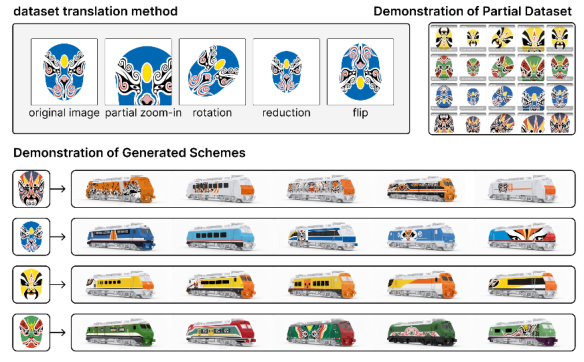
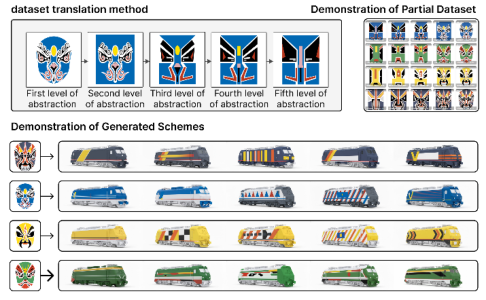
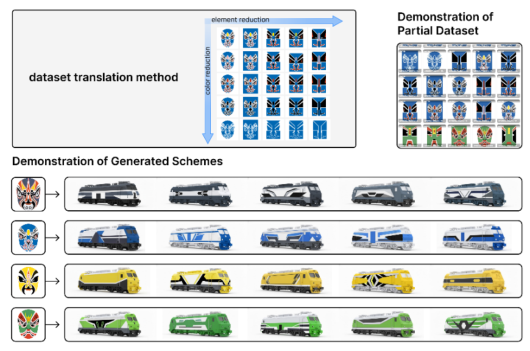
Generation Method Based on Variations in Element Complexity In this experiment, an element complexity grading method was applied to preprocess the original facial pattern motifs. Each original facial pattern sample was subjected to five levels of element complexity translation. Through progressively reducing element complexity, stripping away detailed elements, and retaining core structural elements, the AI model was guided to learn the abstraction and simplification logic inherent in Peking Opera facial patterns. The translated materials were then integrated with the original materials to form the training dataset, which was used for LoRA training. After the completion of LoRA training, the trained LoRA modules were combined with ControlNet technology to accurately map the cultural features of the facial patterns onto the locomotive body. The generated results corresponding to different facial patterns are shown in the figures.
Figure 3: The generation effect of the model trained on a training set simplified through element abstraction.
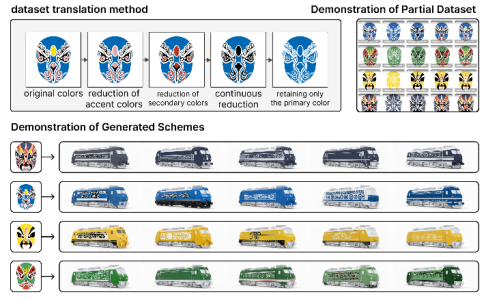
Generation Method Based on Variations in Element Color Complexity This experiment focused on the simplification logic of the color complexity dimension, investigating the influence of color quantity on the visual performance and cultural recognizability of locomotive livery designs. For original facial pattern motifs containing color systems composed of five to six pure colors, a five-level color dimensionality reduction strategy was adopted for experimental preprocessing. Based on the hierarchical structure of primary colors, secondary colors, and accent colors, this strategy implemented a five- level gradient reduction of the original facial pattern colors. Starting from the original state that preserved all traditional colors, secondary accent colors and auxiliary colors were gradually removed, ultimately simplifying the palette to a minimal industrial color scheme consisting of only a primary color and a single auxiliary color. By reconstructing the color gradients of facial pattern samples and annotating them accordingly, a color-oriented LoRA model was trained. The experimental parameters were kept consistent with those in the last Section, and the generated results are shown below.
Figure 4: The generation effect of the model trained on a training set simplified by the number of colors.
Generation Method Based on Combined Variations in Element Color and Complexity This section constructs a two-dimensional experimental matrix of pattern structure and color to analyze the combined effects of these two variables on the generation quality of locomotive livery designs. The five-level pattern abstraction hierarchy described in Section Generation Method Based on Variations in Element Complexity was cross-combined with the five-level color simplification hierarchy described in the last Section. The materials generated through this cross-combination were integrated with the original materials to form the training dataset, which was then used for LoRA training. The resulting generation schemes are shown in the figures.
Figure 5: Example of the generated results of a model trained on a training set simplified by color and abstraction matrices.
RESULTS AND ANALYSIS Analysis of Image Generation Performance Across Three Translation Methods
Element complexity translation implements a hierarchical simplification of facial patterns, allowing the model to acquire a clear structural skeleton and patch organization logic. This optimizes the clarity of generated cultural visual boundaries and effectively reduces fragmented elements, thereby decreasing the difficulty of color separation and construction complexity. However, excessive abstraction can compress distinctive character features into a few generic geometric symbols, diluting cultural recognizability.
Color complexity translation involves compression within the gamut dimension, which effectively enhances the overall consistency and controllability of color separation in the results, facilitating the construction of an industrialized primary-secondary color order. Nevertheless, this method does not directly constrain the structural complexity of patterns. While the number of colors is reduced, decorative density remains high, and the fundamental construction challenges are not fully alleviated.
An Intelligent Generative Design Method for Peking Opera–Inspired Locomotive Liveries 291 Element abstraction and color control translations achieve single-dimension optimization for structural and color complexity, respectively. By combining both into a “Color × Abstraction” matrix-style translation, the model more easily outputs schemes characterized by clear patches, stable visual anchors, and controllable color separation, representing a “balanced solution” that aligns more closely with the context of engineering livery design.
In summary, compared to single-dimension translations (color control or element abstraction), the combined matrix-style translation better balances cultural expression with engineering feasibility, identifying it as the optimal translation method.
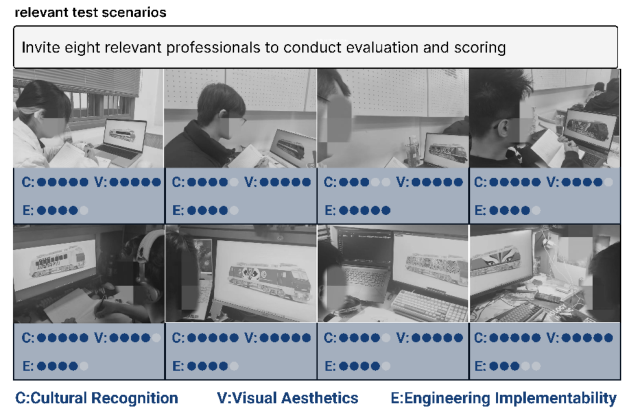
Validation of Generation Performance for the Optimal Translation Method To verify the effectiveness of the proposed translation method, an evaluation panel comprising eight industrial design experts was invited to conduct quantitative assessments and consistency analysis. The evaluation focused on three core dimensions: cultural identifiability, visual aesthetics, and engineering implementability across various generative strategies.
Figure 6: Photos of the design evaluation experiment.
Systematic analysis of the experimental data reveals that the translation method based on the “color × abstraction” combined matrix significantly outperforms single-dimensional generation strategies across all evaluation metrics. Experimental results demonstrate that although single-element abstraction translation improves edge clarity, it is highly prone to semantic dilution, leading to the loss of core cultural features. Conversely, while single- color dimensionality reduction preserves traditional tones effectively, the lack of constraints on complex pattern structures results in cluttered visual effects that fail to meet the spray coating feasibility requirements of actual engineering. In contrast, the combined matrix translation method proposed
in this study achieves a deep integration of cultural semantics and industrial production standards while maintaining stable visual anchors. Expert evaluation results indicate that this scheme ranked first in comprehensive membership scores, with a high degree of consistency in expert opinions. This fully demonstrates that the method can effectively overcome common defects in general AIGC schemes, such as fragmented patterns and color overlapping. By satisfying complex engineering constraints, it significantly enhances both the cultural expressiveness and the scheme maturity of locomotive livery designs.
CONCLUSION
Taking Peking Opera facial makeup as a case study, this research constructed an intelligent generation methodology framework for locomotive livery centered on translation strategies. Initial comparative experiments based on conventional AIGC workflows revealed that while generated schemes could present the cultural style of facial makeup, they often suffered from fragmented patterns, overlapping colors, and excessive complexity, making it difficult to meet engineering constraints such as spray separation and maintenance.
To address these issues, this paper proposed single-track translations for element and color complexity and further developed a “Color × Abstraction” combined matrix-style translation to implement collaborative constraints. The results show that while single-element abstraction improves boundary clarity, it carries a risk of semantic dilution; similarly, single-color dimensionality reduction enhances unity but fails to resolve dense structures. The combined matrix-style translation achieves a stable equilibrium between cultural identification, visual order, and implementability, confirming it as the optimal strategy. During the workshop, the Expert Fuzzy Comprehensive Evaluation method verified the compliance of the generated schemes, validating their potential for practical industrial application.
In conclusion, the primary contribution of this paper is the proposal of an intelligent generation path for locomotive livery that reconciles cultural expression with engineering constraints, providing a reusable methodological reference for AIGC applications in heavy rail transit equipment. Future research will introduce more granular engineering rules and integrate human-AI collaborative interactions. By parameterizing the translation matrix into a visual interface, a closed-loop workflow—from generation to evaluation and subsequent refinement—can be established, providing robust methodological support for the cultural expression and engineering implementation of China’s rail transit equipment in the international market.
Cross-Cultural Product Design Research Status, Hotspots, and Future Trends Based on Bibliometrics, ICADI ‘24: Proceedings of the 2024 International Conference on Artificial Intelligence, Digital Media Technology and Interaction Design. pp. 340–346. https://doi.org/10.1145/3726010.3726063
An Intelligent Generative Design Method for Peking Opera–Inspired Locomotive Liveries 293 Gao, Robert X. Krüger, Jörg. Merklein, Marion. Möhring, Hans-Christian and
Váncza, József. (2024). Artificial Intelligence in manufacturing: State of the art, perspectives, and future directions, CIRP Annals. https://doi.org/10.1016/j. cirp.2024.04.101 Ghasemi, Parisa. Chenxi Yuan, Tucker Marion and Mohsen Moghaddam. (2024).
DCG-GAN: design concept generation with generative adversarial networks, Journal of Engineering Design. Huang, Jingming. (2023). Deep visual generation for automotive design upgrading and market optimising, PhD thesis, University of Glasgow. Liu, Jiatong. and Yue Huang. (2026). LoRA-Fine-Tuned Latent Diffusion for High-
Fidelity Digitization of Classic Mongolian Patterns, Applied Sciences 16(1). Mohamad, Gamal Moustafa Hussien. and Mazen Alfuraih. (2024). The Role of Artificial Intelligence in Automotive Design: A Comprehensive Review, International Journal of Engineering Research and Applications 14(11). pp. 72–82. Radhakrishnan, S. Bharadwaj, V., Manjunath, V. and Srinath, R. (2018). Creative
Intelligence – Automating Car Design Studio with Generative Adversarial Networks (GAN), in: Machine Learning and Knowledge Extraction, Holzinger, Andreas (Ed.). pp. 153–169. Rombach, Robin. Andreas Blattmann, Dominik Lorenz, Patrick Esser and Björn Ommer. (2022). High-Resolution Image Synthesis with Latent Diffusion Models, proceedings of the IEEE/CVF Conference on Computer Vision and Pattern Recognition (CVPR). Shen, Y. Duan, O. Xin, X. et al. (2024). Styled and characteristic Peking opera facial
makeup synthesis with co-training and transfer conditional styleGAN2, Herit Sci, Volume 12, No. 358. https://doi.org/10.1186/s40494-024-01463-3 Yu, Chunyang. Pai Zheng, Tao Peng, Xun Xu, Steven Vos and Xipei Ren. (2025).
Design meets AI: challenges and opportunities, Journal of Engineering Design 36(5-6). pp. 637–641. Zhu, Linna. and Ningyu Xiang. (2025). A Sustainable Intelligent Design Framework: Integrating AIGC with AHP-QFD-TRIZ for Product Development, Sustainability 17(20). Zhu, Z. T. Yu, Y. Wang and J. Xu. (2025). Revolutionizing Imaging Design Content
With AIGC: User-Centered Challenges, Opportunities, and Workflow Evolution, IEEE Access 13. pp. 87600–87620.
LISTED IN THE AHFE DIGITAL BOOKSTORE CATALOGUE
Explore the complete digital volume
Interdisciplinary Practice in Industrial Design
Read this individual research paper free through the original publisher, or explore the full digital proceedings book.
ISBN 978-1-964867-98-4
Explore this ISBN in the AHFE Bookstore ↗Listed in the July 2026 bookstore catalogue; search by ISBN to confirm current availability · Digital book purchase optional