Jia Qin Li, Luo Wang (2026). From Result Imitation to Cultural Translation: An Intelligent Generation Approach for Dong Brocade Patterns Based on Patternology. In: Global Issues Challenge: Challenges in AI at the Human Level. AHFE Open Access, vol. 234, pp. 77–88. https://doi.org/10.54941/ahfe1007460
Generative artificial intelligence (AI) has become a significant frontier in pattern design, but generating culturally informed patterns remains challenging. Mainstream training data biases limit AI's understanding of minority cultures, leading to superficial feature replication and cultural appropriation in AIGC. This study uses Dong brocade as a case, shifting from "Lamarckian copy-the-product" to "Weismannian copy-the-instruction.", it adopts a Weismannian concept of cultural inheritance, focusing on transmitting intrinsic generative logic as 'instructional information'. Through fieldwork and Patternological analysis, a systematized Dong brocade knowledge “instructional information set” was constructed and implemented in a customized generation system. Comparative experiments demonstrate that this method significantly outperforms general models in cultural authenticity. This approach reshapes AI from a general imitator into a culturally informed translator, providing a replicable and culturally sustainable pathway for intelligent innovation in minority pattern designs.
The Dong are an ancient ethnic group living in the south-central region of China. Dong brocade is one of their most representative traditional textiles (Qin, 2022). As a typical form of “geometric” ethnic pattern, Dong brocade patterns use points, lines, and planes as their basic units. Through compositional principles such as repetition, symmetry, and continuity, these units are organized into complex yet ordered images (Wang & Bai, 2024; Meron, 2022). This structured and abstract formal language gives Dong brocade a stable compositional logic in hand weaving.
In the context of the growing integration of digital technology and innovation-oriented design, digital technologies represented by generative AI can now participate in ideation and iteration in pattern design. Applying AI to pattern innovation can effectively shorten the design cycle and enrich the expressive forms of patterns. This has become one of the key research directions at the intersection of computer science and design studies (Shi et al., 2023). However, when intelligent technologies are applied to Dong brocade as a niche form of ethnic brocade, maintaining cultural authenticity Received February 5, 2026; Revised April 7, 2026; Accepted April 22, 2026; Available online July 20, 2026
78 Li and Wang and semantic accuracy in the generative process remains a key challenge for both research and practice (Liu et al., 2024). To address these issues, this study takes Dong brocade as a case and proposes a generative method grounded in Patternology. By deconstructing its underlying generative logic and semantics, the study constructs a systematic instructional information set for Dong brocade knowledge and, on this basis, develops a generative system, providing new pathways and insights for the intelligent innovation- oriented design of Dong brocade.
RELATED WORK
The application of intelligent technologies in traditional pattern design has made significant progress in recent years.Early work mainly relied on parametric methods. Subsequently, approaches such as evolutionary computation (Zhao et al., 2015) and fractal theory (Tian et al., 2019) were applied to the primitive-level imitation and innovative design of ethnic patterns.
With technological advances, deep learning models have significantly expanded the capabilities of intelligent generation of traditional patterns. Methods such as generative adversarial networks (GANs) (Qin et al., 2021; Yan et al., 2023), variational autoencoders (VAEs) (Zhou et al., 2022), and diffusion models (Tao et al., 2025; Yao et al., 2024; Xiao et al., 2025) have been introduced into research on traditional pattern generation, greatly enhancing the creativity and diversity of generated patterns. Trained on large-scale datasets, these models have shown strong potential for generating patterns with innovative visual aesthetics (Carlini et al., 2023). They have driven a shift in innovative pattern design towards intelligent generation and transformations of visual form.
In terms of market applications, Intelligent pattern design tools such as Repper and more.graphics use parametric methods or text-to-image pipelines to generate patterns. They can rapidly produce diverse design alternatives and support partial visual previews. Furthermore, the development of general- purpose platforms such as Midjourney, Runway, and DeepArt has also demonstrated the broad applicability and importance of intelligent pattern generation in design practice.
CHALLENGES IN INTELLIGENT GENERATION OF DONG BROCADE Although intelligent generation technologies have made significant progress in visual form, the use of generative artificial intelligence (AIGC) for pattern innovation—especially for niche ethnic brocades such as Dong brocade— still faces many challenges, mainly manifesting in the following three types of issues:
Visual alienation: Most generated results exhibit a hybrid style that mixes multiple types of ethnic brocade. As a result, the distinctive visual characteristics of Dong brocade are weakened or even distorted, making it difficult to clearly distinguish and identify Dong brocade.
From Result Imitation to Cultural Translation 79 Cultural semantic deviation: The generated results contain pattern elements from non-Dong brocade or other ethnic group. At the same time, the selection and pairing of motifs lack cultural connotations that match specific scenes and themes, which can lead to patterns that are “hard to understand.”
Weaving difficulties: Many generated images appear visually striking on screen. However, in terms of line thickness, interlacing, and the organization of color blocks, they deviate significantly from the actual weaving logic of Dong brocade. When applied to specific products, they are also difficult to align with realistic size proportions and modes of use.
To address these three problems, we return to a macro-level view of cultural transmission and pattern generation. Theories of cultural transmission and memes help explain why AI often fails in ethnic pattern generation. Dawkins defines “memes” as the smallest unit of cultural transmission, comparable to genes in biological evolution (Dawkins, 2017). Blackmore further distinguishes two cultural evolution paths: direct imitation of the final “result” and replication of the “instructional information” that produces the result (Blackmore, 2000). Most AIGC-based pattern generation still follows the copy-the-product path. Models learn visual representations from generic datasets and reproduce styles through generation pipelines. This approach can mimic surface features of traditional patterns, but it rarely captures deeper cultural semantics and generative logic. As a result, outputs may show visual alienation or cultural appropriation. To overcome these limits, a shift is needed from copy-the-product to a Weismannian path centred on copy- the-instruction. Here, what is transmitted is not the final output, but the steps and rules that generate it: the instructional information. For intelligent pattern generation, this requires building generative rules grounded in cultural logic and embedding them into the algorithmic framework, so that machine vision can align with cultural semantics. In this context, Patternology provides a theoretical basis for constructing instructional information. This study takes Dong brocade as the subject and uses Patternology to deconstruct its generative laws across visual aesthetics, cultural semantics, and weaving art, and then constructs a set of instructional information for intelligent technologies.
THE VISUAL AESTHETICS OF DONG BROCADE Primary–Secondary Structure of Dong Brocade Patterns
Chen (2020) in The Principles of Pattern Composition, argues that the primary–secondary structure is a key principle for organizing composition. The primary elements carry the visual focus and convey the thematic meaning; The secondary elements provide support and fill the visual field, helping to maintain visual balance. This idea echoes Kandinsky’s distinction between basic elements and secondary elements (Kandinsky, 1979). This principle of formal aesthetics, which distinguishes primary and secondary elements, is also reflected in the design of Dong brocade patterns. When Dong brocade patterns are taken as the object of study, their components can, according to
80 Li and Wang the theory of primary–secondary structure, be divided into primary elements and secondary elements.
Primary elements in Dong brocade patterns are usually located at the compositional center or other key nodes. They tend to have complex forms, vivid colors, and relatively large areas, carrying the main symbolic meanings of Dong brocade, such as octagonal flower motif, phoenix motif, and magpie motif.
Secondary elements have relatively simplified forms, often consisting of geometric or abstract patterns, such as bamboo root motif, dragon tail motif, and geometric motifs. These elements are typically placed around the primary elements or in border areas, serving to create rhythm and maintain visual balance.
In different compositions, the same pattern can switch roles. For example, when the fish motif serves as a primary element, it is often placed at the center of the brocade surface. Its body appears full, with a spindle-shaped middle,. When used as a secondary element, the fish motif is highly geometricized into a fishbone shape, arranged in a two-directional continuous pattern in the border area, primarily serving a decorative function.
This study summarizes the common categories of primary and secondary elements in Dong brocade. It also categorizes the morphological differences of the same motif in different roles (Table 1). This categorization transforms the “primary–secondary relationship” from an empirical judgment into annotatable structural information, providing a clear data foundation for subsequent analysis.
Table 1: Primary–secondary structure of patterns.
Table available in the original PDF paper.
Name Type Example Phoenix Primary elements
Secondary elements Fish Primary elements
Secondary elements
dragon Primary elements Secondary elements
Octagonal flower Primary elements People Primary elements
Water Secondary elements
From Result Imitation to Cultural Translation 81 Geometric Composition of Dong Brocade Patterns
The human pursuit of order and proportion is rooted in an intrinsic, organic necessity.(Corbusier, 1900). In the weaving of Dong brocade, weavers draw on their embodied understanding and application of natural forms and geometric rhythm. With a limited set of points, lines, and planes as basic units, and following rules of repetition, symmetry, and continuity, they construct highly ordered patterns. From the perspective of geometric composition, Dong brocade layouts can be divided into two main types: Dahua brocade and Xiaohua brocade.
Dahua brocade uses a rectangular composition with an overall axially symmetric layout. The central unit is typically a diamond or square shape, containing one or two primary elements arranged in a Four-directional Continuous Pattern or in a radial layout. Around the central unit, patterns arranged in a diagonal Two-directional Continuous Pattern extend to both sides, forming a “center–wings” hierarchical structure. In a piece of Dahua brocade, the number of primary elements generally does not exceed four. These primary elements are interleaved with one or two types of secondary elements.
Xiaohua brocade is built on several Cycle Units. These units are tiled across the entire brocade surface in a Four-directional Continuous Pattern. A Cycle Unit is the smallest compositional unit that can be seamlessly tiled in both the horizontal and vertical directions . Each Cycle Unit may contain a single primary element or a combination of primary and secondary elements. Multiple Cycle Units can also be used to form several horizontal sequences. These sequences are arranged alternately in the vertical direction to create the overall pattern.
The specific compositional forms are summarized in the table below. Based on the above analysis, this study abstracts Dong brocade compositions into a set of rule diagrams that encode information such as image proportion and the number of patterns. In these diagrams, A denotes primary elements and B denotes secondary elements (Table 2).
Table 2: Composition of Dong brocade patterns.
Table available in the original PDF paper.
Index Type Primary Elements Secondary Elements Example
1 Dahua 1 4-5
2 Dahua 1-2 4-5
3 Dahua 1-4 4-5
4 Xiaohua 1 0
5 Xiaohua 1-2 1-2
6 Xiaohua 1 2-4
CULTURAL CONNOTATION OF DONG BROCADE In the Chinese cultural context, Patterns are not only decorative but also serve as an important medium for recording collective memories and values (Li, 2018). For non-literate ethnic groups such as the Dong, culture is transmitted through oral traditions and material forms. In this context, ornamental patterns become a key vehicle for cultural transmission. Different types of motifs carry different semantic features. In actual Dong brocade weaving practice, some motifs—because they symbolize specific cultural functions such as marriage, fertility, or protection—are used only by particular genders or in specific ritual contexts. If such cultural semantics are ignored in generation and application, it may lead to cultural misuse or even cause offense. Therefore, to ensure the accurate transmission of cultural meanings, this study structures the semantics of Dong brocade patterns into two main dimensions: pattern cultural attributes and pattern contextual attributes.
Cultural meaning: Cultural meanings refer to the symbolic meanings conveyed by the patterns. These items are derived from literature and oral interviews with Dong brocade weavers.
Element types: Patterns are categorized into five types based on their visual origin and imagery features: animal patterns, plant patterns, human patterns, natural patterns, and artifact patterns.
Target users: Patterns are categorized based on the intended audience, such as gender, age, or social identity (e.g. women, children).
Usage context: Patterns are classified by the type of medium and their intended use, including categories such as daily use, weddings, funerals, and birthdays.
Building on this, this study develops a semantic labeling structure for Dong brocade patterns. Each pattern is assigned both a “cultural attribute label” and a “contextual attribute label.” The specific semantic labeling structure of Dong brocade patterns is shown in Table 3.
Table 3: Semantic annotation of Dong brocade patterns.
Table available in the original PDF paper.
Name Cultural Meaning Element Types Target Users Usage Context Phoenix Romance, Fertility Animal Daily, Wedding Unrestricted
Nature Birthday, Rituals Children
Sun Auspiciousness, Health, Peace People Harmony, Unity Human Daily, Harvest, Rituals Unrestricted
CRAFT CONSTRAINTS OF DONG BROCADE The formation of Dong brocade patterns is constrained by the structure of the loom and by hand-weaving techniques. Traditional Dong brocade is mainly woven using handlooms, where the loom frame size and the density of the warp and weft together determine the maximum effective width of the
From Result Imitation to Cultural Translation 83 fabric (approximately 45 cm). These factors also limit the minimum scale of the pattern elements and the complexity of the forms that can be achieved.
Dong brocade patterns are always attached to concrete textile carriers. Differences in size, proportion, and mode of use across products can significantly affect the compositional effect of the patterns and the way cultural information is conveyed.
Xiaohua brocade patterns are compact, with weak directionality and strong repetitiveness. These characteristics make them suitable as large-scale background patterns or for full surface coverage, such as in headscarves, handkerchiefs, and fabrics. They maintain their integrity during cutting and use.
Dahua brocade patterns are larger and feature a clear central composition, making them more suitable for areas that require a visual focal point, such as front panels or the center of shawls.
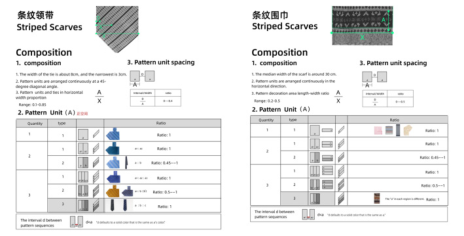
If simply transplanted onto narrow carriers (such as headbands), the pattern may become fragmented due to cutting and stretching, weakening the original meaning and aesthetic. Therefore, this study takes typical textiles, such as scarves, square kerchiefs, and neckties, as examples to establish a set of Dong brocade pattern adaptation rules for design practice, including common size ranges and parameters for pattern adjustment. Using striped scarves and neckties as examples, the schematic representation of these rules is shown in Figure 1.
Figure 1: Product craft rules for striped scarves and striped neckties.
INTELLIGENT GENERATION SYSTEM FOR DONG BROCADE At the tool development stage, this study builds an intelligent design workflow based on the instructional information set for Dong brocade distilled from Patternology theory. This workflow is intended to address key shortcomings of current general-purpose generative models. To this end, the intelligent generation system for Dong brocade proposed in this study adopts a system: an instructional information set knowledge base, a vector database, and a parametric composition and AI motif generation module. Among these components, the instructional information set knowledge base is used to consolidate reusable rules and constraints; the vector database enables retrieval and matching of design elements; and parametric composition and AI motif generation transform the retrieved elements into editable pattern.
Figure 2: Workflow and interface of the intelligent generation system for Dong brocade.
Instructional Information Set for Dong Brocade Generation Building on the previous systematic deconstruction of the visual aesthetics, cultural connotation, and weaving art of Dong brocade, this study further draws on the core ideas of the copy-the-instruction model of cultural meme transmission. On this basis, the instructional information set for Dong brocade generation is divided into three interrelated subsets. The visual instructional information subset constrains the visual form. The semantic instructional information subset imposes semantic constraints on the selection and combination of patterns to ensure accurate cultural connotation. The weaving instructional information subset translates weaving techniques and product specifications into quantified and parameterized data, so that the generated patterns can be woven and adapted to specific products. as shown in Table 4.
Table 4: Dong brocade instructional information set.
Table available in the original PDF paper.
Type Instructional Information Content visual aesthetics pattern instructional information primary– secondary structure
Patterns are divided and annotated as primary and secondary pattern elements to clarify their visual weight and position within the composition.
geometric composition
compositional instructional information
The compositional rules of typical Dong brocade types are systematized to provide reusable compositional templates for the generation system.
Cultural connotation
cultural attribute
semantic instructional information
Patterns are encoded along the dimensions of cultural attributes and element types to support automatic retrieval and matching under specific cultural themes.
scenario attribute
Labels for “target user group–use scenario” are assigned to support automatic retrieval and matching in appropriate contexts.
Craft constraints
format constraint
craftsmanship instructional information
The effective weaving width of the loom is translated into compositional constraint parameters.
product carrier Pattern adaptation rules are parameterized according to the specifications of different products.
From Result Imitation to Cultural Translation 85 Requirement Decomposition and Instruction Retrieval Matching
At the design requirement decomposition stage, the system first uses natural language processing (NLP) to perform semantic parsing of the user’s natural language input. It then applies similarity-based retrieval to find matching design elements in the database. To support this process, the three core types of instructional information described above are organized into structured documents. Each document is annotated with its element type, instruction type, content, and parameter range. Each design element is linked to one or more core instructions and then written into the database. In this way, when the system receives a new design requirement, it can use vector similarity to quickly generate element combinations that fit the requirement well across the pattern and composition dimensions.
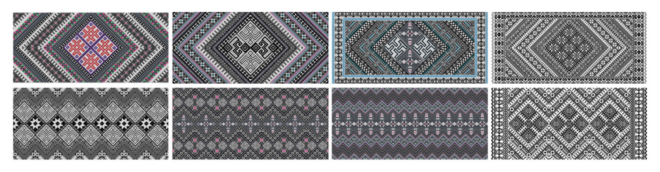
Parametric Composition and Motif Generation After completing the selection and combination of design elements, this study adopts a parametric composition and AI motif generation approach to achieve precise control over pattern generation. At the compositional level, the system abstracts typical Dong brocade structures such as Dahua brocade and Xiaohua brocade into parametric templates. It then sets pattern size, repetition period, and related attributes as adjustable parameters. Users or algorithms can adjust these parameters within predefined ranges. This enables different visual styles while preserving the established compositional logic of Dong brocade. At the motif level, this study trains a Dong brocade- specific LoRA model based on Stable Diffusion 1.5. Dong brocade motifs are filtered and uniformly cropped. Automatic labeling is combined with manual correction to construct a high-quality annotated dataset. On the model side, a positive LoRA is trained to reinforce typical Dong brocade styles, while a negative LoRA is trained on low-quality samples to suppress blur, deformation, and other undesired artifacts.
Figure 3: Product craft rules for striped scarves and striped neckties.
COMPARATIVE EXPERIMENT To quantitatively evaluate the proposed intelligent generation system for Dong brocade and examine whether it alleviates three issues—visual alienation, cultural semantic bias, and weaving difficulties—this study conducts a comparative experiment using three general-purpose models (Midjourney, Stable Diffusion, and DCGAN) as baselines.
86 Li and Wang To control variables, the same set of Dong brocade–focused prompts is used across all four systems. The prompts include typical usage scenarios and thematic meanings. Each system generates three images, producing 12 images in total. All outputs are standardized in image size and presentation format.
An expert panel is then invited for a double-blind evaluation. The panel (N = 8) includes three Dong brocade weavers, two Dong culture researchers, and three Dong brocade designers, each with over two years of relevant research or practice. Using a 1–5 Likert scale, experts rate each image on three dimensions—visual aesthetics, cultural authenticity, and weavability— without knowing which model produced the image.
During the formal session, the 12 images are shown in random order. Mean scores are calculated for each model (Table5). After scoring, experts select one most satisfactory and one least satisfactory image and provide brief reasons for their choices.
Table 5: Likert-scale ratings.
Table available in the original PDF paper.
System Visual Aesthetics Cultural Authenticity Weavability System Proposed system 4.25 4.375 4.5 Proposed system
DCGAN 2.375 1.75 1.875 DCGAN Statistical analyses were conducted to compare the proposed system with the three general-purpose AI generative models. Normality tests were first performed on the expert-level mean ratings for each evaluation dimension. For data that met the normality assumption, paired-samples t-tests were used; for data that did not meet the assumption, Wilcoxon signed-rank tests were applied. The results showed that the proposed system obtained higher mean scores than the three general-purpose AI models across all three evaluation dimensions.
Visual aesthetics. The proposed system received a mean score of 4.25, higher than Midjourney (2.75), Stable Diffusion (3.25), and DCGAN (2.38). Statistical tests showed that the differences between the proposed system and Midjourney, as well as between the proposed system and Stable Diffusion, were both significant according to Wilcoxon signed-rank tests (both W = 0, p = .008). The difference between the proposed system and DCGAN was also significant according to a paired-samples t-test, t(7) = 17.37, p < .001. Experts generally believed that the patterns generated by the proposed system were more stable in terms of composition, motif presentation, and local detail control, and that their overall visual performance was clearer.
Cultural authenticity. The proposed system received a mean score of 4.38, higher than Midjourney (1.88), Stable Diffusion (3.88), and DCGAN (1.75). Statistical results showed that the proposed system scored significantly higher than Midjourney, t(7) = 17.75, p < .001, and DCGAN, t(7) = 15.28, p < .001. Although the difference between the proposed system and Stable Diffusion did not reach statistical significance (W = 0, p = .063), the proposed system still obtained a slightly higher mean score, indicating a tendency toward
From Result Imitation to Cultural Translation 87 advantage. Combined with the experts’ qualitative feedback, the proposed system showed stronger alignment with the existing cultural context in terms of motif selection and combination, suggesting that the instructional information set and semantic constraints helped mitigate issues of “cultural appropriation” and “semantic loss.”
Weavability. The proposed system received a mean score of 4.50, significantly higher than Midjourney (2.00), Stable Diffusion (2.38), and DCGAN (1.88). Statistical tests showed that the difference between the proposed system and Midjourney was significant according to a Wilcoxon signed-rank test (W = 0, p = .008), while the differences between the proposed system and Stable Diffusion, t(7) = 9.76, p < .001, and between the proposed system and DCGAN, t(7) = 19.78, p < .001, were significant according to paired-samples t-tests. In the images generated by the general-purpose models, experts repeatedly pointed out issues such as chaotic lines and broken local structures, with some patterns even being described as “difficult to weave according to the pattern.” By contrast, under the constraints of mathematical instructions and parametric composition, the proposed system generated patterns that were more consistent with the weaving logic of Dong brocade in terms of width control, line thickness, and structural connections. Several weavers further noted that these patterns were “suitable for trial weaving.”
CONCLUSION
In summary, using Dong brocade as a case, this study directly addresses three common issues that arise in the intervention of intelligent technology in the weaving of ethnic minority brocades: visual alienation, cultural semantic bias, and difficulties in weaving.Building on Patternology theory, this study deconstructs the visual aesthetics, cultural connotation, and weaving art of Dong brocade. It also systematizes the knowledge embedded in traditional pattern design. It then constructs an instructional information set tailored for AI generation and develops a custom system that integrates a vector database with parametric adjustment.
The experimental results show that, compared with general-purpose models, the proposed system significantly improves the visual stability, cultural authenticity, and weavability of the generated patterns.
Of course, this study has several limitations. First, the scale of the data and the scope of the model are limited: the model primarily relies on Dong brocade motif data collected and organized by this study, with a relatively small sample size. Second, the current system primarily outputs static patterns and “weaving sketches” and has not yet fully integrated digital jacquard loom control with the complete product development production chain. Further progress is needed in terms of engineering implementation and industry collaboration in the future.
Overall, this study proactively reshapes the generation processes of AI, transforming it from a general image generator into a cultural context translator. It provides a replicable, transferable, and culturally sustainable pathway for the intelligent and innovative design of Dong brocade and other ethnic minority patterns.
ACKNOWLEDGMENT
This work is supported by the Key Laboratory of Culture and Tourism and sponsored by Lushan Lab Research Funding. The English grammar was reviewed with the assistance of ChatGPT.
REFERENCES
Blackmore, S., 2000. The meme machine (Vol. 25). Oxford Paperbacks. Carlini, N., Hayes, J., Nasr, M., Jagielski, M., Sehwag, V., Tramer, F., Balle, B., Ippolito, D. and Wallace, E., 2023. Extracting training data from diffusion models. In 32nd USENIX security symposium (USENIX Security 23),pp. 5253–5270. Chen, Z. 2020. Methods of pattern composition. Nanjing Shifan Daxue Chubanshe. Corbusier, L., 1900. Le Corbusier vers une architecture. G. Crès. Dawkins, R., 2017. O gene egoísta. Editora Companhia das Letras. Kandinsky, W. and Rebay, H., 1979. Point and line to plane. Courier Corporation. Lei, G., 2016. Lei Guiyuan on pattern design art. Shanghai Wenhua Chubanshe. Li, B., 2018. Research on the relationship between the concept of creation in
“Kaogong Ji” and Patternology. Journal of Southeast University (Philosophy and Social Science), 2018,20(05), pp. 119–125. Liu, J., Ma, X., Wang, L. and Pei, L., 2024 ‘How can generative artificial intelligence techniques facilitate intelligent research into ancient books?’, Journal of Computing and Cultural Heritage, 17(4). Meron, Y., 2022. Graphic design and artificial intelligence: Interdisciplinary
challenges for designers in the search for research collaboration. Qin, Z., 2022. Research on Tongdao Dong brocade from the perspective of cultural ecology. Ph.D. thesis, Hunan University. Qin, Z., Liu, Y.-H. and Zheng, D.-Y.,2021 ‘Aided design path of Dong brocade
pattern driven by semantics’, Packaging Engineering, 42(14), pp. 65–73. Shi, Y., Shang, M. and Qi, Z., 2023. Intelligent layout generation based on deep generative models: A comprehensive survey. Information fusion, 100, p.101940. Stanford University, Hasso Plattner Institute of Design (2010) An introduction to
design thinking: Process guide [PDF]. [Viewed 5 February 2026]. Available at: https://web.stanford.edu/~mshanks/MichaelShanks/files/509554.pdf Tao, Y., Fu, X., Wu, J., Bian, Z., Zhu, A., Bao, Q., Zheng, W., Wang, Y., Zhu, B., Yang, C. and Zhou, C., 2025, April. AIFiligree: A Generative AI Framework for Designing Exquisite Filigree Artworks. In Proceedings of the 2025 CHI Conference on Human Factors in Computing Systems (pp. 1–18). Xiao, Y., Lin, X., Ji, T., Qiao, J., Ma, B. and Gong, H., 2025. AI-Assisted Design:
Intelligent Generation of Dong Paper-Cut Patterns. Electronics, 14(9), p.1804. Yan, H., Zhang, H., Liu, L., Zhou, D., Xu, X., Zhang, Z. and Yan, S., 2022. Toward intelligent design: An AI-based fashion designer using generative adversarial networks aided by sketch and rendering generators. IEEE Transactions on Multimedia, 25, pp. 2323–2338. Yao, Z., Lyu, S., Lu, Y., Sun, Q., Li, H., Wang, X., Liu, G. and Mi, H., 2024,
May. ShadowMaker: Sketch-based creation tool for digital shadow puppetry. In Extended Abstracts of the CHI Conference on Human Factors in Computing Systems (pp. 1–5). Zhao, H.Y., Peng, H. and Zhang, X.L., 2015. A generation method of carpet pattern based on evolutionary computation. Journal of Graphics, 36(01), pp. 41–46. Zhou, Z., Liu, X., Shang, J., Huang, J., Li, Z. and Jia, H., 2022. Inpainting digital
Dunhuang murals with structure-guided deep network. ACM Journal on Computing and Cultural Heritage, 15(4), pp.1–25.
LISTED IN THE AHFE DIGITAL BOOKSTORE CATALOGUE
Explore the complete digital volume
Global Issues Challenge: Challenges in AI at the Human Level
Read this individual research paper free through the original publisher, or explore the full digital proceedings book.
ISBN 979-8-950676-10-9
Explore this ISBN in the AHFE Bookstore ↗Listed in the July 2026 bookstore catalogue; search by ISBN to confirm current availability · Digital book purchase optional