Chengcheng Ma, Mengkun Bi, Min Hua (2026). AI-Empowered Design of Museum Cultural and Creative Products: Creator Identity, Consumption Values, and Purchase Intention. In: Global Issues Challenge: Challenges in AI at the Human Level. AHFE Open Access, vol. 234, pp. 65–76. https://doi.org/10.54941/ahfe1007459
The integration of Artificial Intelligence (AI) in the design process is transforming the cultural and creative industries, especially in the design of Museum Cultural and Creative Products (MCCPs). This study investigates consumer perceptions of creativity in AI-generated MCCPs and applies the Theory of Consumption Values (TCV) to assess how different dimensions of consumer value:quality value, social value, innovation value, and experiential value affect purchase intentions toward AI-designed MCCPs. Additionally, it explores how perceptions of creativity influence purchase decisions.The study is divided into two parts: study1 with a sample of 546 participants, examines how consumers perceive the creativity of MCCPs designed by AI versus human designers. Study2 based on 412 completed surveys, explores consumer purchase intentions for AI-designed products and how perceptions of creativity in AI-designed products influence the relationship between consumption values and purchase intentions. The findings show that consumers are more likely to accept AI-designed products when they perceive them as emotionally appealing and culturally valuable. The study also finds that creativity perception enhances the positive impact of quality, social, innovation, and experiential values on consumers' intension to purchase AI-generated MCCPs.This study helps deepen the understanding of the intersection between AI, creativity, and consumer behavior. The results provide valuable insights for cultural institutions, designers, and marketers, helping them leverage AI to enhance product design while maintaining cultural authenticity.
Museums have increasingly been reconceptualized as public cultural institutions centered on community service and cultural dissemination. The International Council of Museums’ 2022 definition describes museums as “non-profit, permanent institutions serving society,” responsible for research, collection, preservation, interpretation, and display of heritage (ICOM, 2022). Within this context, MCCPs are designed as functional cultural objects inspired by museum narratives, serving both cultural communication and market exchange functions (Cheng et al., 2024). UNESCO defines cultural Received March 6, 2026; Revised April 7, 2026; Accepted April 21, 2026; Available online July 20, 2026
goods as carriers of ideas and symbolic meaning, with MCCPs representing a form of cultural commodity within the museum context (UNESCO, 2009). Unlike ordinary consumer goods, MCCPs serve as an important medium through which consumers establish emotional connections with cultural heritage, seeking not only to fulfill utilitarian needs but also to resonate with the cultural narratives embedded in museum collections (Tu, Liu, and Cui, 2019). With ongoing technological advances, AI has become increasingly involved in cultural and creative product design. Generative AI tools can rapidly produce diverse conceptual proposals (Ramesh et al., 2022), blend traditional cultural elements with contemporary aesthetics (Gatys et al., 2015), and co-create intangible heritage content with human creators, enabling participatory storytelling and sustainable heritage transmission (Wang et al., 2025). Data-driven recommendation systems can further offer personalized MCCP suggestions based on individual consumer preferences, thereby enhancing purchase intention (Yun and Chun, 2024). Notably, AI’s entry into the design domain has given rise to three coexisting creative modes: fully AI-generated design, independent human design, and human-AI collaboration (in which the designer provides thematic direction, AI generates an initial draft, and the designer refines the final output).
However, AI has historically been perceived as lacking individuality and emotional depth, and its creative capacity is often met with systematic consumer resistance known as algorithm aversion (Dietvorst et al., 2015; Magni, Park, and Chao, 2024). This tension is particularly consequential for MCCPs, where consumers are especially sensitive to the credibility of creative intent and cultural authenticity (Zhu and Rahman, 2025). Yet how creator identity shapes creativity evaluation, and which consumption value dimensions drive purchase intention for AI-designed MCCPs, have yet to be systematically examined empirically.
This study addresses this gap through two experiments. Study 1 compares consumer creativity assessments across three creator identity conditions (AI-generated, human-designed, and human-AI collaborative) using the MPCM scale (Cheng et al., 2024). Study 2 draws on the Theory of Consumption Values (TCV) to examine how quality, social, innovation, and experiential value influence purchase intention toward AI-designed MCCPs, and tests whether attitude toward AI moderates these relationships.
LITERATURE REVIEW
Creativity Assessment Dimensions for MCCPs Cheng et al. (2024) developed the Museum Product Creativity Measure (MPCM) through large-sample empirical research, proposing five core dimensions: Affect, Usefulness, Aesthetics, Cultural Value, and Novelty. However, confirmatory analysis revealed that the Novelty dimension demonstrated weak discriminant validity and was therefore excluded from the final measurement model. The remaining four dimensions are adopted in this study to assess consumer creativity perceptions across three creator identity conditions. Specifically, Affect captures emotional responses such
AI-Empowered Design of Museum Cultural and Creative Products 67 as attractiveness and pleasure; Usefulness concerns functional and practical value; Aesthetics addresses visual appeal and refinement; and Cultural Value reflects the product’s role in cultural transmission and education.
Theory of Consumption Values The Theory of Consumption Values (TCV) explains consumer purchase decisions as driven by multiple value dimensions rather than price or functionality alone (Sheth et al., 1991). This study adapts the framework to the consumption characteristics of MCCPs: functional value is refined into quality value to emphasize design excellence; emotional value is reconceptualized as experiential value to encompass both sensory and affective dimensions of cultural experience; and epistemic value is reframed as innovation value to reflect the technological novelty of AI-generated design. Conditional value is omitted as it does not form a distinct measurable dimension in this context (Zhao et al., 2021; Malodia et al., 2021). Social value is retained from the original framework. The extended TCV has been successfully applied to analyze consumer behavior toward AI products (Malodia et al., 2021), making it a suitable theoretical framework for Study 2.
Attitude Toward AI and Algorithm Aversion Attitude toward AI refers to individuals’ cognitive beliefs and affective orientations toward AI’s technological capabilities and its involvement in the creative process (Schepman and Rodway, 2020). Algorithm aversion theory holds that people systematically avoid relying on AI judgment even when it performs comparably to humans, an effect particularly pronounced in creative domains where consumers tend to attribute greater creativity and emotional value to human-created works (Dietvorst et al., 2015; Magni, Park & Chao, 2024). However, this bias is not universal; its magnitude is significantly moderated by individual differences in attitude toward AI (Schepman & Rodway, 2020). In the context of MCCPs, individual differences in attitude toward AI may therefore function as an important boundary condition shaping how each consumption value dimension drives purchase intention.
HYPOTHESIS DEVELOPMENT The Impact of Consumption Value on Purchase Intention
Quality value reflects consumers’ subjective assessments of a product’s practical attributes and physical characteristics, encompassing perceived reliability, durability, and cost-effectiveness (Sheth et al., 1991). Prior research confirms that quality value reduces uncertainty and enhances value- for-money judgments, thereby increasing purchase intention (Sweeney & Soutar, 2001).
H1: The quality value of AI-designed MCCPs has a positive effect on purchase intention.
Social value reflects the symbolic significance of a product in enhancing social status, fostering a sense of belonging, and conveying self-image (Sheth et al., 1991). When a product is perceived as capable of elevating social status
or gaining peer recognition, consumers are more likely to form purchase intentions (Zhang et al., 2024). Prior research confirms that social value positively influences purchase intention toward AI products (Malodia et al., 2021). H2: The social value of AI-designed MCCPs has a positive effect on purchase intention.
Innovation value captures consumers’ perceived utility from a product’s technological novelty, design originality, and uniqueness, including the sense of freshness, knowledge acquisition, and disruption of existing solutions (Sheth et al., 1991). Research on the Palace Museum’s cultural products confirms that innovation value significantly promotes purchase intention (Zhao et al., 2021).
H3: The innovation value of AI-designed MCCPs has a positive effect on purchase intention.
Experiential value encompasses not only functional fulfillment but also the pleasure derived from sensory enjoyment, emotional arousal, and immersive interaction during consumption (Holbrook, 1999; Mathwick et al., 2001). Empirical research confirms that experiential value significantly predicts purchase intention (Varshneya & Das, 2017).
H4: The experiential value of AI-designed MCCPs has a positive effect on purchase intention.
Moderating Role of Attitude Toward AI Attitude toward AI refers to individuals’ cognitive beliefs and affective orientations toward AI’s technological capabilities and its involvement in the creative process (Schepman & Rodway, 2020). In the emotionally and culturally laden consumption context of MCCPs, individual differences in attitude toward AI may function as an important boundary condition, shaping how each consumption value dimension drives purchase intention.
Consumers with more positive attitudes toward AI are more likely to perceive AI’s technological involvement as a guarantee of design quality rather than a threat. Research confirms that AI involvement in the design process enhances consumers’ perception of a product’s functional value (Xu & Mehta, 2022), and consumers with more positive attitudes toward AI are more likely to translate this enhanced functional perception into stronger quality-driven purchase motivation.
H5a: Attitude toward AI positively moderates the effect of quality value on purchase intention.
Innovation value centers on consumers’ perception of a product’s technological novelty and originality. Consumers with more positive attitudes toward AI possess greater technological openness and are more inclined to view AI-generated design as an expression of innovative capability, making the moderating effect of attitude toward AI on the innovation value pathway particularly salient (Sohn et al., 2021). Conversely, consumers with more negative attitudes may find their translation of perceived novelty into purchase intention attenuated by resistance to AI.
AI-Empowered Design of Museum Cultural and Creative Products 69 H5b: Attitude toward AI positively moderates the effect of innovation value on purchase intention.
Experiential value encompasses the pleasure derived from aesthetic appreciation and emotional resonance. Consumers with more positive attitudes toward AI are more willing to engage emotionally with the aesthetic expression of AI-designed products, amplifying the effect of experiential value on purchase intention, whereas those with reservations about AI may experience emotional detachment due to authenticity concerns, weakening this effect (Puntoni et al., 2021).
H5c: Attitude toward AI positively moderates the effect of experiential value on purchase intention.
Social value reflects consumers’ motivation to gain social recognition and express identity through products. Consumers with more positive attitudes toward AI are more likely to regard AI-designed products as symbols of personal taste and technological sophistication, thereby strengthening the effect of social value on purchase intention (Zhang et al., 2022).
H5d: Attitude toward AI positively moderates the effect of social value on purchase intention.
METHODS
Study1 Participants were recruited via the Wenjuanxing online survey platform across multiple cities in China, and randomly assigned to one of three experimental conditions (AI-generated, human-designed, and human-AI collaborative). A total of 480 valid responses were retained (approximately 160 per group). Each questionnaire included an attention check item to exclude invalid responses.
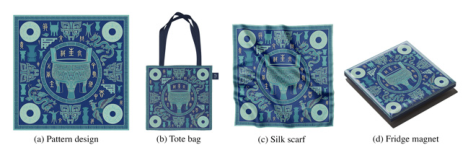
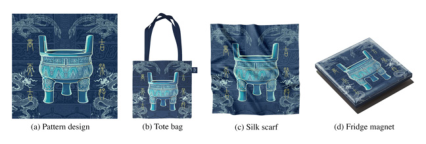
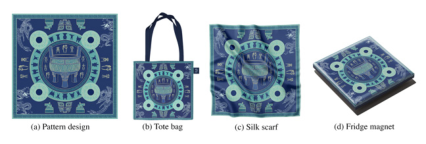
Three typical 2D graphic MCCPs themed on bronze artifacts from the Shanghai Museum served as visual stimuli: a silk scarf, a canvas bag, and a fridge magnet. For each product, three versions were created corresponding to the three creator identity conditions: AI-generated (Figure 1), human- designed (Figure 2), and human-AI collaborative (Figure 3). The three image sets were kept consistent in cultural theme, color scheme, and visual complexity, with creator identity as the sole manipulation. A pretest (n = 93, 31 per group) confirmed no significant differences across conditions in visual quality, cultural theme consistency, or visual complexity (all p > .05).
Figure 1: AI-generated versions of the three MCCP stimuli.Figure 2: Human-designed versions of the three MCCP stimuli.Figure 3: Human-AI collaborative versions of the three MCCP stimuli.
A one-factor, three-level between-subjects design was employed, implemented through three separate questionnaires. Each questionnaire clearly identified the creator identity of the displayed products at the outset, and participants were exposed only to the images corresponding to their assigned condition. Product creativity was assessed using the MPCM scale (Cheng et al., 2024), comprising 21 items across four dimensions (Affect, Usefulness, Aesthetics, and Cultural Value) on a seven-point Likert scale (1 = strongly disagree, 7 = strongly agree).
Study2 Participants were recruited via the Wenjuanxing online survey platform, with samples drawn to ensure diversity in gender, age, and educational background. Data collection lasted two weeks, yielding 405 valid responses (male: 189, 46.67%; female: 216, 53.33%). Participants in Study 2 were entirely independent from those in Study 1, with no sample overlap, to avoid order effects across studies.
Study 2 used the same AI-generated images of bronze-themed 2D MCCPs from the Shanghai Museum (silk scarf, canvas bag, and fridge magnet) as those in the AI-generated condition of Study 1. At the outset of the questionnaire, participants were asked to imagine selecting a creative souvenir at the Shanghai Museum’s cultural and creative products store, and were informed that all displayed products were generated by AI design tools.
The survey comprised four sections: (1) attitude toward AI, (2) perceived consumption value, (3) purchase intention, and (4) demographic information. Scales for perceived consumption value and purchase intention were adapted from Zhao et al. (2021), covering quality value (4 items), social value (4 items), innovation value (4 items), experiential value (4 items), and purchase intention (4 items). The experiential value scale was modified for the online survey context, drawing on Varshneya and Das (2017) to focus on visual aesthetic experience and cultural emotional experience, replacing items from Zhao et al. (2021) that presupposed an on-site visit context. Attitude toward AI was measured using five items from the General Attitudes towards
AI-Empowered Design of Museum Cultural and Creative Products 71 Artificial Intelligence Scale (GAAIS; Schepman & Rodway, 2020), selected to reflect the cognitive belief dimension and avoid conceptual overlap with the purchase intention scale. All constructs were measured on a seven-point Likert scale (1 = strongly disagree, 7 = strongly agree).
RESULT
Study1 Data from 480 valid responses (n = 160 per group) were analyzed using SPSS 27.0. Although Shapiro-Wilk tests indicated non-normal distributions across all four dimensions (p < .001), skewness and kurtosis values remained within acceptable ranges, and ANOVA is robust to mild normality violations with samples of this size (Field, 2018). Levene’s test indicated heterogeneity of variance for Aesthetics and Usefulness, for which Games-Howell post hoc tests were applied; Tukey HSD was used for Cultural Value and Affect.
One-way ANOVA revealed significant effects of creator identity on all four MPCM dimensions, with effect sizes ranging from medium to large (η² = .068–.139). Post hoc comparisons showed a consistent pattern: the human-AI collaborative group scored significantly lower than both the AI-generated and human-designed groups across all four dimensions (all p < .01). Comparisons between the AI-generated and human-designed groups revealed dimension-specific differences: AI-generated products scored significantly higher on Usefulness (M = 5.69 vs. 4.84, p < .001) and Cultural Value (M = 5.48 vs. 5.11, p = .026), while no significant differences emerged on Aesthetics (p = .176) or Affect (p = .057).
These results suggest that AI’s creative advantage is dimension-specific, manifesting primarily in the breadth of cultural symbolism (Cultural Value) and functional-formal integration efficiency (Usefulness), consistent with the theorization of AI’s combinatorial creativity advantage (Choi et al., 2024). The absence of significant differences on Aesthetics and Affect indicates that consumers do not perceive AI as superior in visual sensibility or emotional depth. The systematically lowest scores for the human-AI collaborative group (Affect: M = 4.41; Usefulness: M = 4.34; Aesthetics: M = 4.43; Cultural Value: M = 4.25) suggest that ambiguity in creative attribution undermines overall creativity evaluation, consistent with perceived authenticity theory (Valsesia et al., 2016).
Table 1: One-Way ANOVA results for creator identity effects on MPCM dimensions.
Study2 Data were analyzed using PLS-SEM with SmartPLS 4.0, following the two- step procedure recommended by Anderson and Gerbing (1988). To assess common method bias, Harman’s (1976) single-factor test was conducted. The KMO value was 0.913 and Bartlett’s test of sphericity was significant (p < 0.001), confirming the suitability of the data for factor analysis. The first unrotated factor accounted for 37.059% of the variance, below the 50% threshold, indicating that common method bias does not pose a significant threat to the results.
Measurement model assessment followed the criteria recommended by Hair et al. (2019). Internal consistency was satisfactory, with Cronbach’s α ranging from 0.912 to 0.925 and composite reliability (rho_c) ranging from 0.938 to 0.942, both exceeding the 0.70 threshold. Average variance extracted (AVE) ranged from 0.763 to 0.800, exceeding the 0.50 criterion, supporting convergent validity. All HTMT values ranged from 0.043 to 0.575, well below the 0.85 threshold, confirming discriminant validity. VIF values ranged from 1.104 to 1.841, indicating no multicollinearity concerns.
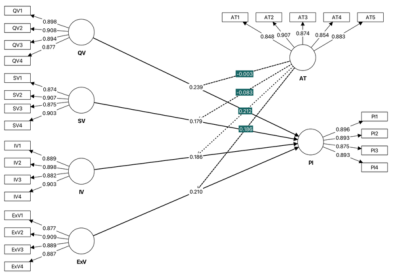
Figure 4: PLS-SEM structural model with path coefficients.
The structural model explained 55.5% of the variance in purchase intention (R² = 0.555). All five predictors exerted significant positive effects: quality value (β = 0.239, t = 5.599, p < 0.001), experiential value (β = 0.210, t = 3.890, p < 0.001), innovation value (β = 0.186, t = 4.114, p < 0.001), social value (β = 0.179, t = 3.818, p < 0.001), and attitude toward AI (β = 0.149, t = 2.925, p < 0.01). The effect order suggests that consumers prioritize tangible quality and craftsmanship over technological novelty when purchasing AI-designed MCCPs, consistent with the affective-cultural nature of this product category (see Figure 4).
Moderation was tested using the Product Indicator Approach (Chin et al., 2003) with bootstrapping (5,000 resamples). Attitude toward AI significantly moderated the effects of innovation value (β = 0.212, t = 3.437, p < 0.01) and experiential value (β = 0.186, t = 2.353, p < 0.05) on purchase intention, supporting H5b and H5c. Moderation was non-significant for quality value (β = −0.003, p = 0.955) and social value (β = −0.083, p = 0.177), thus H5a and H5d were not supported. Detailed results are presented in Table 2.
Table 2: Results of hypothesis testing.
Table available in the original PDF paper.
Hypothesis Path Coefficient (β) t Value p Value Supported H1 QV → PI 0.239 5.599 < 0.001 Yes
H2 SV → PI 0.179 3.818 < 0.001 Yes H3 IV → PI 0.186 4.114 < 0.001 Yes H4 ExV → PI 0.210 3.890 < 0.001 Yes
H5a AT × QV → PI −0.003 0.057 0.955 No H5b AT × IV → PI 0.212 3.437 < 0.01 Yes H5c AT × ExV → PI 0.186 2.353 < 0.05 Yes
H5d AT × SV → PI −0.083 1.351 0.177 No
CONCLUSION AND LIMITATION This study examined how creator identity influences consumer creativity perceptions of AI-designed MCCPs, and how consumption value dimensions and attitude toward AI shape purchase intention. Study 1 demonstrated that creator identity significantly affects creativity evaluations across all four MPCM dimensions (η² = .068–.139). AI-generated products scored significantly higher than human-designed products on Usefulness and Cultural Value, while no significant differences emerged on Aesthetics and Affect, challenging the stereotype that AI-generated design lacks cultural depth and emotional resonance. Notably, human-AI collaborative products received the lowest scores across all dimensions, suggesting that ambiguity in creative attribution systematically undermines creativity perception, a finding consistent with perceived authenticity theory (Valsesia et al., 2016). Study 2 identified quality value as the strongest driver of purchase intention (β = 0.239), followed by experiential, innovation, and social value, indicating that consumers prioritize tangible quality over technological novelty when purchasing AI-designed MCCPs. Attitude toward AI significantly moderated the effects of innovation value and experiential value, but not quality or social value, demonstrating that algorithm aversion operates selectively rather than uniformly across consumption value dimensions.
These findings offer three theoretical contributions. First, they extend the MPCM scale (Cheng et al., 2024) to the domain of AI-generated content. Second, they integrate the TCV framework with attitude toward AI as a moderator, providing a more complete account of purchase decision-making for AI-designed products. Third, they refine algorithm aversion theory (Dietvorst et al., 2015) by demonstrating its boundary conditions in cultural creative consumption contexts. For practice, museums promoting AI-designed MCCPs should foreground product quality and cultural experience rather than technological novelty, and communicate creator identity clearly, as ambiguous attribution appears to reduce perceived creativity.
This study has several limitations. The sample was drawn exclusively from Chinese online platforms, limiting cross-cultural generalizability. The cross- sectional design cannot capture changes in consumer perceptions as generative
AI technology evolves, pointing to the need for longitudinal research. Additionally, visual stimuli in Study 2 were generated solely by Gemini AI; future research could systematically compare consumer evaluations across different AI tools. Finally, this study focused on 2D graphic products; the creativity perception and purchase behavior dynamics of 3D products and digital cultural goods remain to be explored.
ACKNOWLEDGMENT
This work was supported by Shanghai Jiao Tong University (Grant No. WH220527002), the International Association of Cultural and Creative Industry Research (Grant No. IACCIR202304), and the Ministry of Education (Grant No. HZKY20220068). The authors gratefully acknowledge the generous financial and administrative support provided by these institutions and their dedicated staff.
REFERENCES
Anderson, J. C., & Gerbing, D. W. (1988). Structural equation modeling in practice: A review and recommended two-step approach. Psychological Bulletin, 103(3), 411–423. https://doi.org/10.1037/0033-2909.103.3.411 Cetinic, E., & She, J. (2022). Understanding and creating art with AI: Review and
outlook. ACM Transactions on Multimedia Computing, Communications, and Applications, 18(2), 1–22. https://doi.org/10.1145/3475799 Cheng, H., Sun, X., Xie, J., Liu, B.-J., Xia, L., Luo, S.-J., Tian, X., Qiu, X., Li, W., & Li, Y. (2024). Constructing and validating the museum product creativity measurement (MPCM): Dimensions for creativity assessment of souvenir products in Chinese urban historical museums. Humanities and Social Sciences Communications, 11(1), 1–17. https://doi.org/10.1057/s41599-024-02780-5 Chin, W. W., Marcolin, B. L., & Newsted, P. R. (2003). A partial least squares
latent variable modeling approach for measuring interaction effects: Results from a Monte Carlo simulation study and an electronic-mail emotion/adoption study. Information Systems Research, 14(2), 189–217. https://doi.org/10.1287/ isre.14.2.189.16018 Choi, D., Hong, S., Park, J., Chung, J. J. Y., & Kim, J. (2024). CreativeConnect: Supporting reference recombination for graphic design ideation with generative AI. Proceedings of the CHI Conference on Human Factors in Computing Systems, 1–25. https://doi.org/10.1145/3613904.3642234 Dietvorst, B. J., Simmons, J. P., & Massey, C. (2015). Algorithm aversion: People
erroneously avoid algorithms after seeing them err. Journal of Experimental Psychology: General, 144(1), 114–126. https://doi.org/10.1037/xge0000033 Field, A. (2018). Discovering statistics using IBM SPSS statistics (5th ed.). SAGE Publications. Gatys, L. A., Ecker, A. S., & Bethge, M. (2015). A neural algorithm of artistic style.
arXiv. https://doi.org/10.48550/arXiv.1508.06576 Hair, J. F., Risher, J. J., Sarstedt, M., & Ringle, C. M. (2019). When to use and how to report the results of PLS-SEM. European Business Review, 31(1), 2–24. https:// doi.org/10.1108/EBR-11-2018-0203 Harman, H. H. (1976). Modern factor analysis (3rd ed.). University of Chicago Press. Holbrook, M. B. (Ed.). (1999). Consumer value: A framework for analysis and
research. Routledge.
AI-Empowered Design of Museum Cultural and Creative Products 75 ICOM. (2022). Museum definition. https://icom.museum/en/resources/standards-
guidelines/museum-definition/ Magni, F., Park, J., & Chao, M. M. (2024). Humans as creativity gatekeepers: Are we biased against AI creativity? Journal of Business and Psychology, 39(5), 643–656. https://doi.org/10.1007/s10869-023-09912-9 Malodia, S., Dhir, A., Bilgihan, A., Can, A. S., & Kar, A. K. (2021). Academic and
practitioner anticipated consumer behavior during the COVID-19 pandemic. Journal of Business Research, 132, 938–950. https://doi.org/10.1016/j. jbusres.2020.11.013 Mathwick, C., Malhotra, N., & Rigdon, E. (2001). Experiential value: Conceptualization, measurement and application in the catalog and Internet shopping environment. Journal of Retailing, 77(1), 39–56. https://doi.org/10.1016/ S0022-4359(00)00045-2 Puntoni, S., Reczek, R. W., Giesler, M., & Botti, S. (2021). Consumers and artificial
intelligence: An experiential perspective. Journal of Marketing, 85(1), 131–151. https://doi.org/10.1177/0022242920953847 Ramesh, A., Dhariwal, P., Nichol, A., Chu, C., & Chen, M. (2022). Hierarchical textconditional image generation with CLIP latents. arXiv. https://doi.org/10.48550/ arXiv.2204.06125 Schepman, A., & Rodway, P. (2020). Initial validation of the general attitudes
towards artificial intelligence scale. Computers in Human Behavior Reports, 1, Article 100014. https://doi.org/10.1016/j.chbr.2020.100014 Sheth, J. N., Newman, B. I., & Gross, B. L. (1991). Why we buy what we buy: A theory of consumption values. Journal of Business Research, 22(2), 159–170. https://doi.org/10.1016/0148-2963(91)90050-8 Sohn, K., Sung, C. E., Koo, G., & Kwon, O. (2021). Artificial intelligence in the
fashion industry: Consumer responses to generative adversarial network (GAN) technology. International Journal of Retail & Distribution Management, 49(1), 61–80. https://doi.org/10.1108/IJRDM-03-2020-0091 Sweeney, J. C., & Soutar, G. N. (2001). Consumer perceived value: The development of a multiple item scale. Journal of Retailing, 77(2), 203–220. https://doi. org/10.1016/S0022-4359(01)00041-0 Tu, J.-C., Liu, L.-X., & Cui, Y. (2019). A study on consumers’ preferences for the
Palace Museum’s cultural and creative products from the perspective of cultural sustainability. Sustainability, 11(13), Article 3502. https://doi.org/10.3390/ su11133502 UNESCO. (2009). 2009 UNESCO framework for cultural statistics (FCS). UNESCO Institute for Statistics. Valsesia, F., Nunes, J. C., & Ordanini, A. (2016). What wins awards is not always
what I buy: How creative control affects authenticity and thus recognition (but not liking). Journal of Consumer Research, 42(6), 897–914. https://doi.org/10.1093/ jcr/ucv093 Varshneya, G., & Das, G. (2017). Experiential value: Multi-item scale development and validation. Journal of Retailing and Consumer Services, 34, 48–57. https:// doi.org/10.1016/j.jretconser.2016.09.010 Wang, Y., & Zhou, Y. (2025). Artificial intelligence-driven interactive experience for
intangible cultural heritage: Sustainable innovation of blue clamp-resist dyeing. Sustainability, 17(3), Article 898. https://doi.org/10.3390/su17030898 Xu, L., & Mehta, R. (2022). Technology devalues luxury? Exploring consumer responses to AI-designed luxury products. Journal of the Academy of Marketing Science, 50(6), 1135–1152. https://doi.org/10.1007/s11747-022-00854-x
Yun, X., & Chun, M. H. (2024). The impact of personalized recommendation on purchase intention under the background of big data. Big Data and Information Analytics, 8, 80–108. Zhang, H., Bai, X., & Ma, Z. (2022). Consumer reactions to AI design: Exploring
consumer willingness to pay for AI-designed products. Psychology & Marketing, 39(11), 2171–2183. https://doi.org/10.1002/mar.21721 Zhang, Q., Wang, Y., & Ariffin, S. K. K. (2024). Consumers’ purchase intention in live-streaming e-commerce: A consumption value perspective and the role of streamer popularity. PLOS ONE, 19(2), Article e0296339. https://doi. org/10.1371/journal.pone.0296339 Zhao, L., Shu, S., Shao, J., Booth, E., & Morrison, A. M. (2021). Innovative or not?
The effects of consumer perceived value on purchase intentions for the Palace Museum’s cultural and creative products. Sustainability, 13(4), Article 2412. https://doi.org/10.3390/su13042412 Zhu, Q., & Rahman, R. (2025). Authenticity in souvenir design integrating cultural features of Dunhuang’s mural heritage: A qualitative inquiry. Humanities and Social Sciences Communications, 12(1), Article 403. https://doi.org/10.1057/ s41599-025-04403-z
LISTED IN THE AHFE DIGITAL BOOKSTORE CATALOGUE
Explore the complete digital volume
Global Issues Challenge: Challenges in AI at the Human Level
Read this individual research paper free through the original publisher, or explore the full digital proceedings book.
ISBN 979-8-950676-10-9
Explore this ISBN in the AHFE Bookstore ↗Listed in the July 2026 bookstore catalogue; search by ISBN to confirm current availability · Digital book purchase optional