Oscar Oviedo-Trespalacios, Felicia Laksanadjaja, Helma Torkamaan (2026). Skill Development, Maintenance, Erosion, and Revaluation: How Knowledge Workers Experience Generative AI. In: Global Issues Challenge: Challenges in AI at the Human Level. AHFE Open Access, vol. 234, pp. 55–64. https://doi.org/10.54941/ahfe1007458
Generative AI (GenAI) is rapidly embedding itself in knowledge work, supporting tasks such as writing, analysis, coding, and information synthesis. Although widely promoted as enhancing productivity and learning, concerns persist regarding overreliance, deskilling, and erosion of professional expertise. Current debates typically frame GenAI’s impact on skills in binary terms—upskilling versus deskilling—yet empirical evidence on how workers themselves experience these changes in everyday practice remains limited. This study examines how knowledge workers perceive the impact of GenAI on their professional skills. Semi-structured interviews were conducted with 38 professionals in the Netherlands, including academics (e.g., lecturers and professors) and non-academic professionals (e.g., consultants, analysts, engineers, legal professionals, and public sector employees) with varying levels of experience. Data were analyzed using inductive thematic analysis to identify recurring patterns in participants’ accounts of skill-related change. Four perceived skill outcomes emerged: skill development, skill maintenance, skill erosion, and skill revaluation. Skill development involved acquiring or strengthening competencies through learning from GenAI outputs, expanded information access, and offloading routine tasks to focus on higher-level work. Skill maintenance described situations where participants perceived little or no change, often linked to selective and critical use. Skill erosion referred to diminished ability to perform tasks independently without GenAI support. Skill revaluation captured shifts in perceived skill importance as certain tasks became delegable while others gained prominence. Overall, findings indicate that GenAI’s impact on professional skills is heterogeneous and practice-dependent. The proposed four-outcome framework offers a nuanced account of how workers interpret skill change in everyday GenAI use.
Generative Artificial Intelligence (GenAI) is rapidly reshaping knowledge work—an occupational domain defined by complex problem-solving, abstraction, and specialized expertise. Unlike earlier forms of automation that executed predefined procedural tasks, GenAI generates text, code, and analytical outputs that approximate expert reasoning. Its workplace adoption has accelerated dramatically; recent surveys indicate that 75% of
knowledge workers report using GenAI tools in their daily tasks (Microsoft & LinkedIn, 2024). Reported benefits include increased efficiency, enhanced creativity, and improved task focus. However, as GenAI systems assume more cognitively demanding functions, human roles may shift from active knowledge construction toward supervisory oversight. This redistribution of cognitive effort raises important questions about how sustained reliance may reshape professional expertise over time.
Research on automation provides theoretical grounding for these concerns. The Automation Paradox suggests that as systems become more capable and reliable, humans engage less frequently and less deeply, potentially weakening their capacity to intervene when automation fails. Empirical research on earlier technologies demonstrates that cognitive offloading can alter underlying skill structures: reliance on GPS has been associated with reduced spatial memory performance (Dahmani & Bohbot, 2020), and automation in aviation has been linked to declining manual decision- making proficiency (Volz & Dorneich, 2020). These patterns align with the concept of skill erosion, defined as the gradual decline of expertise resulting from insufficient practice or excessive reliance on automation. When core cognitive processes are repeatedly outsourced, opportunities for rehearsal, reflection, and error-based learning diminish, potentially weakening underlying competencies over time. Emerging evidence indicates that GenAI may produce comparable dynamics. Reliance on AI-generated outputs has been associated with reduced critical evaluation and independent reasoning (Lee et al., 2025), raising concerns that sustained delegation of analytical and generative tasks could erode higher-order cognitive skills. These findings suggest that the central issue is not merely short-term performance effects, but a broader reconfiguration of how cognitive effort—and ultimately expertise—is distributed within sociotechnical systems.
Despite growing debate, discussions of GenAI’s impact on professional skills remain polarized between narratives of upskilling and deskilling. This binary framing overlooks how knowledge workers themselves interpret and experience skill change in everyday practice, particularly within real organizational contexts. Existing research has largely relied on experimental or performance-based measures, providing limited ecological insight into perceived competence, dependence, and adaptation. Accordingly, the aim of this study is to develop an empirically grounded understanding of how knowledge workers perceive and make sense of skill-related changes associated with GenAI use. To achieve this, the study employs a qualitative approach to identify and analyze perceived skill outcomes and the mechanisms through which they are experienced during ongoing GenAI integration.
METHODS
This study employed an exploratory qualitative research design to examine how knowledge workers perceive the impact of Generative AI (GenAI) on their professional skills. Given the emergent and rapidly evolving integration of GenAI into workplace practices, and the limited empirical understanding of how skill transformations are experienced in situ, a qualitative approach
Skill Development, Maintenance, Erosion, and Revaluation 57 was deemed most appropriate. The study focuses on perceived skill outcomes, defined as participants’ interpretations of how GenAI use influences the development, maintenance, erosion, or revaluation of their expertise. While the broader research project also examined self-regulation strategies adopted in response to GenAI use, the present paper concentrates specifically on perceived skill outcomes. Semi-structured interviews were therefore selected to enable systematic exploration of shared themes while retaining flexibility to probe contextual differences and individual reflections. The study received approval from the Delft University of Technology Human Research Ethics Committee.
Participants and Recruitment The final sample consisted of 38 knowledge workers based in the Netherlands who had the option to use Generative AI (GenAI) in their professional activities. Actual usage was not required in order to capture perspectives from both users and non-users. Participants were grouped into broader occupational categories: Consulting and strategy-related roles represented the largest share of the sample (39.5%), followed by education and academic roles (18.4%), public sector professionals (13.2%), business and data analysts (10.5%), engineering and technical roles (13.2%), and smaller representation from legal and life sciences domains (5.2%). Participants varied substantially in professional experience, with 63.1% in early career stages (0–5 years), 10.5% mid-career (5–10 years), and 26.3% senior professionals (>10 years). Gender distribution was balanced.
Participants were recruited using purposive sampling to ensure variation across occupational sectors and levels of professional experience. Recruitment was conducted through university-affiliated networks, professional networks, and targeted outreach via professional social media platforms. Calls for participation were disseminated through institutional mailing lists and professional contacts to reach knowledge workers across academic and non-academic domains. This strategy aimed to capture diverse workplace contexts and varying degrees of exposure to Generative AI. Participation was voluntary, and individuals were included if they met the eligibility criterion of having the option to use GenAI in their professional activities.
Data Analysis Data were analyzed using reflexive thematic analysis following Braun and Clarke (2021), a flexible method for identifying and interpreting patterns of meaning across qualitative datasets. An inductive approach was adopted to allow codes and themes to emerge from participants’ accounts rather than being imposed a priori. Consistent with reflexive thematic analysis, theme development was interpretative and iterative rather than procedural or reliability-driven. ATLAS.ti software was used to facilitate data organization and coding. Emerging codes and themes were discussed with supervisors to critically examine interpretations and thematic boundaries. Although frequencies of codes and themes were recorded to ensure comprehensive
coverage, prevalence was not treated as an indicator of importance, given the variability inherent in semi-structured interviews. Descriptive qualifiers (e.g., “most,” “majority,” “some”) are used where relevant, and quotations have been minimally edited for readability without altering substantive meaning.
RESULTS AND DISCUSSION
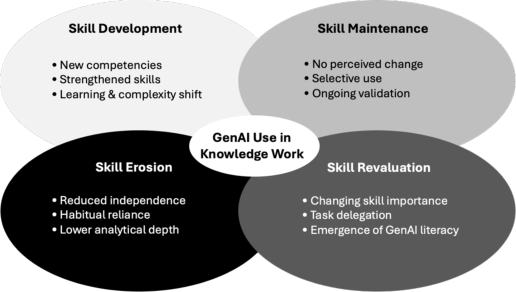
Participants described GenAI’s impact on professional skills as varied and context-dependent, rather than uniformly beneficial or detrimental. Their accounts revealed four perceived skill outcomes: skill development, skill maintenance, skill erosion, and skill revaluation. These outcomes reflect different ways in which expertise may evolve as GenAI becomes embedded in everyday work practices and were linked to underlying mechanisms such as learning from AI outputs, task delegation, validation practices, and habitual reliance. Although analytically distinguished for clarity, participants often described these outcomes as interrelated and contingent upon patterns of use and individual dispositions. Figure 1 presents the thematic framework illustrating the four skill outcomes and their associated mechanisms.
For analytical clarity, each trajectory was defined according to the type of change participants associated with GenAI-supported work. Skill development referred to acquiring new competencies or strengthening existing ones through learning and task reallocation. Skill maintenance reflected situations where skills were perceived to remain stable, often due to selective or critical use. Skill erosion captured diminished independent task capability, particularly under sustained delegation. Finally, skill revaluation described shifts in perceived importance of specific skills within evolving work practices.
Skill Development Participants perceived GenAI as having the potential to support skill development, both through acquiring new competencies and strengthening existing ones. Two primary mechanisms emerged: learning with GenAI and developing GenAI proficiency. Many described learning directly from AI outputs, internalizing writing styles or analytical structures. As one participant noted, “you start remembering certain words… so you learn from it too” (Participant 21), highlighting how exposure to AI-generated text could subtly shape professional expression. Such accounts align with broader evidence suggesting that GenAI can enhance cognitive and technical skills when used as a learning scaffold rather than a substitute (Daniel et al., 2025). However, participants emphasized that learning benefits depended on active engagement. Some reported that distrust in GenAI outputs prompted deeper verification and reflection, suggesting that critical interaction—rather than passive reliance—was central to development. This observation resonates with findings by Lee et al. (2025), who identified a negative association between uncritical confidence in AI and perceived critical thinking.
A second mechanism concerned the redistribution of effort through task delegation. Participants described using GenAI for routine or repetitive tasks in order to allocate more time to complex, developmental activities. One
Skill Development, Maintenance, Erosion, and Revaluation 59 engineer explained, “you’re less focused on the things you already know… so you can actually spend more time on the tasks that truly teach you new things” (Participant 8). This reflects research indicating that GenAI may reduce cognitive load and free resources for higher-order reasoning (Avello- Martínez et al., 2024). Yet this redistribution may have uneven effects across career stages: while experienced professionals may leverage freed capacity productively, reduced exposure to foundational tasks could constrain skill formation for novices. Finally, participants also framed GenAI proficiency itself as a newly emerging professional competence, echoing discussions of GenAI literacy as a necessary capability for effective human–AI collaboration (Pinski & Benlian, 2024). Taken together, these findings suggest that skill development under GenAI integration is contingent upon engagement quality, task redistribution, and evolving forms of AI-related expertise.
Skill Maintenance Skill maintenance refers to participants’ perceptions that their professional skills remained stable despite GenAI integration, reflecting neither noticeable development nor erosion. Approximately 70% of participants described situations in which their current use of GenAI had not substantially altered their competence. For some, this stability resulted from reduced learning opportunities. While GenAI could enhance output quality, it occasionally replaced hands-on practice or reduced exposure to corrective feedback. One participant reflected on using GenAI to draft text in a new style: “That was a potential learning moment… but I didn’t do it. It’s not that my skills decreased, but I also didn’t learn anything new” (Participant 35). Similarly, improved outputs sometimes led to less peer feedback: “Now I only get two notes back… ultimately, you learn a lot less from it” (Participant 7). These accounts echo concerns that AI-assisted tools may reduce opportunities for practice and reflective learning (Natali et al., 2025). Reduced social interaction around work products may also interrupt informal knowledge exchange processes that are central to professional development (Hadjimichael & Tsoukas, 2019). Conversely, many participants attributed the absence of skill erosion to limited, selective, or critically reflective use of GenAI. Around 40% emphasized that infrequent use or deliberate validation prevented skill decline. As one participant explained, “I haven’t used it consistently enough… I’ve always used it as line-level precision surgery” (Participant 20). Others described routinely validating outputs: “I always assume it’s wrong, so I always validate the answer” (Participant 11). Such accounts align with research emphasizing mindful engagement as protective against automation- induced skill degradation (Rinta-Kahila et al., 2023; Lee et al., 2025). These findings suggest that maintenance is not a passive state but often the outcome of deliberate regulation. In this sense, skill stability under GenAI integration appears contingent not on the technology itself, but on patterns of engagement and reflective oversight.
Skill Erosion A large majority of participants (≈80%) anticipated that GenAI could negatively affect professional skills over time. In their accounts, skill erosion was primarily understood as a reduced ability to perform tasks independently
without GenAI support, and secondarily as a decline in the depth or quality of outputs. Participants described erosion as becoming visible in settings where GenAI is unavailable (e.g., meetings) or where quick judgment is required. As one participant noted, erosion would be apparent “if all the work leading up to that seems good, but the execution ultimately and the human element of the work is not up to par” (Participant 16). Another emphasized the practical constraint that “GenAI isn’t going to help you in a meeting… You have to be able to do that yourself” (Participant 19). This perception aligns with how skill erosion is described in automation research: as tasks are increasingly executed by automated systems, users gradually lose understanding and procedural competence, becoming less able to operate effectively when the system is absent or fails (Rinta-Kahila et al., 2023). For knowledge work, such erosion has been linked to reduced organizational resilience, as embedded reliance on intelligent systems can weaken human capability to manage exceptions, uncertainty, and novel situations (Natali et al., 2025).
Participants’ accounts pointed to task delegation as the central mechanism linking GenAI use to erosion. Delegation was described as allowing GenAI to fully or partially execute cognitive work (e.g., drafting, summarizing, ideation, analysis), thereby reducing opportunities for skill application. Nearly 40% explicitly reported that delegating tasks to GenAI could undermine their skills, with one participant warning that GenAI “poses a threat when you outsource all or a large part of your analyses to AI [and], in doing so, lose your ability to think” (Participant 4). This mechanism is consistent with theory and evidence that underutilized skills are at risk of atrophy over time (Macnamara et al., 2024). Importantly, participants also noted constraints on delegability: when GenAI outputs were unreliable or tasks required domain judgment, workers were “forced back” into active problem-solving. As one analyst explained, “ChatGPT does something wrong and then the model simply doesn’t work… you still have to use other sources or try it yourself” (Participant 21). Such accounts suggest that erosion risk may be highest where tasks become fully delegable and workflows normalize AI-completion without robust human re-engagement.
Beyond delegation, participants described decreasing skill use as the immediate pathway through which erosion develops, with three interrelated sub-mechanisms: habitual reliance, reduced motivation to work independently, and diminished skill engagement. Habitual reliance (noted by roughly half) reflected automatic or unreflective use: “why am I using this now?… I do it more of an automatic thing” (Participant 21). Reduced motivation was described as “laziness” or decreased willingness to generate content independently: “ChatGPT makes me a bit lazier in using my creativity when writing to people” (Participant 2). Diminished engagement referred to the broader pattern of disuse—skills being practiced less often because GenAI is available—captured by one participant’s reflection that automation can make people “lazy to do things the way we used to,” thereby “losing the skills of doing it that way” (Participant 25). Participants commonly framed this as a progressive shift rather than an immediate drop in performance, consistent with the view that erosion is a
Skill Development, Maintenance, Erosion, and Revaluation 61 gradual process of capability loss rather than a sudden failure state (Rinta- Kahila et al., 2023). Notably, although many acknowledged erosion as a theoretical risk, few described themselves as currently overdependent. Some explicitly reframed dependence as acceptable or even desirable in specific domains—an interpretive move that connects directly to skill revaluation (Participant 26; Participant 20).
Finally, participants emphasized that erosion is not uniform, highlighting susceptibility as a moderator. Approximately a quarter suggested that vulnerability depends on prior proficiency and the maturity of a skill: highly practiced routines were seen as more resistant, whereas less-developed or higher-order skills were viewed as more fragile. Experienced professionals often expressed lower perceived vulnerability (“I’ve been working… for more than 20 years… I am not afraid of losing those skills,” Participant 25), while educators frequently shifted concern toward students who had not yet developed foundational competencies (Participant 27). This perception partially aligns with automation findings that well-rehearsed, procedural skills may remain relatively stable while more cognitively demanding skills show greater decline under automation reliance (Casner et al., 2014). Taken together, these findings indicate that skill erosion under GenAI integration is not an inevitable outcome, but a contingent sociotechnical process shaped by the extent of task delegability, patterns of reduced skill engagement, prior levels of expertise, and how individuals normatively interpret and regulate their dependence on the technology.
Skill Revaluation Skill revaluation emerged as a central outcome of GenAI integration, referring not simply to gains or losses in capability but to shifts in the perceived relevance and function of specific skills. Approximately half of participants described reassessing which competencies remain essential as GenAI assumes responsibility for routine cognitive tasks. Skills associated with repetitive drafting, summarization, or certain forms of technical execution were frequently viewed as declining in importance, while oversight, validation, orchestration, and prompt formulation gained prominence. As one participant noted, rather than mastering a programming language in detail, workers increasingly need to “know how to write the right prompts to get it done for you” (Participant 16). This shift was not framed as degradation but as transformation, with professionals moving toward a “controlling function rather than having to come up with everything yourself” (Participant 16). Such accounts align with research documenting a redistribution of cognitive effort in AI-supported work, where the human role shifts from direct task execution to supervision and refinement (Lee et al., 2025; Shihab et al., 2025), and where higher-order cognitive and integrative skills gain salience as routine procedural skills decline. Participants also emphasized the emergence of GenAI literacy as a new professional competency, echoing calls for AI-related capabilities in contemporary labor markets (Annapureddy et al., 2025). Importantly, revaluation reframed erosion: some participants explicitly considered
the decline of certain skills acceptable when tasks were appropriately delegated—“I don’t mind if my skills deteriorate… It’s similar to how I don’t mind if my handwriting deteriorates” (Participant 26). In this sense, revaluation operates as a normative filter through which development, maintenance, and erosion are interpreted, underscoring that skill change under GenAI integration is not solely a technical phenomenon but a strategic renegotiation of professional priorities within evolving sociotechnical systems.
Cross-Skill Synthesis and Implications Across participants, the four perceived skill outcomes—development, maintenance, erosion, and revaluation—were not mutually exclusive but often coexisted within the same individual and across different tasks (see Figure 1). Participants described developing certain competencies (e.g., GenAI proficiency or strategic oversight) while simultaneously experiencing reduced engagement or capability in others, depending on task characteristics, degree of delegation, and patterns of validation. As illustrated in Figure 1, these outcomes are best understood as multidimensional rather than binary. The findings therefore challenge simplistic narratives of upskilling versus deskilling and instead demonstrate that GenAI integration produces differentiated and contingent skill trajectories. Skill transformation appears less a direct consequence of the technology itself and more a function of how it is embedded within sociotechnical practice—how frequently tasks are delegated, how critically outputs are reviewed, and how expertise is redistributed. Importantly, revaluation emerged as a normative lens through which other outcomes were interpreted, with some erosion deemed acceptable when tasks were strategically delegated. Together, these insights suggest that organizations should move beyond productivity-oriented metrics and explicitly calibrate which skills require preservation, which warrant deliberate development, and which can be responsibly automated. Without such intentional alignment, unexamined delegation practices may inadvertently erode competencies essential for long-term professional resilience and adaptive capacity.
Figure 1: Multidimensional skill outcomes associated with GenAI use in knowledge work.
CONCLUSION
This study advances a nuanced account of how knowledge workers experience skill transformation under Generative AI integration. Rather than confirming simplistic narratives of upskilling or deskilling, the findings demonstrate that GenAI gives rise to four interrelated and practice-dependent outcomes: development, maintenance, erosion, and revaluation. Skill trajectories were shaped not by the technology alone, but by patterns of delegation, depth of engagement, validation practices, and prior expertise. Importantly, revaluation functioned as a normative filter through which other outcomes were interpreted, revealing that some forms of erosion are considered acceptable when strategically aligned with evolving work priorities. Discussions of GenAI and skills therefore require greater conceptual precision and responsibility: framing the technology as inherently deskilling—or inherently empowering— obscures the contingent and sociotechnical nature of its impact. Finally, this study is based on self-reported perceptions within a single national context and does not directly measure longitudinal changes in performance. Future research should integrate qualitative insight with longitudinal and behavioral data to examine how perceived and actual skill trajectories converge or diverge over time, particularly across career stages and organizational contexts.
REFERENCES
Annapureddy, R., Fornaroli, A., & Gatica-Perez, D. (2025). Generative AI literacy: Twelve defining competencies. Digital Government: Research and Practice, 6(1), 1–21. Avello-Martínez, R., Gajderowicz, T. and Gómez-Rodríguez, V.G., 2024. Is ChatGPT
helpful for graduate students in acquiring knowledge about digital storytelling and reducing their cognitive load? An experiment. RED-Revista de Educación a Distancia, 24(78). Braun, V. and Clarke, V., 2021. Thematic analysis: A practical guide. SAGE Publications Ltd. Casner, S.M., Geven, R.W., Recker, M.P. and Schooler, J.W., 2014. The retention of
manual flying skills in the automated cockpit. Human factors, 56(8), pp. 1506–1516. Dahmani, L. and Bohbot, V.D., 2020. Habitual use of GPS negatively impacts spatial memory during self-guided navigation. Scientific reports, 10(1), p. 6310. Daniel, K., Msambwa, M.M. and Wen, Z., 2025. Can generative AI revolutionise
academic skills development in higher education? A systematic literature review. European Journal of Education, 60(1), p. e70036. Hadjimichael, D. and Tsoukas, H., 2019. Toward a better understanding of tacit knowledge in organizations: Taking stock and moving forward. Academy of Management Annals, 13(2), pp. 672–703. Lee, H.P., Sarkar, A., Tankelevitch, L., Drosos, I., Rintel, S., Banks, R. and Wilson,
N., 2025, April. The impact of generative AI on critical thinking: Self-reported reductions in cognitive effort and confidence effects from a survey of knowledge workers. In Proceedings of the 2025 CHI conference on human factors in computing systems (pp. 1–22). Macnamara, B.N., Berber, I., Çavuşoğlu, M.C., Krupinski, E.A., Nallapareddy, N., Nelson, N.E., Smith, P.J., Wilson-Delfosse, A.L. and Ray, S., 2024. Does using artificial intelligence assistance accelerate skill decay and hinder skill development without performers’ awareness? Cognitive Research: Principles and Implications, 9(1), p. 46.
Microsoft & LinkedIn (2024) 2024 Work Trend Index Annual Report: AI at work is here. Now comes the hard part. Microsoft Corporation. Available at: https://www. microsoft.com/en-us/worklab/work-trend-index (Accessed: 20 February 2026). Natali, C., Marconi, L., Dias Duran, L.D. and Cabitza, F., 2025. AI-induced deskilling
in medicine: a mixed-method review and research agenda for healthcare and beyond. Artificial Intelligence Review, 58(11), p. 356. Pinski, M. and Benlian, A., 2024. AI literacy for users–A comprehensive review and future research directions of learning methods, components, and effects. Computers in Human Behavior: Artificial Humans, 2(1), p. 100062. Rinta-Kahila, T., Penttinen, E., Salovaara, A., Soliman, W. and Ruissalo, J., 2023. The
vicious circles of skill erosion: A case study of cognitive automation. Journal of the Association for Information Systems, 24(5), pp. 1378–1412. Shihab, M.I.H., Hundhausen, C., Tariq, A., Haque, S., Qiao, Y. and Mulanda, B.W., 2025, August. The Effects of GitHub Copilot on Computing Students’ Programming Effectiveness, Efficiency, and Processes in Brownfield Coding Tasks. In Proceedings of the 2025 ACM Conference on International Computing Education Research V. 1 (pp. 407–420). Volz, K.M. and Dorneich, M.C., 2020. Evaluation of cognitive skill degradation in
flight planning. Journal of Cognitive Engineering and Decision Making, 14(4), pp. 263–287.
LISTED IN THE AHFE DIGITAL BOOKSTORE CATALOGUE
Explore the complete digital volume
Global Issues Challenge: Challenges in AI at the Human Level
Read this individual research paper free through the original publisher, or explore the full digital proceedings book.
ISBN 979-8-950676-10-9
Explore this ISBN in the AHFE Bookstore ↗Listed in the July 2026 bookstore catalogue; search by ISBN to confirm current availability · Digital book purchase optional