Università degli Studi di Firenze, Dipartimento DIDA, Design for Spatial Relations Lab, Design Campus - via Sandro Pertini 93- 50041 Calenzano- Firenze, Italy ↗
When smart city data and technology are now primarily used to manage public safety, energy, health, and education, the city's identity is becoming increasingly important. Cultural innovation and diversity as sustainable resources appear to be an urgency for smart cities. The advancement of virtual/digital technologies has fundamentally altered the narrative scenario of the city, and the design discipline can contribute to the development of new narrative forms through the mediation of physic systems and virtual systems. This paper analyzes which are the new ways of people interact with space in contemporary urban environments through case studies. The aim is to solve the question of how cyberspace specifically interferes with physical space in today's urban space, and what new spatial perception people have when they are moving in urban space. These cases include flash mob, hybrid games, IoTs projects. The authors attempt to understand new characteristics and trends associated with human interaction in urban spaces through the examination of these cases.
Narrative, as a dynamic and procedural term, is used to precipitate the relationship between people and cities. It is practical, live, ongoing, and participatory, ultimately reinforcing urban identity. The narrative context is critical to the urban space, it refers to the cultural context, the city's identity, and a sense of place. All these facets demonstrate how meaningful the space is. Today's urban policy initiatives incentivize innovation and promote culture and innovation as drivers of sustainable urban development. When people explore urban spaces, people want to take the initiative and discover how they want to feel. Thanks to emerging technologies, exploring urban spaces in a more enjoyable, playful, adventurous, and Ludo-literate manner has become the norm. However, when technology is used to manage urban space, it re- energizes the way people think about and perceive a new urban environment, resulting in a new interpretation of territory.
Before the advent of digital technologies, the interaction with urban space was mainly through practices of mental association between names and places (e.g., the names of the streets and squares, the presence of public buildings such as museums, schools, theaters, or other physical elements). Today, people write texts on their mobile phones, connect them to specific geographical locations and share them on the web thanks to localization technologies and the Internet. This leads to an interpretation of space that includes emotional participation in the localization process.
Many scholars' works have shown that technology has altered the definition of place and the city's narrative. Scott McQuire believes that technology is redefining space. “The image of the city, and the ways of imagining existence within its bounds, are in flux. If the function of the wall as an architectural staple has been increasingly drawn into question, so have the private space of the home and the public space of the street.” (McQuire et al. 2008). Richard Coyne explains how ubiquitous devices can generate a slew of small digital tags indicating human activity in virtual space. These tags symbolize participatory measures to adjust the environment through small-scale local intervention, which ultimately regulates the formation of places. (Coyne et al. 2010.). Janet Murray, a scholar of cyberculture, argues that digital media has a spatial dimension, computers reshape our lives' narratives. She examines cyberspace's distinct narrative proper-ties and pleasures. (Murray et al. 2017).
Adriana de Souza e Silva has coined the term "hybrid spaces" to describe the new scenarios that are surfacing in urban spaces in the information age. Information processing and computing are integrated into the world of everyday objects and environments by pervasive devices. The constant movement of users carrying portable devices that are always connected to the Internet creates “hybrid spaces”. (Silva et al. 2006).
Real and virtual connections are now biunivocal. As physical space is transferred to virtual space, virtual space enters physical space through IoT technologies. At the interface between real and virtual, the emotional experience of space is extended seamlessly. Media networks, digitalization, ubiquitous devices, real-time data, and
Human Interaction & Emerging Technologies (IHIET-AI 2022) Artificial Intelligence & Future Applications https://openaccess.cms-conferences.org/#/publications/book/978-1-7923-8989-4 the fusion of virtual and physical space are all changing the face of urban space and the perception of people in the city. Digital technology in smart cities has the potential to make a significant contribution to the study of narrative, space, and place. It's necessary to update the factors that give city dwellers a sense of belonging and identity.
In order to reconstruct the relationships between citizens and urban spaces it is necessary to transform the virtual experience in space from passive experience to active experience that interacts with the perceptions and feelings of people. This paper examines some cases that significantly broaden the role of digital technologies in the public space within smart cities. The examples show innovative, fun, and multicultural ways of accessing urban space. There are several examples, including the Internet of Things and location-aware gaming, urban Flash mob. The goal is to conduct an analysis of the ongoing narrative surrounding the developments of smart cities and consider the strategic role of design in contributing to the creation of new urban identities.
THE CASE STUDIES OF URBAN HYBRID SPACE NARRATIVES A common feature of the examples examined in this paper is that they shape virtual space connections and anchor them to physical space. The networked public can engage in issues of common concern and concentrate on physical space action. In each of the three cases, descriptive analysis will be used to examine the following indicators.: Technologies used in the project; Interaction between people and city space (both virtual and physical); and Creation of urban identity. The two primary dimensions examined are the physical city space and the virtual city space.
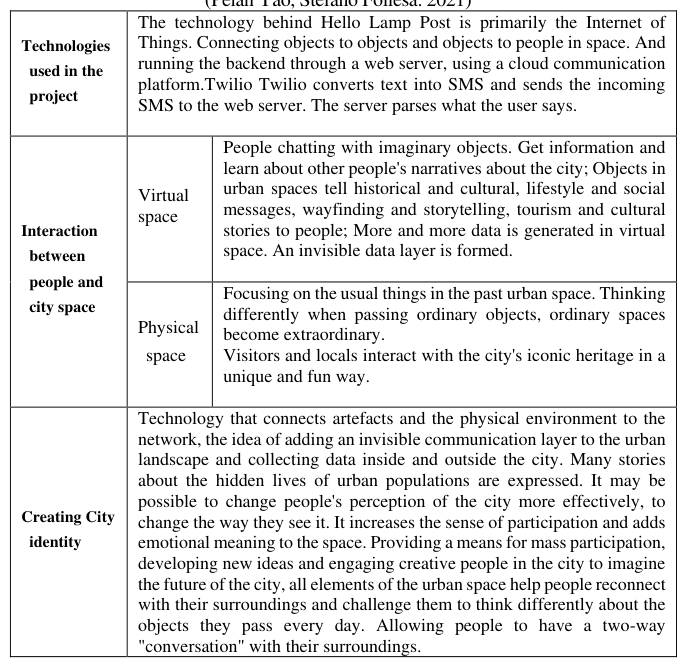
Case 1: Hello Lamp Post Hello Lamp Post was the winning project in the 2013 Playable City Awards announced by PAN Studio in Bristol. Hello Lamp Post premiered in Bristol in 2013. It has now been deployed in over 25 cities worldwide. Hello Lamp Post invites people to have fun conversations with familiar objects in the city using a simple text messaging system. The playful platform that lets people chat to street objects. Content includes: Community engagement. Wayfinding and storytelling. Urban Design and Engagement. Cultural and tourism engagement. After downloading the appropriate application and selecting the street furniture object with which to communicate, the user scans the QR code on the object to "wake up" the object and the conversation will use the keyword "hello". The object will then ask a series of questions via SMS. The next person who "logs in" with the object can also learn about previous responses.
Table 1: A case study of Internet of Things project (Peian Yao, Stefano Follesa. 2021)
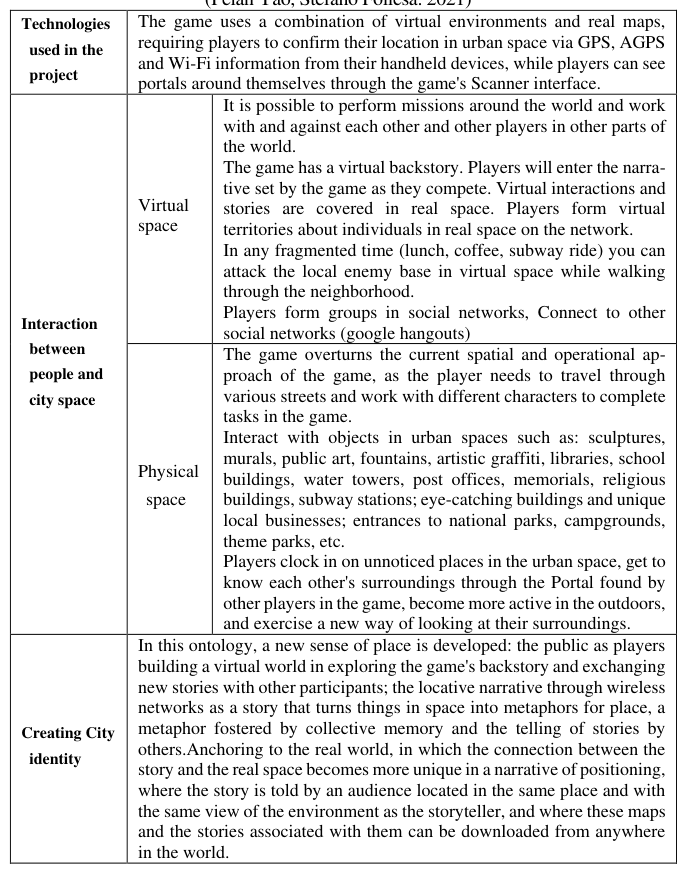
Case 2: Ingress Ingress is a location-based massively multiplayer virtual reality game. Developed by Niantic Labs, it was officially released on December 15, 2013. The content of the game is combined with the geography of the real urban space, where the player has to reach the portals that appear on the city map with his mobile phone to conquer and defend them (portals are buildings, sculptures, artworks, landmarks, etc. in the urban space). After capturing a target, the player can upload the name of the landmark and describe its history, cultural factors, in order to tell their story. The game is divided into two camps of users in the backstory set by the game, competing with each other in virtual space for mastery of the city in real space, and for control of the Portal in the real world. The method of competition is that the player must approach the portal in real space, and then attack it with virtual weapons in the mobile device. Ultimately, the player wins by conquering multiple portals and connecting multiple portals
Human Interaction & Emerging Technologies (IHIET-AI 2022) Artificial Intelligence & Future Applications https://openaccess.cms-conferences.org/#/publications/book/978-1-7923-8989-4 controlled by their camp to create a Control Field, covering the most Mind Units (MUs). The portals controlled by different camps appear in different colors: green when controlled by the Enlightenment camp, blue when controlled by the Resistance camp, and gray when uncontrolled, and both players can occupy these gray portals.
Table 2: A case study of location-aware gaming (Peian Yao, Stefano Follesa. 2021) Technologies used in the project The game uses a combination of virtual environments and real maps, requiring players to confirm their location in urban space via GPS, AGPS and Wi-Fi information from their handheld devices, while players can see portals around themselves through the game's Scanner interface.
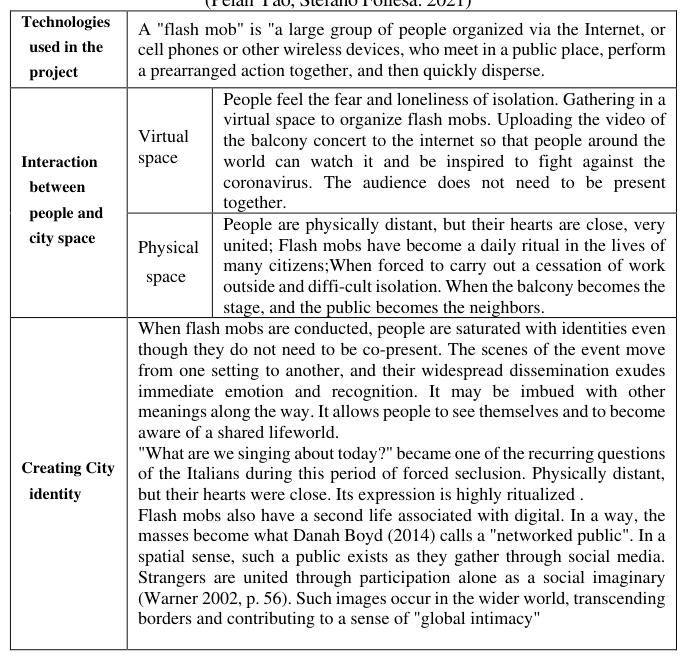
Case 3: Flash mob in Italy- Balcony Concert at 6pm During the great epidemic blockade in 2020, one way Italian cities responded to the coronavirus emergency was thru flash mobs ,by singing together on the balconies of their homes at 6 pm. During the epidemic blockade the flash mob has become a regular ritual in which everybody participates: children, youngsters, and adults. It's a way to get closer to each other, even though everyone is in their own homes. The initiative shows a way of smiling and a way of dispelling fears with upbeat and carefree songs. People went out onto the balconies and stopped to greet the audience near the houses and the neighbors on the balconies of the opposite buildings. The public played instruments or sang songs, people also sang the national anthem together, etc. The neighbors near the house are the audience, and the neighbors applaud. After about 15 minutes people disperse again.
Table 3: A case study of urban flash mob (Peian Yao, Stefano Follesa. 2021) Technologies used in the
FUNDINGS Ryan asserts that human society has evolved from oral narratives to textual narratives, visual narratives, and finally to the current context of digital narratives (Ryan et al.2008). Historically, narratives were bound by boundaries, references, and dimensions. Today, people see the world through the eyes of those who are not present, through the eyes of imagined "others." The superposition of virtual and physical space (as well as personal and public space) has altered how people perceive space. The terms "here" and "there" are frequently used interchangeably (Parisi et al. 2015). Although it is a familiar space on a daily, the non-physical perception pattern evokes a sense of the incredible. Internet users live in two worlds: the real four- dimensional world of length, quantity, and temperature of time, and the world where consciousness remains after all dimensions have been stripped away. With the advancement of technology, people are increasingly stepping out of the real world unconsciously. A well-known example is when people are using their mobile phones on the subway, their minds simultaneously enter a world that is disconnected from real space. They were unaware of what occurred in real space during this period. When they returned to real space after a brief stay in cyber space, they missed the stop.
The narrator is no longer a manager, but a voice for the citizens. Citizens, audiences, or users share a new narrative through digital media. People are more interested in the little things that have been neglected in the past than in the big buildings and tourist attractions. Games play an important role in understanding this change in social identity. Imagination, creativity, and emotion all play a significant role in understanding media narratives.
CONCLUSIONS
In virtual space, urban communities expand, inspiring creators to innovate in public space. Narrative design acts on those elements of diversity, the goal of design is not to reinvent the device but to focus on those elements that can interact with the place and read the stories of the place through the human senses. While street names, points of interest, and museums are all intrinsic to cities' narratives, the rise of new communication technologies has altered the cultural geography of cities. We've also discovered a new scenario to view the mediated technological environment: everyone tells their own story about a place, and the public's emotional state is reflected on social media, resulting in a network that reflects changing moods.
The authors would like to acknowledge the facilitating work of their research group at the laboratory: University of Florence, DIDA Department, Design for Spatial Relations Lab.
REFERENCES
McQuire,S. (2008). The Media City: Media, Architecture and Urban Space.
London:SAGE Publications Ltd. pp.11. Coyne, R. (2010). The Tuning of Place,Sociable Spaces and Pervasive Digital Media. London : The MIT Press. pp.147. Murray,J. (1998). Hamlet on the Holodeck: The Future of Narrative in Cyberspace.
London : The MIT Press. AS e Silva. (2006). From Cyber to Hybrid: Mobile Technologies as Interfaces of Hybrid Spaces. Space and Culture, J. Vol 9, Issue 3, pp. 261-278. Ryan,M.L. (2011). Transfictionality across Media. In: Pier,J and Ángel García
Landa, J. Theorizing Narrativity. Berlin, Boston: De Gruyter. pp. 385-418. Parisi,L. (2015). “Where 2.0.” Exploring the Place Experience of “Hyperconnected” Digital Media Users. Sociologica, Fascicolo 3. SMARTCITIESDIVE Website.( 2019). Available from: https://www.smartcitiesdive.com/news/hello-lamp-post-residents-closer-to- cities/548676/ INGRESS PRIME Website. Available from:https://ingress.com/ The Local Italy Website.(2020). Available from: https://www.thelocal.it/20200317/here-are-italys-official-top-five-balcony-chart- hits/ THE MUSEUM OF FEELINGS Website. Available from: http://www.themuseumoffeelings.com/
Read this individual research paper free through the original publisher, or explore the full digital proceedings book.
ISBN 978-1-7923-8989-4
Explore this ISBN in the AHFE Bookstore ↗Listed in the July 2026 bookstore catalogue; search by ISBN to confirm current availability · Digital book purchase optional