Bhaskar Mishra, Samrat Dev (2024). Enhancing public engagement and awareness: An analysis of internet meme posts usage by Indian police departments on Instagram. In: Human Factors in Communication of Design. AHFE Open Access, vol. 136, pp. 114–126. https://doi.org/10.54941/ahfe1004974
Social media has become integral to individuals' everyday routines, with messaging applications and platforms serving as the predominant online destinations globally. These platforms have played a significant role in increasing the prominence of internet memes, which serve as vehicles for disseminating information through the utilization of comedy and sarcasm. In this study, we examine how Instagram posts by Mumbai, Delhi, Assam, Rajasthan, and Uttarakhand police about road safety, cybercrime, women's safety, and consent engage with the public, raise awareness about these issues, and improve police-public relations. We collected 100 static memes from the Instagram pages of the police departments between January 1, 2022, and February 28, 2023, and conducted a synthesis of metadata related to these internet memes to assess their likes and comments as a secondary source of information. In addition, we used exportcomments.com to export comments from posts to.csv files and Azure Machine Learning (AML) web services to assess the sentiments (positive, neutral, or negative) of the comments. As primary data, a questionnaire survey with 90 participants (ages ranging from 23 to 43 years, 34% male and 66% female) was conducted to analyze the potential impact of internet memes on social awareness, their informativeness, and the level of trust associated with the information they convey. Purposive random sampling was employed for the selection of the respondents. A bivariate Pearson's correlation coefficient (r) was calculated to determine the strength and direction of the linear relationship between social awareness, informativeness, and the level of trust in conveyed information. The results showed that the internet memes in the corpus received over 2 million likes and were liked an average of 3369 times. The sentiment analysis of the 692 comments reveals that of them, 90.50% (629) were favorable or positive, 5.61% (39) were neutral, and 3.88% (27) were negative. This shows that people's perceptions of and interactions with the police department on Instagram are generally positive due to the platform's wide reach, high level of involvement in the form of likes, and the dearth of comments expressing dissatisfaction. The bivariate correlation (r (88) =.79, p <.001) between these two factors (social awareness and informativeness) was positive and high. There is a significant association between the potential to alter public awareness and the level of informative substance transmitted by internet memes. The study concludes that the strategic use of internet memes by Indian police departments on Instagram significantly enhances public awareness, engagement, and positive perceptions regarding road safety, cybercrime, women's safety, and consent issues. In addition, Internet memes have the potential to be a beneficial and novel tool for social awareness issues, addressing social and public concerns across social media platforms.
Enhancing Public Engagement and Awareness: An Analysis of Internet Meme Posts 115
INTRODUCTION
Social media has become a popular tool for individuals (of all ages), cor- porations, and governments to interact. With social media becoming more integrated into daily life, more government organisations are increasing their presence on social platforms such as Facebook, Instagram, Twitter, and YouTube (Srivastava, 2013). Social media in government organisations may transform citizen involvement and participation through accountable respon- siveness and collaborative transparency (Karakiza, 2015; Sharif et al., 2015; Bonsón et al., 2017; Charles and Pal, 2020). Government organisations like police departments are increasingly using social media to engage with the public, for real-time data exchange, to transform police-public relations, and raise awareness regarding social issues (Sachdeva and Kumaraguru, 2014).
In the last few years, several Indian police departments across the coun- try have adopted a new approach on social media platforms to increase user interactions on their respective platforms and to raise awareness on social topics such as road safety, cybercrime, health, women’s safety and consent. This new approach uses humorous posts, which are often internet meme-based (Mishra and Chowdhury, 2022), on their respective social media platforms (Social Samosa, 2023). Over time, police departments have started using the internet meme approach while, previously, the police were the topic of the internet memes produced by others (Bayerl and Stoynov, 2016). The internet meme approach has led to a substantial rise in the number of fol- lowers on the police department’s social media accounts (The Times of India, 2019). In addition, the Police Department’s use of internet memes has been widely reported in the mainstream media, such as the Delhi Police’s use of internet memes to communicate with young people published in the New Indian Express, 2022. The Assam Police also started a campaign against drunk and rash driving using multiple famed figures like Hamlet and James Bond, Iron Man, and Captain America to combat crime and generate aware- ness (India News, 2022). The use of the internet meme approach by police departments on social media platforms has demonstrated effectiveness in increasing user engagement (Charles and Pal, 2020; Wood 2020; Wood and McGovern, 2021). However, a knowledge deficit persists regarding the sub- sequent outcomes following the exposure of the intended users to this new approach. Further investigation is necessary to comprehend the potential impact of an internet meme-based approach on the awareness and attitudes of its intended users. Previous studies have discussed the post-level engagement of the police department’s social media which focuses on policy-related posts. Additionally, some studies have compared post-level engagement between comic posts, such as internet memes, and other types of posts (e.g., fac- tual posts) (Wood, 2020). However, to date, there has been no comparison conducted across multiple police departments regarding internet meme post- level engagement dynamics. Furthermore, there has been limited study of the potential impact of an internet meme-based approach on the awareness and attitudes of its intended users.
This study, therefore, contributes to the existing literature by addressing two questions regarding the issue of engagement with four Indian police
116 Mishra and Dev
departments that employ internet meme posts on Instagram. Firstly, it aims to assess and compare post-level engagement dynamics, specifically the number of likes, and analyse the sentiments of user comments on the internet meme posts by Rajasthan, Assam, Uttarakhand, and Delhi police departments, on their respective Instagram accounts. Secondly, it evaluates the public attitudes towards the meme posts used by the Indian police departments on social topics such as road safety, cybercrime, health, women’s safety and consent.
METHODOLOGY
Methods
For this study, the research approach includes a descriptive and comparative analysis (Madani et al., 2013; Johnson et al., 2018; Sinelnikova-Muryleva et al., 2019) of post-level engagement as assessed by the number of likes on internet meme posts among four police departments. It employs a cross- sectional design to investigate engagement dynamics over a set period, with statistical tests used to measure differences in engagement levels, and sentiment analysis to analyse user reactions.
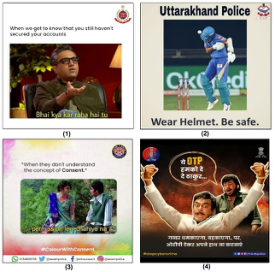
Data Collection We manually identified and collected a sample of 84 static internet memes from the Instagram accounts of Rajasthan, Assam, Uttarakhand, and Delhi police departments between January 1, 2022, and January 31, 2023, using a criteria sampling approach (Figure 1). The internet meme posts were selected on the specific criteria (a) address topics such as road safety, cybercrime, women’s safety and consent (b) collected still images, with text added (c) incorporate some form of humour token (Carroll, 2014) (d) more than a minimum of 50 likes. Post-level engagement metadata, including likes, and comments counts, were collected for the analysis.
Figure 1: Sample dataset of internet meme posts collected from the Instagram accounts of Rajasthan, Assam, Uttarakhand, and Delhi police departments on social topics such as road safety, cybercrime, health, women’s safety and consent (collected from the official Instagram accounts of Rajasthan, Assam, Uttarakhand, and Delhi police departments).
Enhancing Public Engagement and Awareness: An Analysis of Internet Meme Posts 117
Data Visualization The post-level engagement data for the four police departments were visual- ized using Origin Pro software, with a four-panel graph created to examine engagement trends over time.
Export User Comments We selected ten static internet meme posts which were the highest likes and comment counts from the data sample and retrieved available comments using exportcomments.com (Oloo, 2022). The URL of the internet meme post was copied and pasted into the exportcomments.com portal to extract the comments. The free version of the software allowed for the extraction of a maximum of 100 comments. The data was exported in a standard.csv file format that included the date, the name of the user who posted, profile ID, likes, and comments left by the user. This process resulted in a total of 692 comments being collected through ten internet meme posts. The comments were retrieved concurrently with the retrieval of internet memes, specifically during the period from 10–28 June 2023.
Questionnaire Survey A questionnaire survey was conducted with 90 respondents aged 23 to 43 years (34% male, 66% female) who were university students, faculties, and staff in Dehradun, India. These participants voluntarily participated in the survey and, the study spanned eight weeks. Convenience sampling, a form of non-probability sampling, was employed to select respondents. We used ten internet meme posts from different police department Instagram accounts to assess respondents’ opinions. And posed questions regarding the capacity of internet memes to influence social awareness, focusing on their informa- tiveness, and trustworthiness. The five-point rating scale was used for these questions.
Data Analysis Sentiment analysis is a way of categorising comments to Instagram posts as either negative, neutral, or positive (Loft et al., 2020). For sentiment analysis, we used Azure Machine Learning (AML) web services to assess the sentiment (positive, neutral, or negative) of comments (Harfoushi et al., 2020; Qorib et al., 2023). The AML Team has created an add-on for Microsoft Excel called “Azure Machine Learning.” Using this Excel add-on, we calculated the sentiment scores and divided the polarity scores into positive, negative, and neutral attitudes.
We conducted a one-way between groups analysis of variance (ANOVA) to determine whether there is a significant difference between the post-level engagement, as measured by the number of likes, on internet meme posts among Rajasthan, Assam, Uttarakhand, and Delhi police departments. In addition, we conducted Tukey HSD (Honestly Significant Difference) tests to find out exactly which police departments among Rajasthan Police, Assam Police, Uttarakhand Police, and Delhi Police will differ from the others in post-level engagement, as measured by the number of likes, on internet meme posts.
We conducted Friedman’s two-way ANOVA, to determine whether there is a significant difference between the impact of internet memes on social awareness, informativeness, and trust among ten internet meme posts while
118 Mishra and Dev
accounting for the non-normal distribution of the data. In addition, the Wilcoxon signed rank test was conducted for pair-wise comparisons.
RESULTS AND DISCUSSION
A one-way between groups analysis of variance (ANOVA) was used to inves- tigate the potential impact of Rajasthan, Assam, Uttarakhand, and Delhi police departments on the post-level interaction, as measured by the number of likes on internet meme posts. The assumptions of normality and vari- ance homogeneity were evaluated using the Shapiro-Wilk and Levene’s tests, respectively. Neither was violated. The results of the one-way Analysis of Variance (ANOVA) were statistically significant, indicating that the post-level engagement, as measured by the number of likes on internet meme posts, varies significantly among Rajasthan, Assam, Uttarakhand, and Delhi police departments, F(3, 80) = 7.87, p<0.001, η2=0.23 (Table 1).
Table 1. Summary of a one-way between groups analysis of variance (ANOVA) showing significant differences in post-level engagement (Likes) on internet meme posts across police departments.
Table available in the original PDF paper.
Sum of Squares df Mean Square F Sig.
Between Groups 6021840.792 3 2007280.264 7.867 .000 Within Groups 20411281.020 80 255141.013 Total 26433121.810 83
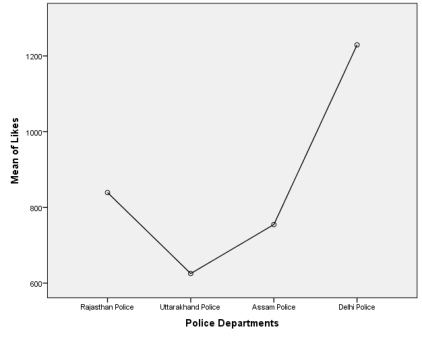
Post hoc analyses with Tukey’s HSD (using an α of.05) revealed that the Uttarakhand police (M = 625.22, SD = 416.99) had significantly lower likes compared to the Delhi police (M = 1229.23, SD = 589.08) on inter- net meme posts. Additionally, the Assam police (M = 754.64, SD = 367.94) had significantly lower likes compared to the Delhi police. However, there was no significant difference in the number of likes between Rajasthan police (M = 839.18, SD = 452.25) and Assam police on internet meme posts. Sim- ilarly, there was no significant difference in the number of likes between Rajasthan police and Uttarakhand police, Rajasthan police and Delhi police, and Assam police and Uttarakhand police on internet meme posts (Table 2).
Table 2. Post hoc analyses with Tukey’s HSD (multiple comparisons).
Table available in the original PDF paper.
Std. Error Sig. 95% Confidence Interval
(I) Police Department (J) Police Department Mean Difference (I-J)
The “Means plot” is the visual representation of the comparative averages of the post-level engagements, as measured by the number of likes, on the internet meme posts among police departments, including Rajasthan police, Assam police, Uttarakhand police, and Delhi police. This graph clearly shows that Uttarakhand police received the average lowest likes, whereas Delhi police received the average highest likes on internet meme posts (Figure 2).
Figure 2: A comparison of average likes on internet meme posts received by different police departments.
When interpreting the findings, it is clear that there is a significant differ- ence between the post-level engagement, as measured by the number of likes, on internet meme posts among Rajasthan, Assam, Uttarakhand, and Delhi police departments. In addition, Delhi police had significantly higher likes compared to Rajasthan, Assam, and Uttarakhand police. These variations in engagement dynamics, as measured by the number of likes on internet meme posts, may reflect differing strategies used by the Indian police departments.
The need for police departments to increase the visibility of their social media presence has resulted in several empirical studies examining the ele- ments that lead to increased public engagement with police social media content. Such studies (Lieberman et al., 2013; Fernandez et al., 2015;
120 Mishra and Dev
Van De Velde et al., 2015) have found that audience engagement with police social media content is influenced by various factors, including the pattern of the content, the frequency of posts, the timing of the content, and the usage of informal communication. Furthermore, it was shown that posts with a slightly higher positive sentiment compared to negative sentiment have a higher likelihood of drawing attention when shared by the users (Berger and Milkman, 2012; Fernandez et al., 2015; Loft et al., 2020). Some stud- ies found that Engagement is a term commonly used by social media users and commentators to describe the activities they engage in on social media platforms, such as liking, sharing, or commenting on posts (Crump, 2011; Fernandez et al., 2015; Van De Velde et al., 2015). Some studies claim that liking, sharing, or commenting on police social media posts does not amount to “meaningful” engagement, reserving the term “engagement” for more dia- logue between police and the general public on social media (Kudla and Parnaby, 2018). Police departments that can effectively leverage these fac- tors may experience higher levels of engagement and interaction with their online community. Wood (2020) conducted a study on The New South Wales (NSW) police force in Australia, which utilised humorous internet memes and cute images of police animals to increase user engagement with their posts. In contrast, our study on multiple police departments such as Rajasthan, Assam, Uttarakhand, and Delhi police departments, incorporated humorous internet memes that use Bollywood film content with captions intending a humorous effect to increase user engagement with their posts. This highlights the use of different cultural references and internet meme strategies across regions. The Delhi police, in particular, lead in terms of engagement due to their consistent and frequent posting schedule, active engagement with users via comments, and content alignment with current trends. This contrasts with other police departments such as Rajasthan, Assam, and Uttarakhand, whose engagement strategies are not as robust or timely. It is true that the media landscape is ever changing, bringing with it both new possibilities and challenges for police departments. Every police department may proactively change its communi- cation techniques to effectively communicate with the general public based on their individual audience demographics, regional context, and subject mate- rial (Wood, 2020). Departments with greater levels of engagement can serve as role models for others by sharing best practices and novel methods for content development and public involvement.
The result reveals that the sentiment analysis of 692 comments on internet meme posts related to the police departments of Rajasthan, Assam, Uttarak- hand, and Delhi showed that 90.50% (629) of the comments were positive or favorable, 5.61% (39) were neutral, and 3.88% (27) were negative. Below are some user comments on the internet meme posts that have been taken from social media platforms i.e., Instagram of Rajasthan, Assam, Uttarak- hand, and Delhi police departments. The first two comments commend the Indian police departments for effectively humorously spreading awareness. Some comments praised the creativity of the meme posts. Many commenters praised or admired the Assam, Uttarakhand, and Delhi police’s use of internet memes as a communication technique, indicating that it had a good impact on their view of the department or organisation.
Enhancing Public Engagement and Awareness: An Analysis of Internet Meme Posts 121
IMS Hats off to the Marketing team of @delhi.police_official..They are creating awareness in such a great funny way.
PC Hats off @delhi.police_official for creating awareness.... APS Creativity at its peak #uttarakhandpolice HS amazing thought @policerajasthan VK Hats off @delhi.police_official creativity at its peak.... RK I so appreciate the creative team of @assampolice. It never fails to awe me . AT When the tech department belong to gen z haha @policerajasthan MU Salute @uttarakhandpolice SP Awesome way@delhi police In total, the high degree of favourable attitude indicates that internet meme-based communication has helped foster a connection and confidence between police departments and the general public (Kelly, 2015; Lee and McGovern, 2013b; Loft et al., 2020). In addition, these internet meme posts engage with the public, increase awareness about social and public issues, and enhance police-public relations.
The questionnaire survey results revealed that of the 90 respondents in the study, 65.6% were female (n=59) and 34.4% were male (n=31). Approxi- mately, more than half (n=58) of the respondents were between 15–24 years old, and 28.9% (n=26) were between 25–44 years. For the level of edu- cation, 36.7 % of the respondents had completed post-graduation (n=33), followed by graduation 34.4% (n=31). According to the professional status, most respondents (80%, n=72) were students.
The collected survey data were analysed using Friedman’s two-way ANOVA, to explore the impact of internet memes on social awareness, infor- mativeness, and trust among ten internet meme posts while accounting for the non-normal distribution of the data. A Friedman two-way ANOVA indi- cated that ranking of the respondent’s perceptions of the impact of internet memes on social awareness, informativeness, and trust varied significantly among internet meme examples, χ2F (Chi-square) = 13.910 (corrected for ties), df = 2, N – Ties = 90, p = 0.001. The mean rank is 2.22 for the influence of internet memes on social awareness, 1.84 and 1.94 for informativeness and trustworthiness respectively. A statistically significant Friedman two-way ANOVA is ambiguous. It indicates that only two condi- tions differ. To determine the source of the significance, undertake a series of pairwise comparisons. Follow-up pairwise comparisons with the Wilcoxon Signed Rank test and a Bonferroni adjusted α of.017 indicated that the respondents perceived the influence of internet memes on social awareness (Mean Rank = 2.22) as significantly more than their informativeness (Mean Rank = 1.84), T = 566, z = −-3.442 (corrected for ties), N – Ties = 90, p = 0.001. The difference between the respondent’s perceptions of the infor- mativeness of internet memes and the trustworthiness of internet memes (Mean Rank = 1.94) was non-significant (p = 0.194). Similarly, the differ- ence between the respondent’s perceptions of the informativeness of internet
122 Mishra and Dev
Equation reproduced from the original PDF.
When interpreting the findings, it is clear that rankings of the respondent’s perceptions of the impact of internet memes on social awareness, informative- ness, and trust varied significantly among internet meme posts. The higher ranking of the influence of internet memes on social awareness compared to informativeness and trustworthiness suggests that respondents perceive inter- net meme posts as effective tools for raising awareness on social issues. This aligns with the notion that internet memes can serve as vehicles for spreading messages and shaping public discourse. In addition, the respondents per- ceived the influence of internet memes on social awareness as significantly more than their informativeness, and trust. This suggests that while internet memes may effectively raise awareness, they may not always convey detailed or informative content. These findings have implications for the strategic use of internet memes by police departments and other organisations, highlight- ing the need to balance entertainment value with informative and trustworthy content to maximize their effectiveness in public communication efforts.
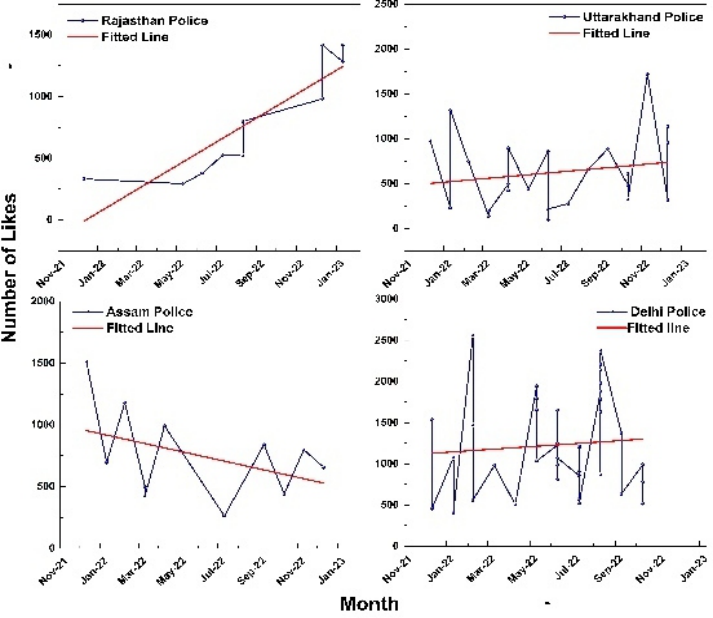
Figure 3: A four-panel graph from January 2022 to January 2023 that compares post-level engagement trends between the police departments of Rajasthan, Assam, Uttarakhand, and Delhi. Each panel depicts a separate police department, allowing for a comparison of engagement patterns over time. The X-axis represents months of internet meme posts, while the Y-axis represents the number of likes received.
Enhancing Public Engagement and Awareness: An Analysis of Internet Meme Posts 123
We used Origin Pro software to create a four-panel graph comparing post- level engagement trends in Rajasthan, Assam, Uttarakhand, and Delhi police departments, from January 2022 to January 2023. Each panel of the graph represented a different police department, allowing for a comparative anal- ysis of engagement patterns over time. The x-axis of each panel represented the months of the internet meme posts, while the y-axis represented the num- ber of likes received. By visualizing the engagement data in four independent panels, we were able to see individual trends for each police department and compare their levels of engagement over the specified period. With the use of this method, we were able to conduct a thorough analysis of post-level engagement dynamics amongst the various police departments and determine any significant differences or patterns in engagement behavior throughout the study (Figure 3).
The Aditri Foundation and the Jaipur traffic police successfully coordi- nated a road safety campaign on May 12, 2023 (The Print, 2023). From the inspection, we found that month there appears to be a larger peak on the graph. Additionally, we employed a tool called Linear Fit, which shows that the trend line is increasing and moving upward, indicating that the internet meme posts are receiving more likes beyond that point. Similarly, Uttarak- hand police started a 15-day awareness campaign on 5 December 2022, to educate school students regarding road safety (The Times of India, 2022). From the inspection, we found that month there appears to be a larger peak on the graph. Similarly, we employed a tool called Linear Fit, which shows that the trend line is constant, it indicates that there is no significant change in the trend of post-level engagement over time. However, for the Assam Police, we employed a tool called Linear Fit, which shows that the trend line is decreasing downward and indicating a negative trend in post-level engage- ment over time. This implies that internet meme posts are obtaining fewer likes over time, indicating a decrease in user engagement with the internet meme content. This conclusion may raise questions regarding the effective- ness of the internet meme posts or the need to change the content approach to boost user interaction. Similarly, for Delhi police, we employed a tool called Linear Fit, which shows that the trend line is constant, it indicates that there is no significant change in the trend of post-level engagement over time. This data implies that the level of user involvement with internet meme posts is stable, with no significant variations in engagement patterns over time.
So, overall, there were more spikes in the graph due to news stories, major dates, or the commencement of the campaigns. As a result, it may be argued that internet meme activity correlates with news coverage (McLoughlin and Southern, 2021). The spikes in engagement around significant events or cam- paigns may reflect increased user interest and interaction with the internet meme content, highlighting the potential influence of news stories and cur- rent events on user engagement with internet meme posts on social media platforms. One of this study’s limitations is that it only looks at likes as an engagement indicator, ignoring other variables that affect post- and page-level engagement. Furthermore, due to limitations in the free version of export- comments.com, only 100 comments were exported, potentially restricting the
124 Mishra and Dev
depth of sentiment analysis. The small sample size of responders further lim- its the generalisability of the findings. In the future, neurodesign techniques such as EEG, and Eye-tracking (visual attention) analysis can be employed to investigate internet meme designs used for social awareness (Chowdhury and Chakraborty, 2021; Mishra and Chowdhury, 2023).
CONCLUSION
In conclusion, this study emphasises the growing importance of social media platforms and internet memes as significant communication tools in modern culture.
The results show that Delhi police obtained substantially more likes than other departments, indicating the success of their internet meme efforts in gaining user attention. In addition, the sentiment analysis indicated that the majority of replies to the internet meme content were positive, indicating that the audience responded favourably to it. Furthermore, the questionnaire study revealed the potential impact of internet memes on social aware- ness, informativeness, and trust, demonstrating their utility as a means for spreading information and encouraging favourable attitudes toward social concerns. In total, this study emphasises the need for police departments to use internet memes strategically to increase public awareness and engage- ment, as well as the potential of internet memes as new tools for addressing social and public concerns on social media platforms. In addition, inter- net memes have the potential to be a beneficial and novel tool for social awareness issues addressing social and public concerns across social media platforms.
ACKNOWLEDGMENT
The author sincerely appreciates all the users who participated in this study. Your invaluable contributions and feedback were crucial in shaping the research and enhancing the quality of our findings. This work would not have been possible without your active involvement and cooperation.
REFERENCES
Bayerl, P. S., & Stoynov, L. (2016). Revenge by photoshop: Memefying police acts in the public dialogue about injustice. New media & society, 18(6), 1006–1026. Berger J, Milkman KL. What makes online content viral? J Mark Res 2012;49
(2):192–205. Bonsón, E., Royo, S., & Ratkai, M. (2017). Facebook practices in Western European municipalities: An empirical analysis of activity and citizens’ engagement. Admin- istration & Society, 49(3), 320–347. Booher, Harold, ed. (2003). Handbook of human systems integration. New Jersey: Wiley. Carroll, N. (2014). Humour: A very short introduction. Oxford: Oxford University
Press. Charles, D. D., & Pal, J. (2020, March). When the King Turns Jester: A Carnivalesque Analysis of Police Outreach on Social Media in Kerala. In International Development Informatics Association Conference (pp. 186–200). Cham: Springer International Publishing.
Enhancing Public Engagement and Awareness: An Analysis of Internet Meme Posts 125
Chowdhury A, Chakraborty P. (2021) Memes that Evoke Emotions: A Neurodesign Strategy for Brand Communication and Experience. Smart Innovation, Systems and Technologies. 221: 147–156. doi: 10.1007/978-981-16-0041-8_13/COVER. Crump, J. (2011). What are the police doing on Twitter? Social media, the police and
the public. Policy & internet, 3(4), 1–27. Fernandez, M., Cano, A. E., & Alani, H. (2015). Policing engagement via social media. In Social Informatics: SocInfo 2014 International Workshops, Barcelona, Spain, November 11, 2014, Revised Selected Papers 6 (pp. 18–26). Springer International Publishing. Harfoushi, O., Hasan, D., & Obiedat, R. (2018). Sentiment analysis algorithms
through azure machine learning: Analysis and comparison. Modern Applied Science, 12(7), 49. India News. Press Trust of India. January 16, 2022. Iron Man To Ham- let To Queen: Assam Police’s Partners In Crime-Fighting 2022 Website: https://www.ndtv.com/india-news/hamlet-james-bond-iron-man-join-assam-poli ce-to-fight-crime-2710731. Johnson, J., Ohlson, M. A., & Shope, S. (2018). Demographic changes in rural America and the implications for special education programming: A descriptive and comparative analysis. Rural Special Education Quarterly, 37(3), 140–149. Karakiza, M. (2015). The impact of social media in the public sector. Procedia-social
and behavioral Sciences, 175, 384–392. Kelly, A. (2015). Social media and police legitimacy. Australasian Policing, 7(2), 37–39. Kudla, D., & Parnaby, P. (2018). To serve and to tweet: An examination of police-related Twitter activity in Toronto. Social media+ society, 4(3), 2056305118787520. Lee, M., & McGovern, A. (2013b). Policing and media: Public relations, simulations
and communications. London: Routledge. Lieberman, J. D., Koetzle, D., & Sakiyama, M. (2013). Police departments’ use of Facebook: Patterns and policy issues. Police quarterly, 16(4), 438–462. Loft, L. H., Pedersen, E. A., Jacobsen, S. U., Søborg, B., & Bigaard, J. (2020).
Using Facebook to increase coverage of HPV vaccination among Danish girls: An assessment of a Danish social media campaign. Vaccine, 38(31), 4901–4908. Madani, H., Claesson, J., & Lundqvist, P. (2013). A descriptive and comparative analysis of three common control techniques for an on/off controlled Ground Source Heat Pump (GSHP) system. Energy and Buildings, 65, 1–9. McLoughlin, L., & Southern, R. (2021). By any memes necessary? Small political
acts, incidental exposure and memes during the 2017 UK general election. The British Journal of Politics and International Relations, 23(1), 60–84. Mishra B and Chowdhury A (2022) Internet Memes Are Impacting Society: Perspectives from Brand Communication to World Peace Promotion. In North-East Research Conclave. Springer Nature Singapore. 33–48. Mishra B, Chowdhury A. (2023) Applying Eye Tracking Technique to Evaluate
Poster Design: A Study on World Peace Poster. Springer Series in Design and Innovation. 32: 175–183. doi:10.1007/978-3-031-35385-7_10/COVER Oloo, D. (2022). The role of online news consumers in lessening the extent of misinformation on social media platforms. communication spectrum. Qorib, M., Oladunni, T., Denis, M., Ososanya, E., & Cotae, P. (2023). Covid-
19 vaccine hesitancy: Text mining, sentiment analysis and machine learning on COVID-19 vaccination Twitter dataset. Expert Systems with Applications, 212, 118715.
126 Mishra and Dev
Sachdeva, N., & Kumaraguru, P. (2014). Online social media and police in India: Behavior, perceptions, challenges. arXiv preprint arXiv:1403.2042. Sharif, M. H. M., Troshani, I., & Davidson, R. (2015). Public sector adoption of
social media. Journal of Computer Information Systems, 55(4), 53–61. Sinelnikova-Muryleva, E. V., Shilov, K. D., & Zubarev, A. V. (2019). Essence of cryptocurrencies: descriptive and comparative analysis. Finance: Theory and Practice, 23(6), 36–49. Social Samosa. #Samosa Snippets. Shamita Islur. Jan 24, 2023. From Delhi
to Mumbai - how Indian Police departments use pop culture & humour Website: https://www.socialsamosa.com/2023/01/indian-police-departments-co mmunication-strategy/. Srivastava, M. (2013). Social media and its use by the government. Journal of public administration and governance, 3(2), 161–172. The New Indian Express. By Amit Pandey. 26th June 2022. Delhi cops use memes to reach out to youth, spread awareness Website: https://www.newindianexpress.com/thesundaystandard/2022/jun/26/delhi-cops -use-\penalty-\@M{}memes-to-reach-out-to-youth-spread-awareness-2469696. html. The Print. 12 May, 2023. Jaipur Traffic Police and Hockey Wali Sarpanch
Neeru Yadav join forces for Road Safety Campaign in Jaipur. Web- site: https://theprint.in/ani-press-releases/jaipur-traffic-police-and-hockey-wali-s arpanch-neeru-yadav-join-forces-for-road-safety-campaign-in-jaipur/1570727/. The Times of India. Dec 4, 2022. Uttarakhand: Drive to educate school kids against underage 2-wheeler riding. Website: https://timesofindia.indiatimes.com/city/deh radun/drive-to-educate-school-kids-against-underage-2-wheeler-riding/articlesh ow/95973279.cms. The times of India. Police department’s meme team a hit with net-savvy new-gen.
Jan 2, 2019 Website: https://timesofindia.indiatimes.com/city/coimbatore/police -depts-meme-team-ahit-with-net-savvy-new-gen/articleshow/67341964.cms. Van De Velde, B., Meijer, A., & Homburg, V. (2015). Police message diffusion on Twitter: analysing the reach of social media communications. Behaviour & Information Technology, 34(1), 4–16. Wood, M. A. (2020). Policing’s ‘meme strategy’: understanding the rise of police
social media engagement work. Current issues in criminal justice, 32(1), 40–58. Wood, M. A., & McGovern, A. (2021). Memetic copaganda: Understanding the humorous turn in police image work. Crime, media, culture, 17(3), 305–326.
LISTED IN THE AHFE DIGITAL BOOKSTORE CATALOGUE
Explore the complete digital volume
Human Factors in Communication of Design
Read this individual research paper free through the original publisher, or explore the full digital proceedings book.
ISBN 978-1-964867-12-0
Explore this ISBN in the AHFE Bookstore ↗Listed in the July 2026 bookstore catalogue; search by ISBN to confirm current availability · Digital book purchase optional