Yunfan Zhang, Eakachat Joneurairatana (2024). Integrating Tradition with Modernity: Transformation of Tang Dynasty Aesthetics in Contemporary Costume Design Through Dunhuang Mural Inspirations. In: Human Factors for Apparel and Textile Engineering. AHFE Open Access, vol. 134, pp. 36–47. https://doi.org/10.54941/ahfe1004913
This study delves into the aesthetic elements of clothing in China's Dunhuang murals from the Tang Dynasty, aiming to understand their transformation and inheritance in contemporary costume design. It seeks to reveal the integration of traditional culture with modern fashion, emphasizing the fusion of ancient and modern aesthetics and its impact on the contemporary costume industry. The methodology involves analyzing Tang Dynasty costume characteristics as portrayed in Dunhuang murals, focusing on aspects like smooth lines, simplicity, and color coordination. It then examines how these aesthetics are transformed and inherited in current costume trends, highlighting the innovative integration of classical Tang elements into modern designs. The findings indicate that this creative blend leads to fashionable attire that resonates with both classical and contemporary tastes, diversifying design styles and revitalizing the clothing industry. Conclusively, the study underscores the significant influence of Tang Dynasty aesthetics on contemporary dress culture. The adaptation and modern reinterpretation of Tang attire not only enrich the contemporary clothing market but also deepen the appreciation of traditional Chinese culture. This research offers fresh insights into cultural inheritance and innovation, advocating for China's contemporary costume design to exhibit its unique allure globally, thus facilitating the spread and exchange of Chinese culture in today's interconnected world.
Currently, the revival and reinterpretation of Chinese traditional costumes are receiving attention from the design community. My professional back- ground in costume design has naturally turned my research interest to this fascinating topic. Based on the study of the aesthetic elements of traditional costumes in China’s Tang Dynasty Dunhuang murals, this project examines how the elements of Tang Dynasty aesthetics can be brought into a con- tinuous dialog with fashion elements around modern apparel design. This exploration not only contributes to the ongoing dialogue around modern
Integrating Tradition With Modernity: Transformation of Tang Dynasty Aesthetics 37
custome design but also emphasizes the potential of historical aesthetics to enrich and enrich contemporary design narratives.
The Tang dynasty was one of the most prosperous dynasties in ancient China, with the economy, politics, and culture reaching their peak during this period. As an era of continuity in Chinese history, the Tang dynasty not only achieved great prosperity in terms of high economic development, cultural hundred schools of thought, and foreign exchanges but also witnessed the glorious period of Dunhuang murals. During the Tang Dynasty, the economy was prosperous and stable, and the artwork was brilliant, with a large num- ber of grottoes being excavated throughout the country, and frescoes being painted extensively, creating a large number of exquisite grotto frescoes and pushing the art of China’s Dunhuang grottoes and frescoes to their peak.
During this glorious period, costumes, as one of the most important elements of Tang dynasty Dunhuang murals, possessed remarkable artistic value and research potential and became an important basis for studying the aesthetics of Tang dynasty costumes. Just as Wolfring (1915) described the history of the nameless art, the Dunhuang murals are a truly nameless history of the aesthetics of costume art, with the structure of the people’s costumes in each mural as the basic element, which demonstrates the artistic styles and aesthetics of the Tang Dynasty. The costumes of the Tang Dynasty embodied a highly integrated aesthetic concept, featuring a flowing and free- flowing, simple and bright style, focusing on the artistic expression of lines, models, colors, and other aspects, conveying the beauty of mildness and sub- tlety, and exuding a harmonious and rounded charm of oriental aesthetics. Dunhuang dress aesthetics is regarded as a treasure of Chinese culture, and its eclectic style and temperament have profound practical significance in contemporary Chinese aesthetics.
THE AESTHETIC CHARACTERISTICS OF TANG DYNASTY COSTUME ART IN DUNHUANG MURAL PAINTINGS IN CHINA Dunhuang mural paintings have made remarkable achievements in the his- tory of global culture and art with their superb painting techniques, realistic figures and exquisite compositional designs. Aesthetic researchers at home and abroad have highly praised Dunhuang art, and the artistic beauty of Tang Dynasty costumes in Dunhuang murals has benefited from this. According to Song (2023) and Zhang (2023), the enlightened political culture of the Tang dynasty led to the exchange and fusion of Chinese civilization and foreign cultures, resulting in the formation of a unique clothing style characteristic of the Tang dynasty. This unique dress style profoundly influenced the dress style, life philosophy, and aesthetic orientation of people in the Tang Dynasty. This unique aesthetic characteristic of the Tang Dynasty is mainly manifested in the linear beauty of dress shape, the tonal beauty of color and the formal beauty of dress.
The Linear Beauty of Tang Dress Modeling in Dunhuang Murals Chinese artistic paintings and aesthetic expressions tend to be more sub- tle. When depicting the beauty of the human body, Chinese art tends to
38 Zhang and Joneurairatana
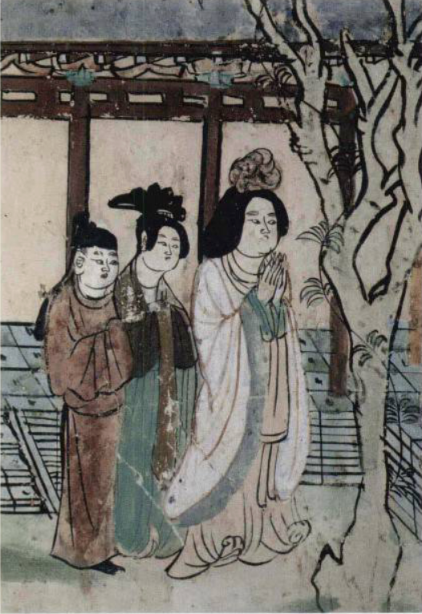
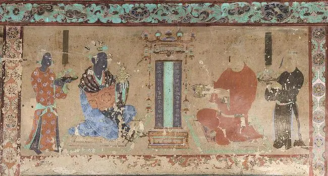
present it more subtly, metaphorizing beauty through the lines of clothing patterns and fluttering gestures, rather than directly displaying the nature of the body.Interestingly, these lines are not only meant to depict clothing but also to express dynamics and chiaroscuro, especially on an aesthetic level, displaying a unique sense of rhythm (Hong Wu, 2021). In painting, China has long insisted on the use of line modeling. In Dunhuang murals, the depic- tion of Tang dynasty clothing also makes extensive use of linear depiction and aesthetic expression. For example, the long, lightweight skirts are paired with fine sarongs, giving the overall structure of long lines. The way of wear- ing the high-waisted long skirt tied up to the chest visually raises the position of the waistline and creates the effect of stretched lines, making the overall proportional relationship between the garment and the human body more slender, and presenting a more graceful rhythm and linear aesthetics. Among them, the costume of the woman in Cave 130’s Lady Dudu’s Portrait (see Figure 1) is particularly outstanding, with the figure wearing a long-sleeved, round-necked, narrow-mouthed, transparent tulle jacket and a long skirt that trails down to the floor, with the inner skirt bunched up to the chest, stretch- ing the lines effectively by raising the position of the waistline, making the overall proportion appear more slender and upright, and demonstrating the beauty of the Tang dynasty’s distinctive linear stretch of the art of dress.
Figure 1: Lady Dudu in cave 130 (adapted from Dunhuang mural recovery, 2013).
Integrating Tradition With Modernity: Transformation of Tang Dynasty Aesthetics 39
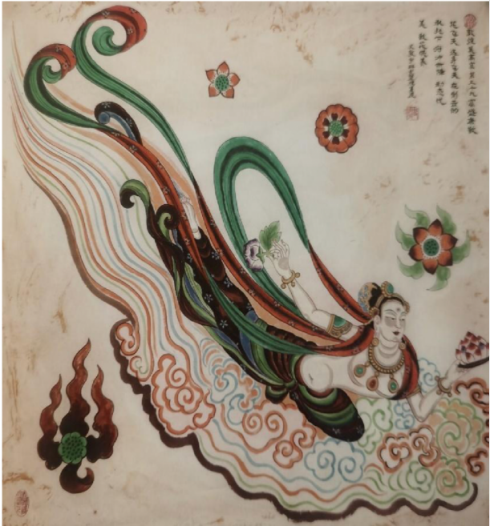
Meanwhile, the large and small sizes of Flying Apsaras in the Mogao Caves at Dunhuang possessing linear beauty as well. The Flying Apsaras are depicted in strong and elegant line drawings, with clear and free lines, and the smooth and free lines seem to have vitality, making the Flying Apsaras show a sense of dynamic movement in the static murals. Japanese scholar Takanashi Takanashi (2000) pointed out that the flow of Flying Apsaras’ outfit is one of the world’s top design aesthetics. The Flying Apsaras as if the world of the Buddha dancing elves, reflecting the Dunhuang murals a high degree of artistic and aesthetic decorative. In the frescoes, the painting method of line drawing and heavy color is used, emphasizing more the overall shape of the vividness, showing a natural sense of movement and rhythmic beauty, unique to the traditional aesthetic characteristics of oriental painting.
Taking Cave 39 of Dunhuang in Tang Dynasty as an example (see Figure 2), careful observation and analysis will show that every line in the painting is sketched by the painters after careful deliberation. From an over- all perspective, the lines of the clothing and straps are flowing and sparse, echoing each other, reflecting the elegant form of the Flying Apsara, dynamic posture, and beautiful symbolism, just like the Chinese Venus. The auspicious clouds under the feet of the Flying Apsara also have a sense of flow, together with the whole picture outlined vividly, incomparably vivid. The performance of the line makes it a unique symbolic meaning and aesthetic value, full of rhythm and rhythmic beauty.
Figure 2: Flying Apsara in cave 39 (adapted from Dunhuang mural recovery, 2013).
40 Zhang and Joneurairatana
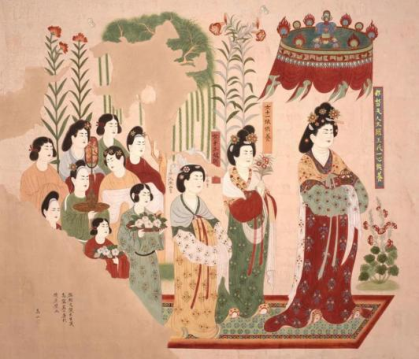
Figure 3: The queen’s costume in cave 45 (adapted from cave 45, 2013).
The Color Beauty of Tang Dynasty Clothing Art in Dunhuang Mural Paintings The color beauty of Tang Dynasty clothing art in Dunhuang murals is also an important part of the aesthetics of Tang Dynasty clothing art.
The construction of Dunhuang grottoes began in the late 16th century and has evolved over many dynasties. However, in Dunhuang murals, the colorfulness of Tang Dynasty costumes far surpasses that of other dynasties. The hues of the images are mainly red, cyan, and green, and the coloring method mainly adopts the flat painting method, presenting a rich and elegant style, focusing on the clever combination of colors and lines. The colors of the costumes are more colorful and gorgeous, making the whole picture show a rich, elegant and dignified feeling.
In addition to this, Dunhuang murals of the Tang Dynasty period are unique in their use of color, not only presenting a rich and varied palette but also cleverly using different color blocks in the costumes for contrast. Espe- cially in the clothing on the cloak, the small area of contrast is particularly strong, each small color block in the pattern forms a unique color contrast relationship. The overall costume design takes the balanced use of long large color blocks as the main form of expression, and the small color blocks in the chapter pattern coordinate with the large color blocks in the main body of the costume, constituting a unified and harmonious way of contrast. Take the 130th cave female donors portrait as an example (see Figure 1), the paint- ing of the outer cover coat, long skirt, and poncho three each using a single color for clever color block matching. This design not only realizes the color harmony of costume art but also produces the effect of stimulating the senses through contrast. The overall color presents a harmonious and unified aes- thetic, which not only meets the aesthetic needs of the people at that time but also brings shocking color impact visually. These unique color expressions have a special infectious force, perfectly demonstrating the subtle beauty of contrast and harmony in the Tang Dynasty clothing color art.
Integrating Tradition With Modernity: Transformation of Tang Dynasty Aesthetics 41
Formal Beauty of Tang Dynasty Costumes in Dunhuang Murals The formal beauty of female costumes during the Tang Dynasty in Dunhuang murals is varied, specifically in the following areas.
Balance Beauty of Unique Design China has always emphasized the beauty of symmetry, and the field of dress is no exception. Symmetry constitutes one of the most basic forms in dress modeling, giving people a sense of simplicity and rigor. Since the human body structure itself is symmetrical, wearing symmetrical clothing is more comfort- able, psychologically gives a sense of stability and coordination, and reduces visual fatigue compared to complicated designs. In the picture of the queen’s costume on the north wall of Cave 45 of Tang Dynasty (see Figure 3), the queen wears a bun, a flower on her head, a round-necked shirt, a long skirt, an outer robe, and cloud-head shoes, all of which are symmetrically shaped to the left and right. The queen’s headdress, in particular, employs center sym- metry, producing a remarkable visual impact and accentuating the dignity of the noble queen.
Unique Repetition Repetition refers to the arrangement of the same element that appears several times according to a certain pattern. In Cave 130 (see Figure 1), in the picture of the Dudu’s wife, Wang Taiyuan, saluting the Buddha, the Dudu’s wife and her two daughters are wearing cross-necked floral Ru skirts, on which the floral four-square consecutive patterns have become a repetitive element, while the maids of honor behind them are wearing men’s round-necked robes, whose robes also show four-square consecutive patterns. Among them, the shoe worn by the Dodu’s wife and the five-flower shoe of the eldest daughter belongs to the two-square continuity, which forms a repetitive element. These patterns maintain a certain connection and distance from each other, which not only has a buffering effect visually, but also increases the layering of the costumes.
Melodic Beauty of Staccato and Melody Melody, also known as rhythm, was originally a term in the field of music, but in the styling design of clothing, it refers to the way the elements are arranged according to a certain law. Melody is a key factor in the movement of modeling elements, and the human eye produces a sense of rhythm with the change and rhythm of the elements. The queen’s costume in the north wall of Cave 217 of Tang Dynasty vividly demonstrates this idea (see Figure 4). She is wearing a wide-sleeved Ru skirt, and at that time the aristocrats preferred the beauty of richness, so the Ru skirt is wide and rich in fabric, forming many regular fold lines, which regularly radiate outward from the center of the folds like the tail of a peacock or the petals of a flower, forming the modeling of a radiating melody.
42 Zhang and Joneurairatana
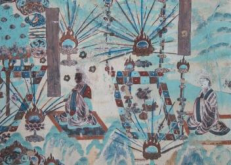
Figure 4: Image of the empress in cave 217 (adapted from cave 217, 2011).Figure 5: The mural painting of the cave 231 (adapted from cave 231, 2012).
Layering Effect The layering effect is the gradual increase of the effect through the arrange- ment of isometric differences, which is mainly reflected in the layering of the cut pieces of the costumes or the change of the colors on the costumes to produce the layering beauty. In Cave 231 of the Middle Tang Dynasty (see Figure 5), a noblewoman wears a brocade upper jacket and a long val-dyed skirt. The val-dyeing process is unique in that it helps to express the layer- ing of motifs through the method of Ikat dyeing and then weaving the cloth, which not only helps to express the layering of motifs but also has a kind of shadowy aesthetic. Behind the noblewoman stands an attendant wearing a male round-necked floral robe, the robe is red witha blue floral pattern, the clashing color treatment makes the pattern more three-dimensional, forming a sense of hierarchy, and the waist is bundled with a pink and green silk belt, which divides the proportion of the body and also forms another level.
TRANSFORMING CHINESE DUNHUANG MURAL ELEMENTS INTO MODERN COSTUME DESIGN The artistic value contained in the Dunhuang treasury provides design- ers with extensive and rich creative space. In the actual design applica- tion, domestic designers have carried out in-depth excavation of Dunhuang Mogao Cave art, especially in the application of Dunhuang frescoes and algae wells and other elements of the application of the practice has achieved fruitful results. Designers have skillfully integrated the aesthetics and the- matic elements of Dunhuang frescoes into modern clothing design, promoting a useful dialog between historical aesthetics and modern aesthetics. Dun- huang murals have gradually entered the public’s vision and life in a symbolic form, and have become an important reference and source of inspiration in contemporary design.
Integrating Tradition With Modernity: Transformation of Tang Dynasty Aesthetics 43
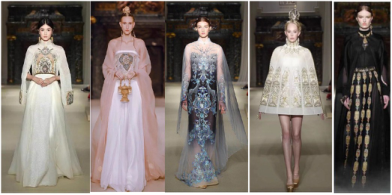
Legend of Gaia: Painted Wall - A Glance of a Thousand Years series In the spring/summer 2019 fashion show (see Figure 6), designer Xiong Ying brought her brand Legend of Gaia to present the art of Dunhuang clothing on the Paris fashion stage again. With the theme of Painted Walls - A Thou- sand Years at a Glance, the show was inspired by the art of Dunhuang cave paintings, skillfully utilizing the elements of Dunhuang frescoes such as Fly- ing Sky and Bodhisattvas, presenting a visual feast full of oriental beauty. The designers skillfully used the elements of Flying Apsara and Bodhisattva in Dunhuang mural paintings to present a visual feast full of oriental beauty. When choosing fabrics, the designer incorporated traditional Chinese tech- niques such as Su embroidery and woofing to make the costumes more rich and dynamic.
In terms of technique, color is also a key element in the creation of clothing. In this series, the colors of the garments are fully borrowed from the Dunhuang mural color palette, choosing representative colors such as pink-green and dark grey, and integrating them into the works through deconstruction and restructuring. Every detail of the entire collection was designed with meticulous care and complicated processes, fully demonstrat- ing the mystery and shock of Dunhuang and showing the world the ultimate Chinese oriental beauty. The color elements, content materials, and creative designs of the Chinese dresses and Dunhuang murals are integrated to form a natural and smooth combination.
Figure 6: Painted wall - a glance of a thousand years collection (adapted from Legend of Gaia’s website, 2019).
SHIATZY CHEN - QI LIANG COLLECTION SHIATZY CHEN is a fashion brand with the concept of creating a new style in China. While highlighting its characteristics, the brand is committed to the inheritance and promotion of oriental national culture. Each released series of clothing is skillfully integrated with Chinese cultural concepts and traditional elements, giving the brand a deep cultural heritage, while realizing the inheritance of traditional culture.
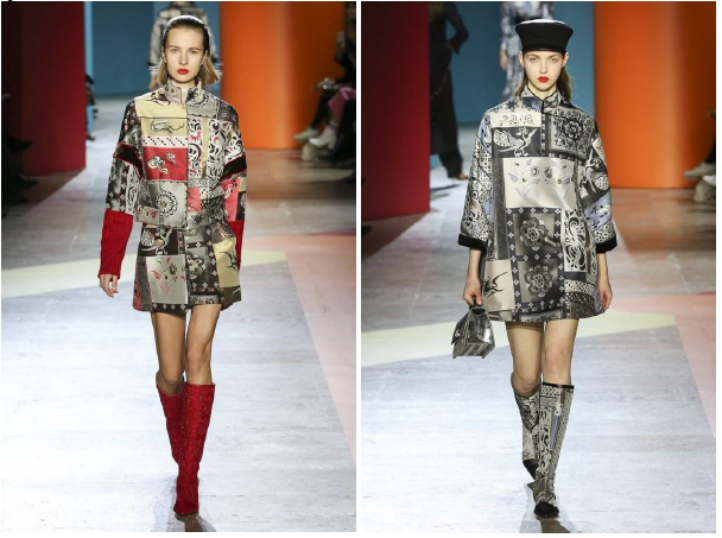
In the Qi Liang collection launched for fall/winter 2018/2019 (see Figure 7), SHIATZY CHEN once again puts the spotlight on the Mogao Caves in Dunhuang, using the patterns in the caves as a source of inspira- tion. By skillfully recombining and reinterpreting elements from the East and
44 Zhang and Joneurairatana
the West, the brand offers a fresh interpretation of the traditional patterns in Dunhuang’s murals, which are rich in symbolism. This innovation allows tra- ditional motifs to be presented in clear symbolism and simple, vivid shapes, creating clothing that meets the aesthetics of the new era. In addition to the innovative application of traditional patterns, the brand combines elegant and straight modern styling with the traditional bias placket styling, fus- ing the simple and sharp cutting process with the traditional cheongsam’s piping process. Gray is the main color, and through the clever splicing of different color blocks, a rhythm and rhyme is formed, highlighting the beau- tiful meaning of traditional patterns, while showing the unique beauty of the wearer.
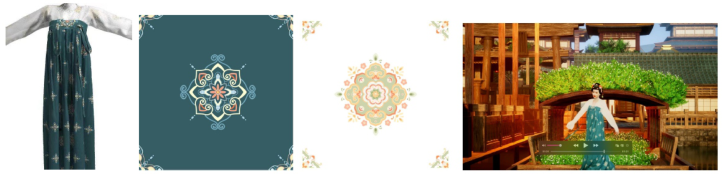
Author’s Design Experiment Based on the above research and designer design case study, combined with the foundation project, the authors used 3D CLO and other clothing mod- eling software to carry out some series of virtual simulation clothing design practice attempts. While simulation modeling of Tang Dynasty buildings and environments, innovative restoration of the images of donors and women in Tang Dynasty murals was carried out digitally. In the face and makeup of the characters, (see Figure 8) combined Tang Dynasty aesthetics with modern aesthetics to make an innovative design, so that it looks historical and cultur- ally flavorful but not so traditional, in line with modern aesthetics. In terms
Integrating Tradition With Modernity: Transformation of Tang Dynasty Aesthetics 45
of the structure of the costume, a simple streamlined structure with a high waist design is used to highlight the linear beauty of Tang Dynasty dress aes- thetics. In the use of color, the classic colors often found in Dunhuang murals such as pink-green, beige, blue-green, etc., are used for the contrast between dark and light hues, large and small areas, while the author’s design of the Baoxiang floral pattern is used as an embellishment and modulation in the color blocks, in an attempt to pass on the hierarchical beauty and rhythmic beauty of Dunhuang murals. Finally, combined with the design of the vir- tual scene, the ancient style and appearance of the Tang Dynasty period are restored and reproduced, together with the display of the characters’ dynamic dance movements, in a kind of video presentation.
Figure 8: Author designed experiments (adapted from author’s own work, 2023).
By analyzing and commenting on the Dunhuang-themed design works of two internationally renowned designer brands, combined with the author’s personal experience in design practice, it is found that the combination of design and culture can create new forms of cultural expression and give new cultural connotations to them in specific contexts. Through this symbolic design language, the value of the product is enhanced, attracting more con- sumers with individuality and love for traditional Chinese culture. At the same time, this design concept makes the brand unique and stand out among many competitors, and enhances the brand’s international competitiveness. In the author’s future doctoral research, the theoretical study of Tang Dynasty aesthetics in Dunhuang murals will be further carried out in depth. Then he will explore more deeply its combination with modern clothing and carry out more diversified design practices.
CONCLUSION
Through image analysis and theoretical research on the clothing images in the Tang Dynasty murals in the Mogao Caves in Dunhuang, this paper discusses in depth the characteristics of the clothing aesthetic elements in the Dunhuang murals of the Tang Dynasty in China. The aesthetic features such as linear beauty, color beauty, and formal beauty are summarized, and an attempt is made to transform, inherit innovate, and integrate the aesthetic elements of the Tang Dynasty with modern clothing design.
Dunhuang murals, especially the costumes of the characters in them, con- tain thousands of years of oriental aesthetic culture. The aesthetics of Tang Dynasty dress art have been precipitated over a long period, forming the
46 Zhang and Joneurairatana
forms and connotations that we see today. As part of the plastic arts, the ulti- mate goal of dress design is to make spatial combinations of structure, color, and pattern of material carriers according to the needs of the human body through the rational use of the laws of formal beauty.
It is hoped that this paper’s in-depth excavation and study of Tang Dynasty Dunhuang costume art, will provide more in-depth theoretical support for brands and designers in cultural integration, and help designers to better com- bine oriental costume aesthetics with contemporary fashion design. This will help designers to better integrate oriental dress aesthetics with contemporary fashion design so that the connotation of dress symbols and the beauty of form can be more closely intertwined in the design works, and more cre- ative designs can be presented. Through an in-depth understanding of the Dunhuang costumes of the Tang Dynasty, designers can draw on ancient aesthetic elements to inject new inspiration and vitality into contemporary costume design.
ACKNOWLEDGMENT
First and foremost, I would like to express my heartfelt gratitude to my super- visor, Eakachat Joneurairatana, and secondary supervisor, Jirawat Vong- phantuset for their attentive guidance and advice throughout this research.At the same time, I would like to give special thanks to my postgraduate supervi- sor, Liu Yuanfeng, who initiated my enlightenment in Dunhuang studies and supported me with relevant primary sources. I am also grateful to my senior, Wang Yan, for valuable academic insights and experience sharing. In addi- tion, I would like to thank my family and friends, who have given me endless love and support throughout my research and have been a solid backing for me on my way forward.
REFERENCES
Anthony, Daniels, J. (2012). The murals of Diego Rivera, New Criterion. 50–55. Bing Yang, J. (2014). Aesthetic visual style assessment on Dunhuang murals, Journal of Shanghai Jiaotong University, 28–34. Blogg R, J. (1993). About the art of painting, Australasian Journal of Philosophy,
99–109. Defeng Song, Hanning Zhang, J. (2023). A Brief Analysis of Tang Dynasty Costume Fashion and Its Formation Reason from Dunhuang Frescoes, Westleather. Francis B, J. (2007). Absence, ambiguity, and the representation of creativity in
Vermeer’s The Art of Painting, Psychoanalytic Quarterly, 583–608. Gombrich EH, M. (1995). The Story of Art 16th Edition, Britain: Phaidon Press. Guoyu Shi, Lin Ouyang, Weixiang Shi, Xunjin Jin, M. (2013). Dunhuang Mural Recovery, Jiangsu Fine Arts Publishing House, 58–209. Hong Wu, M. (2018). Women’s Space in Chinese Paintings, Life, Reading,
New Knowledge, Joint Publishing, 129–237. Jingfeng Qi, J. (2014). The Functions of Modern Mural Art, Cross-Cultural Communication, 25–29. Kejia Hu, J. (2003). A study on the painting techniques and materials of the murals
in the Five Northern Provinces’ Assembly Hall, China Heritage, 1–14.
Integrating Tradition With Modernity: Transformation of Tang Dynasty Aesthetics 47
Qiuli Yu, J. (2010). High Road into the Cloud Ni Yun-lin’s Art of Painting and Its Cultural Value, Asian Social. Robert Z, J.(2003). Abstraction in art with implications for perception, Philosophical
Transactions of the Royal Society, 1285–1291. Takao Takanashi, J. (2000). Aesthetic Design Methods Based on Dunhuang Flying Skies, Summary of Papers from the 2000 International Symposium on Dunhuang Studies. Turk, J. (2012). Collaboration, Inclusion, and Empowerment: A like Skills Mural,
Art Education. 50–53. Xiangyang Li, J. (2000). Color Restoration and Image Retrieval for Dunhuang Fresco Preservation, IEEE MultiMedia, 38–42. Zhong Chen, J. (2014). A kernel support vector machine-based feature selection
approach for recognizing Flying Apsaras’ streamers in the Dunhuang Grotto Murals, Pattern Recognition Letters, 107–113.
LISTED IN THE AHFE DIGITAL BOOKSTORE CATALOGUE
Explore the complete digital volume
Human Factors for Apparel and Textile Engineering
Read this individual research paper free through the original publisher, or explore the full digital proceedings book.
ISBN 978-1-964867-10-6
Explore this ISBN in the AHFE Bookstore ↗Listed in the July 2026 bookstore catalogue; search by ISBN to confirm current availability · Digital book purchase optional