Alejandra Torres Jaramiilo, Juan Manuel Maldonado-Matute, Ana Armijos, María José González Calle, María Isabel Arteaga Ortíz, Pedro Fernando Guerreo Maxi (2024). Second-hand fashion and its impact on business sustainability. In: Human Factors for Apparel and Textile Engineering. AHFE Open Access, vol. 134, pp. 105–115. https://doi.org/10.54941/ahfe1004919
The aim of this study was to examine the beliefs that influence the predisposition to buy second-hand clothes. The methodology had a quantitative approach, through the collection of data via an online survey, which were analyzed using the PLS algorithm and the bootstrapping technique for structural equations. The influence of consumers' environmental beliefs, willingness to spend and beliefs on attitudes towards second-hand fashion was assessed. The results indicate that attitude towards second-hand fashion has a mediating effect between beliefs and intention to purchase second-hand clothing; moreover, environment and willingness to spend have a positive and significant effect on attitude towards second-hand fashion.
Climate changes have led to environmentally friendly consumption alterna- tives being presented in various parts of the world. This article examines the environmental consequences of the current clothing system and how second- hand business models support sustainability. The current business model of the textile industry is highly wasteful and polluting as it maintains a linear production of manufacturing, consumption, and waste, which generates large quantities of solid waste that causes permanent damage to the ecosystem. Fur- thermore, the mass production of garments generates not only environmental damage, but also accuses violations of the rights of workers who are forced to participate in long working hours with minimum wages. For these rea- sons, it is established that the fashion industry must look for alternatives that guarantee efficient use of resources, increasing the life cycle of products and seeking a circular production model.
Along these lines, the textile industry and its consumers have recognized the great environmental impact generated by large-scale textile production
and have become more aware of their environmental and social impacts. Faced with this panorama, second-hand clothing sales markets are presented as an alternative that seeks to reduce the waste of clothing after use by the first owner. Thus, recycling clothes and reusing them creates a circular economic model that promotes changes in the traditional linear economic model; Also, it encourages environmental awareness in consumers, discouraging high lev- els of consumerism presenting a new lifestyle. The present study examines the underlying ways in which consumers’ beliefs influence purchase inten- tions for second-hand fashion products. The general objectives of the research were two: (1) to examine how consumers’ beliefs (CR) shape their attitude towards second-hand fashion (AMSM) and (2) to examine how subjective norms (NS), the social behaviour (SC) and attitude towards second-hand fashion impact the purchase intention of second-hand clothing (IC).
CIRCULAR ECONOMY, SUSTAINABILITY, AND ITS CONFLICT WITH THE FASHION INDUSTRY According to Georgescu et al. (2021), the circular economy is defined as a model in which production resources are used efficiently, so that they can be recycled and returned to the environment without negative impacts. In this regard, Rosa et al. (2020) agrees when they explain that the circular econ- omy is a global economic model that minimizes the consumption of finite resources and guarantees sustainable growth over time. Thus, they define it as a restorative system that replaces the term ‘end of useful life’ with ‘restora- tion’. In the same sense, Gandolfo and Lupi (2021) explain that the circular economy is divided into two different ambits; the first, an economic system that achieves sustainable development through the implementation of closed material resource cycles; and the second, a system that encourages economic profit through the reuse of products and resources.
It is possible to establish that the circular economy represents a solution to the negative effects of the traditional linear economic model. According to Stott et al. (2010), if a model based on exploitation-production-waste con- tinues to be applied, by the year 2050, the natural resources of three planets will have been consumed, generating a considerable increase in global carbon emissions and the definitive loss of biodiversity.
Over the years, collaborative economies that have given way to the circular economy begin to form part of the efforts led by governments and compa- nies that seek to create innovative ideas in favour of sustainable development (Shao, Tian, & Fan, 2018). Now, the transition from a traditional model to a circular one carries with it certain implications. To begin, it should be noted that the implementation of the circular economy within a soci- ety requires environmental, ecological, and social awareness. According to Bertassini (2021), an organization must consider three questions to obtain a change towards the circular economy: why change? what to change? and how to change? to transform their production model to another with environ- mental and socially responsible purposes. These changes translate into new
Second-Hand Fashion and Its Impact on Business Sustainability 107
customers and investors who are attracted to more responsible production methods (Amato et al., 2019).
Fast Fashion Industry The United Nations calls the fashion industry a social and environmental emergency, producing 20% of the world’s waste and 10% of global carbon emissions (Bianchi and Gonzalez, 2021). Furthermore, the case of fast fashion is characterized by meeting the strong demands that globalization and its fads bring with it. Zamani et al. (2017) maintain that fast fashion chains seek to respond to new clothing trends and update the clothing available in stores as frequently as possible, to satisfy high and fast demands. In this sense, this industry seeks to keep its prices low so that the consumer is attracted to purchasing more clothing (Rese, Schlee & Baier, 2019).
Hu et al. (2014) comment that stores such as Zara and H&M (most recently Shein), who are participants in the fast fashion industry, present new garments in their stores in periods as short as 3 to 5 weeks. This leads to consumers being tempted to consume new clothes faster, so that “outdated” clothes end up quickly and in larger quantities in landfills, generating waste for the environment. Therefore, it is stated that the existing influences of consumerism affect the textile industry and vice versa, whose impact is mag- nified through media such as social networks, mainly affecting people with impulsive purchasing behaviours, since fast fashion allows them to spend less and more frequently (Brydges, 2021).
The scenario becomes more discouraging when it is recognised that com- panies that base their business on fast fashion take advantage of the cheap labour they can find in low-income countries, with very lax controls of their labour laws (Jha and Veeramani, 2021), reaching extreme situations of child exploitation and exploitation of people in vulnerable situations.
Sustainable Fashion Due to rapid changes in the textile industry, major social and ecological sus- tainability concerns have been raised (Heinze, 2020). In response, responsible fashion manufacturing and consumption initiatives have emerged. In this regard, Hemantha (2021) explains that, in the fashion industry, sustainable development is the main tool that facilitates the achievement of objectives aimed at reuse, recycling and restoration, thus satisfying the generation of sustainable options to the product, its use and disposal (Jeong and Ko, 2021). In this sense, circular fashion or sustainable fashion are two concepts that seek to make a positive change at an environmental level, generating mini- mal waste and changes in the purchasing habits of the people who consume it. Also, sustainable fashion encourages the use of recycled raw materials for the manufacture of garments, such as cotton, wool, or polyester (Hemantha, 2021). In this way, pollution is reduced and even the existing working condi- tions in the textile industry are improved, guaranteeing adequate wages, and working conditions (Guedes, Paillard-Bardey & Schat, 2020). Thus, sustain- able materials for the manufacture of clothing allow fewer resources to be
used and a smaller amount of waste to be generated at the time of manufac- turing. In addition, it contributes to solving the problem of contamination of textiles in landfills, which produce methane when they decompose, a sit- uation that generates a greater negative impact when it is considered that synthetic materials have such a long life that they do not decompose quickly (Morgan and Birtwistle, 2009). According to Abingdon (2016) “extending the average useful life of clothing by just three months of active use per item would lead to a 5% to 10% reduction in each of the carbon, water and waste footprints”.
At this point, it is important to highlight that the adequacy of sustainability in the fashion industry is not limited to the production of garments in natural fabrics, but it is also about the consumer’s preference for brands that base their business models on socially responsible practices with ethical conditions for their employees. It is also about consumers using the clothes they buy for as long as possible, repairing them when necessary or transforming them into a new product (Karadayiusta and Kadaifci, 2021).
Second-Hand Fashion Market Markets for the sale of second-hand products are understood to be those that offer items that have been previously used by someone and are in good con- dition for remarketing and consumption, thus extending the useful life of the goods. According to Estripeau et al. (2022) with an estimated value between 100 and 120 billion dollars worldwide, the market for second-hand clothing, footwear and accessories has almost tripled in size in recent years. Demand from the second-hand market usually focuses on used clothing, which repre- sents 25% of the average second-hand buyer’s wardrobe. While economics used to be the main reason for buying second-hand clothing, this has been displaced and sustainability has become the driving force for consumers to enter the second-hand market.
Product variety also remains important and remains the second driver of second-hand clothing consumption, no doubt driven by the growing popu- larity of resale apps (including social media), in addition, online platforms such as Vinted or Wallapop have gained popularity and offer a large cata- logue of second-hand products. Karadayiusta and Kadaifci (2021) state that generation Z can put an end to the Fast Fashion trend thanks to its cur- rent environmental awareness; even this new transactional modality would directly benefit low-income people and university students who want to obtain clothing in good condition at low prices which is sometimes limited by its economy (Seo and Kim, 2019).
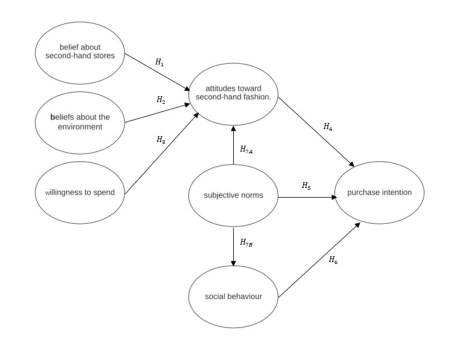
Based on the reviewed literature, we seek to understand what factors influ- ence buyers’ intention to purchase second-hand clothing. For this, the rela- tionships, variables, and hypotheses presented below have been established: i) belief about second-hand stores, ii) beliefs about the environment, iii) will- ingness to spend, iv) attitude towards second-hand fashion, v) subjective norms, vi) social behaviour, and vii) purchase intention.
Second-Hand Fashion and Its Impact on Business Sustainability 109
Figure 1: Constructs made for the assessment of the proposed hypothesis.
H1: Consumer beliefs about second-hand stores positively influence con- sumer attitudes toward second-hand fashion. H2: Consumer beliefs about the environment positively influence the consumer’s attitude toward second- hand clothing items. H3: Consumer willingness to spend positively influences consumer attitude toward second-hand fashion items. H4: Consumer atti- tude towards purchasing second-hand fashion items positively influences consumer intention to purchase second-hand fashion items. H5: The con- sumer’s subjective norms positively influence their intention to purchase second-hand fashion items. H6: Social behaviour positively influences con- sumer intention to purchase second-hand fashion items. H7a: Subjective norms positively influence consumer attitude toward second-hand fashion items. H7b: Subjective norms positively influence consumer social behaviour.
Study Description To carry out the study, non-probabilistic convenience sampling was used, with a quantitative approach, beginning the collection of data through a dig- ital survey where all participation was voluntary and without incentives. The questions used in this research were taken and adapted from previous studies with high levels of reliability and validity. The article by Seo & Kim (2019) was the basis for the main questions and hypotheses on attitude towards second-hand fashion, social behaviour towards purchases, the environment, willingness to spend, beliefs about second-hand stores hand, purchase inten- tion and demographic data. From the article by Cervellon et al. (2012), questions related to motivation and purchase intention were used; Finally, self-authored questions were added to measure the perception of second- hand fashion in the city of Cuenca-Ecuador. This instrument used a 7-point Likert-type scale ranging from (1) totally disagree to (7) totally agree.
To evaluate the measurement model, the following criteria were used: i) indicator reliability, ii) internal consistency, iii) convergent validity and iv) Discriminant Validitydiscriminant validity (Hair et al., 2014). Accord- ing to Hair et al. (2011), the reliability of the indicator shows the capacity
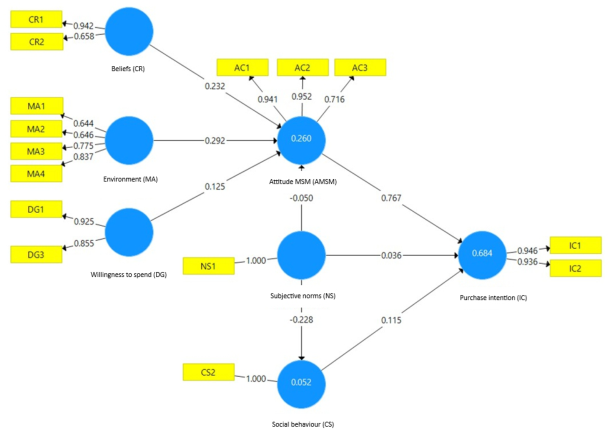
and suitability of the items (indicators) generated for a construct to mea- sure the main concept in each investigation. The reliability of the indicator is estimated through the external loadings, which show estimates of the rela- tionships between the reflective latent variables and their indicators (Hair, Hult, Ringle & Sarstedt, 2017). An item that has a loading greater than 0.5 is considered to have sufficient levels of indicator reliability (Hair et al., 2014). After eliminating items with factor loadings less than 0.5 (DG2, NS2, CS1, CR3), all items considered in the model were statistically significant, suggest- ing sufficient levels of indicator reliability. Table 1 and Figure 2 represent the individual indicator reliability estimate.
Table 1. Indicator reliability, internal consistency, and convergent validity.
In addition, Table 1 shows the internal consistency estimate, which is used to judge the consistency of the results between the items of the same test. It helps determine whether the items measuring a construct are similar in their scores; that is, if the correlations between the items are high. To verify internal consistency, the composite reliability (CR) value and Cronbach’s alpha value (α) should be examined; the composite reliability must be greater than 0.70 (Hair et al., 2017), and according to Hair (2007) the minimum threshold for Cronbach’s alpha value is set at 0.6.
Second-Hand Fashion and Its Impact on Business Sustainability 111
The results in Table 2 indicate that all the constructs of the study have high levels of internal consistency, since the composite reliability and Cronbach’s alpha values of all the constructs are above the recommended threshold values.
Regarding the evaluation of convergent validity, this refers to the degree to which a measure is positively correlated with other alternatives of the same construct (Hair et al., 2017). The evaluation of convergent validity is based on the values of the average variance extracted (AVE), which must be equal to or greater than 0.5 (Hair et al., 2011). The AVE values of the study constructs were all higher than the threshold value, suggesting that all study constructs have high levels of convergent validity. Finally, discrim- inant validity denotes the degree to which a construct is truly distinct from others according to empirical standards. To evaluate discriminant validity, Fornell’s (1981) criteria were used, verifying that the square root of the AVE values of each construct is higher than any correlation between constructs. The logic of the Fornell-Larcker method is based on the idea that a con- struct shares more variance with its associated indicators than with any other construct (Hair et al., 2017). Table 2 shows that all constructs discriminate against each other, suggesting the existence of discriminant validity between them.According to Sohn and Groß (2020), the heterotrait-monotrait rela- tionship (HTMT), which measures the similarity between latent variables, provides additional support to evaluate the discriminant validity of the con- structs. If the HTMT is clearly less than 1, discriminant validity can be considered established. In many practical situations, a threshold of 0.9 reli- ably distinguishes those pairs of latent variables that are discriminately valid and those that are not (Henseler et al., 2015). Table 3 shows that all HTMT values are below 0.9, which supports the existence of discriminant validity between the constructs.
Table 3. Heterotrait-monotrait (HTMT).
Table available in the original PDF paper.
Construct AMSM CS CR DG IC MA NS AMSM CS 0.525 CR 0.557 0.484 DG 0.278 0.107 0.265 IC 0.948 0.519 0.573 0.274 MA 0.522 0.271 0.786 0.309 0.474 NS 0.102 0.228 0.142 0.047 0.050 0.034
Structural Model The estimation of the structural model is shown in Figure 2 and Table 4, the PLS algorithm was run to generate the path coefficients, and bootstrap- ping sampling with 5000 iterations and 255 cases was run to examine the significance of the path coefficients (Henseler et al., 2009; Hair et al., 2011; Hair et al.,2014). The purpose of running the model with all the variables was to establish the results of the direct effect of the dimensions on the intention to purchase second-hand clothing.
Accordin to results of Table 4 it can be stated that the attitude towards second-hand fashion (AMSM) and social behavior (SC) positively affect the intention to purchase second-hand clothing (IC). Furthermore, the relation- ship Beliefs (CR) −> Attitude towards second-hand fashion (AMSM) is pos- itive and significant, also the relationship willingness to spend (DG) −> Atti- tude towards second-hand fashion (AMSM) and environment (MA) −> Atti- tude towards second-hand fashion (AMSM) are positive and significant. The results also indicate a negative impact of subjective norms (NS) on social behavior, the relationship Subjective norms −> Attitude towards second- hand fashion (AMSM) and Subjective norms (NS) −> Purchase intention (CI) is not significant.
A deeper analysis shows that the effect of beliefs (CR) on purchase inten- tion (CR) can be mediated by attitude towards second-hand fashion (AMSM) and that, in turn, the attitude towards second-hand fashion (AMSM) can mediate between the relationships willingness to spend (DG) −> purchase
Second-Hand Fashion and Its Impact on Business Sustainability 113
intention (IC), and environment (MA) −> purchase intention (CI). There is no mediation between subjective norms (NS) and purchase intention.
CONCLUSION
The results obtained in this research indicate that beliefs about second-hand fashion have a positive and significant effect on the attitude towards second- hand fashion, thus H1 is accepted; the environment also has a positive and significant influence on the attitude towards second-hand fashion. The will- ingness to spend positively and significantly influences the attitude towards second-hand fashion, which corroborates the acceptance of H3. The results also indicate that the attitude towards second-hand fashion positively and significantly influences purchase intention, accepting H4. It should be noted that subjective norms do not significantly affect purchase intention, which is why H5 is rejected, in contrast, social behaviour does have a significant and positive impact on purchase intention, which is accepted H6, with respect to H7a and H7b it can be said that subjective norms do not significantly influ- ence the attitude towards second-hand fashion and that subjective norms do influence in a significant and negative way in social behaviour.
REFERENCES
Abingdon. (2016). “Recycled Textile Associations Unite to Combat Media Misconceptions of Secondhand Clothing Industry.” Textile Recycling Association. https://www.smartasn.org/news/pr10-27-16.pdf Bertassini, Ana Carolina, Aldo Roberto Ometto, Semih Severengiz, and Mateus
Cecilio Gerolamo. (2021). “Circular Economy and Sustainability: The Role of Organizational Behaviour in the Transition Journey.” Business Strategy and the Environment Volume 30, No. 7, 3160–93. https://doi.org/10.1002/bse.2796 Bianchi, Constanza, and Matias Gonzalez. (2021). “Exploring Sustainable Fashion Consumption among Eco-Conscious Women in Chile.” International Review of Retail, Distribution and Consumer Research Volume 31, No. 4, 375–92. https: //\penalty\z@{}sdoi.org/10.1080/09593969.2021.1903529 Brydges, Taylor. (2021). “Closing the Loop on Take, Make, Waste: Investigating
Circular Economy Practices in the Swedish Fashion Industry.” Journal of Cleaner Production 293: 126245. https://doi.org/10.1016/j.jclepro.2021.126245 Cervellon, Marie Cécile, Lindsey Carey, and Trine Harms. (2012). “Something Old, Something Used: Determinants of Women’s Purchase of Vintage Fashion vs Second-Hand Fashion.” International Journal of Retail and Distribution Manage- ment Volume 40, No. 12, 956–74. https://doi.org/10.1108/09590551211274946 Cohen, Maurie J. (2020). “Does the COVID-19 Outbreak Mark the Onset of a Sus-
tainable Consumption Transition?” Sustainability: Science, Practice, and Policy Volume 16, No. 1, 1–3. https://doi.org/10.1080/15487733.2020.1740472 D’Amato, D., N. Droste, K. J. Winkler, and A. Toppinen. (2019). “Thinking Green, Circular or Bio: Eliciting Researchers’ Perspectives on a Sustainable Economy with Q Method.” Journal of Cleaner Production No. 230, 460–76. https://doi.org/10. 1016/j.jclepro.2019.05.099 Estripeau, R., Krueger, F., Vitrani, J., Willersdorf, S., Marteau, P.-F., Moizant, F., &
Gasc, M. (2023). The Future of Secondhand Fashion. BCG. https://www.bcg.co m/publications/2023/future-of-secondhand-fashion
Fornell, Claes. (1981). “Evaluating Structural Equation Models with Unobservable Variables and Measurement Error.” Journal of Marketing Research Volume 18, 49–56. Gandolfo, Alessandro, and Lorenzo Lupi. (2021). “Circular Economy, the Transition
of an Incumbent Focal Firm: How to Successfully Reconcile Environmental and Economic Sustainability?”Business Strategy and the Environment Volume 30, No. 7, 3297–3308. https://doi.org/10.1002/bse.2803 Georgescu, Irina, Jani Kinnunen, and Ane Mari Androniceanu. (2021). “Empirical Evidence on Circular Economy and Economic Development in Europe: A Panel Approach.” Journal of Business Economics and Management Volume 23, No. 1. 199–217. https://doi.org/10.3846/jbem.2022.16050 Guedes, Biatriz, Aurore C. Paillard-Bardey, and Anke Schat. (2020). “Improving
Sustainable Fashion Marketing and Advertising: A Reflection on Framing Mes- sage and Target Audience.” International Journal of Market Research Volume 62, No. 2, 124–26. https://doi.org/10.1177/1470785318801152s Hair, J. F., Hult, G. T. M., Ringle, C. M., & Sarstedt, M. (2017). “A Primer on Partial Least Squares Structural Equation Modeling (PLS-SEM). Thousand Oaks.” Sage, No. 165. Hair, J. F., G. T. M. Hult, C. M. Ringle, and M. Sarstedt. 2014. “A Primer on Par-
tial Least Squares Structural Equation Modeling (PLS-SEM). Sage Publications.” European Journal of Tourism Research Volume 6, No. 2, 211–13. Hair, Joe F., Christian M. Ringle, and Marko Sarstedt. (2011). “PLS-SEM: Indeed a Silver Bullet.” Journal of Marketing Theory and Practice Volume 19, No. 2, 139–52. https://doi.org/10.2753/MTP1069-6679190202 Heinze, Lisa. (2020). “Fashion with Heart: Sustainable Fashion Entrepreneurs, Emo-
tional Labour and Implications for a Sustainable Fashion System.” Sustainable Development Volume 28, No. 6, 1554–63. https://doi.org/10.1002/sd.2104 Hemantha, Y. (2021). “Fashion Industry and Sustainability : A Circular Economy Approach.” Henseler, Jörg, Christian M. Ringle, and Marko Sarstedt. (2015). “A New Criterion
for Assessing Discriminant Validity in Variance-Based Structural Equation Mod- eling.” Journal of the Academy of Marketing Science Volume 43, No. 1, 115–35. https://doi.org/10.1007/s11747-014-0403-8 Henseler, Jörg, Christian M. Ringle, and Rudolf R. Sinkovics. (2009). “The Use of Partial Least Squares Path Modeling in International Marketing.” Advances in International Marketing, No. 20, 277–319. https://doi.org/10.1108/S1474- 7979(2009)0000020014 Hu, Zhi Hua, Qing Li, Xian Juan Chen, and Yan Feng Wang. (2014). “Sustain-
able Rent-Based Closed-Loop Supply Chain for Fashion Products.” Sustainability (Switzerland) Volume 6, No. 10, 7063–88. https://doi.org/10.3390/su6107063 Jeong, Dayun, and Eunju Ko. (2021). “The Influence of Consumers’ Self-Concept and Perceived Value on Sustainable Fashion.” Journal of Global Scholars of Mar- keting Science 31 Volume 4: 511–25. https://doi.org/10.1080/21639159.2021. 1885303 Jha, Srirang K, and S Veeramani. (2021). “Sorting Responsible Busi- ness Practices in Fast Fashion: A Case Study of Zar...: University of Warwick EResources” 12 (2): 54–58. https://0-eds-s-ebscohost- com.pugwash.lib.warwick.ac.uk/eds/pdfviewer/pdfviewer?vid=1&sid=6269f9da- 9d60-46cc-8d72-18807ee5e9fc%40redis
Second-Hand Fashion and Its Impact on Business Sustainability 115
Morgan, Louise R., and Grete Birtwistle. (2009). “An Investigation of Young Fashion Consumers’ Disposal Habits.” International Journal of Consumer Studies Volume 33, No. 2, 190–98. https://doi.org/10.1111/j.1470-6431.2009.00756.x Rosa, Paolo, Claudio Sassanelli, Andrea Urbinati, Davide Chiaroni, and Sergio Terzi.
(2020). “Assessing Relations between Circular Economy and Industry 4.0: A Sys- tematic Literature Review.” International Journal of Production Research 58 (6): 1662–87. https://doi.org/10.1080/00207543.2019.1680896 Seo, Min Jeong, and Minjeong Kim. (2019). “Understanding the Purchasing Behaviour of Second-Hand Fashion Shoppers in a Non-Profit Thrift Store Con- text.” International Journal of Fashion Design, Technology and Education Vol- ume 12, No. 3, 301–12. https://doi.org/10.1080/17543266.2019.1611945. Shao, Shuai, Zhihua Tian, and Meiting Fan. (2018). “Do the Rich Have Stronger
Willingness to Pay for Environmental Protection? New Evidence from a Survey in China.” World Development No. 105, 83–94. https://doi.org/10.1016/j.worlddev .2017.12.033 Stott, Peter A., Nathan P. Gillett, Gabriele C. Hegerl, David J. Karoly, Dáithí A. Stone, Xuebin Zhang, and Francis Zwiers. (2010). “Detection and Attribution of Cli- mate Change: A Regional Perspective.” Wiley Interdisciplinary Reviews: Climate Change Volume 1, No. 2. 192–211. https://doi.org/10.1002/wcc.34 Zamani, Bahareh, Gustav Sandin, and Greg M. Peters. (2017). “Life Cycle Assess-
ment of Clothing Libraries: Can Collaborative Consumption Reduce the Environ- mental Impact of Fast Fashion?” Journal of Cleaner Production 162: 1368–75. https://doi.org/10.1016/j.jclepro.2017.06.128
LISTED IN THE AHFE DIGITAL BOOKSTORE CATALOGUE
Explore the complete digital volume
Human Factors for Apparel and Textile Engineering
Read this individual research paper free through the original publisher, or explore the full digital proceedings book.
ISBN 978-1-964867-10-6
Explore this ISBN in the AHFE Bookstore ↗Listed in the July 2026 bookstore catalogue; search by ISBN to confirm current availability · Digital book purchase optional