Saori Kitaguchi, Shintaro Kato (2024). Kimono design and color scheme proposal using image-generating AI technology. In: Human Factors for Apparel and Textile Engineering. AHFE Open Access, vol. 134, pp. 116–123. https://doi.org/10.54941/ahfe1004920
The kimono market has shrunk by about a tenth in 40 years. While demand is decreasing, there is an equal or even more significant shortage of companies and workers, so some existing companies face a greater burden in production than before. Some kimono OEM productions in Nishijin, a part of Kyoto in Japan famous for kimono textiles, have more customers as the number of competitors in the same business is decreasing. This has made it difficult to propose differentiated designs for each customer. In particular, the content of the customer's order is often expressed only in words and abstract expressions, making it difficult to determine the design. In addition, it is usually necessary to consider multiple color schemes for each design. These processes must be carried out by a limited number of people within the company and in a short period. Given the current situation, we believe ‘streamlining the design process’ is necessary in the kimono industry. On the other hand, the technological development of image-generating AI is accelerating rapidly and attracting great social interest. The rapid development of image-generating AI technology is expected to improve the productivity of various operations in various industries. Therefore, this study investigated and verified the possibility of using image-generating AI in the kimono design process. In the experiment, AI was used to generate images using texts as input values, and it was examined whether the design and color scheme of the images matched human impressions. Under the current experimental environment, it was found that the AI-generated images and human impressions were close in terms of country/region with a high degree of accuracy. The color analysis showed that the color of the AI-generated images was comparable to that of human impressions for both the country/region and the adjective word. This suggested the possibility of using image-generating AIs to support the kimono coloring process.
The kimono market has shrunk from 1.8 trillion yen in the 1980s to 192.5 billion yen in 2020, about a tenth of its size in 40 years (Yano Research Insti- tute Ltd., 2022). In addition, the number of companies in the production areas that support the kimono industry has drastically decreased due to the shrinking kimono market (Kyougikai, 2015). On the other hand, there is a certain level of demand. The market size had expanded from 2020 to 2021
Kimono Design and Color Scheme Proposal Using Image-Generating AI Technology 117
due to the increase in economic activity after the calming of COVID-19. How- ever, there are few new entrants of young people into the kimono industry as workers, and the kimono industry faces problems such as an aging popula- tion and a lack of successors (Araki, 2018). Thus, while demand is decreasing as the market shrinks, there is an equal or even more significant shortage of companies and workers, and some of the existing companies are facing a greater burden in production than before. Even kimono manufacturers who are in the business of OEM production of Nishijin textiles, famous for tra- ditional kimono textiles in Japan, have several wholesalers as customers, but the number of customers they have is increasing as the number of competi- tors in the same business is decreasing due to the shrinking of the kimono industry. This has made it difficult to propose differentiated designs for each customer. In particular, the content of the customer’s order is often expressed only in words and abstract expressions, making it difficult to determine the design. In addition, it is usually necessary to consider multiple color schemes for each design. These processes must be carried out by a limited number of people within the company and in a short period of time. Given the current situation, we believe that ‘streamlining the design process’ is necessary for the kimono industry. On the other hand, the technological development of image- generating AI is accelerating rapidly and attracting great social interest, and the rapid development of image-generating AI technology is expected to con- tribute to improving the productivity of various operations in a wide range of industries and enterprises, thereby helping to solve various social problems. The kimono industry, which faces challenges in the design process, may be able to move in a better direction through the use of image-generating AI. Therefore, this study investigated and verified the possibility of using image- generating AI in the kimono design process. In the experiment, AI was used to generate images using texts as input values, and it was examined whether the design and color scheme of the images matched human impressions.
EXPERIMENTAL METHODS In the experiment, digital images of selected texts were generated using an image-generating AI. Colors were extracted from the generated images to investigate the colors associated with each word. Then, human impressions of the design and colors of the AI-generated images were evaluated. The AI’s design and color choices were compared to the human impressions. Finally, a kimono design and color scheme was proposed.
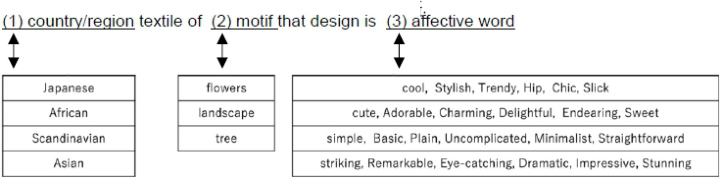
Digital Image Generation Using AI Digital images were generated using DreamStudio, an image-generating AI text-to-image web application developed by Stability AI LTD. Twenty images were generated for each prompt. Prior to generating images, the prompts to be entered into the AI were selected. The prompts were in the form of three elements: (1) country/region, (2) motif, and (3) affective word, and the words connecting these elements. All were entered in English. As shown in Figure 1, a total of 48 combinations of 4 types of (1) country/region (Japanese, African, Scandinavian and Asian), 3 types of (2) motif (flowers, landscape and Tree)
118 Kitaguchi and Kato
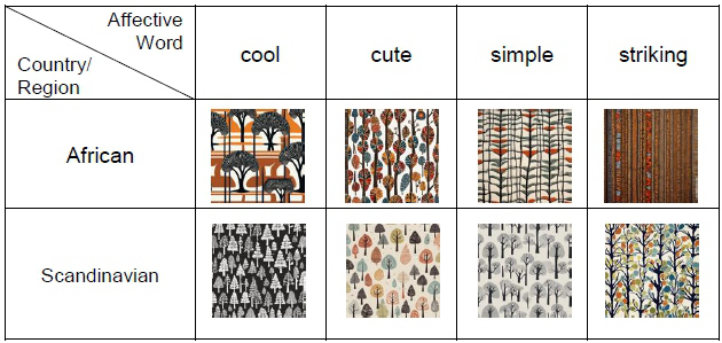
and 4 groups of (3) affective words (cool, cute, simple and striking) were used to compose the prompts. For the (3) affective word, ChatGPT (OpenAI) was used to create groups of synonymous affective word. Examples of the generated images are shown in Figure 2.
Figure 1: Texts entered to prompts.Figure 2: Examples of the AI-generated images.
Color Analysis of AI-Generated Images Representative colors of the AI-generated images were extracted and color features of each prompt were analyzed. A k-means method was applied to each image to cluster colors using MATLAB software (The MathWorks Inc.). Clustering was performed using an optimal number of clusters for each image. The colors of the top three clusters that accounted for the largest percentage of pixels in an image were designated as the representa- tive colors of that image. The colors were defined as the base color (top), the assorted color (second), and the accent color (third). Then, the base, assorted, and accent colors of 20 images from the single prompt were com- bined to form a group. The color distribution was analyzed in terms of the CIELAB color space (CIE, 2004) to use intuitively understandable terms such as lightness and chroma. AI created the images in an RGB space, so the RGB values were converted to the CIELAB values using a sRGB color space (IEC, 1998).
Kimono Design and Color Scheme Proposal Using Image-Generating AI Technology 119
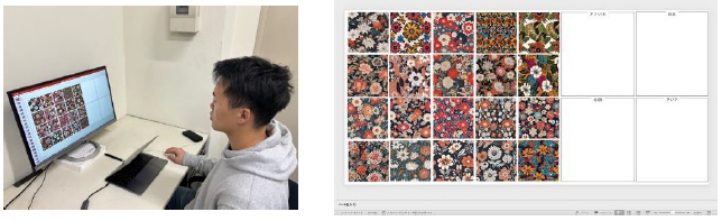
Visual Evaluation A visual evaluation was conducted to assess the impressions people receive from images generated by AI in response to input prompts. In the experi- ment, 960 AI-generated images were displayed to participants on a screen, 20 images at a time, as shown in Figure 3. In Experiment I, participants were asked to divide the images into four groups based on (1) country/re- gion (Japan, Africa, Scandinavia or Asia), with five images in each group. In Experiment II, participants were asked to divide the images into four groups based on (2) affective word (cool, cute, simple or striking), with five images in each group. In Experiment I, the set of 20 displayed images was composed of images that shared the same (2) motif and (3) affective word as contained in the prompts, with five images selected for each (1) country/region. Similarly, in Experiment II, the set of 20 displayed images was composed of images that shared the same (1) country/region and (2) motif as contained in the prompts, with five images selected for each (3) affective word. The experi- ment period was from December 15, 2023, to January 14. The subjects were 20 students from Kyoto Institute of Technology and the Graduate School of Kyoto Institute of Technology, consisting of 15 males and 5 females.
Figure 3: Experimental conditions and an example of the displayed images in visual assessments.
RESULTS
Agreement Rates The visual evaluation results were classified as ‘agreement’ if the partici- pants judged the images to be in the same group as the prompt text used to generate them and as ‘disagreement’ if they were in a different group. The percentage of ‘agreement’ for each prompt (agreement rate) was then calcu- lated. Table 1 shows the agreement rates for Experiments I and II. Experiment I showed remarkable agreement between the AI and the participants. The images with prompts such as ‘African’ and ‘Scandinavian’ showed particu- larly high agreement rates, with most groups exceeding 70% agreement rate. However, images with ‘Japanese’ and ‘Asian’ prompts tended to have lower agreement rates. There were frequent errors in categorizing ‘Japanese’ as ‘Asian’ and vice versa, which may be due to the geographical fact that Japan is part of Asia, suggesting that the distinction between their textile designs
120 Kitaguchi and Kato
may be minimal. In Experiment II, the agreement rates decreased compared to Experiment I. In particular, groups labeled ‘African’ tended to have lower agreement rates. The larger errors were found in categorizing ‘cool’ as ‘strik- ing’ and vice versa. On the other hand, ‘Asian’ and ‘cute’ tended to have higher agreement rates.
Table 1. Agreement rate (%) for experiments I and II.
Table available in the original PDF paper.
Kimono Design and Color Scheme Proposal Using Image-Generating AI Technology 121
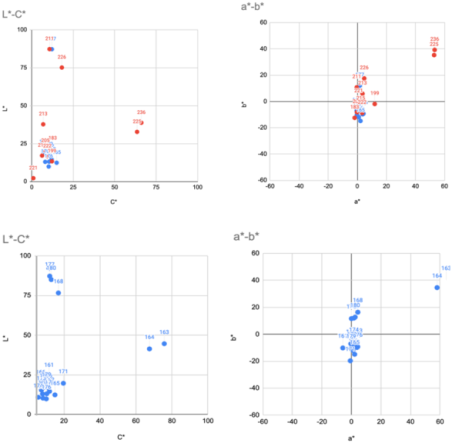
Color Comparison: AI and Human Impressions Regardless of whether the images agreed or disagreed with the AI-generated images as a result of the visual evaluation, the representative colors were extracted from the top 20 images most frequently chosen by the participants for each prompt. The extraction method was the same as described in the section ‘Color Analysis of AI-generated Images.’ Then, those were compared with the representative colors of the AI-generated images, extracted in the section ‘Color Analysis of AI-generated Images.’ For the prompts with high agreement rates in both Experiments I and II, there were significant overlaps between the 20 AI-generated images and the 20 human-selected images, indi- cating little difference in their color distributions. Similarly, for the prompts with lower agreement rates, the distribution of representative colors showed similar trends in both experiments. This suggests that because the colors were similar, it was difficult to distinguish between them(e.g., images with the prompts ‘Japanese’ vs. ‘Asian’ or ‘cool’ vs. ‘striking’), leading to their being classified into opposite groups. Therefore, although the agreement rates were low, there were no significant differences in the color distributions between AI-generated and human-selected images. Figure 4 shows an example of CILEAB L*-C* plots and a*-b* plots of the low agreement rate prompts in Experiment II. The base color distribution plots of the top 20 images are shown at the top of Figure 4 and the base color distribution plots of the 20 AI- generated images at the bottom. The colors from the ‘disagreement’ images are described in red dots in the plots.
Figure 4: The color distributions of the AI-generated images and the human-selected images for the prompt of ‘Japanese textile of flowers that design is cool, stylish, trendy, hip, chic, slick’ (the numbers in the figure are an image ID).
122 Kitaguchi and Kato
PROPOSAL FOR A KIMONO COLOR SCHEME DESIGN SUPPORT SYSTEM Although there was some disagreement between AI and Human impressions, the results of this study suggest the potential of using image-generating AI to generate kimono textile designs and extract colors that closely match human impressions based on textual descriptions. Consequently, this study proposes a kimono design support system that uses image-generating AI to assist in the kimono design creation and color selection process.
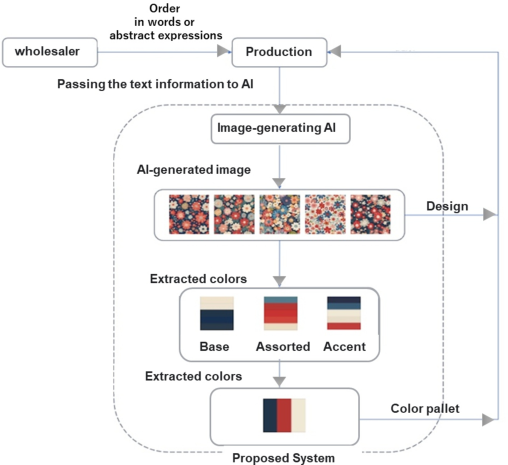
System Overview The proposed system is designed for kimono manufacturers who receive requests from wholesalers. The manufacturers input the desired design or image of the kimono in text form, and the system then displays an image along with the optimal colors. The system operates as follows and the overview of this system is shown in Figure 5.
1. Based on the input prompt, the image-generating AI produces 20 images. 2. The system extracts three representative colors for each generated image based on their prevalence within the image. These are categorized in order of abundance as the base color, the assorted color and the accent color. 3. From the base, assorted, and accent colors of all 20 images, the system extracts three representative colors for each category, creating a color palette representing the text input’s image colors.
This approach was validated with 20 AI-generated images and three rep- resentative colors, yielding positive results. However, the necessity of these specific numbers has not been extensively analyzed, and they could be adjustable within the system.
Figure 5: System overview.
Kimono Design and Color Scheme Proposal Using Image-Generating AI Technology 123
CONCLUSION
This research explored the ability of image-generating AI to bridge the gap between textual concepts and visual representations, proposing a novel tool for kimono manufacturing that could be applied to other creative industries. However, the prompts and images used in this study were limited, indicating the need for further verification with a more diverse range of prompts and a larger number of images.
ACKNOWLEDGMENT
This work was supported by JSPS KAKENHI Grant Numbers JP22K18553.
REFERENCES
Araki, Yuki. (2018) Who Shrank the Kimono Industry? -An Analysis of the Previous Research-. Human and Socioenvironmental Studies, 36, pp. 45–61. https://doi.or g/10.24517/00053066 CIE (2004) CIE Technical Report, Colorimetry. CIE Publication 15, 3rd Edition. IEC (1998) IEC/3WD 61966-2-1: Colour Measurement and Management in Mul-
timedia Systems and Equipment – Part 2-1: Default RGB Color Space – sRGB. International Electrotechnical Commission. Yano Research Institute Ltd. (April 13, 2022) Kimono Market in Japan: Key Research Findings 2022. Website: https://www.yano.co.jp/press-release/show/pr ess_id/2969. Wasou Shinkou Kyougikai (June 16, 2015) Report of the Japanese Clothing
Promotion Study Group. Ministry of Economy, Trade and Industry Website: https://warp.da.ndl.go.jp/info:ndljp/pid/9999276/www.meti.go.jp/committee/kenk yukai/seizou/wasou_shinkou/pdf/report01_01_00.pdf.
LISTED IN THE AHFE DIGITAL BOOKSTORE CATALOGUE
Explore the complete digital volume
Human Factors for Apparel and Textile Engineering
Read this individual research paper free through the original publisher, or explore the full digital proceedings book.
ISBN 978-1-964867-10-6
Explore this ISBN in the AHFE Bookstore ↗Listed in the July 2026 bookstore catalogue; search by ISBN to confirm current availability · Digital book purchase optional