Ivana Salopek Čubrić, Goran Čubrić, Laure Maurice (2024). Interaction of material design elements for improved human tactile comfort. In: Human Factors for Apparel and Textile Engineering. AHFE Open Access, vol. 134, pp. 27–35. https://doi.org/10.54941/ahfe1004912
When it comes to textiles and clothing, human comfort is usually seen as a fundamental need for clothing wearers. This study focuses on the segment of the tactile comfort of textiles. The aim of this study is to determine the effects of material engineering (in terms of different compositional and structural designs of materials used in the manufacture of sportswear) on human perception of the tactile properties of materials. In this study, the focus was placed on the bipolar attributes roughness-smoothness (S-R), which were evaluated by a group of volunteers. For the purpose of evaluation, a set of adequate sportswear materials were selected. The selection of materials was based on the criteria of representativeness (the materials must be representative of the sportswear manufacture), and diversity of yarns (use of different yarns such as standard and recycled polyester, addition of elastane component into the structure to improve the comfort and garment fit). In order to be able to compare the outcomes of the material evaluation conducted by recruited evaluators, additional instrumental measurements were carried out and placed in the context of the subjective results. A roughness tester was used for this part of the measurement. According to the results, the difference between the designed materials in terms of the observed attributes is significant. This leads to the conclusion that the selection of an unsuitable material from the group of investigated materials should lead to an unsatisfactory comfort level and possibly to a less successful performance of an athlete.
When it comes to textiles and clothing, human comfort is usually seen as a basic need for clothing wearers. It is defined as a pleasant state resulting from the harmony between a human being and his environment involving textile material. In general, human comfort when wearing clothing can be divided into three different categories, among which each one gives its contribution towards the described harmony, as well as towards the optimal human perfor- mance. Among different types of comfort classifications, the most used is the one that focuses at the tactile comfort (also known as the fabric hand), ther- mophysiological comfort, and aesthetic/physiological comfort. Among each of these groups, there is a number of different material properties that should be considered. The first two categories are strongly influenced by material
and garment properties. For example, the investigation of thermophysio- logical comfort is dominantly focused at the investigation of the transfer of heat and water vapour (i.e. sweat) trough textile material. The investiga- tion of touch comfort (i.e. fabric hand) excludes those two parameters and focus at the investigaton of properties like softness, roughness, elasticity, etc. The last category (i.e. aesthetic/physiological comfort) depends on subjective perceptions and trends.
Tactile comfort is primarily associated with material properties and is briefly described as the feel of the material on the human body. As such, it is an intrinsic and essential performance requirement for functional and innovative clothing. Due to the described importance of comfort described above, material design is an important research topic in the field of textile and clothing engineering. Considerable efforts have been made to interpret tactile attributes with regard to the human senses. In addition, researchers have pointed out in a number of recent studies that the tactile attributes of the material are one of the decisive factors related to the final decision to purchase a product (Takasaki et al., 2020; Tadesse et al., 2019; Salopek ˇCubri´c et al., 2023). In their study, Harpa et al. (2019) focussed on the sensory evaluation of the tactile properties of stretch denim. The authors selected sixteen under- graduate textile students as panellists. This research suggests that the need to feel the fabrics is self-understood for every buyer of clothing items, regardless of whether they have a background in textiles or not. Salopek ˇCubri´c et al. (2019) categorised the evaluators into seven demographic groups based on age, gender and education level. The authors noted the gender discrepancy between the results obtained for different attributes. This observation was particularly pronounced for the attributes of smoothness and softness, within the group of male evaluators. Dabolina et al. evaluated panellists perform- ing different jobs in the factory that produces fibres to predict the average preferences of a larger consumer group. The outcomes of the study showed that the stiffness of the fabric was the easiest to predict among the set of different attributes. Ishikawa et al. attempted to clarify the differences in the perception of handiness of fabrics among 20 Japanese and 20 Chinese people. According to the study, Chinese people have stronger preferences for fabrics than Japanese people. Compared to the Chinese, the Japanese evaluated the hand feel of fabrics more carefully, including distinguishing different fabric attributes such as fibre and yarn thickness and density. The authors therefore claim that nationality can influence fabric hand perceptions.
EXPERIMENTAL The aim of this study is to determine the effects of material engineering (in terms of different compositional and structural designs of the materials used for the manufacture of sportswear) on human perception of the tactile attributes of the material, i.e. on the fabric hand only. In order to compare the outcomes of the material evaluation conducted by recruited evaluators, additional instrumental tests have been conducted and placed in the context of the subjective evaluation results.
Interaction of Material Design Elements for Improved Human Tactile Comfort 29
DESIGNED MATERIALS For the study, a series of 14 materials were selected from the market that are representative for the production of football sportswear. The selected materials differ in their yarn composition, which was either 100% stan- dard polyester or 100% recycled polyester. In addition, some of the materials were plated with elastane yarn to increase the elasticity of the material and the body fit. The details of the materials, including the sample ID, material composition, and mass per unit area are listed in Table 1. The fabric compo- sition was determined by the manufacturer. The structure of the fabric was determined by the authors of this paper, and the mass per unit area was deter- mined by weighing 10 samples of each material (size 1 dm2) on the analytical balance.
Table 1. Overview of the investigated materials.
Table available in the original PDF paper.
Sample ID Fabric Composition Fabric Structure Mass per Unit Area, g/m2 F1 100% polyester Double jersey mesh 105 F2 100% polyester Double jersey mesh 152 F3 100% polyester Double jersey mesh 192 F4 100% polyester Double jersey plated mesh 157 F5 100% polyester Plated double jersey 136 F6 100% polyester Double jersey mesh 155 F7 100% polyester Interlock 151 F8 100% polyester Double jersey mesh 145 F9 91% polyester + 9% elastane Single jersey 178 F10 92% polyester + 8% elastane Single jersey 197 F11 84% polyester + 16% elastane Single jersey 180 F12 87% polyester + 13% elastane Single jersey 141 F13 100% polyester, recycled yarn Single jersey 130 F14 100% polyester, recycled yarn Single jersey 185
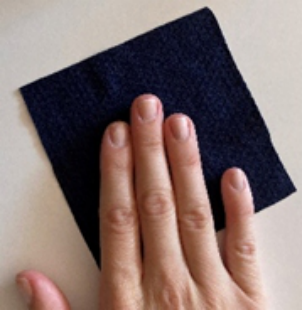
EVALUATION OF ROUGHNESS WITH PARTICIPATION OF EVALUATORS To analyse the roughness of the 14 selected materials, 25 evaluators aged 20–25 years with an average age of 23 years were recruited. The study in which the subjects participated was conducted in accordance with the approval of the Ethics Committee of the University of Zagreb, Faculty of Tex- tile Technology. Before the evaluation began, the subjects were familiarised with the purpose of the test, and the test method was explained to them. The designed materials were cut to a size of 100x100 mm and presented to each evaluator for evaluation of roughness. During the evaluation, the evaluators could see the materials (i.e. the test was not blind). The evaluators were then asked to give their rating of roughness on a smoothness-roughness scale (S-R scale) of 1-7. On the S-R scale, a score of 7 indicates the highest roughness of the material. Figure 1 shows how the material was manipulated during the evaluation.
30 Salopek ˇCubri´c et al.
Figure 1: Material manipulation during evaluation.
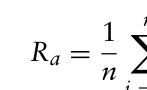
OBJECTIVE EVALUATION OF ROUGHNESS The device used to determine the roughness of the material was the PCE RT- 2000 roughness tester. The data collected by the device is determined from a graph composed of the measured length of the sample in mm and the peaks and valleys of the sample in µm. The arithmetic mean deviation of assessed profile (Ra) is the parameter that is most useful and is often used to analyse the surface structure. The absolute values of the profile variations Z1, Z2, … Zn from the mean line in the evaluation length are mathematically aver- aged to obtain this number. Ra is the widely accepted and applied roughness parameter and is generally used to assess surface roughness. It is the absolute value of the profile changes in the measurement section’s arithmetic mean. Ra is a measurable numerical number that is consistently smaller than Rz determined with the identical roughness profile. Ra is calculated as:
n X
Equation reproduced from the original PDF.Equation reproduced from the original PDF.
where n is the number of them and Zi is related to the ordinate values.
RESULTS AND DISCUSSION
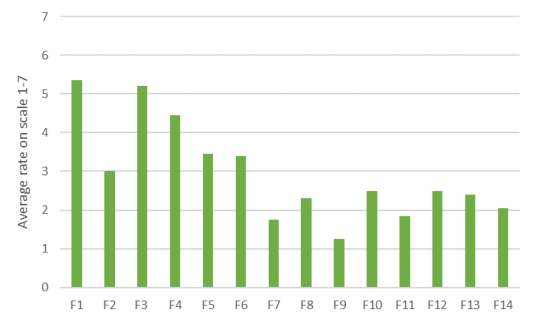
The results of the study include the assessment of roughness on a scale of 1–7 conducted by volunteers and measurements on a roughness tester. The results of the roughness assessment carried out by volunteers are shown in Figure 2. As can be seen from this figure, the average values reported by the evaluators ranged from 1.25 to 5.35, indicating that the evaluators perceived the roughness of the materials to be different. The highest value, i.e. the high- est roughness, is recorded for materials F1 and F3, both of which are 100% standard polyester materials. The lowest roughness is perceived for materi- als F7, F9 and F11, i.e. for the 100% polyester material and the polyester materials with the addition of elastane. As can be seen from Figure 2, the materials made of recycled polyester yarns are perceived as smoother than most materials made of standard polyester yarns.
Interaction of Material Design Elements for Improved Human Tactile Comfort 31
Figure 2: Average rate on the roughness scale 1-7.
From a material engineering point of view, it is important to consider the materials according to their structure (i.e. double jersey vs. interlock vs. sin- gle jersey). In this context, it becomes clear that materials produced in double jersey structure are perceived as rougher than interlock and single jersey mate- rials, while the interlock material (F7) is perceived as the second smoothest within the entirety of the designed materials. Within the group of double jer- sey materials, the roughest materials are F1 and F3, while the smoothest are F2 and F8.
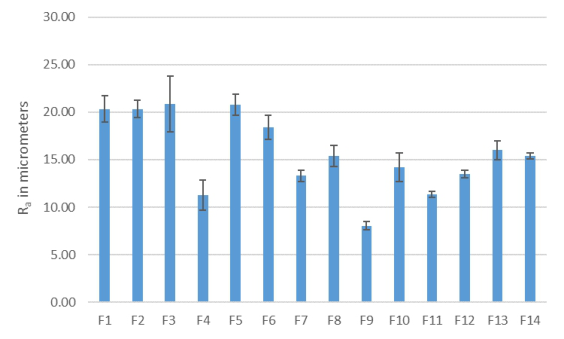
The results of the roughness test with the roughness tester in the horizontal direction of the material are shown in Figures 3 and 4. The mean values of Ra measured for the front side of the materials are in the range of 8.06- 20.86 µm (Figure 3), indicating large differences in the measured property between the observed set of materials. On average, the Ra values are lower for the materials produced with the addition of elastane.
Figure 3: Mean values of Ra measured for the front side of the materials, measured in the horizontal direction of the material.
32 Salopek ˇCubri´c et al.
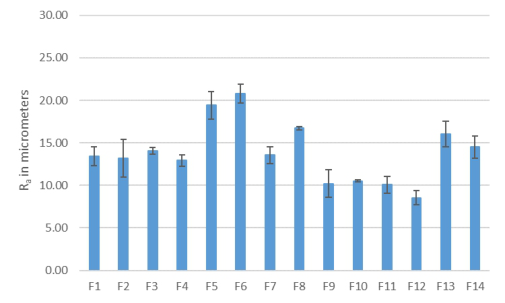
Figure 4: Mean values of Ra measured for the back side of the materials, measured in the horizontal direction of the material.
Mean values of Ra measured for the back side of the materials (Figure 4) are in the range of 8.55-20.82 µm. The highest Ra values were measured for the two materials made of standard polyester and again for the material made of recycled polyester material (F13).
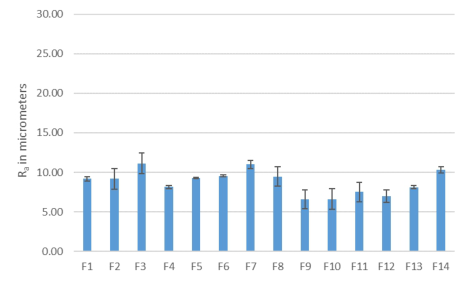
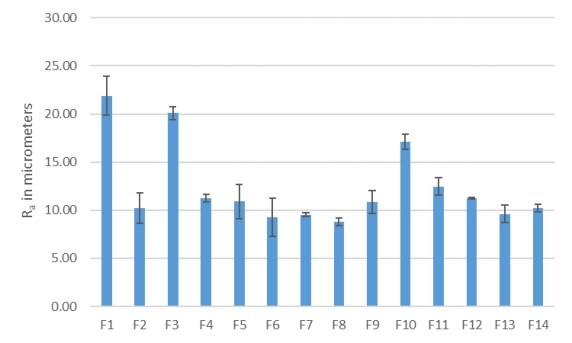
The results of the roughness tests in the vertical direction of the material are shown in Figures 5 and 6. The mean values of Ra measured for the front side of the materials, measured in the vertical direction of the material (Figure 5), are in the range of 6.59-11.13 µm. The Ra values for the measured materials are on average lower than in the horizontal direction of the materials (both on the front and back side) and the differences in the values between 14 materials are less pronounced. Only three materials have the Ra values above 10 µm and this relates to 2 materials made of standard polyester and one made of recycled polyester (all three materials without added elastane component). The mean values of Ra measured for the back side of the materials (measured in the vertical direction of the material) are in the range of 8.80-21.90 µm. The highest Ra values are measured for the two materials made of standard polyester. In contrast to the Ra values measured in the horizontal direction of the material, the Ra values of the recycled polyester materials are lower in the vertical direction of the material.
Figure 5: Mean values of Ra measured for the front side of the materials, measured in the vertical direction of the material.
Interaction of Material Design Elements for Improved Human Tactile Comfort 33
Figure 6: Mean values of Ra measured for the back side of the materials, measured in the vertical direction of the material.
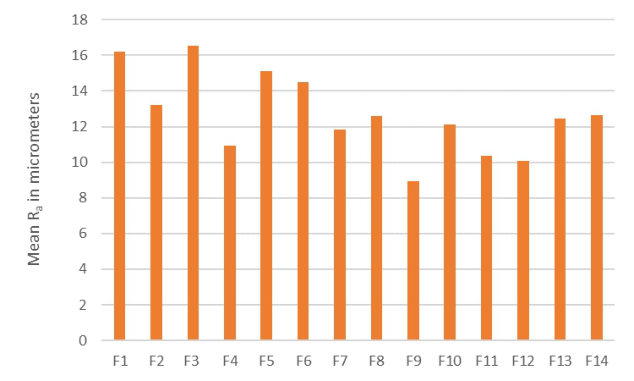
The mean values of Ra, which were determined from the results of the Ra measurement for the front and back side in the horizontal and vertical directions, are shown in Figure 7.
Figure 7: Mean values of Ra determined from all Ra results.
Both the results of the roughness evaluation by volunteers and the results of the mean roughness (Ra value) indicated that materials made of 100 % polyester materials on average have a higher average roughness than those with the addition of elastane. The correlation between the evaluators’ ratings (S-R), and mean values of Ra is moderate with a correlation coefficient of 0.651 (Table 2). It is interesting to note that through objective measurements (with a roughness tester), we found that material F9 was the smoothest, and that the evaluators also rated the same material as the smoothest. The same
34 Salopek ˇCubri´c et al.
was observed when evaluating the roughness of the material. According to subjective and objective measurements, the roughest material is F1 and F3. This indicates that the rates given by evaluators may be considered as reliable for the observed property of roughness. Furthermore, the results showed that evaluators perceived even greater differences in terms of material roughness between the materials compared to the instrumental method (i.e. compared to the mean Ra value). This suggests that the human factor is an important segment in the evaluation of material attributes. Furthermore, these results highlighted the need for additional efforts in material engineering, as the fact that the differences between materials need to be recognised by consumers at a relatively small level. If the evaluators who participated in this study acted as purchasers/consumers of sportswear, the choice would be directed towards materials made with added elastane in terms of the observed prop- erty, whereby recycled materials would not take a back seat compared to standard polyester materials.
Table 2. Correlation between the results of evaluation and instrumental testing.
The aim of this study was to determine the effect of material engineering on the human perception of the tactile attribute of the material (i.e. the fab- ric hand), more specifically the fabric roughness. Moreover, this study was focused at the comparison of the outcomes of subjective and objective evalua- tion of roughness. The results show that the differences between the designed materials in terms of observed attributes is significant, suggesting that the human factor is an important segment in the evaluation of material attributes. This leads to the conclusion that the selection of an unsuitable material from the group of materials analysed should lead to an unsatisfactory comfort level and possibly to a less successful performance of an athlete. The results of the used methods showed a fairly high correlation between the evaluators’ rat- ings and the outcomes of the instrumental measurements. The results of this study can be considered useful for the sportswear market segmentation, and the further development of sportswear targeting specific athlete profiles.
ACKNOWLEDGMENT
This research was fully funded by Croatian Science Foundation, grant num- ber IP-2020-02-5041 “Textile Materials for Enhanced Comfort in Sports” - TEMPO.
Interaction of Material Design Elements for Improved Human Tactile Comfort 35
REFERENCES
ˇCubri´c, Goran. Salopek ˇCubri´c, Ivana and Bojko, Andrea. (2023) “Evaluating the tactile comfort of knitted sportswear depending on the gender of the participants”, proceedings of the 9th International Ergonomics Conference. Zagreb, Croatia. Dabolina, Inga. Abu-Rous, Mohammad and Lapkovska, Eva. (2022). A Fast Train-
ing Method of a Fabric Hand-Feel Panel under Industry Conditions, and Its Conformity with Other Human and Instrumental Approaches, Applied Science, Volume 12, No. 23. Harpa, Rodica. Piroi, Cristina. Cristian, Irina. Visileanu, Emilia and Blaga, Mirela.
(2019). Sensory analysis of textiles: Case study of an assortment of stretch denim, Industria Textila, Volume 70, No. 4. Ishikawa, Tomoharu. Tsunetou, Junki. Yanagida, Yoshiko. Yanaka, Mutsumi.
Mitsui, Minoru. Sasaki Kazuya and Ayama Miyoshi. (2023). Differences in fabric hand perceptions among Japanese and Chinese individuals, International Journal of Clothing Science and Technology, Volume 35, No. 3. Salopek ˇCubri´c, Ivana. ˇCubri´c, Goran and Majumdar, Abhijit. (2023). Sensory Attributes of Knitted Fabrics Intended for Next-to-skin Clothing, JOURNAL OF THE TEXTILE INSTITUTE, Volume 114, No. 5. Salopek ˇCubri´c, Ivana. ˇCubri´c, Goran and Perry, Patsy. (2019). Assessment of Knit-
ted Fabric Smoothness and Softness Based on Paired Comparison, Fibers and Polymers, Volume 20, No. 3. Takasaki, Midori. Sakurai, Masanao. Oomori, Atsushi. Watanabe, Souta. Nishikawa, Shigekazu. and Miyake, Hajime. (2020). Relationship between Sub- jective and Objective Evaluations of Knitted Fabrics for Summer Garments, Journal of Fiber Science and Technology, Volume 76, No. 1. Tadesse, Melkie Garnet. Harpa, Rodica. Chen, Yan. Wang, Lichuan. Nierstrasz, Vincent and Loghin, Carmen. (2019). Assessing the comfort of functional fab- rics for smart clothing using subjective evaluation, Journal of Industrial Textiles, Volume 48, No. 8.
LISTED IN THE AHFE DIGITAL BOOKSTORE CATALOGUE
Explore the complete digital volume
Human Factors for Apparel and Textile Engineering
Read this individual research paper free through the original publisher, or explore the full digital proceedings book.
ISBN 978-1-964867-10-6
Explore this ISBN in the AHFE Bookstore ↗Listed in the July 2026 bookstore catalogue; search by ISBN to confirm current availability · Digital book purchase optional