Christian Vocke, Wilhelm Bauer, Carmen Constantinescu, Daniela Popescu (2023). Hybrid Intelligence - how to gain competitive advantages and process innovations in challenging times. In: Creativity, Innovation and Entrepreneurship. AHFE Open Access, vol. 74, pp. 79–85. https://doi.org/10.54941/ahfe1003308
Current influences such as the Corona pandemic, war in Ukraine and the resulting energy crisis, delivery and supply bottlenecks, and climate change are calling on the state, society, and business to deliver cooperative and sustainable concepts in response. In addition to developments in the areas of demography and decarbonization, in particular potentials of internal as well as cross-company digitalization of processes and structures lead to a profound transformation of our working world. Promising innovations are also promised by hybrid AI approaches, new network architectures and AI simulations using quantum computers. The presentation will show how hybrid AI methods can be used to combine the knowledge and experience of experts (e.g., specialists) with data-based approaches that use machine learning methods to analyze statistical correlations and derive recommendations for new business models and forms of human-machine interaction for process optimization.
“AI becomes the new electricity”(Jahn, 2023). Currently there are many such titles with superlatives. Now – after decades of recurring hypes in terms of AI – the tipping point of AI seems to be here.
According to a recent survey conducted by Bitkom (data based on a total of 1,007 people aged 16 and over interviewed by telephone.) in Germany around three quarters of Germans (73 percent) now believe that AI is an opportunity. Expectations for AI are high among the population, with 8 in 10 (79 percent) convinced that AI will strengthen the competitiveness of the Ger- man economy – up from 66 percent three years ago. Two-thirds (66 percent) now want AI to be used when the technology brings them concrete benefits, for example in medicine or transport. And around half (51 percent) say they already regularly use AI-based products and services in their everyday lives,
such as voice assistants. Around a third (35 percent) (still) fear that humans will be disempowered by machines.
Advances and the increasing application of cognitive systems will also be of central importance in the future according to the Gartner Hype Cycle Emerging Technologies 2022 focusing on three main topics (Perri, 2022):
Tools for optimized technology delivery (e.g., cloud data ecosystems, platform engineering, open telemetry),
further development/extension of immersive experiences (e.g., Digital Twin of a Customer DToC) and especially
accelerated automation through AI (e.g., AI applications for AI model development and training).
TOWARDS A HYBRID COGNITIVE WORLD “In fewer than 70 years, AI has evolved from a scientific concept to a societal constant.” (Guan et al. 2022) – and also for our economic activity and our working world.
Example ChatGPT The success of ChatGPT – a chatbot from the US company OpenAI that can create dialogues or texts resembling those of humans based on AI – hints at the evolution we are facing. For example, ChatGPT can be used to perform the following tasks:
ChatGPT writes a text on any topic on command – in seconds and delivering academic-level essays.
The tool can set up contracts – a few instructions in colloquial language are enough.
It also writes computer programs on its own – the user only must outline what it should be able to do.
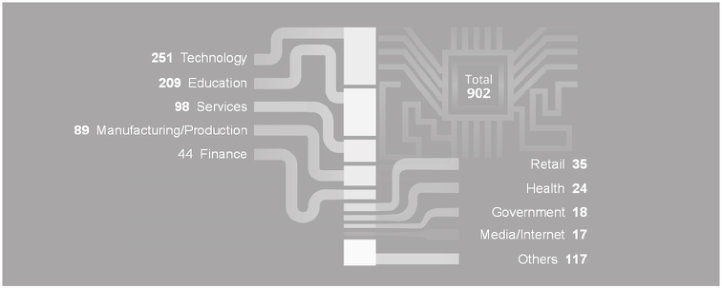
Figure 1: Number of companies and organizations worldwide using OpenAI products (OpenAI is an AI company from the USA, among others ChatGPT) by industry.
Hybrid Intelligence – How to Gain Competitive Advantages 81
And software from OpenAI is already being used by hundreds of compa- nies worldwide especially in the technology and education industries. This is shown by data published by the enterprise software platform Enterprise Apps Today. Less widespread are OpenAI applications in governments, the media, and – omitted from the chart due to space constraints - the hospitality industry, law firms, and the cultural sector (Janson, 2023).
In addition, there are a variety of other tools based on AI used across organizations being implemented in a wide range of domains and industry processes.
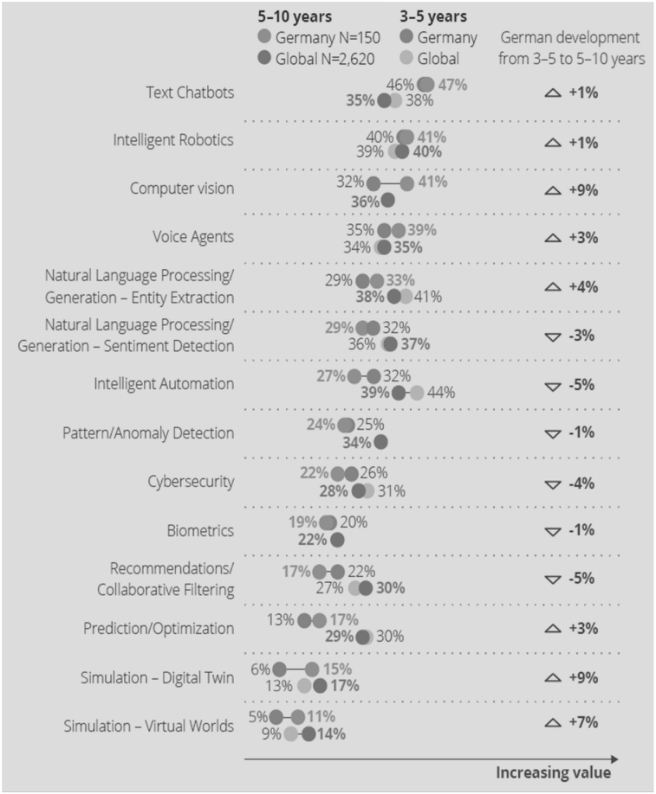
Industry-specific insights and detailed case studies can be found in Deloitte’s global State of AI in the Enterprise where respondents were asked to rank the AI applications that will drive the most value over the next 3–5 years and 5–10 years, (Bringmann et al. 2022):
Figure 2: AI applications driving the most value over the next 3–5/5–10 years.
It becomes evident that German respondents see chatbots as the main value driver and expect a large increase in value creation through computer vision in the coming years. The value drivers reported globally, on the other hand, are more evenly spread across multiple applications, such as intelligent robotics, intelligent automation, and natural language processing.
Technical Limitations of AI at the Workplace Across the vast range of real-world usage scenarios, there have been far more instances of augmentation of human work by smart machines than of full automation – and that scenario is expected to continue for the foreseeable future.
AI systems may perform well in the research lab or under highly controlled application settings, but they still needed human help in the types of real- world work settings. For the moment, however, it is important not to expect more of AI than it can deliver although the systems are more and more opti- mized or are able to improve themselves. Some of the important limitations are described (see below Table 1) (Davenport and M. 2022): The AI revolution therefore is going differently than expected: Programs like ChatGPT are still in their beginning – but the goals of companies like OpenAI are aiming at creating computer programs that can learn any task. AI rather can be understood as a tool to drive forward processes and tasks involving knowledge, language and creativity.
Oliver Brock, professor at the Robotics and Biology Laboratory and spo- kesman for the “Science of Intelligence” cluster at the Technical University of Berlin, does not see ChatGPT as a “breakthrough” in artificial intellige- nce research. For one thing, he says, development in this field is not erratic but continuous. For another, the project represents only a small subset of AI research. ChatGPT, however, could be considered a breakthrough in another area, namely the interface between humans and the Internet (IDG Tech Media GmbH. 2023).
Management Challenges Beyond Technology “Many employees simply don’t know whether AI will do them more harm or good. Employers should address this uncertainty, address existential fears, and look together at what AI means for their own jobs.” (Rickens, 2023).
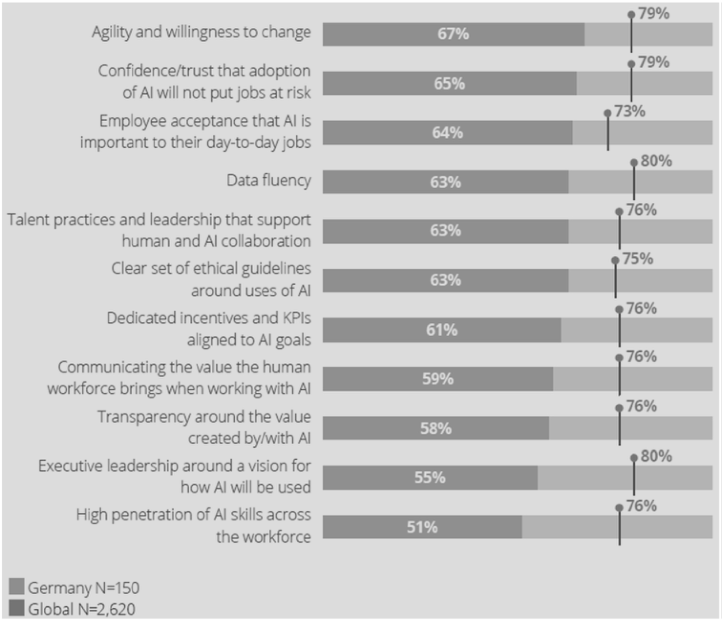
This statement illuminates that AI requires more than data mastery: Com- panies also face many managerial challenges in introducing AI into their organizations which are basically the following: Develop an intuitive under- standing of AI, organize for AI and re-think the competitive landscape. Thus, integrating the capabilities of humans and machines is a looming issue (Ran- sbotham et al. 2017). To this end, cultural initiatives and in this context especially the agility and willingness to change, confidence respectively trust and employee acceptance, are of central importance (Bringmann et al. 2022): However, a recent representative online survey conducted by the Civey Institute shows: Germans are by no means unanimous in seeing the AI revo- lution as the major threat it is often portrayed to be. Accordingly, a majority of 57.8 percent believe “definitely not” or “rather not” that their jobs could
Hybrid Intelligence – How to Gain Competitive Advantages 83
Table 1. Selected limitations of AI at the workplace.
Table available in the original PDF paper.
Limitation Explanation Creating new knowledge and transferring it to a system Need for humans to create new knowledge before it can be transferred to an AI system for AI won’t be able to extract and appropriately organize work-relevant knowledge from experienced human brains anytime soon. Evaluating and choosing the very best option
AI is good at taking an initial stab at a decision, but when that decision is consequential, humans often need to weigh in and make a final judgment. Framing problems, and then training and coaching
AI can’t frame the problem to be solved in the first place or find data to address that problem. Understanding context AI doesn’t yet understand the broader context in which the business and the task to be performed are taking place. Understanding emotional situations and needs
AI systems can AI systems can provide recommendations but are unable to consider emotional needs related to special occasions.
Figure 3: Cultural initiatives (“extremely important”/”slightly important”).
be threatened by AI. “Yes, definitely” or “rather yes” answered 23.9 percent. The rest are undecided.
HYBRID INTELLIGENCE – FOSTERING PROCESS AND BUSINESS INNOVATIONS ON THE BASIS OF AN INTEGRATED METHODOLOGY Against the background of the previous remarks, it has to be noted that humans will not become superfluous. Thus, many human skills such as communicating with colleagues and customers, gaining trust and confidence or acting empathically will not be mastered by machines in the foreseeable future.
Creative algorithms will primarily take on working tasks like searching for and sorting information, summarizing, or translating texts. Furthermore, the central added value of cognitive systems lies in the design of new forms of human-machine interaction helping to make decisions or to generate new products, services or business models.
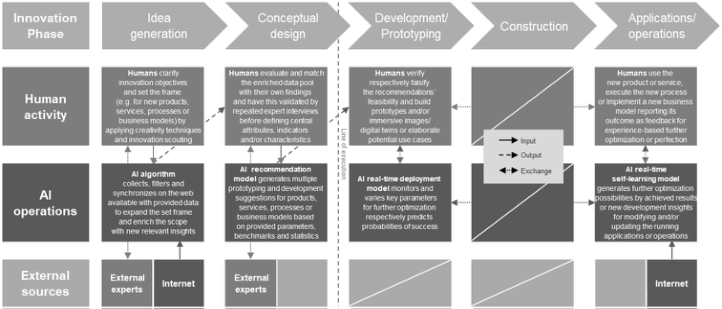
In order to enable companies to achieve competitive advantages and pro- cess innovations an integrated methodology has been developed (cf. also Vocke and B. 2022) combining human and artificial intelligence in means of co-creation that can be applied in different phases of the innovation process: The heart of this holistic methodology consists of the permanent human-machine interplay leading to in-depth knowledge about inten- ded developments, solutions and strategies. For this purpose, the combination of human skills and experiences, the application of creati- vity techniques and AI machine learning models is the crucial key for success.
In the coming years, machines will become increasingly creative and develop into indispensable sparring partners for humans – especially in companies. Artificial intelligence will provide the competitive edge in many organizations in the future with its ideas. The so-called generative AI will revolutionize knowledge work. The sooner you explore the opportunities, the better. “We will have to work less than we do today” (Matthes, 2023) – and beyond that: we will be more productive than ever before.
Hybrid Intelligence – How to Gain Competitive Advantages 85
REFERENCES
Bringmann, Björn. Beierschoder, Marc. Esser, Ralf. Fach, Peter. Göckelmann, Stella and Wendland, Philipp. (December 2022). Fueling the AI Transformation – Four Key Actions Powering Widespread Value from AI, right now in Germany. Deloitte’s State of AI in the Enterprise | 5th Edition report | German Cut. Deloitte Website: https://www2.deloitte.com/de/de/pages/trends/state-of-ai-in-the-enterpr ise-2022.html Davenport, Thomas H. and Miller, Steven M. (October 5, 2022). What Machines
Can’t Do (Yet) in Real Work Settings. MITSloan Management Review Web- site: https://sloanreview.mit.edu/article/what-machines-cant-do-yet-in-real-work -settings/ Guan, Lan. Roussiere, Philippe. Vasal, Ajay. Vohra, Sanjeev. (2022). The Art of AI Maturity – Advancing from Practice to Performance (Accenture Report Presentation) IDG Tech Media GmbH. (January 31, 2023). “Die Schwachstellen von ChatGPT”.
CIO Website: https://www.cio.de/a/die-schwachstellen-von-chatgpt,3704267 Jahn, Thomas. (January 27, 2023). “KI wird die neue Elektrizität”. Han- delsblatt: https://www.handelsblatt.com/meinung/kommentare/kommentar-zu-c hatgpt-ki-wird-die-neue-elektrizitaet-/28943632.html Janson, Matthias. (February 6, 2023). Künstliche Intelligenz – Wo OpenAI-Software bereits im Einsatz ist. Statista GmbH Website: https://de.statista.com/infografik/ 29240/zahl-der-unternehmen-und-organisationen-die-openai-produkte-nutzen/ Matthes, Sebastian. (February 14, 2023). “Wir werden weniger arbei- ten müssen als heute” (Interview mit Bill Gates). Handelsblatt Website: https://www.handelsblatt.com/politik/international/microsoft-gruender-im-inter view-bill-gates-wir-werden-weniger-arbeiten-muessen-als-heute/28973628.html Perri, Lori. (August 10, 2022). What’s New in the 2022 Gartner Hype Cycle for
Emerging Technologies. Gartner, Inc. Website: https://www.gartner.com/en/article s/what-s-new-in-the-2022-gartner-hype-cycle-for-emerging-technologies Ransbotham, Sam. Kiron, David. Gerbert, Philipp and Martin Reeves, Martin.
(2017). Reshaping Business With Artificial Intelligence – Closing the Gap Between Ambition and Action. (September 6, 2017). MITSloan Management Review Web- site: https://sloanreview.mit.edu/projects/reshaping-business-with-artificial-intell igence/ Rickens, Christian. (February 3, 2023). “Revolution: Künstliche Intel- ligenz erobert die Wissensarbeit”. Handelsblatt Morning Briefing: https://www.handelsblatt.com/meinung/morningbriefing/morning-briefing-re volution-kuenstliche-intelligenz-erobert-die-wissensarbeit-/28961500.html Streim, Andreas and Uhl, Merle. (February 23, 2023). “Drei Viertel sehen Künstliche Intelligenz als Chance” (Bitkom Newsletter). Vocke, Christian and Bauer, Wilhelm. (2022). “Status Quo and Quo Vadis: Crea-
tivity Techniques and Innovation Methods for Generating Extended Innovation Processes”, in: AHFE International, Human Factors and Systems Interaction, Vol. 52, 2022, pp. 373–379 (https://doi.org/10.54941/ahfe1002178).
LISTED IN THE AHFE DIGITAL BOOKSTORE CATALOGUE
Explore the complete digital volume
Creativity, Innovation and Entrepreneurship
Read this individual research paper free through the original publisher, or explore the full digital proceedings book.
ISBN 978-1-958651-50-6
Explore this ISBN in the AHFE Bookstore ↗Listed in the July 2026 bookstore catalogue; search by ISBN to confirm current availability · Digital book purchase optional