“A technique for producing ideas” (James Webb Young,1940) has been a bible for advertising people since its publication. It says, “An idea is nothing more nor less than a new combination of old elements.''(P.15) It also says, “ An idea is a new combinations”.(P.20). But it never mentions how you can combine ideas with an excuse: “This part of the process is harder to describe in concrete terms because it goes on entirely inside your head.”(P.20) Another well known technique for idea producing is the “KJ method”(Jiro Kawakita,"Abduction”1967). It is an approach to find ideas by organizing ideas and it doesn't explain how you can produce ideas by combining elements.Now we are in an era where creation is the important drive force of economic activities in our society and creation is producing ideas. But still the process of producing ideas is in the veil. I am a film director, educator, as well as management consultant. Many of my students and clients need to find an idea with an objective such as career goal, new business idea, project idea. When I help them, I often deploy techniques I use for developing movie projects. I realized I always go through the same path with them. So I developed the “SA method” based on the path I always go through with my students or clients. I am now developing a software application based on the method.Combining two ideas is not so difficult but combining three ideas is extremely difficult. “SA method” helps people to produce ideas by combining three elements. “SA method” assumes an idea with three elements must be a “synthesis” produced by an aufheben in dialectic development with two elements. And each of three elements must be a synthesis produced in dialectic development with the rest respectively. When an idea is produced with three elements, the dialectic is revolved with the same three elements so that the idea is kneaded. “SA method” also has a process of quantifying it and describing it, which not only helps to ferment ideas in mind but also helps to select ideas at each proper timing. This selection also helps to separate the idea generation stage and the idea selection stage. According to my observation, people, who are not good at producing ideas, don’t know the importance of the separation. The SA method is a unique combination of practical and original use of dialectic development and Analytical Hierarchy processing.I conducted pilot tests with 35 undergraduate students at Utsunomiya University and 6 undergraduate students at Chuo University in November of 2021 to find their career goal using the SA method. During the trial, some people had difficulties producing 25 ideas. There may be some reasons such as not being accustomed to generating ideas and “SA method”, and 25 was an unnecessarily large number. Also they didn’t have enough time to search for information about their career development.We are now considering how to refine the methodology. Also, we have started to develop a Web based tool or PC application to work with the “SA method” visually. I would like to conduct further research projects such as comparing “SA method” with “KJ method” while refining the method.
Generating ideas is vital to economic activities. People need to generate ideas for various purposes, such as business, creative work, and career design. The first author of this paper now works as a film director and writer, but he also has been involved in many fields: management consulting, education, entrepreneurship, and advertising. It appears to be very diversified fields, but essentially the core of his activities in each field is the same: producing ideas. Through the various experiences, he developed a unique idea genera- tion method for himself. This methodology is not only for his work but also for students and clients. He had a business coach as a client and developed the SA method based on what he had been doing subconsciously so that anyone could do the same work as he would do for students and clients.
In this paper, we explain the flow of the SA method in section 2 and present the comparison with other idea creation methods in section 3. In section 4, we explain the research methodology. Then the result of a pilot project of the SA method with 45 engineering major students of Utsunomiya University and six economics major students of Chuo University is explained in section 5. At last, we conclude this paper and explain the further studies such as further improvement in its application.
THE SA METHOD The SA method assumes an idea with three elements must be a “synthe- sis” produced by an “aufheben” in dialectic development with two elements. “Aufheben” is defined as follows in the Oxford Dictionary of Philosophy; “In the philosophy of Hegel, dialectical progress occurs when each of a the- sis and its antithesis are aufgehoben, or overcome by a synthesis that builds only on the good bits of each.” Combining two elements to generate ideas is a commonly used approach and nothing new. However, the SA method helps people generate ideas by combining three elements. When people combine two elements, it already has three elements when they generate an idea by combining two elements.
In most cases, people are unaware of the existence of the third element. Any ideas generated by combining two elements will be used or not used. If a user counts the criterion used as an element, any ideas generated by dialectic development must have the third element.
The SA method assumes each of those three elements must be a synthe- sis produced in dialectic development with the rest respectively. In the SA method, the dialectic development is revolved around the same three elements so that the idea is kneaded. The SA method also has steps of quantifying and describing the idea. These steps help to ferment ideas in mind. This selection also helps separate the idea generation and the idea selection stages. If peo- ple do the two stages simultaneously, they often face difficulties in producing ideas. According to our observation, people, who are not good at producing ideas, do not know the importance of separation. The SA method is a unique combination of the practical and original use of dialectic development and Analytical Hierarchy processing.
COMPARISON WITH OTHER METHODS “A technique for producing ideas” (James Webb Young, 1940 [1]) has been a bible for people in advertising industry since its publication. It says, “An idea is nothing more nor less than a new combination of old elements.” However, it never mentions how you can combine ideas with an explanation: “This part of the process is harder to describe in concrete terms because it goes on entirely inside your head.” although it introduces five steps: “First, the gathering of raw materials”, “Second, the working over of these materials in your mind”, “Third, the incubating stage, where you let something besides the conscious mind do the work of synthesis”, Fourth, the actual birth of the Idea—the “Eureka! I have it!”, and “Fifth, the final shaping and development of the idea to practical usefulness.”
Another well-known technique for idea creation is the KJ method intro- duced by Jiro Kawakita in his book “Hasso-hou” (Abduction) in 1967 [2]. It says, “This abduction method was originally developed for field research. Especially for the issues you encounter when you try to let the data speak by itself as an enlightened summary based on the data you gathered by your observation.” So, the KJ method is not an approach to help people to use dialectic development.
A Novel Idea Generation Method, “SA method” 149
On the contrary, the SA method is a unique approach to help people to find ideas with three elements by revolving dialectic development so that peo- ple can combine multiple elements. The dialectic development is often used consciously or subconsciously to combine two elements for producing ideas.
However, we realized there is always a hidden third element because people generate ideas by combing two elements because they always pick ideas based on some sort of value(s). If the value(s) as an element is counted, it is the third element because the final ideas people use must have at least three elements: thesis element, anti-thesis element, and synthesis element.
The SA method is an approach to generate ideas by revolving those three elements consciously. The SA method also has kneading processes utili- zing Analytical Hierarchy Processing (AHP), which helps people to connect multiple elements in their mind.
The SA method is similar to the approach suggest by “A technique for producing ideas” but it is different in utilizing quantitative decision-making approach of AHP and qualitative approach by describing to knead ideas con- sciously in addition to utilizing dialectic development by revolving with the third element.
RESEARCH METHODOLOGY We conducted a pilot project to evaluate effectiveness and usability of the SA method. We recruited 51 participants: 45 third year engineering major Japanese students at Utsunomiya University and 6 first year economics major undergraduate multinational students at Chuo University.
With this pilot project, we requested the students to find their career goals using the SA method application. We modified the dialectic development for the purpose with specific three elements: “Personal Uniqueness/Strength” “Income”, and “Social Contribution” to revolve as thesis element, antithesis element, and synthesis element respectively in each of three dialectic deve- lopment. Participants were also provided with following steps with spread sheet so that they can do necessary calculation easily.
Step 1. Generate 25 ideas by connecting 5 ideas with ”your strength/unique- ness” point of view and 5 ideas with “income” point of view. Then, evaluate the 25 ideas with “social contribution” point of view in 0-10 scale and select the top 10 ideas.
Step 2. Generate 25 ideas by connecting 5 ideas with ”social contribution” point of view and 5 ideas with “your strength/uniqueness” point of view. Then, evaluate the 25 ideas with “income” point of view in 0-10 scale and select the top 10 ideas.
Step 3. Generate 25 ideas by connecting 5 ideas with ”income” point of view and 5 ideas with “social contribution” point of view. Then, evaluate the 25 ideas with “your strength/uniqueness” point of view in 0-10 scale and select the top 10 ideas.
Step 4. List 30 ideas obtained from step 1-3. Decide each weight of “your strength/uniqueness”, “income”, and “social contribution”. Also decide each idea’s score in three categories in 0-10 scale. Then calculate weighted sum for each idea using a spread sheet.
Step 5. Select the top3 ideas based on the score by weighted sum and pick the one following his/her feeling.
For the 45 students at Utsunomiya University, basic explanation about dialectic development was given in their classroom online by the third author and the students were asked to work on the above steps with “filling in” instruction on a google form and the spread sheet with calculation formula. The students are given a week to finish their tasks. For the 6 students at Chuo University, the first author gave instruction in English participating in their class online and remotely gave instruction on how they can use the SA method with google form “filling in” instruction and the spread sheet with calculation formula. And then, they are also given a week.
After they picked their best idea, we asked them to answer three questions by 1–10 Likert scales and asked them to add some comments.
1. Are you happy with the result? 2. Did it help you to have clearer idea? 3. Do you think you can utilize this method for other purposes besides career goal?
RESULTS
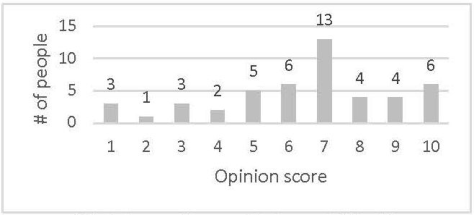
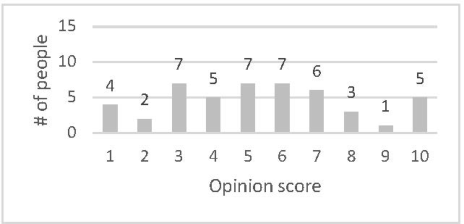
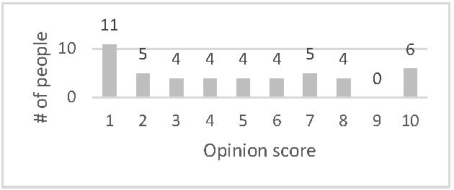
Figures 1–3 show the results of the questionnaire after the work. 45 stu- dents of 45 students completed the questionnaire at Utsunomiya University. 2 students of 6 completed the questionnaire. Responses in two universities are aggregated for all three figures. The x-axis shows the score for each que- stion, and the larger score means the better evaluation. The y-axis shows the number of participants. Table 1 shows the average and standard deviation of the score.
Participants’ responses are widely dispersed. Here is the qualitative analy- sis of additional comments. Many students had difficulty producing 25 ideas for each phase because it was too painstaking. However, some people appreci- ate the SA method as a solid way of producing ideas and thinking through the issues step by step. The kneading process utilizing AHP is working well, and the decision-making method is interesting for some students. This method helps students expand their list of ideas, and some students come up with a career goal they never thought.
Moreover, a few picked up such career goals as their final career goal in this pilot project. The SA method is very new to all students. A student suggested the possibility of using the SA method in a group work. Another student suggested that having input from his friends, brothers, and parents could be helpful.
A Novel Idea Generation Method, “SA method” 151
Figure 1: Are you happy with the result? (n=47).Figure 2: Did it help you to have clearer idea? (n=47).Figure 3: Do you think you can utilize this method for other purposes besides career goal? (n=47).Table 1. Average score and standard deviation (n=47).
Table available in the original PDF paper.
Question Average S.D.
Are you happy with the result? 6.43 2.46 Did it help you to have clearer idea? 5.34 2.56 Do you think you can utilize this method for other purposes besides career goal? 4.68 3.08
CONCLUSION
This paper presents the outline of the SA method, a novel idea generation method, and the evaluation result. Although some participants appreciate the method, average scores are medium or relatively low. Followings are the future tasks for improving the SA method.
Firstly, the SA method is developed by a person in the advertising industry to generate ideas for various issues such as film ideas and business ideas. In the advertising industry, the idea is everything. People spend billions of dollars on advertisements. People in the advertisement industry generate hundreds of ideas overnight for their clients. However, the students who participated in this project did not have the experience. So, it is quite natural for them to feel the SA method is painstaking. It might be better to reduce the number of ideas to produce each phase.
Secondly, we did not provide enough material search opportunities in this pilot project. If good instructions on how students should do material search, it could be a different experience. A well-designed instruction design with a phase of material search could improve the SA method significantly.
Thirdly, if students work with the SA method over a longer period, it could be very different. A career decision is a serious matter for students, and students probably want to have more than a week.
Lastly, the necessity and motivation for students to use the SA method vary depending on the individual. When the students need to generate ideas, they probably utilize the SA method most.
The SA method is still embryonic, and further refinement is needed with more pilot projects such as with students who major in film. It is interesting because the author developed this method for his film. However, more pilot projects should be conducted with students and people working in society to make this method widely used.
REFERENCES
James Webb Young: A technique for producing ideas, pp. 15–23, (1940). Jiro Kawakita: Hasso-hou (Abruption), pp. 13–14, kindle version (1967). (in Japanese).
LISTED IN THE AHFE DIGITAL BOOKSTORE CATALOGUE
Explore the complete digital volume
Affective and Pleasurable Design
Read this individual research paper free through the original publisher, or explore the full digital proceedings book.
ISBN 978-1-958651-17-9
Explore this ISBN in the AHFE Bookstore ↗Listed in the July 2026 bookstore catalogue; search by ISBN to confirm current availability · Digital book purchase optional