After COVID-19, people are interested in healthcare, so the market for health tourism is increasing. Forest bathing is one of the attractive activities during a trip. To provide tourists with information on the healing effects of forest bathing, we are researching to clarify the questions of "What exactly are the effects of forest bathing, and what causes the healing effects? and "How can we optimally present tourist information on the healing effects? By building a generic model of technology for providing information on forest bathing through experiments in Oku-Nikko, we aim to spread our research results to the health-oriented society. In recent years, research on the default mode network, the idle state of the brain, has been progressing. It has been reported that during meditation and other tasks with low cognitive load, a state of mind wandering occurs, in which attention is directed not to events in the external environment but to one's internal self, and one thinks about various things in a hazy way. It has also been reported that the default mode network, which consists of multiple memory areas in the brain, is activated during mind wandering, and it has been pointed out that this activation may connect memories in various brain regions under conscious awareness, facilitating creativity. In forest bathing, people are relaxed with low cognitive load, which is thought to facilitate the activation of the brain's default mode network, and thus, benefits such as increased creativity can be expected. In this presentation, we will describe the results of our investigation into the relationship between forest bathing and the default mode network, and in particular, whether forest bathing activates the default mode network.
Although restrictions on movement have been requested due to the spread of COVID-19, people are gradually returning to tourist destinations as vac- cination progresses. According to “COVID-19 and Transforming Tourism” (UNWTO 2020), after COVID-19, tourism in nature and with small numbers
of people is recommended. In addition, the digitalization of the tourism ecosystem is recommended. In Japan, Minister of Environment Koizumi proposed “GoTo National Park (Minister of Environment, 2020)” to enjoy nature while avoiding three densities. In 2018, the national government will launch a “health tourism certification system,” and in the years before the Corona disaster, it is expected that the number of tourists will increase. According to the Global Wellness Tourism Economy (Global Wellness Insti- tute, 2018), the global tourism market is expected to grow from about $639 billion in 2017 to $919.4 billion in 2022, mainly in Asia and the Middle East. When it comes to health tourism in Japan, forest bathing is a prime exam- ple. Also, mindfulness tourism is becoming popular, such as in Thailand (The Mindful Tourist, 2020).
We have been researching the development of tourism resources using ICT in the Nikko region, and we would like to contribute to the development of tourism, including health tourism, in the future. There are two questions.
(Question 1) What are the effects of forest bathing, and what brings about the healing effects?
(Question 2) How can we best present tourism information on healing effects?
We plan to elucidate these issues with neuroscience and psychology and conduct research that will lead to tourism support compatible with the increasing health consciousness after COVID-19. In particular, from a neu- roscientific point of view, some studies have shown that activation of the default network is effective for relaxation and new ideas, and we would like to verify this in the actual field.
RELATED WORKS The amount of cortisol is often used to measure the effect of forest bathing (Nei et al., 2009). However, even if the effect as an area is known by using cor- tisol, it is not easy to provide pinpoint information on which place and how much relaxation effect is good, for example, near a waterfall here or there, or under this huge tree. Recently, research on the default mode network, an idle state of the brain, has progressed (Koizumi et al., 2020). When we feel relaxed by taking a forest bath, for example, and pay attention to our inner world, a state of mind-wandering (in which you think about many things in a daze) is created, which is expected to activate the default mode network. As a result, it is expected that memories in various parts of the brain under the conscious mind will be connected, and the brain will be in a state that facili- tates creativity (Hasenkamp, Wilson-Mendenhall et al., 2012), (Hasenkamp and Barsalou, 2012). What is the actual situation (Ikegaya, 2005)?
Is it only in the great outdoors or in places like shrines and temples that we can feel healing? What is the relationship between zazen, meditation, and forest bathing? The Buddha attained enlightenment in the forest, under the Bodhi tree. Also, it is said that ideas come to us on our pillows, one after another in our dreams, and when we wake up in the morning, we have completely forgotten about them, but sometimes something triggers us to remember them. The actual forest and various urban and linguistic land- scapes may contribute to such an effect. If forest bathing or strolling promotes
Effect of Forest Bathing for Mindwandering 175
an activated state of the default mode network, we can measure its effects by continuously measuring EEG and whether there are differences between locations.
Therefore, we thought that if we could measure the effect of forest bathing in real-time, along with location information, during a walk in Senjogahara, it would be possible to show visitors where the relaxing effect of forest bathing is strongest, and also to examine what factors bring about the relaxing effect.
There is no research linking the healing effects of forest bathing and power spots with brain activity, and we decided to start this research and develop- ment to support tourism that meets the growing health consciousness after COVID-19.
EXPERIMENT Outline
We performed the experiment twice, on November 3rd and 5th, 2023, at Senjogahara with nine students and one faculty member (Nov. 03). Seven students and three faculty members (Nov. 05). Weather conditions on Nov. 03 were fine and warm (17.8 degree Celsius at noon, and Nov. 05 was cloudy and cold (11.8 degree Celsius at noon).
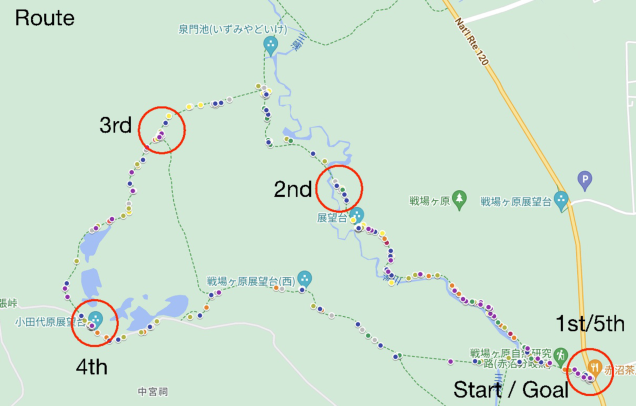
We walked a hiking route, and we measured brainwaves and corrected answers to questions relating to mind-wandering three times (Start, Middle, and Goal, Nov. 03) and five times (Start, Middle-1,2,3, and Goal, Nov. 05). The route is shown in Figure 1. The questionnaires are shown in the next subsection.
Questioners We prepared two questionnaires as follows to measure the status of mind- wandering. We asked five times during hiking in Senjohgahara.
Questioner-1 (free answer): Please write in sentences what was on your mind or thoughts while walk- ing during this survey, not words. If there is more than one, please try to recall as much as possible. Please write what you thought while walking, not your impressions of the survey. For example, about yourself, others (family, friends, etc.), home, school, past, future, etc.
Questioner-2 (6 questions, answered by 6 level RUMINATION SCALE (Bar, Moshe, 2022; Wendy Treynor et al., 2003); 1: almost never, 6: mostly always): (1) Has difficulty staying focused on simple or monotonous tasks (2) While reading a document, book, etc., I find myself thinking about something else, or dillydallying, and then going back to read it again (3) Not paying enough attention to do things (4) Listening to others and finding yourself thinking about something else (5) Thinking about something else while working or in class.
Figure 1: Route and the points where answering questioners.
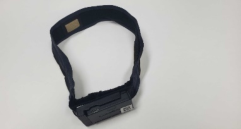
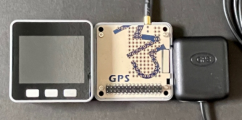
Brainwave Sensor and GPS We measure brain waves to measure the effects of forest bathing. We used the proper timing of the brainwaves: alpha waves increase when we relax, and beta waves increase when we are tense. In this study, we will also measure theta waves. In a recent study, for example, it was reported that high acti- vation of the theta band was observed in the frontal region when watching a highly rated movie (Dmochowski et al., 2012), which makes it possible to estimate the situation in which forest bathing relaxes and results in feeling positive emotions. Typically, EEG sensors are large devices used in hospitals, but we have developed a wearable EEG sensor that can acquire data for sev- eral hours, as shown in Figure 2, in cooperation with a US venture company. Figure 3 shows the data logger that we are currently using.
It is linked to the EEG sensor and can record location information via GPS. We can find out where people are relaxing by analyzing collected information, which can be used as a power spot and a tourist resource.
RESULT
Questioner-1 This questionnaire aimed to measure how mind-wandering happens. If mind- wandering is happening, the answer should be longer and may contain several topics simultaneously. Some researchers (such as (Bar, Moshe, 2022)) men- tion that if mind-wandering is happening, the answer may contain several different categories of topics.
The data of the two days are similar. However, the two items show the differences. As shown in Table 1, the number of positive answers was only 10% on Nov. 05; however, 30% on Nov. 03. the number of char- acters also differs. The mind-wandering level was high if there were many characters (= long sentences and many categories). Weather conditions cause the difference.
Effect of Forest Bathing for Mindwandering 177
Figure 2: EEG sensor.Figure 3: GPS module. Table 1. The answer of questioner-1.
Generality of topics Positive/Negative Categories Characters Relating to today’s situation Not relating to today’s situation Positive Negative Neutral The number of categories The number of caharacters The number of caharacters per topic
Table 2. Change of the number of topics during the experiment.
Table available in the original PDF paper.
Nov. 05 Measured point Status
Nov. 03 Measured point Status
ID #1 #2 #3 #4 #5
ID #1 #2 #5 4 — 1 — even 5 — 1 2 up 6 — 1 1 even 7 1 1 1 even 9 — 2 1 down 10 — 1 1 even 12 1 1 1 even 13 3 — 5 up 14 — 2 2 even
1 2 1 2 3 3 up 2 1 1 1 1 1 even 3 2 1 2 2 2 up 4 2 1 1 1 1 even 5 2 1 1 1 1 down 6 3 2 3 3 3 up 7 2 1 2 2 2 up 8 2 1 1 2 3 up 10 1 2 1 1 3 up 11 2 2 1 1 down
Table 2 shows the change in the number of topics according to the walking. On Nov. 03, only one case (11%) decreased the number of topics in the answer. On the other hand, two cases (22%) increased the number of topics in the answer.
Also, on Nov. 05, only two cases (20%) decreased the number of topics; on the other hand, 60% increased the number of topics in the answer.
If we can assume that mind-wandering increases the number of topics in the answer, even in an uncomfortable weather condition, mind-wandering occurs during hiking. So, hiking is effective for mind-wandering.
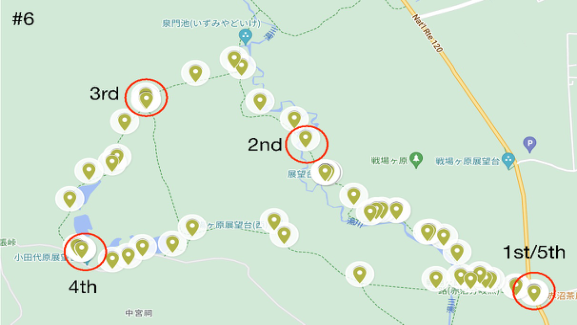
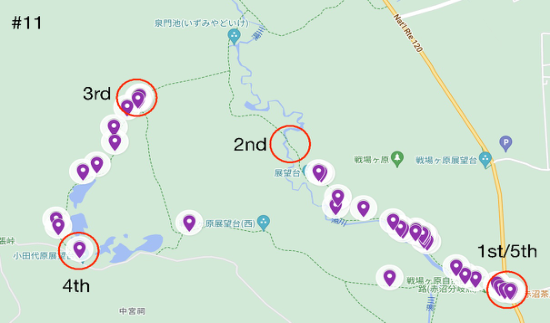
Figure 4 shows the EEG data and location data during hiking in Senjyo- gahara. Each pin displays where a person feels relaxed, calculated as Media- tion/(Attention + Mediation) >0.7. Attention and Mediation are parameters included in the output of the SOC for brainwave measurement and are almost similar to β wave and α wave—examinee #6. The examinee relaxed almost all points during the hiking, and the number of topics in the answer was 3->2->3->3->3. This result shows the high mind-wandering. On the other hand, as shown in Figure 5, examinee #11 showed 2->2->1->1 (missed input at the goal). From the first point to the second point, the examinee felt relaxed, so the number of topics at the second point was two; however, from the second point to the third point, the examinee did not feel relaxed, so the number of topics at the third point decreased. From the fourth point to the goal, the examinee also did not feel relaxed and forgot to input the answer. We want to continue performing experiments in different seasons and weather conditions.
Figure 4: Relaxing points of examinee #6 (Nov. 05).Figure 5: Relaxing points of examinee #11 (Nov. 05).
Effect of Forest Bathing for Mindwandering 179
Questioner-2 In Table 3, the result of Questionnaire-2 is shown. The average was almost the same on both dates. However, the distribution was different. These weather conditions caused this difference.
Table 4 shows the relation between Questioner-1 and Questioner-2. This result shows no clear relation between the mind-wandering level from Questioner-1 and Questioner-2 (RUMINATION SCALE). We need to inves- tigate the sentences in the questionnaire in detail.
Table 3. The result of Questioner-2.
Table available in the original PDF paper.
Nov. 03 Nov. 05 Average 3.55 3.32 Distribution 0.91 1.20 min 2.20 1.60 max 5.00 5.80
Table 4. Relation between Questioner-1 and 2.
Table available in the original PDF paper.
Nov. 03 Q1 Q2 Nov. 05 Q1 Q2 ID ID 4 even 2.7 1 up 2.4 5 up 3.8 2 even 4.6 6 even 4.5 3 up 3 7 even 2.7 4 even 3.6 9 down 3.3 5 down 2.8 10 even 4.6 6 up 2.1 12 even 2.9 7 up 1.8 13 up 4.9 8 up 5.3 14 even 2.6 10 up 3 11 down 4.8
CONCLUSION
This research investigates the relationship between mind-wandering, hiking, and forest bathing. The result shows a relationship between them even under different weather conditions.
FUTURE WORK
After several experiments, we will try to find the essential items that cause mind-wandering. However, we found some problems in our prepared questionnaire, so we must try to change them.
ACKNOWLEDGMENT
This research is supported by JSPS Kakenhi (JP17H02249, JP18K111849, JP 20H01278, 20H05702, 22K12598, 23H03649).
REFERENCES
Bar, Moshe. Mindwandering: How Your Constant Mental Drift Can Improve Your Mood and Boost Your Creativity, ISBN-13:978-1408888025 (2022). Dmochowski, J. P., Sajda, P., Dias, J., & Parra, L. C. (2012). Correlated compo-
nents of ongoing EEG point to emotionally laden attention–a possible marker of engagement?. Frontiers in human neuroscience, 6, 112. Global Wellness Institute (2018) Global Wellness Tourism Economy 2018, https://globalwellnessinstitute.org/wpcontent/uploads/2018/11/GWI_GlobalWell nessTourismEconomyReport.pdf. Hasenkamp, W., Wilson-Mendenhall, C. D., Duncan, E., & Barsalou, L. W. (2012).
Mind wandering and attention during focused meditation: a fine-grained temporal analysis of fluctuating cognitive states. Neuroimage, 59(1), 750–760. Hasenkamp, W., & Barsalou, L. W. (2012). Effects of meditation experience on functional connectivity of distributed brain networks. Frontiers in human neuroscience, 6, 38. Ikegaya, Y., (2005) Why is the cerebrum always active even when there is no input
from the outside world?, Experimental Medicine (in Japanese). Koizumi, K., Ueda, K., Li, Z., & Nakao, M. (2020). Effects of transcranial direct current stimulation on brain networks related to creative thinking. Frontiers in Human Neuroscience, 14, 431. Minister of Environment (2020) GoTo National Park (Press conference report),
https://www.env.go.jp/annai/kaiken/r2/0929.html. Nei, D., Yuasa, M., (2009) Forest Therapy in Akazawa Natural Recreational Forest, Forest Technology Exchange Meeting (in Japanese). The Mindful Tourist (2020) Shinrin Yoku Forest Bathing Retreat: The 5 Senses Journey at Healing Garden, Chiangmai, Thailand, https://www.youtube.com/watch?v=-wrqU8KwLd0. UNWTO (2020) Global Guidelines to Restart Tourism, 5 Harmonize and coordinate
protocols & procedures, Website: https://webunwto.s3.eu-west-1.amazonaws.co m/s3fs-public/2020-05/UNWTO-Global-Guidelines-to-Restart-Tourism.pdf. Wendy Treynor, Richard Gonzalez, and Susan Nolen-Hoeksema, “Rumination Reconsidered: A Psychometric Analysis,” Cognitive Therapy and Research 27 (2003): 247–259, https://doi.org/10.1023/A:1023910315561.
LISTED IN THE AHFE DIGITAL BOOKSTORE CATALOGUE
Explore the complete digital volume
Affective and Pleasurable Design
Read this individual research paper free through the original publisher, or explore the full digital proceedings book.
ISBN 978-1-958651-99-5
Explore this ISBN in the AHFE Bookstore ↗Listed in the July 2026 bookstore catalogue; search by ISBN to confirm current availability · Digital book purchase optional