Yuko Hiramatsu (2024). Creativity: The Writer as Transmitter and the Recipient as Reconstructor. In: Affective and Pleasurable Design. AHFE Open Access, vol. 123, pp. 181–189. https://doi.org/10.54941/ahfe1004689
This study examines creation by information recipients by the linguistic landscape survey in Nikko, a World Heritage Site in Japan. Linguistic landscape refers to the language signs along public roads. We can see traditional Japanese ways there. Old Japanese sometimes used a part of the ancient poems as a common culture in their poem, and from there, they created a double emotion of their own compositions and the ancient poems. This is a proactive and creative method in which the recipient adds a new vision to the one created by the creator/sender of the information. It is said Japanese language has a strong recipient-responsibility tendency, in which the recipient should take the initiative in grasping the meaning. A world-famous example is the stone garden at Ryoanji Temple in Kyoto. The stones and sand remind the viewers of large natural bodies of water and mountains. The creator assumed that those who see it will be actively involved and imagine. This tradition remains in Nikko roadside. For example, "Akebono(dawn)" is written on the board, as a name of a confectionery. When Japanese people look at the word "Akebono”, they remember the beginning of the Pillow Book, "Spring is Dawn (is best)”. Strawberry sweet reminds them of the beautiful dawn of spring. This is a double structure and is one of the manifestations in the Japanese culture of "Mitate". The pedestrians who walk along the road, are reminded of their cultural backgrounds, and there they pause to think and savor the double structure. It is the creation by the recipient that bridges the gap between the two. The uniqueness is not created by the creator, but rather the shared one is used to expand the imagination and share the senses. Considering tourism information application, it is not enough for such a creation. Applications provide as much detailed information as possible. Such information may be useful before the trip. However, when tourists stand in front of some stores, do they need detailed information about inside by smartphone? What is needed is for tourists to stop in front of the store. It is important that they are actively interested. Rather, it is also effective to leave the information incomplete (Zeigarnik effect). Novelty is required in tourism.However, in traditional Japanese cultural areas such as Nikko, where foreign tourists are increasing, the recipients do not have the same cultural background as senders of information. A major challenge is how to have a creative space for those who do not make common knowledge. There are three possibilities.Standardization is underway in the global. There is a possibility of new "Mitate" based on the commonality of the standardized parts.Foreign tourists will know the Japanese way of seeing things as repeaters.The "Mitate" will not be established. However, each visitor will create something new from what he/she has obtained. (Horizon of Expectation)Any or more of these are possible. Creation is in the hands of both the creator and the recipient.
People have a lot of information today. Will the amount of information that people accept ever exceed their processing capacity? Or information overload become less of a problem now that they do not necessarily process the infor- mation themselves, with AI selecting from the recipient’s history according to his or her preferences? Interaction with others or other things makes stress for people. However, such stimulus sometimes makes them active. Creation sometimes produces as results of stimulation.
Co-researchers and I have researched linguistic landscapes in Nikko, one of the World Heritage sites in Japan, since 2017. We focus on the information that attracts people, especially the positioning of recipients. People, it means tourists here, are sometimes not just recipients, but also use their imagination from some signs on the road. I will describe the following with regard to the positioning and creation of the recipients in Japanese expressions and will mention the future of information dissemination.
Section 2 refers to the definition of each term in this paper and related papers, and Section 3 presents specific case studies in Nikko. In addition,
many tourists come to Nikko from abroad. Therefore, I refer to similar meth- ods in the West and explore the potential for acceptance and translation of linguistic landscapes in Nikko. Section 4 presents the conclusion of this paper.
TERMINOLOGIES AND PREVIOUS RESEARCH Linguistic Landscape and Culture
Linguistic landscape is “visibility and salience of languages on public and commercial signs in a given territory or region” (Landry and Bourhis, 1997). A wide range of information signs can be found on the streets, from build- ing names, directions, and prohibitions to shop advertisements. Some of these signs are standardized and multilingual, such as toilet sign and warn- ing notices, while others are difficult to translate. Cultural elements that are characteristic of the tourist destination often do not lend themselves to translation.
There are various definitions of “culture”. Edward Burnett Tylor defined culture as “Culture and Civilization, taken in its wide ethnographic sense, is that complex whole which includes knowledge, belief, art, morals, law, cus- tom, and any other capabilities and habits acquired by man as a member of society” (Tylor, 1871). Based on this definition, culture indicates the char- acteristics of the total ethnic group and can vary from one social group to another. One of the aims of tourism is to enjoy these differences, to recog- nize them as “novelties” and to experience different cultures. In other words, it is difficult to translate objects with local uniqueness into other languages. There are many traditional things that live local characteristics that are dif- ficult to translate into other languages. However, they are cultural points of reference.
The Culture of “MITATE” in Japan Japan had a short-poetic literature from the 7th century. In the first place, there was a strong element of greeting rather than an object for reading in these short poems, in which the writer and readers means the sender and recipients of information. It was a greeting to the recipient and as a gift to each other. The recipient of poem then became the sender/writer. The basis of this exchange was the knowledge of ancient poetry as a common culture and education. Waka, the Japanese traditional poetry, uses 31 syllables (5, 7, 5, 7, 7). Creators sometimes used a technique whereby the expression of an ancient poem was used as part of one’s own creation, from which a double sentiment of one’s own Waka, adding depth to the short poem. This is the technique of “Honkadori”, which has been widely seen in the Anthology of New and Old Japanese Poetry named Shinkokin Waka Shu. It is a method that differs from the current information society style, in which originality is not merely quote, but rather parts of the poem that are in tune with the other person’s poem are created, and originality is then built on top of that.
The method that overlaying known information and own creations to cre- ate depth, have been also widely deployed outside of old poetry. “MITATE”
Creativity: The Writer as Transmitter and the Recipient as Reconstructor 183
is the same way. It is the method in which a new “vision” is created by super- imposing a different kind of image on the object in front of recipients. It is a method in which a new <vision> is generated by superimposing a different kind of image in front of their eyes (Moriya, 2013). Although often treats in the same way as a metaphor, in a simile, the features of an object are expressed by borrowing images of other well-known objects to make them more comprehensible, and the purpose of the expression is solely to explain the ‘object’ being seen. On the other hand, “MITATE” is certainly the same way as the simile in that similarities are found between two things, but other than the similarities, it is desirable to make as much of a leap as possible” (Hayakawa, 1995). The gap between the similarities creates a widening of the image. There is research showing that the Japanese language has a strong receptor responsibility (Hinds, l987) the tendency to believe that the receiver should take a more proactive approach to meaning, and “MITATE” is a part of this. It is a proactive and creative method (Ikegami, 2013), in which the recipient adds a new ‘vision’ to the one created by the creator/sender of the information. One world-famous example is the stone garden at Ryoanji Tem- ple in Kyoto. The stones and sand remind the viewer of large natural bodies of water or mountains. The creator of the stone garden assumed that those who see it will proactively engage with it and imagine it.
EXAMPLES AND TRANSLATIONS OF MITATE IN THE RESEARCH AREA IN NIKKO Examples of “MITATE” in the Research Area
Both the author and the readers construct an expansive world within a limited number of characters in Japanese old poetry. This technique is not limited to a few artists but can be seen in the language landscape along the Nikko roadside as a rooted part of Japanese culture. Along the roadside, there are messages for tourists, but they are not only statements of intention by the poster, but also postings that leave the destination of the information to the recipients/tourist, as in the case of “MITATE”.
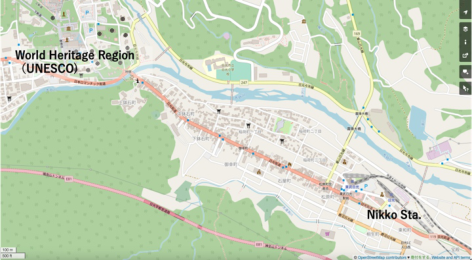
Figure 1: Map of the research area in Nikko (main street to the world heritage sight).
184 Hiramatsu
In the research area from JR Nikko Station to Shinkyo Bridge (See Figure1), there are many Japanese confectionery shops and Japanese food shops, such as yokan (bean jelly) and Yuba (Tobu skin). The “MITATE” technique can be seen in the names at Japanese confectionery shops.
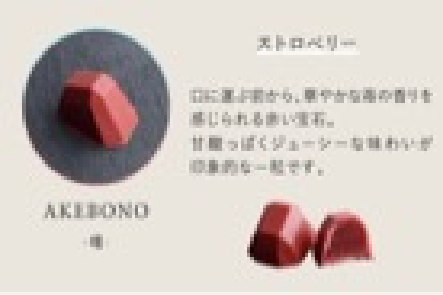
“AKEBONO/ Akebono 曙/ STRAWBERRY”. For example, this is a name of sweets at long-established Japanese con- fectionery shop. The name of the light red strawberry sweets is “Akebono”. For foreigners, the gap between the alphabetical characters “AKEBONO” and “STRABERRY” remains unfilled, but for Japanese people, “Haru wa Akebono (In spring it is the dawn that is most beautiful. (Translated by Ivan Morris, 1971)”, the opening line of “The Pillow Book”: a famous old book in Japan, comes to mind. Even if the sky is the same red, “dusk” does not lead to “spring”, the season of strawberries. Japanese imagine the dawn of spring from the little sweets. Small confectionery overlaps with big nature.
Figure 2: Expranation about sweets named AKEBONO at Japanese confectionery.
In the tea ceremony where Japanese sweets is served, one of the triggers in front of people in the four-and-a-half-mat tearoom is the little sweets, from which they imagine the nature outside or imagine some old poems. For example, when the confectioner named “Tatsuta River” is placed in front of the guests of the ceremony, they imagine the river flowing brightly with the autumn leaves which an old poem described.
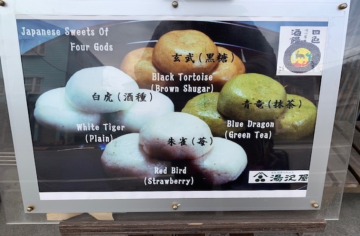
Another shop also has a display of Manju (Japanese sweets) with the name “Shijin (four gods)” (See Figure 3) The Four Gods are the names of the gods who govern the four directions of heaven, namely the Blue Dragon in the east, the White Tiger in the west, the Vermilion Sparrow in the south and the Xuanwu in the north. The four beasts. The round sweets in their normal forms, without these names they would simply be common sweets. Names of the Gods who control the four directions of heaven, make the small pastries more imaginative for customers and increases their value.
The imagination spreads from a small confectionary, and the best part of Japanese culture appears in the notices of the Japanese confectionary shops along the street.
Creativity: The Writer as Transmitter and the Recipient as Reconstructor 185
Figure 3: Japanese Manju named four gods.
Originator’s and Recipient’s Responsibility - The Role of the Information Recipient Regarding products such as Japanese sweets with “MITATE”, there is a dif- ference in more than just the translation between Japanese and English. In the case of English, the provider of the product is accountable, and clearly indi- cate the names of ingredients. On the other hand, in the case of the Japanese sweets, the confectioner, the creator of the sweets, names them with his imag- ination. This is a kind of message to customers. The responsibility is left not only to the sender/the confectioner of the information but also to the receivers/customers. By tracing the name, customers imagine and share the thoughts of the confectioner. This is a kind of communication that is only possible with the same cultural background.
Customers walking on the Nikko main street can think and taste the dou- ble structure by evoking the cultural background, on the assumption that they have the same culture. It is creation through this process. It is conclud- ing creation by customers/the recipients that bridges the gap between the two. Uniqueness is not created only by the confectioner, but rather the shared one is used to expand the imagination and share the senses. However, it is diffi- cult to ask foreign tourists walking along the street to overcome these cultural differences. How can we convey this expansion to tourists who have grown up in a different culture?
Positioning of Similar Receptors in the West In the West, Hans Robert Jauss proposed a theory of reception (reception aesthetics) in the 20th century, which, in opposition to the “work immanent hermeneutic”, focused on the consideration of the interaction between the work, the author and the reader (the recipient). In his History of Literature as Provocation, Jauss focused on the social and communicative functions of literature and analyzed the interpretation of works from the perspective of “horizons of expectation” (Jauss, 1970).
In another field contemporary with Jauss, but focusing on the field of culture and communication, linguist Gumperz (1982) proposed an inter- actional sociolinguistics in which meaning is interpreted according to the contextualization cues of society and culture. He proposed an interactional
186 Hiramatsu
sociolinguistics in which meaning is interpreted according to social and cultural contextualization cues (Gumperz, 1982).
“MITATE” in the linguistic landscape is similar in structure to accep- tance theory in terms of language understanding based on a common culture. H.R. Jauss stated that the interpretation and reception of a text always pre- supposes the context of the experience of aesthetic perception. In addition, he told that the gap between the recipient’s horizon of expectation and the work, between what is already familiar from conventional aesthetic experience and the change of horizon required by the reception of a new work, determines its artistic character in terms of reception aesthetics. There are also some points that seem to be common in regard to looking, such as “MITATE” is certainly the same way as a parable in that similarities are found between two things, but it is desirable to make leaps as far as possible except for the similarities” (Hayakawa, 1995).
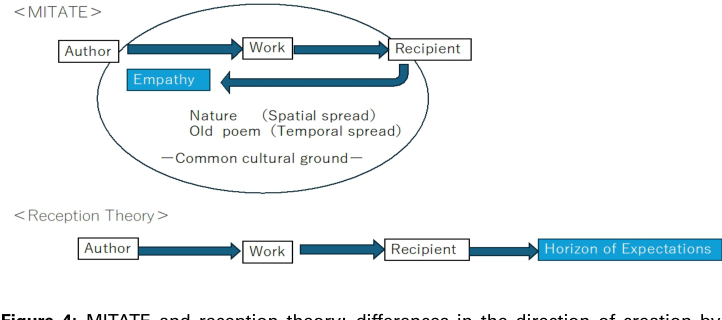
However, there are significant differences in terms of whether this gap is taken as a conflict or whether the recipient crosses the gap to ‘empathy’.
These are not the same times or fields, and it is difficult to say that they are directly related to each other in influence. However, they all have one thing in common in that they do not entrust creation solely to the side of the sender of information, but consider creation to include the reception and communication of the recipient of the information. This traditional expres- sion is based on the premise of the active involvement of the recipient, who is not simply swamped by too much information or passively looking at the information sent to him or her. There is an element of sparking creativity by the information sender as well as by the information receiver (See Figure 4).
Figure 4: MITATE and reception theory; differences in the direction of creation by recipients.
“MITATE” Culture Under Review in Japan and for Inbound As for “MITATE”, its value is being reassessed in the 21st century when introducing Japanese culture abroad. There are also developments in tourism and cuisine for foreign tourists. They are consciously written in alphabetical rather than Japanese characters.
Creativity: The Writer as Transmitter and the Recipient as Reconstructor 187
The website of a travel agency called MITATE has an introduction to tours in English. It says “We provide authentic travel products, including Japanese food culture, crafts, and lifestyle experiences” (DMC specialising in cultural experiences, 2023). There is also a restaurant in Kyoto called ‘Arashiyama MITATE’, founded in 2022, which states that it aims to fuse Kyoto cuisine with French cuisine.
They mentioned above do not explain the content of “MITATE”itself well, but they discuss “MITATE” as Japanese culture. For foreign tourists, this could be the first step in learning about MITATE and a chance to become interested in it. It has a part to play in the novelty of tourism.
In addition, the restaurant’s method of using Japanese culture alongside foreign ones is not just a matter of being pedantic, but is also a part of the tea ceremony method in the first place. The tea ceremony is a way of showing guests a new world. For example, Japan Times reports that the following tea ceremony was held.
“The charm of the tea ceremony is that as long as hosts observe just a few key points, the rest can be carried out with relative freedom. Just as Sen no Rikyu himself famously used a fishermen’s basket as a flower vase, there is no problem with co-opting unlikely objects for use in a tea ceremony. Known as “mitate,” this can help the host give expression to their own ideas. Below the kakemono is an arrangement of flowers. In July, a vintage Tiffany hand- blown Venetian glass vase was used. Furthermore, on the tatami mat where the tea was prepared, there was a traditional stove and pot, and next to it a Louis Vuitton travel trunk, which played the role of a chest that might be used when making tea during a trip” (Terao, 2023).
In addition to these, a cloud service called “MITATE system” exists in Japan. The explanation is that it is named after traditional Japanese culture. (Toppan Cosmo).
“MITATE” is not only an ancient Japanese method, but is also deployed in Japan today as a source of creation.
CONCLUSION
At first glance, there is enough information nowadays. The tourism applica- tions currently deployed in many tourist destinations try to provide as much detailed information as possible, rather than creating room for creativity for many explanations and recipients. Such information may be useful before the trip. However, when standing in front of the shop, do they need detailed infor- mation about what is inside the shop via your smartphone? What is needed is for tourists to stop in front of the shop. It is important that the recipient takes an active interest in it. It may be useful to leave some imperfections that leave room for the imagination to remain interested, attracted and wanting to go inside, rather than a lot of information to fall back on.
Rather than being information-centered in current applications and the positioning of the recipient remaining passive, is it possible to think of things that make people stop and have room for the recipient to make things up? There is also a method of creating a chain of creation, with the possibility of mutually creative things like Japanese old poetry, where the exchange of communication fosters rich content.
188 Hiramatsu
In traditional Japanese cultural areas such as Nikko, where the number of foreign tourists is increasing, the recipients do not have the same cultural background as the information senders. In the case of foreigners, they do not necessarily share the same elements and culture. Rather, how to create a creative margin for the recipients who do not have it is a major challenge. Specifically, can foreign tourists understand and imagine the sights along the Nikko roadside? Could there feel some “MITATE” in contemporary society?
There are three possibilities.
Standardization is underway in the global. There is a possibility of new “MITATE” based on the commonality of the standardized parts.
Foreign tourists will know the Japanese way of seeing things as repeaters.
The “MITATE” will not be established. However, each visitor will create something new from what he/she has obtained (“Horizon of Expecta- tions” by Jauss).
People take the time and trouble to get away from the everyday, seek nov- elty and experience the unusual in their travels. They accept the gap from the everyday as something new. In application development, too, elements are required that make people aware of such gaps, that allow them to try to know the differences to the extent imaginable, and that stimulate the imagi- nation of the recipient, who can actively engage in trying to understand them. We should consider the creation of mutual imagination, in which the receiver and sender fill in the gaps and create each other, rather than one-way attempts by senders to convey perfect information in a responsible manner.
ACKNOWLEDGMENT
This research is supported by JSPS KAKENHI Grant Number JP 22K12598. Acknowledgement of the cooperation of the Nikko shopping association.
REFERENCES
Ayashiyama MITATE Group, “ABOUT” URL: https://mitate-kyoto.com. Gumperz, J. J, “Discourse Strategies Cambridge”, University Press (1982). Hayakawa, M (1995) “MITATE-e ni tuite-MITATE no Kouzo to Imi” (About the MITATE picture - the structure and meaning of MITATE)”, in japanese, Bijutsu- shi no danmen (Cross-section of art history), pp. 427–446, Seibundo-syuppan, Osaka. Hinds, J. (1987). Reader versus writer responsibility: A new typology. In U. Connor,
& R. Kaplan (Eds.), Writing across languages: Analysis of L2 texts, pp. 141–152. Hiramatsu, Y. Morishita, M. (2023), “Learning From Linguistic Landscapes - Practical English Language Learning and Awareness of Traditional Culture”, Conference: 15th International Conference on Education and New Learning Technologies, pp. 838–844. Hiramatsu, Y. Ito, A. Sasaki, Ueda, K et al. A. (2020). “A Survey to Create Attrac-
tive Contents for Tourism -To Comprehend Other Cultures”, In book: Computer Aided Systems Theory – EUROCAST 2019, pp. 407–415. Hiramatsu, Y. (2021), “An Issue on Communication between Shop Owners and Touristsin the Case of Japanese Traditional Method of MITATE”, the 38th Annual Meeting of Japanese Cognitive Science Society, pp. 795–798, Hokkaido.
Creativity: The Writer as Transmitter and the Recipient as Reconstructor 189
Ikegami, Y. (2013), “From “mie”(え) to “mitate”(立て)–Cognitive linguistic foundations of the tropes deeply rooted in bodiliness and subjectivity”, The National Conference of the Japanese Cognitive Linguistics Association 13, pp. 625–629. Jauss, Hans Robert “Literaturgeschichte als Provokation der Literaturwissenschaft”,
(1967). Jauss, Hans Robert; Elizabeth Benzinger (1970). “Literary History as a Challenge to Literary Theory”. New Literary History. 2 (1): pp. 7–37. Landry, R. Bourhis, R. (1997), “Linguistic Landscape and Ethnolinguistic Vitality:
An Empirical Study”, Journal of Language and Social Psychology Vol. 16(1), pp. 23–49. MITATE, “DMC specialising in cultural experiences” (Aug. 09, 2023), URL: https: //mitate.kyoto/dmc/. Moriya, M. (2013), “Some Notes on ‘Mitate’ in Japanese Language and Japanese
Culture : from the Viewpoint of ‘Homology’”, Studies in Japanese language and Japanese literature (23), pp. 1–14, Soka university. Ryoanji Temple-Zen Temple with famous rock garden, Japan guide.com, website: https://www.japan-guide.com/e/e3909.html. Sei Shônagon, (about 10 century), “The Pillow Book of Sei Shonagon (Classics)”,
translated by Ivan Morris 1971, Website: https://www.goodreads.com/quotes /160468-in-spring-it-is-the-dawn-that-is-most. Tera, T, “How ‘the way of tea’ conveys Japanese culture” (Sep. 29, 2023), the Japan times, URL: https://sustainable.japantimes.com/magazine/vol28/28-01. Toppan Cosmo, “About the name MITATE” (in Japanese), URL: https://www.topp
an-cosmo.jp/mitate/. Tylor, E, B. (1871), “Primitive Culture”, London: John Murray & Co., 2 vols. pp. 1–25.
LISTED IN THE AHFE DIGITAL BOOKSTORE CATALOGUE
Explore the complete digital volume
Affective and Pleasurable Design
Read this individual research paper free through the original publisher, or explore the full digital proceedings book.
ISBN 978-1-958651-99-5
Explore this ISBN in the AHFE Bookstore ↗Listed in the July 2026 bookstore catalogue; search by ISBN to confirm current availability · Digital book purchase optional