Vesna Marija Potočić Matković, Ivana Salopek Čubrić (2025). Swim shirts optimization for better thermal comfort. In: Human Factors in Design, Engineering, and Computing. AHFE Open Access, vol. 199, pp. 503–513. https://doi.org/10.54941/ahfe1006862
Thermoregulation is essential for balancing body heat from metabolism and the environment, especially in sportswear like swim shirts. The aim of the research is to test how well conventional swim shirts provide thermophysiological comfort and how the thermophysiological comfort of swim shirts could be improved by optimizing the material. Following the aim of the research the heat resistance of the materials was measured using the Sweating Guarded Hotplate in laboratory conditions. Then, the surface temperature of the volunteers wearing swim shirts was measured using a FLIR thermal camera, in real conditions, at the indoor pool. A heat distribution model for swim shirts was developed. Experiment analyzed temperature changes of 6 participants, wearing 3 swim shirts of similar raw material composition (PA+EL) but different fabric mass, in 6 body zones on the front side and 6 body zones on the back side. After acclimatization at an ambient temperature of 30°C, participants swam for 10 minutes in 27°C pool water. Imaging showed temperature drops across all body zones, ranging between 1.1°C and 3.2°C. Regardless of the differences in the temperature drop due to the different materials of swim shirts and variations in the body size and age of the participants, all three models of heat distribution in swim shirts show the same characteristics. Heat loss is higher on the back, particularly in the shoulder blade area, then on the back around the waist, with nearly equal average temperature drops in the waist area at the front, followed by the chest area. The smallest temperature drops, both at the front and back, occurred in the abdominal and lower back areas. Therefore, to better maintain optimal thermoregulation, swim shirts should use materials of varying masses to correspond to the zones of greater or lesser heat loss. This can easily be achieved today by using seamless knitting techniques on flat knitting machines, circular knitting machines, or warp knitting machines.
The functions of clothing vary: it can create a barrier, mediate interaction with the environment, or help the body adapt. While all clothing is functional, the design of functional clothing prioritizes purpose over appearance. This requires an interdisciplinary approach focusing on protection, health, safety, and efficiency. Functional clothing merges science and art, combining scientific methods with creative approaches, centering on the user.
The textile market constantly demands innovation, driving the development of functional materials. These textiles serve sectors such
as hygiene, military, healthcare, and personal protection, increasingly integrating health monitoring features. Sportswear is a growing segment, influenced by material properties and design solutions. The sportswear market is expanding beyond professionals to recreational users, blending functionality with fashion (Chowdhury et al., 2012; Chowdhury et al., 2014). Fashion sportswear results from collaborations between designers and sports brands, emphasizing contemporary design (LNCS Homepage, 2025; Origin Outside, 2025; FashionBeans, 2025). Basic sportswear prioritizes aesthetics while casual sportswear mimics functional wear for home or light activity (Manshahia and Das, 2014). Functional sportswear enhances performance with technologies like seamless knitting, improving comfort, aesthetics, and functionality (Power, 2018). Key properties include thermoregulation, moisture permeability, mobility, and durability, with clothing choices depending on activity and environment (Kothari, 2003). Advances in fibers have improved aerodynamics, absorption, breathability, strength, and body conformity. Sportswear must provide comfort, protection, and support, with materials and designs tested on professional athletes.
The following sections will discuss thermal comfort in swim shirt design for women. The aim of the research was to test how well conventional swim shirts provide thermophysiological comfort and how the thermophys- iological comfort of swim shirts could be improved by optimizing the material.
In order to ensure optimal thermoregulation, the human body must be kept in thermal balance. This means that the thermal energy produced by the body’s metabolism and the energy from the environment must be equal, preventing the loss or gain of thermal energy. Swim shirt with good thermophysiological properties should provide the user with thermal balance and minimal bodily strain during various water temperatures and physical activities (Mecheels, 1999). This means that the user does not experience a pronounced feeling of cold or heat, but rather a sense of thermophysiological comfort.
The use of polyamide for swim shirt materials is often and offers many advantages. Polyamide sportswear is easy to wash, dries quickly, and retains its shape well. Another advantage of polyamide is its durability, tear, abrasion, chemicals, and oils resistance. Polyamide materials are also resistant to wrinkling, and seawater (Johnston and Hallett, 1999; Yitai Knitting, 2024; Militký et al., 2018).
During the production of textile for swimming, polyamide is often blended with elastane in various proportions to ensure comfort, optimal fit, and flexibility. A small amount of elastane added to the textile material allows the garment to return to its original shape after each stretch. The textile material stretches and contracts in accordance with the movement of the body’s muscles, which helps improve muscle recovery and reduce muscle fatigue during swimming by providing support from the garment. Elastane can be directly incorporated into a structure primarily made from another type of fibres, where it is hidden within the structure and ensures the desired fit and comfort (Venkatraman, 2016; Johnston and Hallett, 1999).
Swim Shirts Optimization for Better Thermal Comfort 505
Knitted fabrics are most often preferred when making sportswear, in this case, swim shirts. Due to their elasticity, they ensure freedom of movement and provide the necessary comfort.
MATERIAL OF SWIM SHIRTS For this experiment, a representative set of swim shirts was selected, produced by Pletix company, Croatia. The raw material composition and properties of the knitted fabrics for swim shirts are shown in Table 1.
Table 1: Composition and properties of the knitted fabrics for swim shirts.
Table available in the original PDF paper.
Fabric ID
Type of Polymer Fineness (dtex) Mass Per Unit Area (g/m2) SS1 polyamide 80%, elastane 20% 110 190 SS2 rec. polyamide 78%, elastane 22% 150 190 SS3 polyamide 59%, elastane 41% 44 218
As seen from Table 1, these swim shirts are made of typical materials that can be found on the market. SS1 is advertised as perfect balance between lightweight and elasticity, SS2 a sustainable fabric made of a regenerated polyamide that turns waste problems into fashion, and SS3 as the fabric that sculpts the body for a new beauty, correcting the figures. Polyamide is the basic polymer in all three samples (SS1, SS2, SS3). The fabric SS3, with 41% elastane, is expected to be the most elastic among the three compared, followed by SS2 at 22% elastane, and SS1 with 20% elastane. In terms of yarn fineness, SS2 has the coarsest yarn at 150 dtex, which may contribute to its durability and strength. Regarding fabric mass per unit area, fabrics SS1 and SS2 have the same mass per unit area, while fabric SS3 is slightly heavier at 218 g/m2.
METHOD OF CONDUCTING THE EXPERIMENT Following the aim of the research - to test how well conventional swim shirts provide thermophysiological comfort and how the thermophysiological comfort of swim shirts could be improved - first, the heat resistance of the materials described above was measured in laboratory conditions. Measuring heat resistance allows manufacturers to develop specialized swimwear for different environments, such as wetsuits for cold-water activities, ensuring safety and optimal comfort. Properly tested swimwear meets consumer expectations and provides reliable protection for prolonged exposure to water.
Then, the surface temperature of the volunteers wearing above described swim shirts was measured using a thermal camera, in real conditions - at the indoor pool. Then, a heat distribution model for swim shirts was developed using the method described in detail below.
506 Matkovi´c and ˇCubri´c
Measuring the Heat Resistance of Materials The Sweating Guarded Hotplate (SGHP) is commonly used to investigate heat resistance, particularly in relation to thermal comfort and clothing performance. It replicates the thermal behaviour of human skin by measuring heat flux, the heat transfer coefficient, and evaporative cooling in a controlled setting. This apparatus is mainly employed to evaluate the properties of fabrics, particularly in environments where sweating occurs, such as outdoor activities or hot working conditions.
The (SGHP) method follows specific standards for testing heat and moisture transfer properties of materials, particularly in relation to thermal comfort and fabric performance. One widely recognized standard for SGHP testing is ISO 11092:2014 (ISO, 2014).
The SGHP features a thermally regulated heated plate that maintains a constant temperature resembling human skin. The heat resistance is determined according to the following formula (Eq. 1):
Rct = (Ts −Ta)
−Rct0 (1) H A
where: Rct - dry resistance of sample only (m2KW–1) Ts - hotplate surface temperature (
C) Ta - ambient temperature (
C) H/A - zone heat flux (Wm–2) Rct0 - bare plate dry resistance (m2KW–1).
Measuring Body Temperature With Thermal Camera In an experiment using a FLIR infrared thermographic camera, changes in surface temperature were analysed in participants wearing a two-piece swimsuit and a swim shirt of above described materials. The study involved six female participants with an average age of 49 years. All research procedures were approved by the Ethics Committee of the University of Zagreb, Faculty of Textile Technology.
Participants were provided with appropriate swimsuits and swim shirts (labelled as SS1, SS2, and SS3) to examine surface temperature changes before and after swimming in a pool. The sizes of the swimsuits and shirts ranged from Europe size 38 to 44, considering the participants’ body structure.
The experiment began with an acclimatization phase, during which participants spent 10 minutes in an indoor pool area with an ambient temperature of 30
C. After acclimatization, they were recorded with an infrared thermographic camera to determine their initial body temperature before physical activity. The camera was positioned at a fixed distance of 2 meters from the participants. A thermogram was made for the front and back of the body.
The participants swam in the pool for 10 minutes. The water temperature was 27
C. Immediately after swimming; they were again subjected to thermographic imaging to detect temperature changes, on the front and
Swim Shirts Optimization for Better Thermal Comfort 507
back of the body. This process enabled a detailed analysis of temperature variations, contributing to a better understanding of the relationship between physical activity and thermal comfort. The experimental protocol was repeated three times with three types of swim shirts, and applied equally.
Results were obtained from the average values of all six participants in each measurement phase, both before and after swimming. This procedure was carried out for all three selected swim shirts (SS1, SS2, and SS3).
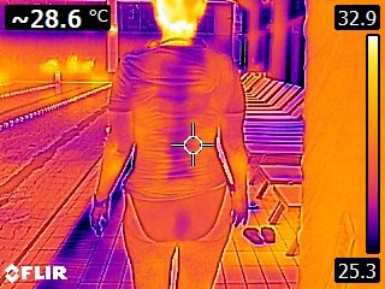
It is important to note that the thermal camera is very accurate, but the limitation of this method is the different metabolism of each person, as well as the different recording conditions (although the air and water temperature in the indoor swimming pool is stable). An example of a thermogram is shown in Fig. 1.
Figure 1: An example of a thermogram in the FLIR Tools software.
Development of a Heat Distribution Model for Swim Shirts To determine participants’ body temperature before and immediately after swimming, and to calculate the average temperature in six zones on the front of the body and six zones on the back of the body the FLIR Tools software, compatible with the FLIR thermographic camera, was used. The use of FLIR Tools software enabled a detailed analysis of the thermal properties of the selected sportswear. Each thermogram provided a clear visualization of the body’s surface temperature distribution, while precise marking of zones on the swim shirts allowed specific tracking of thermal changes in designated areas of interest. The thermograms were precisely marked and divided into six front and six back body zones. The mean temperature was calculated for each zone, for each volunteer, after acclimatization, and after swimming. The temperature difference was calculated for each zone. Individual measurements gave different results, but regardless of body and age differences between volunteers, the largest temperature drop and the smallest temperature drop were recorded in the same body zones. For this reason, it was possible to determine the average value of temperature differences by zone including the analyses of all volunteers.
508 Matkovi´c and ˇCubri´c
RESULTS
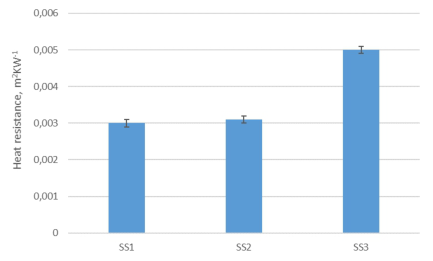
The results of the measured heat resistance of knitted fabrics SS1, SS2 and SS3 are shown in Fig. 2.
Figure 2: Heat resistance of fabrics SS1-SS3.
The heat resistance values of investigated knitted fabrics are in range 0.0030-0.0051 m2·K·W–1, and indicate how well each fabric insulates against heat. Fabrics SS1 and SS2 have lover heat resistance at 0.0030 and 0.0031 m2·K·W–1 in comparison to fabric SS3 whose heat resistance equals 0.0051 m2·K·W–1. The main reason for such a difference is to be associated with the differences in mass per unit area which are 190 and 219 g·m-2. According to the results of measurements, fabrics SS1 and SS2, with the lower heat resistance, are expected to be able to allow accumulated heat to pass through the fabric structure more easily. As a result, those fabrics would be better suited for lightweight, high-performance fabrics where heat retention is not a priority. As opposed, the fabric SS3 is expected to provide the best heat insulation among investigated fabrics. It would likely be warmer and more protective against heat loss when used for the production of swim shirts. Therefore, among investigated fabrics, it would be preferable to use for swimming in colder water.
The results of the recorded surface temperature of swim shirts SS1, SS2 and SS3, front body side, and back body side, divided to 6 zones, before and after swimming are shown in Table 2. The results are the average surface temperature of 6 volunteers.
Table 2: Average surface temperature of swim shirts SS1, SS2 and SS3, front body side, and back body side.
Table available in the original PDF paper.
SS1 Front SS1 Back SS2 Front SS2 Back SS3 Front SS3 Back
32.05 33.28 31.86 32.98 31.47 32.58
zone1 before
32.10 33.27 31.70 33.10 31.45 32.73
zone2 before
32.40 32.63 32.32 32.69 31.72 32.07
zone3 before
Continued
Swim Shirts Optimization for Better Thermal Comfort 509
Table 2: Continued SS1 Front SS1 Back SS2 Front SS2 Back SS3 Front SS3 Back
Table available in the original PDF paper.
32.55 32.53 32.38 32.60 31.87 32.02
zone4 before
32.33 32.30 32.33 32.21 31.58 31.52
zone5 before
32.37 32.35 32.39 32.09 31.58 31.33
zone6 before
29.87 30.07 29.46 30.24 29.87 30.45
zone1 after
29.70 30.18 29.52 30.14 29.73 30.48
zone2 after
29.92 30.02 29.74 30.12 30.17 30.37
zone3 after
29.98 30.08 29.80 30.08 30.17 30.33
zone4 after
29.98 29.95 29.90 29.98 30.28 30.32
zone5 after
30.05 29.97 29.88 29.98 30.30 30.27
zone6 after
The average surface temperature read with a thermal camera, before swimming, and after 10 minutes of acclimatization was 32.24
C (Table 2). After the participants swam in the pool for 10 minutes a drop in temperatures was recorded. The average surface temperature of the body of participants wearing the SS1 shirt was 29.92
C front, and 30.04
C back. The average surface temperature of the body of participants wearing the SS2 shirt was 29.72
C front, and 30.09
C back. The average surface temperature of the body of participants wearing the SS3 shirt was 30.09
C front, and 30.37
C back (Table 2). The temperature drop according to body zones will be discussed later.
DISCUSSION
Of course, we cannot directly compare the results of heat resistance measured by the Sweating Guarded Hotplate and the results of body temperature measured by the FLIR thermal camera. But the connection between higher mass per unit area of material, higher thermal resistance of the material and a smaller drop in body temperature in the volunteer wearing higher thermal resistance material is clearly visible (Fig. 2, 3, 4, 5).
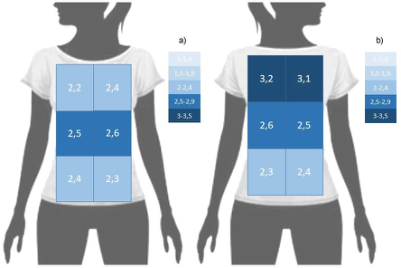
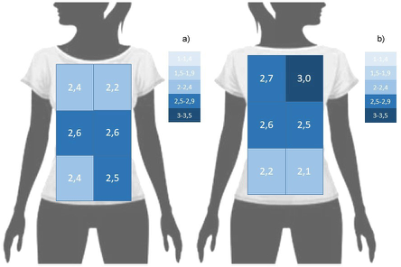
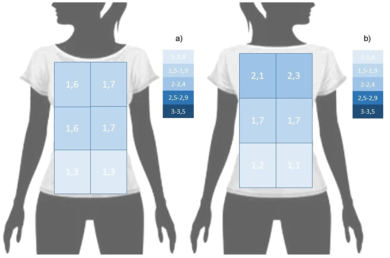
Fig. 3, 4, and 5 show heat distribution model for swim shirts (Model 1, Model 2, and Model 3), created to illustrate temperature changes in the upper body covered by the participants’ swim shirts, divided into six zones, front and back side. Each model uses a different material: Model 1 uses material SS1 (0.0030 m2·K·W–1), Model 2 uses material SS2 (0.0031 m2·K·W–1), and Model 3 uses material SS3 (0.0051 m2·K·W–1). The models show the average temperature drop of all six volunteers according to body zones.
After 10 minutes of swimming in water at 27
C, the temperature dropped in all measured zones, ranging between 1.1
C and 3.2
C. Materials
510 Matkovi´c and ˇCubri´c SS1 (190 g/m2, 0.0030 m2·K·W–1) and SS2 (190 g/m2, 0.0031 m2·K·W–1) have similar characteristics, resulting in a comparable temperature decrease after swimming (Fig. 3, Fig. 4). Material SS3 (218 g/m2, 0.0051 m2·K·W–1) has a higher mass and provides better protection against temperature loss (Fig. 5).
Figure 3: Heat distribution model 1, material SS1, a) front side and b) back side.Figure 4: Heat distribution model 2, material SS2, a) front side and b) back side.
Regardless of the differences in temperature drop due to the different materials of the swim shirts, and the variations in the body size and age of the participants, all three models of heat distribution in swim shirts show the same characteristics. Heat loss is higher in all three models on the back side, particularly in the shoulder blade area, then on the back around the waist, with nearly equal average temperature drops in the waist area at the front, followed by the chest area. The smallest temperature drops, both at the front and back, occurred in the abdominal and lower back areas (Fig. 3, 4, 5). These data provide insight into heat loss by body zones and allow for the design of functional swim shirts for women.
Swim Shirts Optimization for Better Thermal Comfort 511
Figure 5: Heat distribution model 3, material SS3, a) front side and b) back side.
Designing functional swim shirts based on the body mapping concept, a clothing design technique based on monitoring and responding to the body’s reaction during physical activity, would require the combination of several different materials. Since heat loss is greater in all three models on the back, particularly in the shoulder blade area, a material with greater mass should be applied in that area. For the waist zone, both front and back, a material with slightly less mass could be used, while a lighter material could be applied to the chest, abdominal, and lower back zones.
It is certainly worth noting that, from a technological standpoint, seamless knitting would be ideal, as avoiding seams between body zones would further contribute to the feeling of comfort. Using seamless knitwear techniques garments are produced directly on knitting machines without the need for cutting or sewing. For sportswear, it provides better comfort and fit as it eliminates the need for seams. Using flat knitting machines, seamless technology can produce all kinds of outer garments, including sportswear (Stoll, 2024; Shima Seiki, 2024). Circular knitting machine seamless production is typically used for underwear but has now expanded to the production of active wear and swimwear (Santoni, 2024). Sleeves must be knitted separately. Warp knitting seamless technology can also produce sportswear. Using any of the three mentioned technologies, differences in material mass per unit area can be obtained without seams, which would cause differences in thermal resistance, either by knitting with polyamide yarns of different fineness or by knitting in different densities.
The relatively small number of volunteer participants in this study did not prove to be a problem because the temperature drops in the zones followed the same patterns, which was sufficient to draw conclusions about the design of the swim shirts. A limitation of the study is rather related to the gender of the participants, i.e. it would be interesting to see whether similar temperature drops according to the zones would be found in male participants. Also, the study was conducted in an indoor pool. It would be interesting to compare these results with results recorded in harsher, colder weather conditions.
CONCLUSION
Regardless of the differences in the temperature drop due to the different materials of swim shirts and variations in the body size and age of the
512 Matkovi´c and ˇCubri´c
participants, all three models of heat distribution in swim shirts for women show the same characteristics. Heat loss is higher in all three models on the back, particularly in the shoulder blade area, then on the back around the waist, with nearly equal average temperature drops in the waist area at the front, followed by the chest area. The smallest temperature drops, both at the front and back, occurred in the abdominal and lower back areas. Therefore, to better maintain optimal thermoregulation, swim shirts should use materials of varying masses to correspond to the zones of greater or lesser heat loss. This can easily be achieved today by using seamless knitting techniques on flat knitting machines, circular knitting machines, or warp knitting machines.
ACKNOWLEDGMENT
This research was funded by Croatian Science Foundation, grant number IP-2020-02-5041 “Textile Materials for Enhanced Comfort in Sports”— TEMPO and Ministry of Science, Education and Youth under the project “Development and Structural Functionalization of Knitted Sportswear Fabrics Made of Natural and Comparative Man-made Fibers”.
The authors sincerely thank their colleagues and friends for their support, and the time they generously devoted to the thermal camera recordings. Your contribution is deeply appreciated.
REFERENCES
Chowdhury, H., Alam, F., Mainwaring, D., Beneyto-Ferre, J. and Tate, M. (2012).
“Rapid prototyping of high-performance sportswear”. Procedia Engineering, 34, pp. 38–43. Available from: https://doi.org/10.1016/j.proeng.2012.04.00. Chowdhury, P., Samanta, K. K. and Basak, S. (2014). “Recent development in textile for sportswear application”. International Journal of Engineering Research and Technology, 3(5), pp. 1905–191. FashionBeans (n.d.). “How sportswear took over your wardrobe”. Available
from: https://www.fashionbeans.com/article/how-sportswear-took-over-your- wardrobe/ [Accessed 18 March 2025]. ISO (2014). “ISO 11092:2014 Textiles — Physiological effects — Measurement of thermal and water-vapour resistance under steady-state conditions (sweating guarded-hotplate test)”. Johnston, A. and Hallett, C. (2014). “Fabric for Fashion: The Complete Guide”.
London: Laurence King. Kothari, V. K. (2003). “Fibres and fabrics for active sportswear”. Asian Textile Journal, 12(3), pp. 55–61. LNCS Homepage (n.d.). “Why are sportswear giants Nike and Adidas embracing fashion?” Available from: https://www.businessoffashion.com/articles/ intelligence/nike-adidas-sportswear-fashiona [Accessed 18 March 2025]. Manshahia, M. and Das, A. (2014). “High active sportswear – A critical review”.
Indian Journal of Fibre & Textile Research, 39, pp. 441–449. Mecheels, J. (1999). “Anforderungsprofile für Funktionsgerechte Bekleidung”. In: DWI-Schriftenreihe des Deutschen Wollforschungsinstitutes an der TH Aachen. Aachen, Germany, pp. 263–268.
Swim Shirts Optimization for Better Thermal Comfort 513
Militký, J., Venkataraman, M. and Mishra, R. (2018). The chemistry, manufacture, and tensile behavior of polyamide fibers. In: Bunsell, A. R. (ed.) “Handbook of Properties of Textile and Technical Fibres”. Cambridge: Woodhead Publishing, pp. 367–420. Origin Outside (n.d.). “How sportswear became high fashion”. Available from:
https://www.originoutside.com/insights/how-sportswear-became-high-fashion [Accessed 18 March 2025]. Power, E. J. (2018). “Advanced knitting technologies for high-performance apparel”.
In: “High-Performance Apparel”. Elsevier, pp. 113–127. Available from: https:// doi.org/10.1016/b978–0-08–100904-8.00005–5. Santoni (n.d.). “Seamless Machine by Santoni”. Available from: https:// www.santoni.com/en/products/seamless [Accessed 13 October 2024]. Shima Seiki (n.d.). “WholeGarment Technology”. Available from: https:// www.shimaseiki.com/wholegarment/ [Accessed 13 October 2024]. Stoll (n.d.). “Fashion”. Available from: https://www.stoll.com/en/applications/ fashion-test/ [Accessed 13 October 2024]. Venkatraman, P. (2016). Fibres for Sportswear. In: Hayes, S. G. and Venkatraman, P.
(eds.) “Materials and Technology for Sportswear and Performance Apparel”. Boca Raton: CRC Press, pp. 24–51. Yitai Knitting (n.d.). “The benefits of sportswear nylon fabrics”. Available from: https://www.yitaifabrics.com/news/the-benefits-of-sportswear-nylon-fabrics.html [Accessed 15 January 2024].
LISTED IN THE AHFE DIGITAL BOOKSTORE CATALOGUE
Explore the complete digital volume
Human Factors in Design, Engineering, and Computing
Read this individual research paper free through the original publisher, or explore the full digital proceedings book.
ISBN 978-1-964867-75-5
Explore this ISBN in the AHFE Bookstore ↗Listed in the July 2026 bookstore catalogue; search by ISBN to confirm current availability · Digital book purchase optional