Weihan Ge, Yun Wang, Hongyu Ren (2023). Dynamic stability of VR headsets: the effect of contact area on displacement in user motion. In: Human Factors and Wearable Technologies. AHFE Open Access, vol. 85, pp. 92–100. https://doi.org/10.54941/ahfe1003630
Since the metaverse was introduced, virtual reality (VR) head-mounted displays (HMDs) are increasingly being used for VR gaming, sports and 3D films. Additionally, the Pancake optical module has made HMDs smaller and lighter, which greatly increased its comfortability. However, during real use, there will inevitably be a lot of user head mouvements, such as shaking, lowering and raising, etc., which will cause certain displacement of the HMDs due to its inertia. Then the relative displacement of HMDs may affect the pressure and pressure-bearing area of the head, which leads to user discomfort.Currently, the research on the comfort of HMDs primarily focuses on the static scenarios without mouvement. This paper investigated the relative displacement and user comfort of the HMDs in motion. The main purpose of this study is to determine the relationship between HMDs' displacement and the contact area in order to provide design guidances and insights for HMDs, particularly the binding area. This paper also proposed an effective experimental method for measuring the relative displacement of HMDs, which can be used to assess the dynamic stability.A simple VR environment was bulit to guide the participant’s head movements by moving circular lightened dots, for simulating the head mouvements in daily life. At the same time, a wearable ruler sticker was designed to measure the displacement of the HMDs relative to the head.The experimenter took measurements of participants’ heads and assisted them to get familiar with the HMDs, and then pasted ruler stickers on the participants’ faces. The participants put on the HMD and adjust it to a comfortable position. Then they completed the head movement under the guidance of the VR environment and repeated it for 5 times. The same procedure was repeated after changing the contact area of the binding with 40mm*40mm foam cotton pieces. The HMD’s position was recorded before and after the mouvement.The results shows that, the HMDs exhibit a significant displacement relative to the head, after performing typical head motions, which causes some slight discomfort. Meanwhile, after doing a data correlation with SPSS, it can be found that the contact area of the binding is one of the main reasons for HMDs’ displacement. And the displacement can be greatly reduced and the pressure comfort rarely changes when the contact area of the bindings is increased, which has a positive impact on the overall comfort evaluation. Besides, we believe that in addition to the contact area, the mass distribution, pressure, and materials also have an effect on the relative displacement of HMDs, which might be the focus of future research. In future, new prototypes will be developed to increase the accuracy of environmental variables control and the evaluation of different factors.
VR headsets can be divided into smartphone VR headsets, PC VR headsets, standalone VR headsets (all-in-one HMDs, hereinafter referred to as HMDs), etc. Among them, HMDs integrate processors, sensors, batteries, and storage memory to enable users to experience the virtual environment with ease and considerable convenience. Users don’t have to limit themselves indoors but rather may travel anywhere and perform a range of actions while wearing the device. Being more dynamic and unrestrained than the others VR headsets, HMDs have great application potential in various IVR systems and become an essential component of the metaverse.
VR applications have expanded extensively in the fields of entertainment (Talwar et al. 2022), education (Pears et al. 2020), healthcare (Dunnagan and Gallardo-Williams 2020; Pérez-Escamirosa et al. 2020), and training (Gra- bowski 2021). VR movies and games are becoming more sophisticated, and
The Effect of Contact Area on Displacement in User Motion 93
headsets are becoming more widely accepted and ingrained in daily life (Ball et al. 2021). The increasing variety of use scenarios of HMDs will present a series of new design challenges.
With longer wearing time and diversified user actions, a better HMD wea- ring method design providing optimized stability, pressure distribution, and heat dissipation performance is required to mitigate the discomfort caused by the heavy mass of the device. Stability is one of the most important influ- encing factors of users’ experience while wearing HMDs, which is directly linked to its strap design. Hard straps have a small area of contact with the users’ heads, which increases thermal comfort as well as the tendency of slip- ping, while soft straps generate a higher local pressure on users’ heads, but significantly improve stability. The design research of HMDs should focus on how to balance all relative elements to deliver the optimal user experience, in order to improve product competitiveness.
DYNAMIC STABILITY OF HMDS In the vision of the metaverse, HMDs will be used in almost all aspects of real life, users may wear their own device to complete various tasks or experiences on a daily basis which includes many head or body movements of different ranges. Users’ movements while wearing HMDs may easily cause the device to slip or even fall off, because its pressure comfort, and stability have not been balanced out (Xueqi Yu 2017). The device’s displacement can reflect its dynamic stability and have a strong effect on user comfort (Ruyang Yu et al. 2021). Gemperle et al. introduced dynamic wearability to provide a more exten- sive and detailed design solution for wearable devices that can be used in motion (Gemperle et al. 1998). Dynamic wearability is the stable and appro- priate state of a device while worn under dynamic conditions, which is usually more demanding than static wearability. A headset’s sliding condition in a dynamic state is a crucial factor for its dynamic wearability.
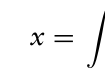
HMDs generate complex force interactions with users’ heads while being worn. In order to analyze their static wearability, we can simplify the forces to (1) pressure perpendicular to the contact surface; and (2) friction parallel to the contact surface. The following equation describes how, the addition of motion results in a dynamic force change between the HMD and its user’s head, and as a result, a relative slip:
ZZ f
ZZ
ZZ
Equation reproduced from the original PDF.
a.dt.dt −
g.dt.dt
dm.dt.dt −
f is the friction force at the HMD’s contact point, dm is the mass of the HMDs at the contact point, g is the acceleration of gravity, and x is the rela- tive slip between the HMD and the user’s head. The HMD slides relatively when head movement occurs because the static friction’s acceleration af is smaller than the head motion’s acceleration.
In current studies, the relative slip issue of the device can be improved by increasing the contact pressure, but this results in a notable reduction in the pressure comfort of HMDs (Xueqi Yu 2017). Many alternative design
approaches have been explored, and the contact area between the HMDs and users’ heads differs greatly, which in turn affects the pressure distribution and relative slip. In order to discover appropriate design strategies for HMDs to improve dynamic stability and overall user experience, it is important to analyze the contact area variation of these devices.
Current research on dynamic stability research concentrated mainly on head-worn devices such as masks, headphones, and goggles. There is a lack of attention to the dynamic stability and slippage of HMDs, despite the fast growth of applications. However, current assessment methods can be adopted in the case of HMDs. Yu et al. measured the cumulative displacement of four different designs of headphones during common motion by attaching Ruler Sticker to users’ heads (Ruyang Yu 2021). Pang et al. measured the rotation angle and degree of dislodgement of headsets in motion (Pang et al. 2018). Lee et al. used coordinate paper and an extension ruler to determine the angle of headgear in different postures. The above studies are conducted based on existing products, it would be necessary to study the dynamic stability and comfort of HMDs by changing their attribute variables in a quantitative manner, in order to better develop forward-looking design strategies.
The main purpose of this experiment is to analyze the displacement of HMDs relative to users’ heads in motion. Participants were recruited to eva- luate the wearing comfort. By adding foam pads to change its contact area, the relationship between the contact area, the relative displacement, and the users’ perceived comfort were subsequently investigated.
MATERIALS AND METHOD VR Headset
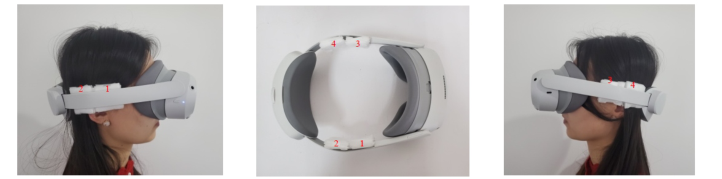
As shown in Fig. 1, a commercial standalone VR headset (Pico 4) was used in this study. Its total weight is less than 300g, and it uses an adjustable hard strap with an adjustment wheel at the back. The left and right sides of the strap aren’t in direct contact with the users’ heads, so we can easily change the contact area between it and the human head.
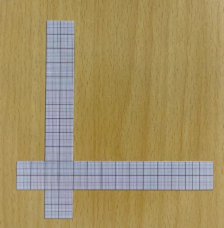
Ruler Sticker A customized ruler sticker was designed to measure the relative displacement of the HMD while being worn. It stuck firmly to the skin of users’ faces without causing apparent discomfort. As shown in Fig. 2, a 1mm grid of coor- dinates was printed on the sticker and can be used to read the HMD’s location
Figure 1: Commercial VR headset, PICO 4.
The Effect of Contact Area on Displacement in User Motion 95
Figure 2: Ruler Sticker.
directly and then determine the relative displacement after the users’ head motion.
Light Dot Tracking VR Game A VR game of light dot tracking was developed for the experiments. In the game, participants were instructed to turn their heads to follow a moving light dot and keep it at the center of their field of vision, as shown in Fig. 3. The head movement can then be indirectly controlled by adjusting the rotation angle and speed of motion of the light dot.
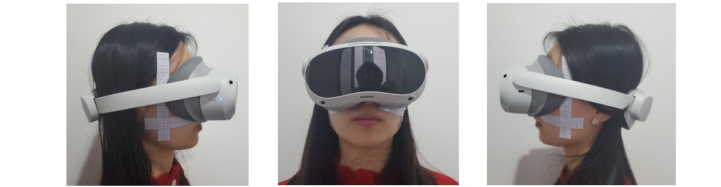
Foam Pads Due to its low density and softness, the foam pad is often used as cushio- ning and protection. In this experiment, it was fastened to the straps of the HMD to change its contact area. The foam pad was cut into small pieces of 20*20mm to fit the size of the straps. Based on the shape of the PICO 4, we chose to add the foam pads at the sides of the head, as shown in Figure 4. Due to its small thickness, there was no change in the contact area when one piece of foam pad was fixed on the HMDs. By continuously changing the number of foam pads, it was discovered that 20 pieces of foam pads could achieve contact between the head and foam pads so the contact area was added 4 cm2. In the experiment, we fixed a set of 20 pieces of 20*20 mm foam pads on each side of the head to increase the total contact area of 8 cm2. In ano- ther group of experiments, we fixed two sets of 20 pieces of 20*20 mm foam pads on each side of the head to increase the total contact area of 16 cm2.
Figure 3: Light dot tracking VR games that lead the head to turn left.Figure 4: The foam pads in the human head position.
Participants A total of 21 participants (13 females and 8 males) were recruited to par- ticipate in this experiment, with an average age of 23 years (ranging from 20 to 26 years old). All participants were in good physical and mental condi- tion, well informed of the process of the experiments, and able to successfully complete the experiment.
EXPERIMENT Prior to the experiment, the experimenter briefly introduced the experiment contents, precautions, and follow-ups to the participants. Then the partici- pants complete a form, providing their basic personal information including their gender, age, etc., and clearly referring to their willingness to participate. Participants’ head circumference and other parameters were taken and recor- ded. The experimenters then helped participants put on the HMD and adjust it comfortably. At this point, participants were asked to complete the first comfort evaluation scale.
With the assistance of experimenters, the participants learned the basic use of the HMD and the operation of the tracking game. After they were familiar with the experiment environment, HMD was taken off and the ruler stickers were pasted on their face. Then they put the HMD back on and tighten it to the same setting as previously. The experimenter then marked on the ruler-sticker the initial coordinate position of the HMD.
Participants completed the specified head movement at the specified speed and acceleration while playing the light dot tracking game. After each game, the participants were prompted to maintain their current positions. The expe- rimenters would assist them in slowly returning to their initial position, and then mark the new coordinate position of the HMD. At that time the par- ticipants were asked to complete the comfort evaluation scale again. The above procedure was repeated five times and all data were recorded. Each participant rested for about 1 min at the end of the whole five experiments and then continued with the next set of experiments.
After that, a set of 20*20mm foam pads were added to each side of the straps to increase the contact area of the HMD with the participants’ heads, in Figure 5. With the addition of one set of spacers each, the straps expand the contact area by 4cm2 in each of the symmetrical places on the left and right sides. And, with the addition of two sets of spacers each, the straps expand
The Effect of Contact Area on Displacement in User Motion 97
Figure 5: Recording of the position of the PICO 4 on participants’ faces.
the contact area by 8cm2 in each of the symmetrical places on the left and right sides. Participants rested for 5 min at this time, and then they needed to readjust the HMD and repeat the experiment. Finally, two sets of 20*20mm foam pads were attached to each side of the strap and the experiment was repeated again. The duration of the whole experiment is about 55min. And between every two experiments, the subjects were given sufficient rest time.
RESULTS
Absolute Value of Displacement The absolute value of displacement (AVD) refers to the average of absolute value of the difference between the initial and the final position of the VR headset relative to the users’ head after each movement of the head. Without any change in the VR headsets, the AVD was 0.54 mm in the vertical direction and 0.47 mm in the horizontal direction, after the participants AVD perfor- med head rotation movements. The experimental data showed that the AVD in the vertical direction is more likely to be unstable relative to the horizontal direction, although the difference between the two was not statistically signi- ficant (p>0.05). Statistical analysis also showed that the AVD of the HMD can significantly affect participants’ perceived comfort (p<0.05).
After changing the contact area of the straps, the AVD with head rotation is shown in Table 1. The AVD decreased each time the contact area was expan- ded by adding foam pads. The AVD between the HMD and participants’ heads was 0.30 mm in the vertical direction and 0.46 mm in the horizontal direction after adding two sets of foam pads, and 0.24 mm in the horizontal
Table 1. The relative displacement of VR headsets with different contact areas after rotation and the corresponding comfort score.
AVD: Absolute Value of Displacement. AD: Actual Displacement.
direction and 0.33 mm in the vertical direction after adding four sets of foam pads. Statistical analysis showed that the contact area of the HMD signifi- cantly affected its relative displacement, both in the vertical and horizontal directions (F = 13.2014, p<0.05), which could lead to changes in its overall comfort.
Actual Displacement Compared to the absolute value of relative displacement, the actual value of displacement is the total difference between the initial position and the final position of the HMD relative to the users’ head after all movements of the head. Through the study of the generation mechanism of relative displace- ment of the HMDs, all motions performed by participants in the experiment caused the VR headsets to move significantly. Its direction and values depend on the acceleration magnitude, the time of the acceleration/deceleration pha- ses, etc. These relative displacements have similar values but indicate different situations. After several movements in opposite directions, the relative displa- cements of the VR headsets may cancel each other out, resulting in a smaller value of the AD compared to its initial position.
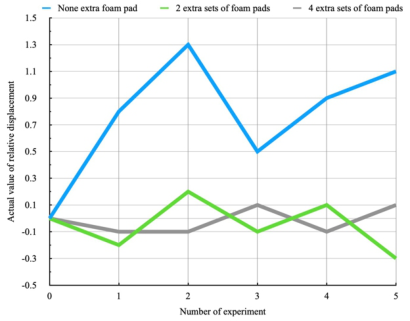
The AD of the Pico 4 after five movements were shown in Table 1. Similar to the AVD, the AD decreases gradually with the increase of the contact area. However, in contrast to the AVD, it was smaller. The AD between the VR headsets and participants’ heads was 0.22 mm in the vertical direction and 0.16 mm in the horizontal direction without any change of VR headsets, 0.15 mm in the vertical direction and 0.09 mm in the horizontal direction after adding two sets of foam pads, 0.07 mm in the vertical direction and 0.02 mm in the horizontal direction after adding four sets of foam pads. As shown in Fig. 6, it can be found that all motions performed by a par- ticipant in the experiment caused the HMD to move significantly. These relative displacements have similar values but indicate different situations. This means that the actual displacement can only conclude the overall change of the position of HMDs after a series of user motions, but cannot reflect
Figure 6: The change in position of the HMDs during five experiments of a participant.
The Effect of Contact Area on Displacement in User Motion 99
the dynamic stability in detail during the process. For example, after adding 2 sets of foam pads in the experiment, the HMD will produce a relative displacement of about 0.3mm with each head movement, like “shaking” back and forth, however, the actual displacement is only −0.3mm. Therefore, the actual displacement cannot be used as the main evaluation indicator for HMDs’ dynamic stability, yet can provide references for more comprehensive analyses.
DISCUSSION
Through quantitative experiments, it can be found that the motion of users’ heads leads to the obvious relative displacement of the HMDs, causing them to deviate from their initial position and reducing users’ perceived comfort. The most obvious way to improve the dynamic stability of the HMDs is to fix it more tightly thus putting more pressure on users’ heads, which will inevitably increase their discomfort. As for the design optimization strategy, it is important to balance pressure comfort in the contact area of the users’ heads with HMDs, and the device’s dynamic stability in user motion.
There existed multiple design possibilities for improving the stability of HMDs. While Oculus Quest 2 uses a flexible braided strap, PICO 4 and many new VR headsets use rigid materials to wrap around the outside of straps, which relies on soft spacers at the front and back to adjust. The latter usually has no direct contact with the user’s head, its limited contact area reduces the friction of the device in the state of motion. In this study, it can be found that under the same rotation, the relative displacement of the HMD was greatly decreased as the contact area of the strap increased. Due to the added friction on both sides of the users’ heads, the HMD would start to slide at a greater angular acceleration, so the sliding trend was suppressed. Attempts to expand the contact area on users’ heads with HMDs could be an effective way to improve the device’s dynamic stability, such as using a wavy shape on the inside of the device, applying mesh-like or Three-dimensional- knitted structure to the straps, or providing standardized pads that users can easily clip on and off, etc.
LIMITATIONS As a tentative exploration for dynamic stability assessment, this experiment still had some limitations. For example, the participants found it difficult to precisely follow the motion of the light dot in the VR game. And due to human subjective limitations, it is difficult for the participants to ensure the exact same head movements as the light dot, so the actual angular velocity and acceleration of participants’ head movement could not be fully consistent with the experiment design, since their eyes would unavoidably be squinted while playing the game.
In addition, during participants’ head movements, the displacements of the HMDs could change dynamically when participants moved or stopped sud- denly. However, this experiment was designed to measure the accumulated relative displacement of the HMD at the end of the entire motion. The relative
displacement at each point in real-time could not be measured accurately, which can be improved in further studies by using acceleration sensors, etc.
CONCLUSION
This experiment proposed a method to explore the dynamic stability of the HMDs during users’ head movements. The results showed that the abso- lute value of displacement (AVD) can be directly used to assess the dynamic stability of the HMDs, and the actual displacement provides referential infor- mation for the comprehensive evaluation of dynamic stability. Furthermore, it can be found that the dynamic stability of HMDs was significantly impro- ved, when the contact area on the user’s head with the device increased. The expansion of the contact area might lead to a minor decline in users’ pressure and thermal comfort, however, a higher overall comfort could be achieved. Based on these observations and analyses, new design concepts are to be expected in the future to better adapt to the more complex and dynamic use scenarios of HMDs in IVR systems.
ACKNOWLEDGMENT
This work is supported by the Beige Institute, China.
REFERENCES
Ball C, Huang KT, Francis J (2021) Virtual reality adoption during the COVID- 19 pandemic: a uses and gratifications perspective. Telemat Inform 65:101728. https://doi.org/10.1016/j.tele.2021.101728 Dunnagan CL, Gallardo-Williams MT (2020) Overcoming physical separation
during COVID-19 using virtual reality in organic chemistry laboratories. J Chem Educ 97(9):3060–3063. https://doi.org/10.1021/acs.jchemed.0c00548 Gemperle F, Kasabach C, Stivoric J, Bauer M, Martin R (1998) Design for wearability. Digest of Papers of 2nd International Symposium on Wearable Computers, Pittsburgh, 1998:116–122. Grabowski A (2021) Virtual reality and virtual environments: a tool for improving
occupational safety and health. CRC Press. Pears M, Yiasemidou M, Ismail MA, Veneziano D, Biyani CS (2020) Role of immersive technologies in healthcare education during the COVID-19 epidemic. Scott Med J 65(4):112–119. https://doi.org/10.1177/0036933020956317 Pérez-Escamirosa F, Medina-Alvarez D, Ruíz-Vereo EA, Ordorica-Flores RM, Minor-
Martínez A, Tapia-Jurado J (2020) Immersive virtual operating room simulation for surgical resident education during COVID-19. Surg Innov 27(5):549–550. https://doi.org/10.1177/1553350620952183 Riva G, Wiederhold BK (2020) How cyberpsychology and virtual reality can help us to overcome the psychological burden of coronavirus. Cyberpsychology Behav Soc Netw 23(5):277–279. https://doi.org/10.1089/cyber.2020.29183.gri Ruyang Y, Yuan C, Xinyi L, Haining W, Renke H (2021) The Stability of Headph-
ones. 12th International Conference on Applied Human Factors and Ergonomics and the Affiliated Conferences, Cham, 2021. Talwar S, Kaur P, Nunkoo R, Dhir A (2022) Digitalization and sustainability: virtual reality tourism in a post pandemic world. J Sustain Tour. https://doi.org/10.1080/ 09669582.2022.2029870 Xueqi Y (2017) Building a Sport Eyewear Human Comfort Rating Scale. Science
Innovation 5(5): 307–312.
LISTED IN THE AHFE DIGITAL BOOKSTORE CATALOGUE
Explore the complete digital volume
Human Factors and Wearable Technologies
Read this individual research paper free through the original publisher, or explore the full digital proceedings book.
ISBN 978-1-958651-61-2
Explore this ISBN in the AHFE Bookstore ↗Listed in the July 2026 bookstore catalogue; search by ISBN to confirm current availability · Digital book purchase optional