Hiu Tung Yu, Pak Yiu Liu, Ka Po Lee, Xiaolu Li, Joanne Yip (2024). An investigation of garment construction and textile properties in enhancing the plus-size shapewear bra effectiveness. In: Human Factors for Apparel and Textile Engineering. AHFE Open Access, vol. 134, pp. 137–146. https://doi.org/10.54941/ahfe1004923
This study aims to develop an initial design concept to enhance the contouring function of a plus-size shaping bra by investigating significant design features, garment construction, and textile characteristics. The golden ratio theory of the female breast is employed as a reference for evaluating the contouring effectiveness of the plus-size shapewear bra. This evaluation was conducted by collecting visual and numerical data from a 3D body scanner. Additionally, this study investigated perceived comfort in terms of thermal and pressure aspects to establish the correlation between garment construction and wearing comfort. In the experiment, two female subjects with 80D cup sizes were invited to evaluate four plus-size shapewear bras with varying design features. Qualitative and quantitative feedback is gathered through questionnaire and wear trials. The results indicate that a shorter shoulder strap distance, cross-back strap position, and bra cup construction are ideal for supporting and distributing the breast load. Moreover, the stretchability of fabric is found to be correlated with enhancing the contouring function by applying proper garment pressure. Evaluating the thermal comfort of garment is the secondary objective to provide insights into the overall perceived comfort of plus-size shapewear bras available in the market. These results could serve as a valuable reference for advancing bra design for plus-size females and offer potential avenues for further development.
Brasseries are daily lingerie garments essential for females in maintaining their breast health and preventing degeneration of the soft tissue with grav- ity caused by the gravitational pull of the breast load (Wang et al., 2011). In the recent lingerie market, many companies have promoted various types of brasseries that incorporate different functions and designs to cater to the needs of females with diverse body and breast shapes. To achieve a natural breast shape, female customers are likely to purchase shapewear brasseries that aid in gathering breast tissue and contain a push-up function to look less saggy. However, this type of shapewear garment has limitations in providing
the proper cup size for plus-size females with a good fitting and contour- ing function. Generally, bra size in 80D is defined as plus-size bra size in the Asia market, in which the difference between overbust and underbust is 17.5 cm (Zheng et al., 2007). According to the findings of Haworth et al. (2022), two major issues related to the general fitting of the shapewear gar- ments were observed: the garment being either too loose or too tight, and the cups were found to be inadequate in providing complete support for the breast, and thus the bra panels not conforming to the body. Also, recent academic research appears to lack the authority to prove that shaping gar- ments can effectively address the ill-fitting issue by providing a comfortable wearing experience and reshaping the body contour with adequate support. In addition, several literature studies have examined the negative influence resulting from the ill-fitting issue, such as the shapewear with poor control in distributing tension and exerting excessive force on the wearers, lead- ing to discomfort or even harm to potential health risk to a certain degree (McGhee & Steele, 2010; Wood et al., 2008; Haworth et al., 2022). Moreover, the multi-layers of the garment panels of the shapewear, like bra cup and side panel, may block the ability to evaporate the per- spiration on the skin, which may contain the potential risk of caus- ing skin irritation (Leung et al., 2021). In view of this, the pri- mary objective of this study is to identify the proper construction of plus-size shapewear to enhance the perceived comfort in thermal and pressure aspects, especially in terms of breathability and stretchability. This objective is achieved by investigating the contouring performance of plus-size shapewear bras with different designs and assessing the variations in thermal and pressure aspects of different functional shapewear.
MARKET SAMPLES AND MATERIALS Four functional shaping bras in size 80D were sourced as the mar- ket samples. The basic construction of the samples in this study was selected with a design in 3/4 coverage in a thin layer of the cup in examining its supportive function to breast tissue, as well as the shoul- der straps slippering or displacement issues with two types of shoulder straps design. Table 1 documents the images of the samples with the front, back, and side views and indicates the basic construction of the market samples.
To examine the factors affect the contouring effect and perceived comfort of functional shaping bras, a comprehensive investigation was conducted. This involved selecting ten specimens and divided them into five fabric cat- egories based on their used materials, structure, weight and composition. Table 2 lists the materials with names from Fabric A to Fabric J and information on fabric type, composition, thickness, and the technical image.
An Investigation of Garment Construction and Textile Properties 139
Table 1. The plus-size shapewear samples purchased from the market.
Table available in the original PDF paper.
Table 2. Material specification.
Table available in the original PDF paper.
EVALUATION METHOD For testing the textile properties of the specimens, four different experi- ments were conducted. All samples were conditioned at an environmental temperature was retained at 20±1
C with the humidity at 65±2% for 24
hours before the experiments to ensure the consistency of test conditions. For evaluating the thermal comfort, air permeability tester and moisture man- agement tester (Standard: AATCC TM195) were conducted to analyze the permeability by measuring the ventilation resistance (kPa.s/m) value, while the quick dry function of materials was examined by measuring the wet- ting time and water absorption rate. A stretch and recovery tester (Standard: ASTM D6614-07) was utilized to analyze stretchability, length growth after stretching, and recovery rate after releasing the stretch force.
Furthermore, to ensure rigorous testing and minimize experimental bias influenced by previous wearing experiences, two subjects with a normal BMI and cup size of 80D aged 20 were recruited for the wear trial in a conditioned room (20±1
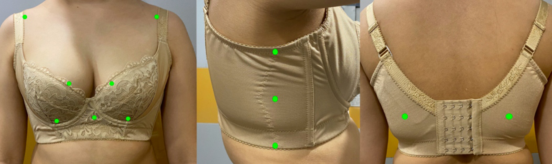
C and at 65±2% humidity). Each market sample was worn by the participants for a duration of 10 minutes, followed by a resting period of 5 minutes to allow the body condition to return to its baseline state. During the experimental process, the subjects were instructed to swing their arms 30 times, then walk slowly for 3 minutes, and subsequently sit for 5 minutes. This wear trial aimed to stimulate the situation of their daily routine. Simul- taneously, the Pliance®-fx-16 system with 3 × 3 socket sensors was used to measure the pressure exerted by the functional garment by placing the sen- sors between the skin and garment at the main pressurized areas, namely the neckline, bottom cup, side panel, and wing as shown in Figure 1. Addi- tionally, the samples were tested with the FLIR infrared imaging camera to capture and analyze the changes in skin temperature before and after wear- ing each sample garment. A 3D body scanner was also used to evaluate the contouring effect by measuring the breast depth and lower pole angle.
Figure 1: Body landmarks on human subjects for garment pressure evaluation.
RESULT AND DISCUSSION
Material Test The results of thermal comfort in terms of air permeability and moisture management ability are presented in Table 3. Fabric A (3 kPa.s/m) exhib- ited lower ventilation resistance compared to fabric B (4.3 kPa.s/m), which means the textile layer of fabric A allows for a consistent airflow without blocking or trapping the air between the skin and fabric. Fabrics with net structure, including fabrics C (lace), fabric E (half tricot), and fabric H (pow- ernet) perform with higher air permeability in their category with the value of 3.4 kPa.s/m, 2.9 kPa.s/m, and 4.6 kPa.s/m, respectively. Lastly, for the foam
An Investigation of Garment Construction and Textile Properties 141
cup, Fabric I (spacer fabric) contain the best breathability among all fabric specimens, with a ventilation resistance value of 2.1 kPa.s/m.
Table 3. Materials properties in air permeability and moisture management ability.
Absorption rate (Percentage) *The numerical results of wetting time, absorption rate, and spreading time are collected by measuring the mean value of the top and bottom surface of the fabric specimens.
Moreover, it was found that fabric thickness and weight affect breathabil- ity. Thicker fabrics, or fabrics with higher weight that contain higher density and less porosity, hinder the complete passage of airflow through the textile layer (Havlová, 2021; Lee et al., 2022). In the moisture management exper- iment, fabrics A and B (cotton lycra fabrics) demonstrate the fastest wetting time among other types of fabrics. This is because cotton fibres are hydro- halic and able to absorb the liquid within 4 seconds (Table 3). Fabrics E and F (half tricot /stabilizer fabrics) exhibited the longest wetting time, ranging from approximately 64 seconds. In terms of water absorption, fabrics A and B (cotton lycra), as well as fabric G (powernet), exhibit superior performance in absorbing liquid compared to the others, with absorption rates of 42.5%, 51.9%, and 64.7%, respectively. Fabric C to F and J demonstrate the faster spreading within 0.5 seconds, while Fabric A and B exhibit the longer spread- ing speed of 4.6 to 5 seconds. Therefore, as a close-skin garment, Fabric A and B (cotton lycra) offer a quick-dry function and higher water absorption ability that could keep the skin surface cool by transferring the sweat away to the outer layer rapidly without trapping the perspiration on the skin and causing stickiness. Wang et al. (2018) and Yu (2011) stated that the discom- fort level of moisture sensations has a more significant impact on human comfort compared to thermal sensations.
In the stretch and recovery experiment, Fabric E, F, I, and J were excluded from analysis as these specific textile materials did not require stretching in the areas of application. Refers to Table 4, fabrics G and H (powernet) have the highest value in stretchability, with 90.3% to 116.65%, followed by fab- rics A and B (cotton lycra), containing a stretch of around 80% to 84%, and fabric C and D (lace) contain the lowest stretchability of 31% to 39%.
According to Yu (2006), textile fabric with an extension rate of 30% to 35% or higher are known to enhance the comfort level of wearing. On the other hand, fabrics with an extension rate lower than 40% may exhibit a better performance in shaping the body contour by effectively controlling the fatty tissue with slight tension. Generally, fabrics with higher stretch
and recovery values are often considered as having outstanding performance. However, the required level of stretchability may vary depending on the spe- cific garment types. When selecting textiles for foundation garments, it is important to strike a balance, because stretchable fabrics may compromise the shaping effect. In this study, fabrics B, C, and G emerge as the optimal choices for creating shapewear with appropriate stretchability and a high recovery rate, ensuring durability and effective body contouring.
Table 4. Stretch and recovery values of specimens.
Table available in the original PDF paper.
Fabrics Cotton Lycra Lace Powernet
A B C D G H Stretch 80% 84% 39% 31% 90% 116% Growth 27 mm 12.9 mm 0.1 mm 2.8 mm 5.4 mm 4 mm Recovery 67% 84% 99% 91% 94% 96%
Wear Trial Following the experiment of wear trial (see Table 5), it is observed that sam- ple 4 shows the most stable change in skin temperature compared to the other samples. This can be attributed to appropriate tension exerted by the garment at the underarm, without raising the skin temperature by over-compressing the fatty tissue. Additionally, the change in skin temperature while wearing all samples remained within the average standard around 32
C–35
C, with a maximum variation of no more than 5
C (Lee et al., 2019).
Table 5. Comparison of skin temperature on particular area.
The garment pressure of a plus-size shapewear bra has contributed to reshaping the body with appropriate tension. In Table 6, it can be observed that sample 4 exhibited the lowest pressure value in each area, which means it demonstrate superior performance in pressure comfort without over-pressing the breast tissue with tightness. According to Song (2011) and Gong & Mei (2019), pressure values ranging from 0.49 kPa.s/m to 2.6 kPa.s/m are considered the most comfortable for the shaping garment. Once the value exceeds 5.88 kPa.s/m, wearers may perceive the garment as excessively tight and uncomfortable, which affects blood circulation and has negative effects on human health. Given the standard as a reference, sample 4 demon- strates effective control in maintaining the pressure value within the comfort
An Investigation of Garment Construction and Textile Properties 143
range for various positions, including neckline, bottom cup, side panel, mid- wing, and underband, with pressure value ranging from 0.08 kPa.s/m to 2.14 kPa.s/m. The appropriate pressure value on the neckline enables the prevention of bulging issues, such as a double-breast profile or flattening of the breast shape with excessive pressure. Although the pressure value on the shoulder slightly exceeded 2.6 kPa.s/m, it remains below the limit of 5.88 kPa.s/m. Therefore, to mitigate any potential discomfort and prevent muscle fatigue during daily wear, the incorporation of wider shoulder straps and a cross-shoulder strap design can aid in distributing the pressure evenly across the shoulder area.
Table 6. Comparison of pressure rate on a particular area.
Table available in the original PDF paper.
Placement of Pressure Sensor
Items Shoulder Neckline Bottom Cup Side Panel Wing Underband
Based on the observations in Table 7, it can be summarized that the length of the high neck point to the bust point in all samples generally reached the standard of the golden breast ratio of 21. 5 cm ±1 cm. Among them, sam- ple 4 shows the most outstanding performance in reshaping the back flesh, resulting in the deepest breast depth of 12.2 cm, followed by samples 1, 2, and 3 in 10 cm to 11.75 cm. The visual results show an impressive advanced shaping function in concentrating and shortening the distance of bust points, achieved through the design features of a shelf bra support with powernet, stretchable lace as a sling, and the most significant design with the high apex to provide excessive support to uplift the breast tissue. Although the public was concerned that the 3/4 cup design could not provide adequate support to breasts, these components help evenly distribute the breast tissue and create a smooth and natural breast curve from the top view, unlike sample 2 on the left breast of human subject B. Hence, the 3D images proved that a bra con- structed with a high apex and sling could effectively support the breast tissue, similar to the supportive effect contributed by the full-cup bra. Furthermore, the wide wing panel and cross-back shoulder strap design aid in relocating the fatty tissue at the upper back, resulting in slight compression and reshap- ing the upper torso to appear slimmer while restoring the natural back curve. Additionally, the contouring performance of sample 4 lifts the breast to reach a lower pole angle of 55.9
, which caters to the golden ratio standard of the upper and lower poles at 45:55 (Rubano et al., 2019; Sandberg et al., 2021). Although samples 1 and 2 are able to create a natural roundish breast curve with the lower pole angle of 46.9
and 49.1
, respectively, the upper chest appeared flatter compared to sample 4.
Refers to Table 7, the cross-back shoulder strap design of sample 4 demon- strates the ability to evenly distribute the pressure on the shoulder due
to the larger surface of the strap. The placement of shoulder straps effec- tively straightens the back while maintaining an appropriate strap width of 22.5 cm, preventing them from sliding off from the shoulder or causing dis- comfort to underarms and breasts during movement. Therefore, it proved the shoulder strap position of sample 4 is an appropriate placement for a plus-size shaping bra while maintaining wearing comfort. In addition, the inclusion of shelf bra support in the garment design facilitates the gathering of breast tis- sue and fatty tissue from the underarm to the centre of the chest, lifting the breast tissue upward and creating an attractive and natural curve. It means that the shelf bra support specifically addresses the issue of sagging breasts caused by gravity. Regarding the construction of the inner cup, although a 3-piece cup can provide additional support to uplift the breast tissue and cre- ate a rounded appearance, it may result in the unnatural shape compared to a cut and sewn cup. Also, the inclusion of the inserted bone in the bra cup is unnecessary for enhancing the shaping effect which may contain risk in over-compressing the breast tissue from the sides.
Table 7. Digital figures of human subjects captured by 3D body scanner.
Table available in the original PDF paper.
Items Sample 1 Sample 2 Sample 3 Sample 4
Front Subject A
Subject B
Side Subject A
Subject B
In addition to the garment construction, the stretchability of the fabric plays a crucial role in contouring effectiveness by exerting slight force to com- press the breast tissue. The bra cup of sample 4 that made of stretchable lace and spacer fabric provides adequate support for the breast tissue, allowing it to fit well in the cup and push upward from the bottom cup direction. Con- versely, samples 1 to 3 with thin layer of cotton fabric cup lack the necessary support in shaping the upper breast due excessive stretchability and softness, resulting in less control over tissue placement.
An Investigation of Garment Construction and Textile Properties 145
CONCLUSION
In conclusion, the findings discussed in this paper indicates the significant impact of garment construction and fabric selection on the perceived com- fort of functional shapewear bras for plus-size females. The stretchability and recoverability of textiles play a crucial role in body contouring effectiveness, as they provide additional support to the shapewear by gathering the fresh tissue and slightly compressing fatty tissue in areas such as the underarm or upper back, resulting in a slimmer appearance. The 3D body scan images reveal that the sling and shelf panels generally lead to better shaping effects, which effectively uplifting the upper breast and achieving a more natural look in line with the concept of the golden ratio for the breast. For thermal and pressure comfort, fabric with higher stretchability, exceeding 40%, can enhance the pressure comfort against applied excessive pressure to the skin surface that contains risk of causing fatigue or affecting blood circulation in raising the body temperature by over-compressing the breast tissue. Fur- thermore, the porosity, thickness, and structure of fabric significantly affect breathability and moisture transmission ability in evaporating the perspira- tion away from the skin surface. Therefore, these properties highly affect the thermal and moisture comfort of a plus-size female daily intimate garment.
ACKNOWLEDGMENT
This research was funded by The Hong Kong Polytechnic University Grant under the Project of Strategic Importance titled “Investigate the Mecha- nism Underlying the Efficacy of Conservative Management” (project code: 1-ZE2H).
REFERENCES
Gong, Y. Q., & Mei, S. Q. (2019, November). Stretch elasticity and garment pressure of shaping-underwear fabric. In IOP Conference Series: Materials Science and Engineering (Vol. 684, No. 1, p. 012010). IOP Publishing. Havlová, M. (2021). Air permeability and structural parameters of single jersey
knitted fabric. Fibres and Textiles, 28(3), 20–27. Haworth, L., May, K., Janssen, J., Selfe, J., & Chohan, A. (2022). The impact of breast support garments on fit, support, and posture of larger-breasted women. Applied Ergonomics, 101, 103701. Lee, C. M., Jin, S. P., Doh, E. J., Lee, D. H., & Chung, J. H. (2019). Regional variation
of human skin surface temperature. Annals of Dermatology, 31(3), 349–352. Lee, K. P., Yip, J., & Yick, K. L. (2022). Investigating the Factors Affecting the Thermal and Tactile Comfort of Summer Undergarments. Human Factors for Apparel and Textile Engineering, 32, 46. Leung, K., Shin, K., Han, F., & Jiao, J. (2021). Ergonomic mastectomy bra design:
Effect on core body temperature and thermal comfort performance. Applied Ergonomics, 90, 103249. McGhee, D. E., & Steele, J. R. (2010). Optimising breast support in female patients through correct bra fit. A cross-sectional study. Journal of Science and Medicine in Sport, 13(6), 568–572.
Rubano, A., Siotos, C., Rosson, G. D., & Manahan, M. A. (2019). The notion of the ideal breast and its variability: reviewing the difficulty of perceiving beauty through defined margins. The Breast Journal, 25(5), 938–941. Sandberg, L. J., Tønseth, K. A., Kloster-Jensen, K., Liu, J., Reece, G., Halle, M.,... &
Selber, J. C. (2021). Beyond the 21-cm Notch-to-nipple Myth: golden proportions in breast aesthetics. Plastic and Reconstructive Surgery Global Open, 9(10). Song, G. (2011). Improving Comfort in Clothing (Vol. 106). Elsevier Science & Technology. Wang, L., Chen, D., & Lin, B. (2011). Effects of side strap and elastic hems of
bra materials on clothing pressure comfort. Journal of Fiber Bioengineering and Informatics, 4(2), 187–198. Wang, Z., de Dear, R., Luo, M., Lin, B., He, Y., Ghahramani, A., & Zhu, Y.
(2018). Individual difference in thermal comfort: A literature review. Building and Environment, 138, 181–193. Wood, K., Cameron, M., & Fitzgerald, K. (2008). Breast size, bra fit and thoracic pain in young women: a correlational study. Chiropractic & osteopathy, 16(1), 1–7. Yu, W. (2006). Innovation and technology of women’s intimate apparel. CRC press. Yu, W. (2011). Achieving comfort in intimate apparel. In Improving comfort in
clothing (pp. 427–448). Woodhead Publishing. Zheng, R., Yu, W., & Fan, J. (2007). Development of a new chinese bra sizing system based on breast anthropometric measurements. International Journal of Industrial Ergonomics, 37(8), 697–705.
LISTED IN THE AHFE DIGITAL BOOKSTORE CATALOGUE
Explore the complete digital volume
Human Factors for Apparel and Textile Engineering
Read this individual research paper free through the original publisher, or explore the full digital proceedings book.
ISBN 978-1-964867-10-6
Explore this ISBN in the AHFE Bookstore ↗Listed in the July 2026 bookstore catalogue; search by ISBN to confirm current availability · Digital book purchase optional