Zhongping Ye, Joanne Yip, Jason Cheung, Ruixin Liang, Jun Zhang, Xiaolu Li, Kai-Yu Tong (2023). Posture correction girdle with intelligent padding system to dynamically adjust the pressure distribution and correct the scoliotic spine. In: Healthcare and Medical Devices. AHFE Open Access, vol. 79, pp. 12–20. https://doi.org/10.54941/ahfe1003468
The progress of adolescent idiopathic scoliosis (AIS) affects the patient’s living quality by increasing the posture imbalance. In early scoliosis, postural correction may be provided to halt the progression of the deformity. Thus, bracing treatment will be introduced to the patients. Compared with the traditional hard brace, the soft brace is preferred due to its intrinsic compliance and light weight. However, in the soft brace, the ideal correction constraints and the contact pressure among the body points are hard to be identified. Therefore, in this study, a new pneumatic padding system is introduced to the posture correction girdle which could dynamically adjust the paddings’ contact pressure. With this calibration design, the therapist could immediately see the effects of the posture correction girdle on patients with different pneumatic pressure from a sitting balance sensing system. Hence, this padding system could provide precise adjustments in order to optimize the pressure level and corrective effect. We have conducted a wear trial with 3 mild scoliosis young subjects with cobb angle between 10-20 degrees. They were invited to undergo a 2-hour trial of the girdle with the optimized pressure parameter. The immediate effects of the posture correction girdle with intelligent pads were evaluated by comparing pre-wearing and post-trial X-ray and 3D scan images. The changes of Cobb and postural angles show that the girdle could reduce the scoliosis curvature and postural imbalance of the subjects. This study demonstrates that an intelligent and sophisticated padding system could be a new alterative intervention to provide optimized pressure with ergonomic designed garments that provide a better healthcare support for patients.
Posture Correction Girdle With Intelligent Padding System to Dynamically Adjust 13
INTRODUCTION
Scoliosis is an abnormal spinal curvature symptom and is diagnosed when Cobb angle is larger than 10 degrees. The progression of adolescent idiopa- thic scoliosis (AIS) can happen more commonly in girls during the growth spurt at puberty (Negrini et al., 2018). This increase will give patients larger posture imbalance, pain, and functional limitations which will reduce their quality of life from a young age (Weinstein et al., 2008). And one of the main factors of this progress is the vicious circle where the patients with spinal deformation will have a larger possibility to increase the deviation with their influenced posture and the reduced ability of body control (Beaulieu et al., 2009; Wong and Wong, 2008; Chen et al., 1998). However, at the early stage of scoliosis, the commonly adopted periodical observation method (Weiss and Goodall, 2008) cannot break this circle. Therefore, bracing treatment can be an alternative method to adjusting the patient’s posture. And accor- ding to the guidelines, soft bracing is one of the acceptable options for early scoliosis treatment (Negrini et al., 2018) which is compliant and light weight, and has a more affordable price than the traditional braces.
Bracing treatment is commonly based on the concept of three points curve correction: one point applies pressure on the curve apex and the other two points give the counter-pressure at each side of the curve (Chalmers et al., 2012; Mac-Thiong et al., 2004; Rigo and Gallo, 2010). And some soft bra- ces, like SpineCor and SpinealiteTM, use the combination of body rotational and tilting constraints to achieve their corrective movements (Coillard et al., 2003; Ali et al., 2020). Although the strategies are varied, the main purpose of the bracing devices is coherent: the brace needs to offer sufficient corre- ctive forces according to the patient’s needs. However, due to the intrinsic compliance of the soft brace, the corrective effect can be easily varied depen- ding on the wearing and daily movement. Hence, finding and keeping the ideal corrective constraints for the patient can become a challenging problem during the soft brace customization.
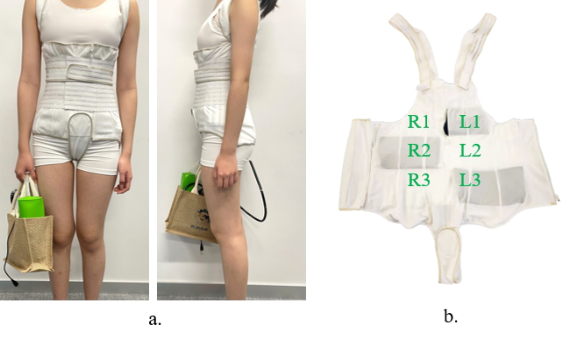
In the previous studies, researchers have adopted the airbags to maintain the contact pressure inside the hard braces and proved to be more effective in the AIS treatment (Lou et al., 2005; Chalmers et al., 2012; Lin et al., 2020). Meanwhile, Liu et al. (2015, 2022) have developed a soft posture cor- rection girdle for early AIS treatment. This girdle is composed of external fabric base, resin bones as primary support, and ethylene vinyl acetate (EVA) foam paddings for specific pressure adjustment (Liu et al., 2015, 2022). As the EVA foam is semi-rigid and pre-made, thickness adjustment on the corre- ctive points is rough which can influence effect of posture correction. Thus, in this study, calibratable pneumatic padding system are introduced to replace the EVA paddings in the girdle pockets (see Figure 1). These paddings will be adjusted according to the subject’s sitting pressure distribution which was shown to be different according to their AIS patterns (Jung et al., 2015). And the immediate effect of posture correction system to early scoliosis ado- lescents is investigated by the 2-hour wearing trial. The result is evaluated based on the pre-wearing and post-trail data including the 3D scanning and the X-ray images.
Figure 1: Padding system with the posture correction girdle: a. system wearing in front view and side view, and b. pockets inside the girdle.
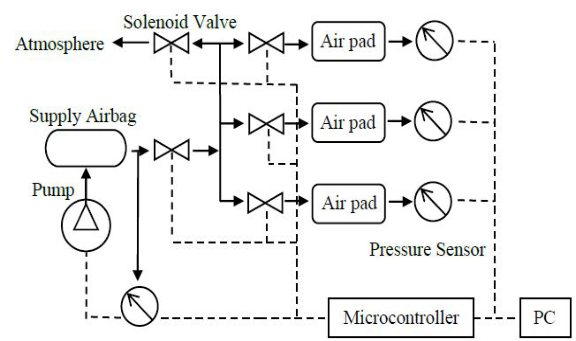
MATERIAL AND METHODS Pneumatic Padding System. To replace the EVA paddings, a new pneumatic padding system is developed for pressure adjustment and patient fitting. It consists of a microcontroller base on ATmega328P (Atmel, San Jose, Califor- nia, USA), five solenoid x-valves (Parker Hannifin, Mayfield Heights, Ohio, USA), four XGZP6847A pressure sensors (CFsensor, Wuhu, China), three customized airbags, one air supplying airbag and one pneumatic 520-20PM micro pump (ZhiRongHuaGuan, Dongwan, China). The pump is powered by a 12V 1000mAh LiPO battery (Turnigy, Kwun Tong, HKSAR). And other devices are powered by a 5V 10000mAh power bank (Mi, Beijing, China). These customized pads are made of TPU-coated nylon fibers and tailored according to the shape of the girdle pockets. To ensure user safety, all these pads are tested to sustain 20Kpa pressure. The diagram of the system is shown in Figure 2.
In this system, the microcontroller changes the air distribution by altering the valve state and maintains the pneumatic pressure by activating the pump. The air distribution is depending on the commands from the personal com- puter which will designate the pressure for each of the air pads. With these target values, the microcontroller will redistribute the air depending on the current pressure inside pads. If the pressure is lower than the aiming value, the supply airbag will offer pre-pressurized air to the air pad. And if it is higher than the value, the air will be released into the atmosphere. As the paddings are in closely contacted with the subject body, the subject’s brea- thing can cause huge fluctuations to the pressure simultaneously (Chalmers et al., 2012). Therefore, the system evens the pad’s pressure sensor values for every 3 seconds as the value to be compared with the appointed pressure. If evened pressure is within the range of designated pressure plus or minus 0.5kPa for one pad, all the relative valves will be closed. As for the air sup- ply, the microcontroller is designed to keep the supply airbag inside pressure from 15 to 20kPa. Using the supply airbag as a buffer, the air can be delivered
Posture Correction Girdle With Intelligent Padding System to Dynamically Adjust 15
Figure 2: Control diagram of the pneumatic padding system.
more smoothly, and the frequency of the pump activation can be reduced. In other words, a pump with an airbag can be less annoying compared with a pump-only design.
Subjects. In this study, three scoliosis subjects were invited. These subjects meet the criteria of age between 10 to 13 years old, female, with mild scoliosis indicated by the Cobb angle from 10 to 20 degrees. They had not taken any spinal treatment before, and they were physically and mentally capable of taking the wear trial. All these subjects had given us their informed consent before the data collection and the trial. Their basic information is summarized in Table 1.
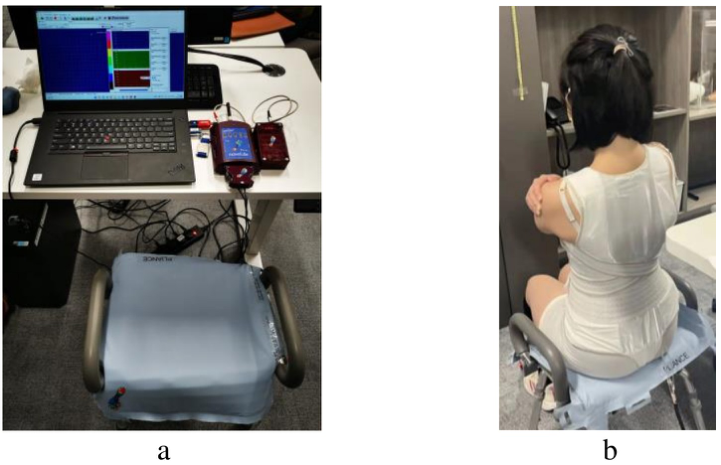
Fitting and Wearing Trial. The size of the girdles were designed and sele- cted according to the patients’ height, and the paddings were inserted into the girdle pockets at the heights of the scoliosis border and apex. For bet- ter fitting, the subject’s sitting balance was measured with a Pliance pressure mat system (Novel Gmbh, Munich, Germany) (see Figure 3a). This mat has a 392 × 392mm2 sensing area with a 16 × 16 sensor arrangement. Each sensor can recognize 2-60kPa pressure on it. This pad was placed on a chair, and subjects were invited to sit on it with their hands placed on the contralateral shoulders as shown in Figure 3b. Their first sitting pressure distribution was recorded in natural wearing. After they donned the brace, their sitting balance would be measured and compared with different pads’ pressure settings. And
Table 1. Basic information about the subjects.
Table available in the original PDF paper.
Cobb angle (
) Height (cm) Weight (kg) BMI
Subject Age Curve type(S/C) 1 13 C 17.1 158.5 50.3 20.0 2 12 S 10.2 158.5 59.8 23.8 3 12 S 13.5 164 47.8 17.7 Mean 13.60 160.33 52.63 20.50 SD 3.45 3.18 6.33 3.08
*BMI: body mass index; SD: standard deviation
Figure 3: Sitting balance measurement: a. pliance system and b. sitting measurement.
during the fitting process, they were not allowed to leave the chair before the calibration was finished. For each measurement, subjects were required to sit stably and record for 30 seconds to take the mean value. The better padding system setting was recognized by three criteria: within the subject’s tolera- nce pressure range, reduced peak sitting pressure, and balanced contact area. The peak pressure and whole contact area were automatically calculated and shown by the Pliance software after each measurement. Among the diffe- rent padding settings, the best-performed one would be selected. Once the fitting was settled, the pressure setting would be memorized by the system, and the padding system would be disconnected from the personal compu- ter. Then, subjects were instructed to take a two hours wearing trial. During the wearing trial, subjects were asked to have different movements including standing, walking, and sitting.
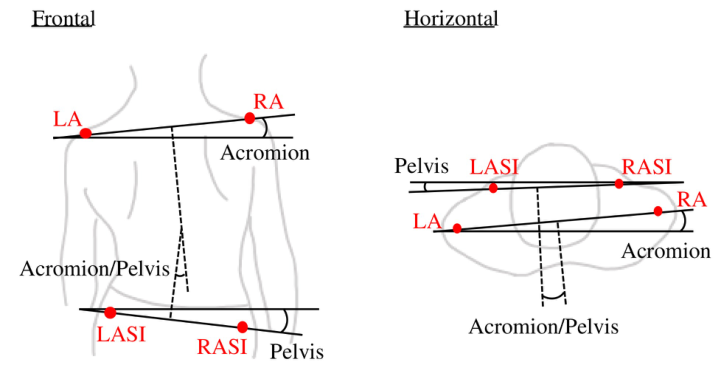
Data Collection and Evaluation. To compare the posture changes of the subjects before the trial (pre) and after the 2-hour with the brace wea- ring (post), 360-degree full-body models were generated by using a three- dimensional scanning system. Subjects were invited to stand on the footprints inside the 3dMDbody system (3dMD, Atlanta, GA, USA) with a natural A pose. Four landmarks, left acromion (LA), right acromion (RA), left ante- rior superior iliac spine (LASI), and right anterior superior iliac spine (RASI), were selected for posture evaluation as shown. 8mm diameter markers were adhered to each landmark for posture angle calculations before the scanning. With these landmarks, acromion, pelvis, and acromion/pelvis angles in the frontal plane and horizontal could be measured as shown in Figure 4. These angle measurements were done by using Fusion 360 (Autodesk, San Franci- sco, USA) on the 3D models. Also, their Cobb angles were measured from the
Posture Correction Girdle With Intelligent Padding System to Dynamically Adjust 17
pre-wearing and post-trial X-ray images. From these data, the effect of the padding system enhanced girdle for posture correction and spinal curvature change could be evaluated accordingly.
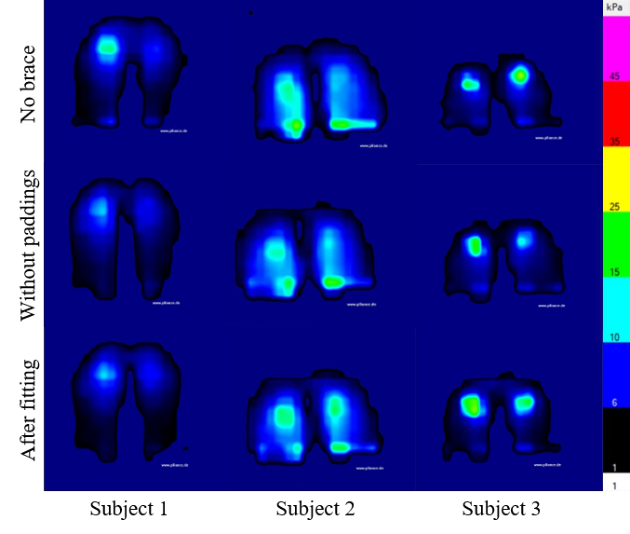
Figure 4: Posture angles in frontal and horizontal planes.Figure 5: Sitting pressure distribution for each subject: without the brace, without paddings, and after the pressure fitting.
RESULT
Sitting balance. The sitting pressure distribution change for each subject is shown in Figure 5. For sitting pressure, more evened pressure distribution and symmetrical contact area mean a better sitting balance. The figure shows that wearing a brace can reduce pressure accumulation and mend the sitting area asymmetry for all subjects. Additionally, having fitted paddings can fur- ther improve the girdle’s balance correction effect. These pressure changes and padding pressure settings are specified in Table 2. Comparing their sit- ting parameters before wearing and after the fitting, the peak pressures are generally reduced, but the contact area changes are varied among the sub- jects. This difference may due to their different sitting imbalance. Although they all have asymmetrical pressure distribution between the left and the right side, subject 2 has a further imbalance between the front and the back side.
Posture and Cobb angles. The posture parameters and Cobb angle before the trial (pre) and after the 2-hour with the brace (post) wearing are listed in Table 3. The posture angles represent the posture deviation from the ideal neutral position. Compared with the pre-posture, after 2 hours of wearing, subjects get a more balanced posture in the frontal plane and more paral- leled shoulder and pelvis in the horizontal plane. And from the Cobb angle comparison, their spinal curvatures are also reduced. This result may imply that improving the AIS sitting balance can also improve their standing posture balance and reduce their spinal deviation. However, due to the limited sample
Table 2. Differences in sitting pressure distribution before and after fitting for each subject.
Posture Correction Girdle With Intelligent Padding System to Dynamically Adjust 19
size, further studies are needed to prove this relationship and the effectiveness of the padding system enhanced girdle for different subjects.
CONCLUSION
In this study, a pneumatic padding system is introduced to the posture corre- ction girdle. It can customize the correction pressure according to mild AIS patient sitting pressure distribution and keep the pressure for daily wearing. These padding adjustments can also have a positive effect on standing posture correction and reduce spinal curvature within a 2-hour wearing trial. Future work would involve more patients to evaluate the system’s effectiveness and improve the system to accommodate different usage scenarios.
ACKNOWLEDGMENT
This study is funded by the Innovation and Technology Fund, HKSAR (Ref. No. ITS/156/20FP) and the Laboratory for Artificial Intelligence in Design (Project Code: RP1-4) Hong Kong Science Park, New Territories, Hong Kong.
REFERENCES
Ali, A., Fontanari, V., Fontana, M. & Schmölz, W. (2020). Spinal Deformities and Advancement in Corrective Orthoses. Bioengineering, 8(1), p. 2. Beaulieu, M., Toulotte, C., Gatto, L., Rivard, C.-H., Teasdale, N., Simoneau, M. &
Allard, P. (2009). Postural imbalance in non-treated adolescent idiopathic scoliosis at different periods of progression. European Spine Journal, 18(1), pp. 38–44. Chalmers, E., Lou, E., Hill, D., Zhao, V. H. & Wong, M.-S. (2012). Development of a Pressure Control System for Brace Treatment of Scoliosis. IEEE Transactions on Neural Systems and Rehabilitation Engineering, 20(4), pp. 557–563. Chen, P.-Q., Wang, J.-L., Tsuang, Y.-H., Liao, T.-L., Huang, P.-I. & Hang, Y.-S.
(1998). The postural stability control and gait pattern of idiopathic scoliosis adolescents. Clinical Biomechanics, 13(1, Supplement 1), pp. S52–S58. Coillard, C., Leroux, M. A., Zabjek, K. F. & Rivard, C. (2003). SpineCor – a non-rigid brace for the treatment of idiopathic scoliosis: post-treatment results. European Spine Journal, 12(2), pp. 141–148. Jung, J.-Y., Bok, S.-K., Kim, B.-O., Won, Y. & Kim, J.-J. (2015). Evaluation for
Postural Balance Pattern of Patients with Adolescent Idiopathic Scoliosis using Pressure Sensor Systems. Recent Advances on Mechanics, Materials, Mechanical Engineering and Chemical Engineering, pp. 138–146. Lin, Y., Lou, E., Lam, T. P., Cheng, J. C.-Y., Sin, S. W., Kwok, W. K. & Wong, M. S.
(2020). The Intelligent Automated Pressure-Adjustable Orthosis for Patients With Adolescent Idiopathic Scoliosis: A Bi-Center Randomized Controlled Trial. Spine, 45(20), pp. 1395–1402. Liu, P.-Y., Yip, J., Chen, B., He, L., Cheung, J., Lun Yick, K. & Pui Ng, S. (2022).
Immediate Effects of Posture Correction Girdle on Adolescents with Early Scoli- osis. Presented at the 13th International Conference on Applied Human Factors and Ergonomics (AHFE 2022). Liu, P.-Y., Yip, J., Yick, K.-L., Yuen, C.-W. M., Tse, C.-Y., Ng, S.-P. & Law, D. (2015).
Effects of a tailor-made girdle on posture of adolescents with early scoliosis. Textile Research Journal, 85(12), pp. 1234–1246.
Lou, E., Chan, C., Raso, V. J., Hill, D. L., Moreau, M. J., Mahood, J. K. & Donauer, A. (2005). A Smart Orthosis for the Treatment of Scoliosis. In: 2005 IEEE Enginee- ring in Medicine and Biology 27th Annual Conference. Presented at the 2005 IEEE Engineering in Medicine and Biology 27th Annual Conference, pp. 1008–1011. Mac-Thiong, J.-M., Petit, Y., Aubin, C.-É., Delorme, S., Dansereau, J. & Labelle, H.
(2004). Biomechanical Evaluation of the Boston Brace System for the Treatment of Adolescent Idiopathic Scoliosis: Relationship between Strap Tension and Brace Interface Forces. Spine, 29(1), p. 26. Negrini, S., Donzelli, S., Aulisa, A. G., Czaprowski, D., Schreiber, S., de Mauroy, J. C., Diers, H., Grivas, T. B., Knott, P., Kotwicki, T., Lebel, A., Marti, C., Maruyama, T., O’Brien, J., Price, N., Parent, E., Rigo, M., Romano, M., Stikeleather, L., Wynne, J. & Zaina, F. (2018). 2016 SOSORT guidelines: orthopaedic and rehabilitation treatment of idiopathic scoliosis during growth. Scoliosis and Spinal Disorders, 13(1), p. 3. Rigo, M. D., Villagrasa, M. & Gallo, D. (2010). A specific scoliosis classification
correlating with brace treatment: description and reliability. Scoliosis, 5(1), p. 1. Weinstein, S. L., Dolan, L. A., Cheng, J. C., Danielsson, A. & Morcuende, J. A.
(2008). Adolescent idiopathic scoliosis. The Lancet, 371(9623), pp. 1527–1537. Weiss, H.-R. & Goodall, D. (2008). The treatment of adolescent idiopathic scoliosis (AIS) according to present evidence. A systematic review. European Journal of Physical and Rehabilitation Medicine, 44(2), pp. 177–193. Wong, W. Y. & Wong, M. S. (2008). Smart garment for trunk posture monitoring: A
preliminary study. Scoliosis, 3(1), p. 7.
LISTED IN THE AHFE DIGITAL BOOKSTORE CATALOGUE
Explore the complete digital volume
Healthcare and Medical Devices
Read this individual research paper free through the original publisher, or explore the full digital proceedings book.
ISBN 978-1-958651-55-1
Explore this ISBN in the AHFE Bookstore ↗Listed in the July 2026 bookstore catalogue; search by ISBN to confirm current availability · Digital book purchase optional