Jingyi Ma, Ka Po Lee, Kenneth Man Chee Cheung, Kai-yu Tong, Joanne Yip (2025). Advancing Scoliosis Treatment: Development and Evaluation of Anisotropic Textile Brace (ATB) for Enhanced Patient Compliance. In: Healthcare and Medical Devices. AHFE Open Access, vol. 171, pp. 81–88. https://doi.org/10.54941/ahfe1006193
Adolescent Idiopathic Scoliosis (AIS) presents significant challenges in treatment adherence, particularly with traditional full-time hard braces, which are often uncomfortable and psychologically burdensome for patients. This study focuses on the development and evaluation of a new generation of Anisotropic Textile Brace (ATB) designed to enhance patient compliance by improving comfort and flexibility while maintaining the efficacy of traditional braces in reducing spinal curvature.Our research addresses the limitations of existing rigid braces. The ATB incorporates intelligent padding and an exoskeleton with hinged vertebrae. These innovations aim to provide corrective forces and optimize treatment outcomes.The study involves a systematic clinical wear trial with 30 subjects aged 10 to 16, diagnosed with AIS. Throughout the trial, we assessed the effectiveness of the ATB using full-spine coronal and sagittal X-ray imaging with an EOS system, measuring parameters such as Cobb angle, pelvic tilt, sacral slope, and lumbar lordosis.Preliminary results suggest that the ATB maintains or reduces spinal curvature without increasing patient discomfort. Continuous feedback from participants regarding wear comfort and flexibility informed iterative design improvements. This study demonstrates the potential of the ATB to revolutionize scoliosis treatment by balancing functionality with enhanced patient compliance, ultimately improving long-term outcomes for AIS patients.
Adolescent Idiopathic Scoliosis (AIS) is a condition characterized by a lateral curvature of the spine that occurs in children during their growth spurt before puberty (Weinstein et al., 2013). Epidemiological data indicate a
prevalence of 1–3% for AIS within the pediatric demographic spanning 10 to 16 years of age, representing the primary risk cohort for this spinal deformity (Weinstein et al., 2008). Bracing is widely used as a non-surgical treatment for AIS and has been shown to be effective, and there are different types of braces used, including rigid full-time braces, rigid night- time braces, and full-time soft braces (Costa et al., 2021). Many different designs are available, in the market, and all attempt to restore the normal contour and alignment of the spine through the use of external forces (Maruyama et al., 2011).
Treatment with rigid bracing, such as thoracolumbosacral orthoses (TLSO) and lumbosacral orthoses (LSO) are the most common non-surgical treatments to prevent progression of the curve (Weinstein et al., 2013). However, common problems associated with rigid braces treatment include physical discomfort caused by skin irritation, limitations in physical activity and the social stigma associated with the unsightly appearance of a rigid braces (Wang et al., 2021). These issues may eventually affect their quality of life (QoL). The outcome of orthotic treatment for AIS often depends on the patient’s compliance with the braces. Good brace compliance reduces curve progression and the rate of surgery in AIS patients (Karol, Virostek, Felton, & Wheeler, 2016). In response to the dual imperatives of overcoming the therapeutic constraints inherent to traditional bracing systems and meeting escalating clinical requirements for enhanced wearability and biomechanical efficacy, the Anisotropic Textile Brace (ATB) has been engineered as a next-generation orthotic solution.
This study explores the development, testing, and clinical evaluation of the ATB, specifically focusing on its design, materials selection and effectiveness in reducing spinal curvature.
METHODOLOGY
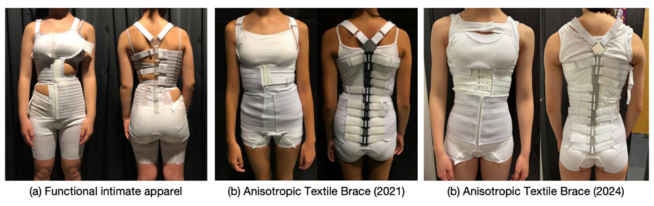
Product Development The ATB is the result of years of research and development, combining advanced materials and innovative design features to enhance the comfort and biomechanical effectiveness of scoliosis treatment (Figure 1). Fok (2020) developed the first prototype of a soft brace, namely functional intimate apparel (FIA) to improve wearability. Building on this foundation, Wong (2021) designed the ATB, incorporating advanced materials and a dynamic hinge bone structure to enhance corrective efficacy. Cheung (2024) further refined the ATB through clinical feedback and iterative design improvements, addressing limitations such as fit variability and pressure distribution. The brace is composed of polymer materials (silicon padding), textile materials (nylon/spandex mesh, polyester/spandex satinette, and polyester/rubber elastic bands), and an exoskeleton with hinged vertebrae made of aluminium and stainless steel. These materials were selected based on their performance in air permeability, abrasion resistance, and mechanical properties, ensuring both durability and comfort during daily wear.
Advancing Scoliosis Treatment: Development and Evaluation 83
Figure 1: The design and development process of the Anisotropic Textile Brace (ATB).
To accommodate a wide range of patients, particularly adolescents aged 10–16 years, this study designed different brace sizes for patient selection, expanding from the original three sizes to five sizes ranging from XS to XL. Additionally, due to the differences in physical development between adolescent girls with AIS and healthy individuals, particularly before puberty, young adults with scoliosis tend to be thinner and lighter than their healthy peers (Barrios et al., 2011). Therefore, measurements for slender body types were referenced in this study. This design builds upon prior work, refining the balance between comfort and corrective force to improve long-term treatment outcomes.
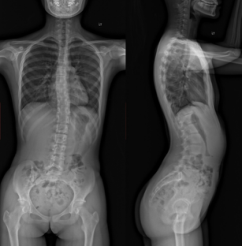
Subject Recruitment Radiographic Evaluation Using the EOS System In this study, 30 candidates underwent radiographic evaluation using the EOS imaging system (EOS Imaging, Paris, France) to obtain concurrent coronal and sagittal full-spine radiographs in standing position (Figure 2). The major advantage of the EOS system is the ability to reduce radiation dose by 50–80% compared to traditional X-ray methods (Melhem et al., 2016). This makes EOS particularly suitable for AIS patients, who require repeated imaging over time to monitor the progression of scoliosis, thus minimizing the potential risks associated with excessive radiation exposure.
Figure 2: Radiologic assessment of patients with AIS: coronal and sagittal full-spine radiographs.
Throughout the course of the trial, EOS imaging was used to assess the effectiveness of the ATB in correcting spinal alignment and to select appropriate candidates for participation. The primary parameters assessed include the Cobb angle, pelvic tilt, sacral slope, and lumbar lordosis, which are critical indicators of spinal deformity and curvatures. These measurements enable a comprehensive evaluation of the patient’s condition and the effectiveness of the ATB in reducing or stabilizing spinal curvature.
In addition to these key spinal parameters, the Risser sign, which reflects skeletal maturity, also plays a crucial role in the recruitment process. The Risser sign helps to assess the degree of skeletal maturation and is important in determining the likelihood of further spinal deformity progression (Karol, Virostek, Felton, Jo et al., 2016). This combination of precise imaging and skeletal maturity evaluation ensures that only suitable candidates are recruited and provides a robust basis for assessing the ATB’s effectiveness.
Clinical Trials The study was designed as a systematic clinical wear trial to evaluate the effectiveness and patient compliance of the ATB. The trial involved 30 subjects aged 10 to 16, diagnosed with mild to moderate scoliosis (Cobb angles between 15 to 45 degrees). Participants were recruited based on specific inclusion criteria, including age, skeletal maturity (Risser sign 0–3), and no prior use of braces, surgical treatment, or physical therapy.
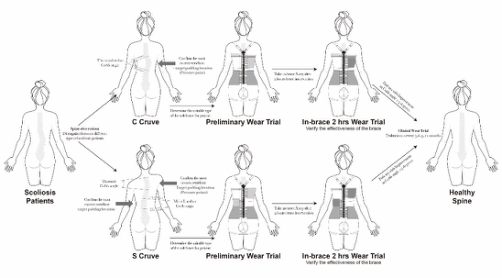
The clinical trial process included multiple stages to evaluate the supporting effect of the ATB. First, all potential participants undergo low- radiation EOS X-ray imaging without wearing the brace to measure the out-of-brace Cobb angle, Risser sign, coronal compensation, and sagittal balance. Eligible participants who meet the recruitment criteria are invited to participate in a preliminary wear trial. Since each case of AIS is unique, the appropriate placement and size of the ATB silicone pads are tailored to the individual patient’s condition, followed by a preliminary wear trial (Figure 3). The skeletal systems of the recruited participants have not yet matured, making their spinal curvatures susceptible to external forces, and wearing the brace for just two hours can effectively predict the maximum effect of corrective treatment (Li et al., 2014). After wearing the ATB for 2 hours, patients underwent low-radiation EOS X-ray examination to confirm that their Cobb angles had improved by more than 5 degrees, meeting the participant recruitment criteria. Finally, appropriate participates were invited to participate in a 12-month clinical trial, with spinal improvement assessed every 3 months, aiming to achieve the optimal treatment effect.
Advancing Scoliosis Treatment: Development and Evaluation 85
Figure 3: Experimental flow chart.
The corrective principle of the soft brace follows the principle of three points pressure system (Gomez et al., 2016), similar to rigid braces, to prevent curve deterioration. Lateral force is applied to the convex side of the main curve for correction in the coronal plane, and two reinforcing straps at the hips apply counterforces to enhance stability and strength. The force exerted in the brace is achieved through elastic bands connected to the hinge bone located at the back center of the soft brace. The elastic bands contain pockets where intelligent silicone paddings are placed. The elastic bands wrap around the body, and by adjusting their tension, they control the pressure and stretch, applying sufficient force to the vertebral bodies to promote correction.
Material Testing To ensure the safety, reliability, and clinical efficacy of the ATB, it is essential to obtain regulatory approval and validate key design components. In accordance with China’s regulatory requirements, the ATB was submitted for registration as a Class II medical device, which is mandatory for products intended for medical use. This certification ensures that the ATB meets national standards for safety and effectiveness. Additionally, the ATB has underwent a three-year validity verification as a spinal orthosis to assess its long-term performance and durability. A crucial design element, the hinge bone that made of 100% aluminium with stainless-steel pin, was subjected to a Twist Axis Life Test to simulate repetitive use, and confirmed its structural integrity under dynamic loads. These testing protocols are vital to demonstrate the product’s robustness and guarantee that it meets the necessary performance standards for clinical applications.
Mechanical Testing of Hinge Bone. The hinge bone, a core structural element of the ATB, was subjected to a Twist Axis Life Test to evaluate its long-term performance. The test protocol was conducted in accordance with ISO standards, involved: Test Conditions: 10,000 cycles of torsional stress at 4.6 ± 0.2 kg-cm torque in both clockwise and counterclockwise directions.
Acceptance Criteria: No functional failure or structural damage after completion of the test.
Accelerated Aging Validation. To validate the three-year lifespan of the ATB, an accelerated aging test was conducted following YY/T0681.1- 2018 (Test methods for sterile medical device packaging - Part 1: Guide for accelerated aging) guidelines. The test utilized an acceleration factor (Q10=2.0) and an Arrhenius equation-based model to simulate 36 months of natural aging within 78 days. Key parameters included: Test Conditions: 60±2
C (accelerated aging temperature) vs. 22±2
C (ambient temperature).
Performance Metrics: Dimensional stability, material strength (e.g., Velcro peel strength ≥2N/cm), and mechanical durability (e.g., hinge bone resistance to 500N tensile force).
RESULTS AND DISCUSSION
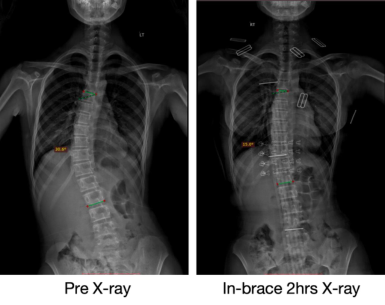
Clinical Trial Result Thirty subjects with AIS participated in the clinical trials. In this study, only a 2-hour wear trial is presented. As shown in Table 1, 23 out of 30 subjects (76.7%) demonstrated a 5
decrease in Cobb angles. Among them, 7 subjects experienced more than a 10
decrease in Cobb angles. The most significant decrease was observed in subject ATB025 (as shown in Fig. 4), whose Cobb angle was 30.6
without the brace and decreased to 15
after wearing the ATB for 2 hours (a change of −51%).
Table 1: Pre- and post-2hrs intervention of ATB in Cobb angles.
Table available in the original PDF paper.
Cobb Angle Cobb Angle
Total Subjects Cobb Angle Follow-Up Period
Improvement (≥10
)
Improvement (5
–9
)
Changes (No Change: <5
)
30 7 16 7
2-Hour Trials (IB)
Figure 4: Clinical trial result: subject ATB025 had a Cobb angle of 30.6◦without the brace, which decreased to 15◦after wearing the ATB for 2 hours.
Advancing Scoliosis Treatment: Development and Evaluation 87
Regulatory and Technical Validation of the ATB: Ensuring Market Readiness The ATB has approved by approved by the Hunan Provincial Drug Administration as Class II Medical Device Certification (No. 20252190170) under China’s Medical Device Classification and Technical Requirements (GB/T 16886-2021), marking a significant step in confirming its safety and effectiveness for clinical use in spinal curvature correction for AIS patients. This certification not only fulfills legal mandates for the market but also establishes the ATB as a trusted solution within mainstream healthcare systems. To ensure long-term reliability, the ATB underwent 3-year accelerated aging tests (YY/T 0681.1-2018), confirming material stability: textile elongation (≥40%), Velcro peel strength (≥2.0 N/cm), and hinge bone tensile resistance (500 ± 5N) remained within tolerance limits, addressing risks of premature degradation in clinical settings.
The 100% aluminum hinge bone with stainless-steel pin passed the 10,000-cycle Twist Axis Life Test under 4.6 kg·cm of torque. This rigorous protocol simulated 3 years of daily use, demonstrating no structural failure or functional impairment. This test validated the hinge is capable to sustain dynamic corrective forces, a key advantage over polymer-based competitors prone to fatigue-induced displacement.
Through rigorous regulatory compliance, comprehensive durability testing, and thorough biomechanical validation, the ATB has successfully transitioned from a prototype to a market-ready medical device. This progression ensures both therapeutic efficacy and patient safety in line with international standards.
CONCLUSION
The Anisotropic Textile Brace (ATB) shows strong potential in treating Adolescent Idiopathic Scoliosis (AIS), with notable improvements in Cobb angle. In the study, 23 out of 30 subjects (76.7%) demonstrated at least a 5
decrease in Cobb angles. Among them, 7 subjects experienced more than a 10
decrease. The brace’s ergonomic design, breathable fabrics, and customizable corrective forces prioritize patient comfort. Recognized as a Class II medical device in China, the ATB’s robust hinge structure and compliance with accelerated aging tests further confirm its reliability. The design and materials used in the ATB can help improve treatment adherence by alleviating the physical and emotional challenges of conventional rigid braces. Future studies should focus on expanding trial populations and incorporating smart technology to enhance dynamic correction and customization, positioning the ATB as a patient-centered advancement in AIS treatment.
ACKNOWLEDGMENT
This project is supported by funding from the RGC Research Impact Fund (Funding body reference number: R5039-23) entitled “Developing a New Generation of Pressure-controlled Wearable Soft Braces to
Improve the Efficiency and Compliance in Treating Adolescent Idiopathic Scoliosis”.
REFERENCES
Barrios, C., Cortes, S., Perez-Encinas, C., Escriva, M. D., Benet, I., Burgos, J., Hevia, E., Piza, G., & Domenech, P. (2011). Anthropometry and body composition profile of girls with nonsurgically treated adolescent idiopathic scoliosis. Spine (Phila Pa 1976), 36(18), 1470–1477. https://doi.org/10.1097/ BRS.0b013e3181f55083 Cheung, H. Y. (2024). Evaluation and enhancement of the performance of
anisotropic textile brace for moderate Adolescent Idiopathic Scoliosis. Costa, L., Schlosser, T. P. C., Jimale, H., Homans, J. F., Kruyt, M. C., & Castelein, R. M. (2021). The Effectiveness of Different Concepts of Bracing in Adolescent Idiopathic Scoliosis (AIS): A Systematic Review and Meta-Analysis. J Clin Med, 10(10). https://doi.org/10.3390/jcm10102145 Fok, L. H. (2020). Functional intimate apparel for adolescents with scoliosis. Gomez, J. A., Hresko, M. T., & Glotzbecker, M. P. (2016). Nonsurgical Management
of Adolescent Idiopathic Scoliosis. J Am Acad Orthop Surg, 24(8), 555–564. https://doi.org/10.5435/JAAOS-D-14-00416 Karol, L. A., Virostek, D., Felton, K., Jo, C., & Butler, L. (2016). The Effect of the Risser Stage on Bracing Outcome in Adolescent Idiopathic Scoliosis. J Bone Joint Surg Am, 98(15), 1253–1259. https://doi.org/10.2106/JBJS.15.01313 Karol, L. A., Virostek, D., Felton, K., & Wheeler, L. (2016). Effect of Compliance Counseling on Brace Use and Success in Patients with Adolescent Idiopathic Scoliosis. J Bone Joint Surg Am, 98(1), 9–14. https://doi.org/10.2106/ JBJS. O.00359 Li, M., Wong, M. S., Luk, K. D., Wong, K. W., & Cheung, K. M. (2014).
Time-dependent response of scoliotic curvature to orthotic intervention: When should a radiograph be obtained after putting on or taking off a spinal orthosis? Spine (Phila Pa 1976), 39(17), 1408–1416. https://doi.org/10.1097/ BRS.0000000000000423 Maruyama, T., Grivas, T. B., & Kaspiris, A. (2011). Effectiveness and outcomes of brace treatment: A systematic review. Physiother Theory Pract, 27(1), 26–42. https://doi.org/10.3109/09593985.2010.503989 Melhem, E., Assi, A., El Rachkidi, R., & Ghanem, I. (2016). EOS ((R)) biplanar
X-ray imaging: Concept, developments, benefits, and limitations. J Child Orthop, 10(1), 1–14. https://doi.org/10.1007/s11832-016-0713-0 Wang, H., Tetteroo, D., Arts, J. J. C., Markopoulos, P., & Ito, K. (2021). Quality of life of adolescent idiopathic scoliosis patients under brace treatment: A brief communication of literature review. Qual Life Res, 30(3), 703–711. https:// doi.org/10.1007/s11136-020-02671-7 Weinstein, S. L., Dolan, L. A., Cheng, J. C., Danielsson, A., & Morcuende, J. A.
(2008). Adolescent idiopathic scoliosis. The lancet, 371(9623), 1527–1537. Weinstein, S. L., Dolan, L. A., Wright, J. G., & Dobbs, M. B. (2013). Design of the Bracing in Adolescent Idiopathic Scoliosis Trial (BrAIST). Spine (Phila Pa 1976), 38(21), 1832–1841. https://doi.org/10.1097/01.brs.0000435048.23726.3e Wong, S. H. (2021). Design and development of anisotropic textile brace for
adolescent idiopathic scoliosis (AIS).
LISTED IN THE AHFE DIGITAL BOOKSTORE CATALOGUE
Explore the complete digital volume
Healthcare and Medical Devices
Read this individual research paper free through the original publisher, or explore the full digital proceedings book.
ISBN 978-1-964867-47-2
Explore this ISBN in the AHFE Bookstore ↗Listed in the July 2026 bookstore catalogue; search by ISBN to confirm current availability · Digital book purchase optional