Emmanuel Ayorinde, Matlou Pheladi, Ntebo Ngcobo (2025). An Assessment of The Benefits of Circular Economy Principles for Sustainable Construction Practices In South Africa. In: Human Factors and Systems Interaction. AHFE Open Access, vol. 192, pp. 174–181. https://doi.org/10.54941/ahfe1006640
The concept of circular economy (CE) is a broad concept that presents a set of options for retaining resource value. Therefore, CE is seen as one of the solutions in adopting sustainable practices in the South African Construction Industry (SACI), as a shift from the traditional linear economy. The purpose of this study is to assess the benefits of the adoption of Circular Economy (CE) principles for sustainable construction practices in the SACI, examining the benefits of these principles to facilitate its adoption level in promoting sustainable construction practices. Data was gathered through a questionnaire survey instrument from participants using a purposive sampling technique. The methods deployed for analysing the data for the study were mean item score and exploratory factor analysis. The study found that while there is limited adaptability of CE within the SACI, its benefits trump the challenges associated with adopting of these sustainable construction practices. The holistic and conscious adoption and adaptability of CE in the SACI will result in economic, environmental, social, and industrial benefits, as well as boost South Africa’s global alignment to Sustainable Development Goals (SGGs). Enhancing the adoption and usage level of CE in the SACI will play a vital role in waste reduction, lower carbon footprint, cost savings, job creation, health benefits, skills development, innovation and technological adoption, which is essential for advancing South African economic growth and social development.
The construction industry is a propeller of great development amongst societies by producing infrastructure such as bridges, dams and roads that led to economic growth, thereby making a global contribution of 6% towards the Gross Domestic Product (GDP). Despite the positive contribution from the building industry, there are however negative implications that hurt the economy, environment and society (Amudjie et al., 2022). The increase in global population leads to more material resource usage which results in the likeliness of scarce and costly material. This also gives rise to the possibility
An Assessment of the Benefits of Circular Economy Principles 175
of losing some material for future use. However, the concept of Circular Economy (CE) poses a promising strategy for addressing these issues by protecting and reducing the use of primary materials and reducing carbon footprint (Behrens et al., 2007). According to Pratt and Lenaghan (2015), the alternative to the linear model that is currently being used is the circular economy concept that incorporates remanufacturing, repairing, reprocessing and designing smart products to keep products and materials running in the economy.
The concept of CE highlights the significance of recycling, reusing, and implementing creative design strategies aimed at reducing waste and keeping materials at their highest value (WRAP, 2016). The principles of CE are considered an effective approach to minimize environmental harm and lower resource usage in the construction industry. Circular economy stands as a promising concept for sustainable construction practices; one of the identified benefits is its ability to minimize waste within construction practices, as waste is a major concern in construction. According to Finamore and Oltean- Dumbrava, (2024), companies could increase resource optimization through the implementation of circular economy principles by decreasing their waste production which can in return maintain and keep the function and value of products and materials through a restorative CE system, as the CE lies within the principles of recycling material. Aigbavboa et al. (2017) state the lifespan of landfill sites for future use will be extended by maximizing the capacity to recycle and reuse construction waste, which will reduce the amount of waste entering landfills and this can achieved by employing the principle of recycling material and using more recycled material will subsequently reduce the amount of transportation needed to move this waste from the construction site to the landfill, which will lower the total amount of CO2 emissions. Furthermore, since strong winds can easily carry landfill odours through, they can pose a problem for the neighbouring community. A significant reduction in the construction cost and the environmental effects can be achieved through the adaptive reuse of the building structure (Osobajo et al., 2020).
In tackling the challenges hindering the adoption of CE principles in the SACI, it’s essential to develop specialized training programs, that communicate the benefits of CE, and provide case studies that illustrate practical applications (Thornback and Adams, 2016). By providing professionals with the right knowledge and resources, the industry can swiftly move toward sustainable construction practices. The objective of this study is to assess the benefits associated with the adoption of CE principles amongst construction professionals to encourage full-scale adoption of sustainable construction practices in the SACI.
METHODOLOGY
This study adopted a quantitative research design with a self-administered questionnaire survey within a post-positivist paradigm. The study focuses on the benefit of the adoption CE principles in the South African construction industry. The study targeted respondents with first-hand knowledge of
construction activities and direct engagement in onsite physical work. The questionnaire items were carefully developed based on a review of the relevant literature. The questionnaire was pilot-tested with a small group of industry practitioners to ensure that the items were clear, understandable and relevant to the study’s objectives. The Likert scale in the questionnaire assisted the respondents in selecting the most appropriate answer from the questions asked, 1 = strongly disagree; 2 = Disagree; 3 = Neutral; 4 = Agree; 5 = Strongly agree. Mean item score (MIS) was used to present the research findings from the Likert scale in descending order.
RESULTS AND DISCUSSION
The descriptive findings provide a ranking of all benefits, from most to least influential, and a table details each benefit’s mean score along with its standard deviation. According to the data collected, Engineers (59.04%) and Construction managers (18.07%) represented the largest groups followed by Project managers (17.9%). In terms of educational background, the majority of respondents held a Bachelor’s degree (42.17%) followed closely by those with Honours degree (36.14%). Regarding experience, (43.37%) of respondents had 6–10 years of experience, showing an openness to the awareness of the benefits associated with CE. Meanwhile, (39.76%) had 1–5 years of experience, offering balanced views between traditional practices and CE adoption.
Mean Item Score
Table 1 shows the ranking of the results of the ranked benefits of the adoption of CE principles in the SACI. The results indicate that the most ranked variable is environmental sustainability with a mean score of 4.22, innovation with a mean score of 4.20, job creation with a mean score of 4.20, and resilience planning with a mean score of 4.19. While the least-ranked benefits are economic growth with a mean score of 4.06, market competitiveness with a mean score of 4.05, and social and community improvement with a mean score of 4.00.
Data Analysis Two types of descriptive statistics were conducted: mean item scores and factor analysis. The variables were ranked using mean item scores, while factor analysis was used to group variables that measure similar underlying effects. The Cronbach alpha was used to assess the internal consistency of the variables in the survey.
Table 1: Mean item score.
Table available in the original PDF paper.
Benefits of the Adoption of CE Mean (X) STD Ranking Environmental sustainability 4.22 0.564 1 Job Creation 4.20 0.579 2 Innovation 4.20 0.620 3 Resilience Planning 4.19 0.573 4
Continued
An Assessment of the Benefits of Circular Economy Principles 177
Table 1: Continued Benefits of the Adoption of CE Mean (X) STD Ranking
Table available in the original PDF paper.
Resource efficiency 4.19 0.573 5 Longevity of Buildings 4.19 0.594 6 Skill development 4.13 0.620 7 Waste reduction 4.11 0.541 8 Cost savings 4.06 0.571 9 Technology advancement 4.06 0.592 10 Economic growth 4.06 0.592 11 Market competitiveness 4.05 0.582 12 Social and community improvement 4.00 0.584 13
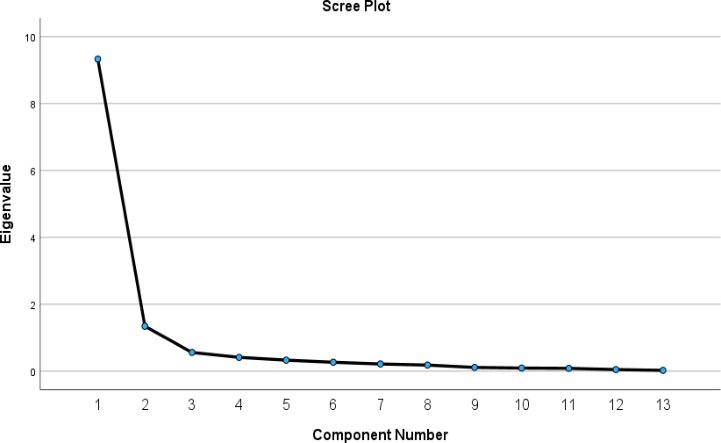
Results From Exploratory Factor Analysis The results of the EFA on the benefits of the adoption of CE principles for sustainable construction practices in the SACI are shown in Tables 1, 2, 3, and 4, along with Figure 1, encompassing a total of thirteen identified variables, with no missing data. These variables highlight the key benefits of the adoption of CE in the SACI context.
Figure 1: Scree plot for factor analysis.
Factor Analysis The Kaiser-Meyer-Olkin (KMO) Measure of Sampling Adequacy was used to determine the appropriateness of the data to undergo exploratory factor analysis (EFA). Additionally, Bartlett’s Test of Sphericity was performed to assess whether the correlation matrix is an identity matrix, where variables would be uncorrelated. The results of the analysis are presented below. The results of the KMO test yielded a value of 0.837, indicating excellent sampling
adequacy. Bartlett’s Test of Sphericity, which produced a chi-square value of 1416.204 with 78 degrees of freedom and a significance level of less than 0.001, further supports the appropriateness of EFA. A significant result from the Bartlett test indicates that the correlation matrix is not an identity matrix, meaning there are meaningful relationships among the variables.
Kaiser-Meyer-Olkin Measure of Sampling Adequacy 0.837 Bartlett’s Test of Sphericity Approx. Chi-Square 1416.204 Df 78 Sig. <.001
These components together capture 82.103% of the total variance before rotation, making them substantial factors in understanding the benefits of benefits for the adoption of CE principles for sustainable construction practices in the SACI context. Varimax rotation was then applied, which is a technique used to make the output more interpretable. This method spreads the variance more evenly across the retained components by aligning the variables more closely to the factors. After applying Varimax, the variance explained by the first two components is redistributed to 71.760% and 10.343%, respectively, resulting in clearer and more distinct patterns. The Scree Plot typically shows a clear “elbow” after the second component, indicating that two factors are the most meaningful in explaining the variance. This aligns with the eigenvalues, where only two components have eigenvalues greater than 1, justifying their retention in the factor analysis. The first two components capture the underlying structure of the data effectively. Using the principal axis factoring extraction method, two distinct components were named, each reflecting specific dimensions related to key benefits for the adoption of CE principles for sustainable construction practices in the SACI context. Component 1 represents environmental sustainability dimension and Component 2 reflects the economic and social dimensions.
Table 2: Rotated component matrix.
Table available in the original PDF paper.
Component
1 2
Environmental sustainability 0.968 Skill development 0.960 Job Creation 0.958 Longevity of Buildings 0.888 Resilience Planning 0.862 Innovation 0.858 Resource efficiency 0.681 Market competitiveness 0.993 Social and community improvement 0.943 Continued
An Assessment of the Benefits of Circular Economy Principles 179
The benefits of adopting Circular Economy principles in South Africa’s construction industry are highly recognized, with environmental sustainability rated as the most significant advantage with a mean score of 4.22. This highlights the industry’s awareness of CE’s potential to reduce ecological impact, preserve natural resources, and minimize waste generation, which are core goals for sustainability. The findings suggest a strong consensus on the environmental gains CE offers, which include reduced landfill use, decreased pollution, and lower resource consumption, thus contributing to broader ecological preservation. Innovation and job creation were also prominent benefits, with a mean = 4.19, indicating that CE principles are both environmentally beneficial and economically stimulating, as they can create new employment opportunities and drive industry advancements in technology, materials, and processes.
Additionally, resilience planning emerged as a key benefit, with respondents recognizing CE’s role in enhancing the durability and adaptability of buildings to withstand environmental and economic changes. This reflects an understanding that CE contributes to long-term infrastructure robustness, enabling structures to better cope with climate change impacts and resource limitations. The benefits associated with CE thus extend beyond environmental gains, encompassing economic and social dimensions that position CE as a comprehensive framework for sustainable development in South Africa. By fostering innovation, resilience, and job
creation, CE can play a transformative role in advancing sustainability while also providing a model for integrating environmental, economic, and social values in construction practices. These findings affirm the multi-dimensional advantages of CE and underscore its potential as a driver of positive change in the South African construction industry.
CONCLUSION
In conclusion, primary and secondary data widely acknowledge the benefits of CE, with environmental sustainability, innovation, and economic growth identified as substantial advantages. Environmental benefits, particularly waste reduction and resource conservation were the highest rated, clearly aligning CE principles and sustainable development goals. These benefits indicate that CE practices are perceived as essential for reducing construction’s ecological footprint, aligning well with global sustainability trends that emphasize reduced resource use and waste minimization.
Economic benefits, such as job creation and cost savings, were also noted, suggesting that CE has the potential to support both economic and environmental goals. The potential for CE to drive innovation further highlights its role in creating new business opportunities and modernizing traditional construction practices. This dual impact of CE, both ecological and economic aligns with the findings from literature that underscore the holistic nature of CE, which enhances sustainability and fosters resilience and economic stability. Therefore, CE adoption offers a strategic path for the construction industry, capable of addressing environmental concerns while providing economic and social dimensions that support long-term economic development.
ACKNOWLEDGMENT
We extend our since gratitude to the Department of Civil Engineering Technology, Faculty of Engineering and the Built Environment, University of Johannesburg, South Africa, for their valuable support and the opportunity to undertake this research project with minimal distractions.
REFERENCES
Aigbavboa, C., Ohiomah, I. and Zwane, T. (2017). Sustainable Construction Practices: ‘A Lazy View’ of Construction Professionals in the South Africa Construction Industry. Energy Procedia, 105, pp. 3003–3010. doi: https://doi.org/ 10.1016/j.egypro.2017.03.743. Adams, K. T., Osmani, M., Thorpe, T. and Thornback, J. (2017). Circular economy
in construction: Current awareness, challenges and enablers. Proceedings of the Institution of Civil Engineers - Waste and Resource Management, [online] 170(1), pp. 15–24. doi: https://doi.org/10.1680/jwarm.16.00011. Amudjie, J., Agyekum, K., Adinyira, E., Amos-Abanyie, S. and Kumah, V. M. A.
(2022). Awareness and practice of the principles of circular economy among built environment professionals. Built Environment Project and Asset Management. doi: https://doi.org/10.1108/bepam-11-2021-0135.
An Assessment of the Benefits of Circular Economy Principles 181
Behrens, A., Giljum, S., Kovanda, J. and Niza, S., 2007. The material basis of the global economy: Worldwide patterns of natural resource extraction and their implications for sustainable resource use policies. Ecological Economics, 64(2), pp. 444–453. BIS (Department for Business, Innovation and Skills) (2013) Supply Chain Analysis
into the Construction Industry, A Report for the Construction Industrial Strategy. BIS, London, UK. Cossu, R. and Williams, I. D. (2015). Urban mining: Concepts, terminology, challenges. Waste Management, 45, pp. 1–3. doi: https://doi.org/10.1016/ j.wasman.2015.09.040. Ellen MacArthur Foundation (2015). Towards a Circular Economy: Business
Rationale for an Accelerated Transition. [online] Available at: https://kidv.nl/ media/rapportages/towards_a_circular_economy.pdf?1.2.1. Finamore, M. and Crina Oltean-Dumbrava (2024). Circular economy in construction - findings from a literature review. Heliyon, 10(15), pp. e34647–e34647. doi: https://doi.org/10.1016/j.heliyon.2024.e34647. Hakkinen, T. and Belloni, K. (2011). Barriers and drivers for sustainable building.
Building Research & Information, 39(3), pp. 239–255. doi: https://doi.org/ 10.1080/09613218.2011.561948. Kay, T. and Essex, J., 2009. Pushing Re-use: Towards a Low-carbon Construction Industry. Internet: http://www. bioregional.com/files/publications/ pushingreuse.pdf [Feb., 2012]. Osmani, M., Glass, J. and Price, A. (2006). Architect and contractor attitudes to waste minimisation. Proceedings of the Institution of Civil Engineers - Waste and Resource Management, 159(2), pp. 65–72. doi: https://doi.org/10.1680/ warm.2006.159.2.65. Osobajo, O. A., Oke, A., Omotayo, T. and Obi, L. I. (2020). A systematic review
of circular economy research in the construction industry. Smart and Sustainable Built Environment, ahead-of-print (ahead-of-print). doi: https://doi.org/10.1108/ sasbe-04-2020-0034. Pratt, K. and Lenaghan, M., 2015. The Carbon Impacts of the Circular Economy Summary Report. Zero Waste Scotland, 15, p. 15. Thornback, J. and Adams, K. (2016). Knowledge Resource for Circular Economy Thinking in Construction. [online] Available at: https:// www.constructionleadershipcouncil.co.uk/wp-content/uploads/2019/06/GBC_ Circular_Economy_Jan_17-9.pdf. WRAP. (2016). WRAP and the circular economy. [online] Available at: https://
www.wrap.ngo/taking-action/climate-change/circular-economy. Yuan, H. and Shen, L. (2011). Trend of the research on construction and demolition waste management. Waste Management, 31(4), pp. 670–679. doi: https://doi.org/ 10.1016/j.wasman.2010.10.030.
LISTED IN THE AHFE DIGITAL BOOKSTORE CATALOGUE
Explore the complete digital volume
Human Factors and Systems Interaction
Read this individual research paper free through the original publisher, or explore the full digital proceedings book.
ISBN 978-1-964867-68-7
Explore this ISBN in the AHFE Bookstore ↗Listed in the July 2026 bookstore catalogue; search by ISBN to confirm current availability · Digital book purchase optional