Chujin Hu, Yuxin Chen, Li Zhao, Yuchen Zhang, Yuxuan Dai, Sibo Gao, Zhejun Zhang, Ruonan Huang, Lingjie Wu, Lu Wang, Wei Liu (2022). Redefining engineering psychology: Designing gestural car HMI for luxury car buyers. In: Human Factors in Accessibility and Assistive Technology. AHFE Open Access, vol. 37, pp. 102–107. https://doi.org/10.54941/ahfe1001648
As the proportion of glazing on the surface of a car further increases, efficient and pleasant human factors between people and glazing become more critical. This study focuses on wealthy buyers with disgust emotion during in-car user journeys, as assigned by the corporate partner. The research team explores specific contexts in an empathetic way and uncovers context-specific pain points and opportunities. A prototype is designed to monitor and prevent scratching and protect passengers' privacy. Gestural or sound interactions are explored through brainstorming, bodystorming, and quick user testing. A visionary video scenario is provided to guide researchers and engineers to implement the interaction designs.
Nowadays, interactive user interfaces have been introduced to cars more fre- quently to realize some features. These interactions significantly save drivers’ attention resources and make them focus more on driving (Kun, 2018). Car glazing is indispensable to a car and can play many roles. However, the gla- zing features are relatively single, and there is little interaction design between glazing and human. The team focuses on wealthy car buyers and aim to design a car glazing with privacy protection, a monitoring system, and uni- que design features that can be achieved through some gesture interactions to meet their needs.
RELATED WORK
Engineering Psychology Derived from experimental psychology, engineering psychology, as a fled- gling subfield, has been gaining more and more psychologists and designers’ attention since World War I (Schultz and Schultz, 2020). Engineering psych- ology combines the concerns with improving equipment from engineering and the concerns with the human brain and mind from psychology, aiming
Redefining Engineering Psychology: Designing Gestural Car HMI for Luxury Car Buyers 103
to adapt the equipment and environments to people from their psychological capabilities and limitations perspective (Stanton, 1996). Engineering psycho- logy, also known as human factor engineering, is an interdisciplinary subject that involves psychology, engineering, ergonomics, neuroscience and so on. Unlike most psychology studies, engineering psychology is an applied subject, which means product design is one of its most essential parts. Engineering psychology can help designers and companies make user-friendly and fool- proof products since they consider users’ psychological features and mindsets. Designers usually need to consider humans and mechanical integrity in engi- neering psychology or human factors engineering (Zhu et al, 2021). For instance, driving an automobile is a familiar example of a simple human- machine system. In driving, the operator receives inputs from outside the vehicle displays inside the vehicle, such as the speedometer, fuel indicator, and temperature gauge (Li et al, 2020). Another famous engineering psych- ology example is the modern push-button handphone handset or keyboards. The layouts of keys are well-designed to conform to human habits, allowing people to type naturally while reducing the chance to cause typing mistakes to the most extent.
Human-Centered Design (HCD) HCD is a design genre that advocates a more promising and enduring appro- ach is to model users’ natural behavior to begin with so that interfaces can be designed that are more intuitive, easier to learn, and freer of performance errors (Oviatt, 2006). The human-centered system, which known as the anth- ropocentric system, rejects the mechanistic paradigm of technological and societal development, providing a powerful alternative philosophy for system design and broader educational and societal developments. Its focus is on exploiting an advanced system that human beings can handle the qualitative, subjective judgments and the machine the quantitative elements (Jacobson and Jacobson, 2000). HCD intends to balance the two competing systems of societal and technological perspectives, advocating the design of flexible systems that permit the people who work with them to shape and manage their work (Gasson, 2003). In contrast to traditional, technology-oriented approaches, HCD prioritizes computer-based information processing and technology-mediated communications over humans and their communica- tive collaboration (Liu, 2022, Liu et al, 2022). Human-centered products would be more ecologically valid and conform to human habits. Implemen- ting HCD in product exploitation is a considerable gesture to customers and can also display the societal eco-friendly ideals of the companies.
Car Human Machine Interaction (HMI) Human-machine system (HMS) research has been burgeoning for more than fifty years. It is widely acknowledged that better symbiosis between humans and machines is essential. HMS comprises three elements, human users, human-machine interface, and machine. The interactions contain all aspe- cts between humans and machines through physical and digital interfaces (Johannsen, 2009). Industries now value HMI greatly since HMI designs
can bring high market value for most products and services (Francois et al, 2017). The car manufacturing industry has shown great interest in HMI development and application for a long time. The HMI design in auto- motive industries has gone through a change from technology-centered to human-centered approaches, emphasizing the application of human factors and knowledge of usability. Nowadays, it is highly valued that the users participate in the HMI development.
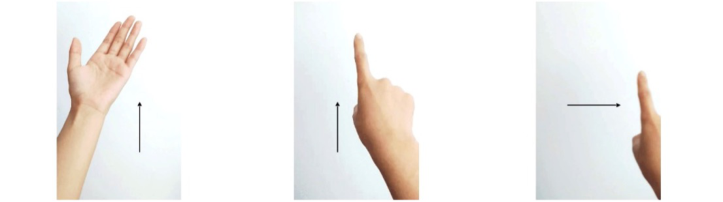
Neurodesign In 2018, a new research track called the Leifer NeuroDesign Research Pro- gram (neurodesign.stanford.edu) at Stanford University has emerged (Auer- nhammer et al, 2020, Ohashi et al, 2022). The program aims to investigate thinking of design, team performance, and practices through approaches from HCI, design research, experimental psychology, and neuroscientific instruments. It examines team practices that produce a meaningful, innova- tive, and practical design. Barrier glazing provided to the user aims to protect their privacy through several gesture interactions, enabling interior glazing between the front and rear seats. The user controls the sound insulation by swiping left or right with a gesture. The user also controls the shadow effect by swiping up and down with a gesture.
APPROACH Human Factor Engineering- Target User Group
The target users provided are wealthy people who have three characteristics. Firstly, they like extraordinary things, caring more about the uniqueness of goods than other qualities. For example, they prefer customized tours desi- gned according to their conditions when selecting tourism products. Secondly, wealthy people want to show off (Nabeshima and Seay, 2015). Buying high- end consumer goods brings them a sense of superiority and social belonging, making them feel they are from the high-income class. Thirdly, the affluent are rarely sensitive to price. They pay for their passions (Klontz et al., 2015).
An Emotion as the Pshchological Indicator The emotion given by Saint-Gobain is disgust. Disgust is an overall emotio- nal experience, one of the human beings’ most basic emotional experiences (Ekman and Levenson, 1983). Unpleasant and disgusting stimuli trigger this emotion. There are several physiological reactions to disgust. Studies have shown that when people are in an aversive mood, their heart rate decreases, finger temperature decreases, and skin conductivity increases (Lee and Lang, 2009) (Rohrmann et al., 2008). Disgust also affects people’s cognitive beha- viors. This is applicable in the field of consumption. For example, the team finds that product aversion negatively predicts consumer satisfaction.
Context of Car HMI The rich often attend various dinner parties and meet different people. On the way to the destination, the car’s condition is closely related to their mood.
Redefining Engineering Psychology: Designing Gestural Car HMI for Luxury Car Buyers 105
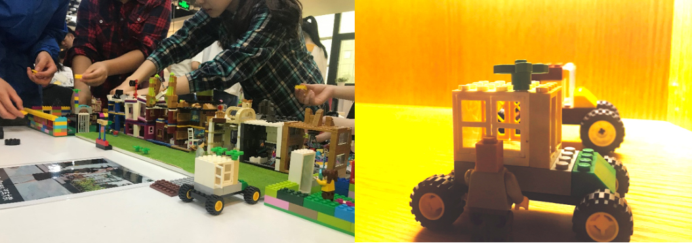
Figure 1: The context built by Lego bricks and intelligent hardware.
Some people who hate the rich will deliberately scrape their cars, which might significantly affect the owner’s mood if the incident happens suddenly and cannot be solved immediately. If the car glazing monitor what happens out- side, it avoids various trouble. Also, they may answer some critical calls in the car on the way to social occasions, such as calling their girlfriend. At this time, the driver in the front seat might inevitably hear the conversation, which causes trouble to the rich. Therefore, the isolation between the front and rear seats is critical. For wealthy people, a car is a means of transpor- tation and a status symbol. Some people might comment on other people’s cars on social occasions, as a consequence of which, it is relatively essential whether the style and design of cars can show their identity and uniqueness.
Design Gestural Interaction The team builds the context of car HMI with Lego bricks and intelligent hardware. It contains the user’s house, the street, the banquet place, and the car that can detect whether someone is approaching and emit a warning sound (see Figure 1).
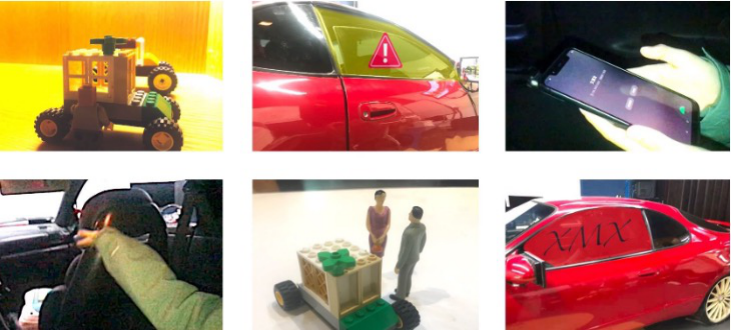
To solve the problem that the wealthy’s cars might be scratched, the team designs a side windshield alarm system. The system is based on distance and pressure sensors. The alarm is triggered if the distance between the suspect and the car is less than a specific value. There is a visual signal on the side windshield, and the surveillance camera is turned on. If the suspect touches the car, this system sends warning information to the user’s cell phone. Then the user can check surveillance video through a mobile application.
As to the privacy problem, the team designs an in-car privacy protection system. The user sitting in the car’s back seat can use gestures to raise in-car glazing to keep himself from being peeped at. The gestures are designed with a view to people’s using habits. The user can raise the in-car glazing between the front and back seats by waving up. By swiping left or right, the user can control the sound-proofing effect. Moreover, he can control the shading effect by swiping up and down.
The team designs decorative lighting to give target users’ pursuit of uniqu- eness. The user can activate the lighting system on the side windshield and a 3D projection above the skylight glazing through a gesture of snapping his fingers. Meanwhile, while the car detects negative comments on its
Figure 2: The designed gestural interactions with interactive glazing.Figure 3: The user scenario.
appearance through the speech recognition system, it turns on the lighting automatically. The user can customize the colors and designs of the light (see Figure 2 and Figure 3).
The team applies the built context to perform quick usability testing and presents different interaction designs by video and evaluated other groups.
DISCUSSION AND FUTURE PERSPECTIVE The team gains information of the target user group, wealthy buyers, through the research on related work and literature, and the emotion indicator disgust. Then the team gets access to the persona and design various interaction styles based on the context of three problems. However, due to the lack of accurate surveys of users, part of the demand analysis and design process is based on our cognition by imagining the real-life context. For example, for wealthy people, when it comes to designing products for them, it is not easy to design products that suit their needs. The team might get more accurate results and provide more satisfying solutions if communication is committed.
The newly designed interactive glazing realizes various interactions but implementing these designs may be tricky. The team believes that good design is consistent with human nature and can understand people. With the progress of technology, more novel and high-efficiency interactions, especi- ally achievements of cutting-edge research in areas like NeuroDesign, would support future HMI in in-car and other contexts.
Redefining Engineering Psychology: Designing Gestural Car HMI for Luxury Car Buyers 107
REFERENCES
Auernhammer, J., Liu, W., Ohashi, T., Leifer, L., Byler, E., & Pan, W. (2020).
NeuroDesign: Embracing neuroscience instruments to investigate human collabo- ration in design. In International Conference on Human Interaction and Emerging Technologies, 284–289. Ekman, P., Levenson, R. W., & Friesen, W. V. (1983). Autonomic nervous system activity distinguishes among emotions. Science, 221(4616), 1208-1210. François, M., Osiurak, F., Fort, A., Crave, P., & Navarro, J. (2017). Automotive
HMI design and participatory user involvement: Review and perspectives. Ergo- nomics, 60(4), 541–552. Gasson, S. (2003). Human-centered vs. user-centered approaches to information system design. Journal of Information Technology Theory and Applica- tion, 5(2), 5. Klontz, B. T., Sullivan, P., Seay, M. C., & Canale, A. (2015). The wealthy:
A financial psychological profile. Consulting Psychology Journal: Practice and Research, 67(2), 127. Kun, A. L. (2018). Human-machine interaction for vehicles: Review and outlook. Foundations and Trends in Human-Computer Interaction, 11(4), 201–293. Jacobson, R. E., & Jacobson, R. (Eds.). (2000). Information design. MIT Press. Johannsen, G. (2009). Human-machine interaction. Control Systems, Robotics, and Automation, 21, 132–62. Lee, S., & Lang, A. (2009). Discrete emotion and motivation: Relative activation in
the appetitive and aversive motivational systems as a function of anger, sadness, fear, and joy during televised information campaigns. Media Psychology, 12(2), 148–170. Li, X., Vaezipour, A., Rakotonirainy, A., Demmel, S., & Oviedo-Trespalacios, O.
(2020). Exploring drivers’ mental workload and visual demand while using an in- vehicle HMI for eco-safe driving. Accident Analysis and Prevention, 146, 105756. Liu, W. (2022). Designing generation Y interactions: The case of YPhone. Virtual Reality and Intelligent Hardware 4(2), 132–152. Liu, W., Zhu, Y., Liu, M., & Li, Y. (2022). Exploring maker innovation: A
transdisciplinary engineering design perspective. Sustainability, 14(1), 295. Nabeshima, G., & Seay, M. (2015). Wealth and personality: Can personality traits make your client rich. Journal of Financial Planning, 28(7), 50–57. Ohashi, T., Auernhammer, J., Liu, W., Pan, W., & Leifer, L. (2022). NeuroDesignSci-
ence: Systematic literature review of current research on design using neuroscience techniques. Design Computing and Cognition’20, 575–592. Oviatt, S. (2006). Human-centered design meets cognitive load theory: Designing interfaces that help people think. In Proceedings of the ACM International Conference on Multimedia, 871–880. Rohrmann, S., Hopp, H., & Quirin, M. (2008). Gender differences in psychophysi-
ological responses to disgust. Journal of Psychophysiology, 22(2), 65–75. Schultz, D. P., & Schultz, S. E. (2020). Psychology and work today: An introduction to industrial and organizational psychology. Routledge. Stanton, N. (1996). Engineering psychology: Another science of common sense? The
Wellbeing and healthcare: Exploring ways of interactive prototyping with mental process. In International Conference on Applied Human Factors and Ergonomics, 123–127.
LISTED IN THE AHFE DIGITAL BOOKSTORE CATALOGUE
Explore the complete digital volume
Human Factors in Accessibility and Assistive Technology
Read this individual research paper free through the original publisher, or explore the full digital proceedings book.
ISBN 978-1-958651-13-1
Explore this ISBN in the AHFE Bookstore ↗Listed in the July 2026 bookstore catalogue; search by ISBN to confirm current availability · Digital book purchase optional