Jing Qiu, Jingyang Li, Zhao Xu, Ruonan Huang, Ruikang Wang, Lingjie Wu, Xiaojian Wu, Fan Yang, Zhejun Zhang, Larry Leifer, Wei Liu (2022). Are answers more important than questions? Planning an empathy design innovation course for young students. In: Intelligent Human Systems Integration (IHSI 2022): Integrating People and Intelligent Systems. AHFE Open Access, vol. 22. https://doi.org/10.54941/ahfe100972
This paper presents the planning of an innovation course for elementary school students. The course is designed and organized by the Beijing Normal University in collaboration with the China Soong Ching Ling Science and Culture Centre for Young People. This course aims to foster children's empathy and creative thinking. There are three core teaching phases: theme exploration, design expression, and prototyping. In addition, the research team applies NeuroDesign techniques (i.e., fNIRS) to quantitatively measure students' development of empathy and innovation to assess the effectiveness of teaching and learning. Educators would refer to this planning for designing other educational courses on fostering creativity.
In the current K-12 education system, finding answers and solutions to questions and problems are critical and essential (van Doorn et al., 2013). In 2016, the report of 'Facing the future: Global experiences in 21st-century core literacy education' published by the World Innovation Summit for Education listed 'creativity and problem-solving skills' as one of the essential literacies for future citizens. The Empathy Design Innovation course created by the BNUX (Liu et al., 2021) combines design thinking (Dym et al., 2005), computational thinking, engineering thinking, and business thinking to foster empathy, collaboration, expression, and practical skills to cultivate K-12 students' creativity (Menéndez and Min, 2019). The study is based on China's educational context, integrating advanced experience of the national education reform practices, leading Chinese students to enter the learning mode of problem identification, conflict resolution, and future innovation through a dynamic learning approach (Niemi and Jia, 2021). The practice has provided innovative ideas for the curriculum system and education reform of primary and secondary schools in China.
As one of the core courses of the leading 'Innovation Education System' in China, this course is based on physical and mental development characteristics of 6-12-year-old elementary school students. It aims to develop creative thinking while cultivating design thinking, computational thinking, engineering thinking, and business thinking holistically to enhance core literacy and boost globally competence.
APPROACH
PREVIOUS WORK Combining the strengths of user experience (UX) discipline and interdisciplinary talent cultivation system, we have created a 4E teaching framework (i.e., Experience, Empathy, Exploration, Evaluation), adopting innovative research methods and visual teaching toolkits, and guiding students to work in teams for project-based learning (Capraro and Slough, 2013). The existing curriculum has been developed through ca. ten thousand hours of research and experimental practice over four years since 2017 (Lyu et al., 2021). The themes of previous
Intelligent Human Systems Integration (IHSI 2022): Integrating People and Intelligent Systems https://openaccess.cms-conferences.org/#/publications/book/978-1-7923-8988-7 courses cover smart home, future transport, and play and learning. For example, the students work in groups and design solutions to integrate with the home environment, meet the user's living habits, and satisfy their needs. The curriculum is divided into two phases. The first focuses on developing students' thinking to identify, analyze, and solve problems. The second focuses on designing and producing solutions. This allows students to experience and explore the entire product design process in a limited amount of time, and to some extent, facilitates their design thinking.
TINKERING EDUCATION The word 'tinker' first appeared in the thirteenth century, and it is used to describe those who would go around fixing various household appliances. In modern times, a tinkerer is a person who desires to explore and has hands-on skills, with curiosity and the ability to learn by oneself. The Chinese term 探客 of tinker was defined for the first time at the 'Maker Education Resource Developer Conference' held in Beijing in 2017, and it is mainly realized through tinkering activities. The word of tinkering means pounding and fixing. Tinkering education is intrinsically related to and different from the current booming creative education and STEM education in China (Quan, 2020). It encourages young people to discover problems, develop ideas, and try various paths to solve problems innovatively with hands- on practice. In this process, learners feel free to use their prior knowledge and acquire new knowledge, construct new understandings and concepts, and internalize and externalize them to improve their tinkering and innovative abilities. With the deepening of practical activities, tinkering education activities generate new situations, problems, and ideas. In solving new issues, young people's practical and social adaptability are gradually fostered and improved.
THE COLLABORATOR The China Soong Ching Ling Science and Culture Centre for Young People (sclaci.sclc2017.org) collaborates and the BNUX collaborate closely. The centre has continuously explored and exchanged ideas on the sustainable development of innovative education in the following areas: 1) Creating a brand-name tinkering education curriculum of lectures, workshops, and courses. Through physical and experiential knocking, sewing, disassembling, sawing, nailing, and bending, children learn to apply materials, use tools, and build things. 2) Integrating innovative education into the general trend of innovation education. 3) Enhancing teacher training quality and strength, including the theoretical and interdisciplinary ability. 4) Making rules for tinkering education in China and playing a leading and guiding role in relevant educational activities. 5) Becoming a bridge between Chinese and foreign tinkering education institutions, experts, and scholars.
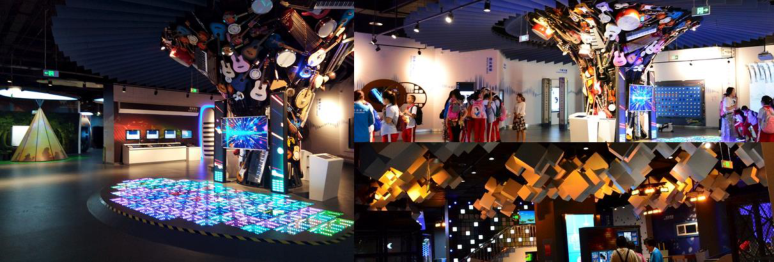
THE RESEARCH CONTEXT The research and course are carried out in an Innovation Space of 5,080 square meters and a
Intelligent Human Systems Integration (IHSI 2022): Integrating People and Intelligent Systems https://openaccess.cms-conferences.org/#/publications/book/978-1-7923-8988-7 comprehensive practice base with the theme of 'Creation and Play' (see Figure 1). The space is divided into three sections of experience, exploration, and challenge. The experience area, with the STEAM (Henriksen et al., 2019) concept as the core, sets up seven topics of music, animation, machinery, electronics, robots, space, and scientific investigation, with a total of 129 experiential installations. The exploration area aims at cultivating children’s innovative thinking and psychological quality. This area holds a series of courses covering topics of humanities, machinery, electronics, art, etc. The challenge area carries out maker activities and competitions, including the Soong Ching Ling Children Innovation Award, the China Youth MICROSTAR Program, the China Youth Innovation Design Competition, etc.
Figure 1. The research context of the Innovation Space.
EMPATHY IN PSYCHOLOGY Empathy is the ability to be cognitively aware of, grasp, and understand the emotions and feelings of others in their place (Weigel, 2017). Empathy is an essential mental tool in the innovation approach and a necessary quality of a human-centered design innovator (Desmet and Fokkinga, 2020). Innovation is driven by the desire to make a difference, by the ability to step outside of oneself and appreciate the lives of others. The foundation of this ability is empathy. Empathy is not equal to sympathy. The former is more about everyday feelings and transposition thinking rather than covering up the negative side of things. Empathy brings people closer, while compassion alienates them. The purpose is to cultivate an empathetic way of thinking by putting themselves into other people's shoes, a metaphor of representing situations and problems.
NEURODESIGN A new research track called the Leifer NeuroDesign Research Program (neurodesign.stanford.edu) at Stanford University has emerged (Auernhammer et al., 2020).
Intelligent Human Systems Integration (IHSI 2022): Integrating People and Intelligent Systems https://openaccess.cms-conferences.org/#/publications/book/978-1-7923-8988-7
It is a practical approach to innovation and an intersection between psychology and design. The study embraces functional Near-infrared Spectroscopy (fNIRS) instruments to capture and measure the changes in neurocognitive activation before and after a design thinking course to improve child empathy. We plan to recruit 30 students to complete the flanker task and the switch task while scanning their brain activities with the fNIRS devices. We have already collected fNIRS data on 7 students (5 boys and 2 girls, M age = 8.57 years, SD = 1.82 years).
COURSE PLAN
THEME The theme of this course is space exploration, which is based on hot topics in China. During this course, students enter the exploration area. Six contexts of field exploration are set. Each student team chooses a specific context and helps a persona solve their problems. The teaching team instructs the students to understand the context and environment in which the story takes place, to identify the difficulties encountered by the persona, and to solve them. Through continuous and iterative reflection and design optimization, the students are expected to generate innovative and appropriate solutions and improve their tinkering and design skills in the process of learning and collaboration.
SCHEDULE This 12-week course is divided into five main phases. The first is the introduction, which consists of one class. It explains the concept of innovation, field observation, and the course schedule (Table 1). Composed of two classes, the second is the theme exploration. The students understand background knowledge and user scenario, recognize empathy and its methodology, practice interview and user portrait techniques, and apply these techniques flexibly. Through the teacher-student interaction, the students collaborate within their teams to use empathy methods, such as context mapping, affinity diagraming, and C-Box. The third is the design expression, which consists of three classes. The students understand abstract methods, such as brainstorming, product sketching, and function descriptions. They propose design solutions through transferring the research data (i.e., persona, pain-points, and qualitative user needs) into conceptual design ideas. The fourth is prototyping, which consists of five classes. The students turn the abstract concepts and ideas into experiential prototypes (Liu et al., 2022). The students learn to master ultralight clay, Scratch 3.0, Lego bricks and WeDo 2.0, and other digital and physical prototyping toolkits. The fifth, with one class, is the presentation and conclusion. The students share main findings and get rewarded according to their performance. The teaching team reflects on lessons learned to help prepare the next iteration of teaching.
Intelligent Human Systems Integration (IHSI 2022): Integrating People and Intelligent Systems https://openaccess.cms-conferences.org/#/publications/book/978-1-7923-8988-7
Table 1. The Course Schedule
Table available in the original PDF paper.
Week Content Duration 1 Introduction, Warm-Up, and Kick-Off 2h/week 2-3 Theme Exploration: The Cultivation of Empathy 2h/week 4-6 Design Expression: The Cultivation of Design Thinking 2h/week 7-11 Prototyping: The Cultivation of Tinkering and Engineering 2h/week 12 Presentation, Conclusion, and Reflection 2h/week
CONCLUSIONS AND NEXT STEPS Through the upcoming iteration of teaching and learning, the students are expected to transform their ideas into hardware and tangible prototypes (Donati and Vignoli, 2015), which would increase their enthusiasm to discover areas of interest and continue exploring. From collecting and analyzing fNIRS data (Saggar et al., 2017), we expect that the students' brain functions related to creativity and executive functions can be improved upon completion of the course. Early outputs of the course include experiential prototypes, visionary storyboards, and video scenarios. We plan to optimize the course content and curriculum according to the results of the creativity measurement experiments and improve the experiment design according to behaviors and experiences collected during the current procedure. To foster and improve students’ creativity in future K-12 education system, we argue that raising tinkering questions and empathetic problems are more critical and essential than finding stylized answers and engineering solutions.
ACKNOWLEDGMENTS
This research is supported by the Sino-Finnish Joint Learning Innovation Institute (JoLii).
REFERENCES
Auernhammer, J., Liu, W., Ohashi, T., Leifer, L., Byler, E., & Pan, W. (2020). NeuroDesign: Embracing neuroscience instruments to investigate human collaboration in design. In International Conference on Human Interaction and Emerging Technologies, 284-289. Capraro, R., & Slough, S. (2013). Why PBL? Why STEM? Why now? An introduction to STEM
project-based learning: An integrated science, technology, engineering, and mathematics (STEM) approach. In STEM project-based learning, 1-5. Desmet, P., & Fokkinga, S. (2020). Beyond Maslow’s pyramid: Introducing a typology of thirteen fundamental needs for human-centered design. Multimodal Technologies and Interaction, 4(3), 38.
Intelligent Human Systems Integration (IHSI 2022): Integrating People and Intelligent Systems https://openaccess.cms-conferences.org/#/publications/book/978-1-7923-8988-7
Donati, C., Vignoli, M. (2015). How tangible is your prototype? Designing the user and expert interaction. International Journal on Interactive Design and Manufacturing, 9, 107-114. Dym, C., Agogino, A., Eris, O., Frey, D., & Leifer, L. (2005). Engineering design thinking, teaching,
and learning. Journal of engineering education, 94(1), 103-120. Henriksen, D., Mehta, R., & Mehta, S. (2019). Design thinking gives STEAM to teaching: A framework that breaks disciplinary boundaries. STEAM education, 57-78. Liu, W., Lee, K.P., Gray, C.M., Toombs, A.L., Chen, K.H., & Leifer, L. (2021). Transdisciplinary
teaching and learning in UX design: A program review and AR case studies. Applied Sciences, 11(22), 10648. Liu, W., Zhu, Y., Liu, M., & Li, Y. (2022). Exploring maker innovation: A transdisciplinary engineering design perspective. Sustainability, 14(1), 295. Lyu, Y., Wang, X., Zhang, B., Wang, Y., Jiang, M., Zhang, Q., Zhang, Y., & Liu, W. (2021). Teaching
practice in the “Empathy Design Thinking” course for elementary school students grounded in project-based learning. International Conference on Human-Computer Interaction, 544-555. Menéndez, A. F., & Min, H. (2019). Embracing Creativity in K-12 Engineering Pedagogy. Promoting Language and STEAM as Human Rights in Education, 141-149. Niemi, H., & Liu, J. (2021). AI in learning: Intelligent digital tools and environments for education.
Journal of Pacific Rim Psychology, 15. Quan, G. (2020). Tracking STEM education development in China: National, regional, and local influences. STEM in the Technopolis: The Power of STEM Education in Regional Technology Policy, 251-283. Saggar, M., Quintin, E.M., Bott, N.T., Kienitz, E., Chien, Y.H., Hong, D.W., Liu, N., Royalty, A.,
Hawthorne, G., & Reiss, A.L. (2017). Changes in brain activation associated with spontaneous improvization and figural creativity after design-thinking-based training: A longitudinal fMRI study. Cerebral Cortex, 27(7), 3542-3552. van Doorn, F., Stappers, P.J., & Gielen, M. (2013). Design research by proxy: Using children as researchers to gain contextual knowledge about user experience. Proceedings of the SIGCHI conference on Human Factors in Computing Systems, 2883-2892. Weigel, S. (2017). The heterogeneity of empathy. Empathy, 1-23.
Intelligent Human Systems Integration (IHSI 2022): Integrating People and Intelligent Systems https://openaccess.cms-conferences.org/#/publications/book/978-1-7923-8988-7
LISTED IN THE AHFE DIGITAL BOOKSTORE CATALOGUE
Explore the complete digital volume
Intelligent Human Systems Integration (IHSI 2022): Integrating People and Intelligent Systems
Read this individual research paper free through the original publisher, or explore the full digital proceedings book.
ISBN 978-1-7923-8988-7
Explore this ISBN in the AHFE Bookstore ↗Listed in the July 2026 bookstore catalogue; search by ISBN to confirm current availability · Digital book purchase optional