Pieter Desmet, Haian Xue, Xin Xin, Wei Liu (2022). Emotion deep dive for designers: Seven propositions that operationalize emotions in design innovation. In: Creativity, Innovation and Entrepreneurship. AHFE Open Access, vol. 31, pp. 169–176. https://doi.org/10.54941/ahfe1001519
This paper presents a five-day intense course that teaches “emotion-driven design” (EDD) to graduate students with a broad variety of disciplinary backgrounds at the Faculty of Psychology, Beijing Normal University. We introduce seven principles drawn from design-relevant emotion knowledge that informed the design of the course’s overall structure, and explain how they guided the development of learning activities and materials. We envision that this paper will interest design educators who aspire teaching how to operationalize emotions in creative design processes to students with little preexisting expertise in (or scientific knowledge about) emotion psychology.
“Emotion-driven design” (EDD) refers to design activities that are (a) infor- med by (positive or negative) emotions of users or consumers, and/or (b) aim to target predetermined user emotions as evoked or mediated by designed artifacts, services, and/or systems. Although user emotions may be taken into consideration in any given design project, they are given a central role in EDD. Since the late 1990s, the challenges of understanding and evoking user emotions have been systematically and increasingly addressed in design rese- arch (Desmet & Hekkert, 2009). These research efforts have resulted in a body of design-relevant emotion knowledge, including theories and models that embody an explicit understanding of the emotion phenomenon in the context of human-design interactions, and tools and techniques that facili- tate emotion-driven design processes. Despite the growing knowledge on this topic, it is still a challenge for design educators to systemically and efficiently teach how to operationalize emotion in creative design processes, especially to students with little preexisting expertise in (or scientific knowledge about) emotion psychology.
COURSE STRUCTURE AND EMBEDDING This course was offered to graduate students of the user experience pro- gram at Faculty of Psychology at Beijing Normal University (Liu et al., 2021, Zhu et al, 2021). It was designed to (a) teach scientific knowledge about human emotion, and (b) inspire by affording direct action in creative pro- cesses. In 2021, 76 students enrolled. They teamed up in 18 groups, which were formed and balanced with their undergraduate backgrounds to ensure within-team diversity. The course was taught in a hybrid in-class and online (using the Zoom platform) form, in five consecutive days. Two professors were involved online, and two teaching assistants helped in the classroom. One professor gave the academic knowledge by lectures, while the other guided the students to practice via one-on-one online meeting rooms. The teaching assistants took the course before and were able to answer basic questions.
SEVEN PRINCIPLES FROM DESIGN-RELEVANT EMOTION KNOWLEDGE Both the course’s overall structure and the educational materials have been based on seven principles drawn from design-relevant emotion knowledge (Desmet et al., 2021): (1) Emotions are subjective: All emotions a per- son experiences in response to a design are mediated by their personal history, motives, and interests. (2) Design evokes micro emotions: Rather than evoking strong emotions, design mostly evokes a stream of multiple mild emotions that are of low intensity, short duration, and mild impact. (3) Humans have fundamental needs: While there is an infinite diversity of human motives that underly emotions, all people share a limited set of uni- versal psychological needs that provide the fundament for our emotional responses to design. (4) Design can evoke diverse emotions: The range of emotions that people can experience in response to consumer goods is a lot more diverse than often recognized in emotion-driven innovation. (5) Nega- tive emotions can be enjoyable: The human emotion repertoire includes a unique space of rich experiences, which embodies emotions that combine pleasure and displeasure. (6) Emotions reveal user motives: Emotions are gateways to understanding what people care about while interacting with design. (7) Emotions are often driven by dilemmas: Most designs evoke mixed emotions because they fulfill one motive while violating another. Below we describe the exercises and learning goals developed based on each of the seven principles.
Principle 1: Emotions are Subjective Individually, students are asked to bring a product to the class that has a personal meaning to them; an object that they cherish. In addition, they write a short introspective essay about the feelings they experience towards this object and why this object is meaningful to them. In class, they share their reflections in small teams. By doing this exercise, students (1) get first-hand experience with how introspection can be used to get access to emotional experiences, and how these introspections can serve as a basis for reflection
Emotion Deep Dive for Designers: Seven Propositions That Operationalize Emotions 171
and analysis. They also learn that (2) emotions are subjective and personal; yet at the same time, we can appreciate, resonance, or empathize with other people’s emotions.
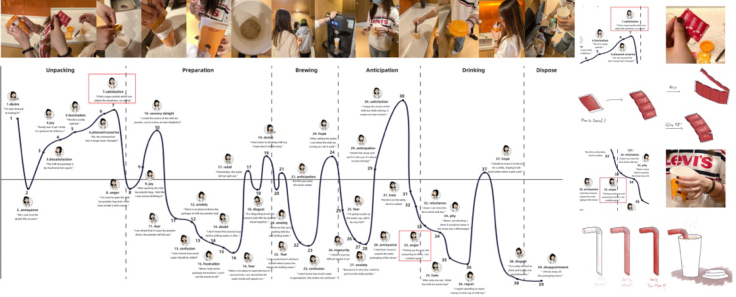
Principle 2: Design Evokes Micro Emotions In small teams, students do a “Micro Emotion Scan” (MES), an exercise that captures the wide range of subtle emotions experienced while using a simple everyday product (e.g., a chocolate box or a cleaning detergent). The MES outcome is an Emotion Map, which is a visualized timeline with an ove- rview of all emotions experienced and identified during the usage journey (see Figure 1 for an example). Each emotion is reported with a verbal label, a pictogram, and a one-sentence description of the specific cause. Next, stu- dents select one negative and one positive emotion and make two redesigns: one that strengthens the positive, and one that reduces the negative emotion. This exercise enables two learnings: (1) human-design interaction involves a constant stream of subtle and fleeting micro-emotions, which can be unco- vered by slowing down the interaction, (2) capturing these micro-emotions can reveal relevant and exploitable design opportunities.
Principle 3: Humans Share Fundamental Needs In small teams, students make an analysis of a functional architectural space, using an overview of 13 fundamental needs (Desmet & Fokkinga, 2020a) as a lens. The selected space is the course classroom, which includes various elements, such as a gallery, informal meeting spaces, and movable workshop tables. Students take their own experiences as the entry-point of analysis, and identify which four needs are best fulfilled by the classroom and explain why. They do the same for the four needs which are most hindered (or least fulfilled). Next, they select two under-fulfilled needs and make a conceptual redesign of the space that improves the fulfillment of both needs. Through this exercise, students learn that even though people have different goals and wishes on the surface, deep down everybody has the same universal psych- ological needs. Students become acquainted with these needs, and practice how they can be used as (1) a means for analyzing the emotional impact of design, and (2) as a starting point for design innovation.
Principle 4: Design Evokes a Wide Varity of Emotions Individually, students collect six personal “samples” of emotions that they have experienced in their everyday life in relation to using or owning a consu- mer product. They are provided with a longlist of 50 emotion concepts/terms (of which 25 pleasant and 25 unpleasant), with corresponding definitions (Desmet & Fokkinga, 2020b). First, they select three emotions that inspire them. Next, they collect two samples for each emotion. For each sample, they make a separate card using a predefined format (with a picture, emotion label, and short description). Cards are printed and placed on a workshop table to serve as input for a class discussion about the subjective quality and diversity of emotions. With this activity, students (1) get first-hand experience with the
Figure 1: The micro emotion scan (left) and two redesigns (right).
diversity of emotions that human-design interaction may evoke, and (2) deve- lop their “emotional granularity”, which is their ability to make fine-grained, nuanced differentiations between similar yet distinct emotional states, and to specifically interpret and articulate them (Yoon et al., 2016).
Principle 5: Negative Emotions can be Enjoyable In small teams, students design for a “rich experience”. As a design context, students are free to select an interesting location in the university campus (e.g., library, canteen, sports field). They target a negative emotion and brain- storm how it can be evoked with a design intervention in the given context. Next, they reflect on how the negative emotion can be transformed to a rich experience by ensuring that the user is protected from possible negative conse- quences (Fokkinga & Desmet, 2012). In this exercise, students learn (1) how negative emotions can serve a function in creating enjoyable experiences, (2) how to distinguish between negative emotions that are plainly unpleasant and those that involve a sense of enjoyment, (3) how to create a negative stimulus while protecting the user from its adverse consequences, so that a negative emotion can be enjoyable.
Principle 6: Emotions Reveal User Motives In small teams, students engage in a participant observation that aims to uncover relevant user motives in a given activity (e.g., buying a snack in a convenience store, or going with friends to a karaoke bar). In the two-staged procedure, students first go to “the field” with one acting as the user/consu- mer and the others observing and capturing as many as emotions experienced by the “user” in that activity, following an established procedure (Ozkara- manli et al., 2018). Next, for each captured emotion, three types of questions are asked and discussed in the team: “what happened” (e.g., “I bought a bag of nuts that was expired”); “what did the user feel” (e.g., “I was angry”), and “why was this event was important to the user” (e.g., “shops should pay attention to what they are selling”). Asking the “why” question gains access
Emotion Deep Dive for Designers: Seven Propositions That Operationalize Emotions 173
to underlying personal motives. With this exercise, students (1) practice obse- rvation and interview techniques that enable them to uncover the relational meaning that underlies emotions. They learn that (2) each emotion involves a stimulus (the event that evokes the emotion) and a personal motive (which gives the stimulus personal relevance). Students learn (3) how to formulate human motives in various levels of abstraction, and how this influences the space of design opportunities.
Principle 7: Emotions Are Often Driven by Dilemmas The dilemma-driven design exercise builds on the overview of user motives that students identified in the previous exercise. All identified user emotions (including the stimulus and underlying motive) are first mapped on separate motive cards. Three teams that studied the same type of activity in the field combine and place their motive cards on a table. They then cluster these cards to identify motive categories and dilemmas between these categories. Finally, each team selects three dilemmas (or pairs of conflicting motives) as starting points and design three interventions that aim to reconcile the conflicts. In this exercise, students learn that (1) motives are most useful in design pro- cesses when their formulation is open-ended (e.g., “I want to eat healthy,” instead of “I want to eat a banana”) and positive (e.g., “I want to eat heal- thy,” instead of “I do not want to eat unhealthy”). In addition, students (2) gain experience with various design opportunities (e.g., compromising, reso- lving, contrasting) that can be taken as pathways to leverage user dilemmas for design innovation.
RESULTS
At the start of each course day (except the first), the students presented their projects (process, results, and key learning). On days 2 to 4, six teams pre- sented (each day different teams). On day 2, the micro emotion project (see Principle 2). On day 3, the fundamental needs project (see Principle 3). On day 4, the rich experience project (see Principle 5). On day 5, all teams presen- ted their motive detection (see Principle 6) and dilemma-driven designs (see Principle 7). Below, work examples are presented for all each four projects.
Micro Emotion Scan: Bottle of Instant Milk Tea The student team scanned their detailed feelings and emotions experienced when using a bottle of instant milk tea (see Figure 1). They uncovered 39 emotions during the opening of a bottle (and reported that they never thought a simple product evokes so many emotions). They selected two emotions as the basis for their redesigns. The first was satisfaction: the user is satisfied when discovering that the product comes with a sugar bag, with gives the option to add sugar. The students’ redesign leveraged this personalization option to further enhance the positive emotion: The sugar bag was divi- ded into four parts, labeled ‘25%’, ‘50%’, ‘75%’, and ‘100%’ respectively. The users can decide how many parts to add, matching their preference. The second emotion was anger, which was caused by scalding due to the hot milk tea. They designed a temperature-sensitive straw: it is white when the tea is
Figure 2: The fundamental need analysis (left) and design intervention (right).Figure 3: The automatic door (left) and rich experience redesign (right).
20°C, pink when it is 50°C, and deep red when it is 100°C. By indicating the tea’s temperature, it enables the user to manage their own safety.
Fundamental Needs: Learning Goal Display In their analysis of the classroom’s need fulfillment, the student team focused on a corridor between a small bar and a break room that is seldomly used because people walked by fast. The needs they selected as “not being fulfil- led” were recognition, purpose, and competence. These were then applied in their design intervention: A learning goal display (see Figure 2). Each stu- dent’s learning objective is posted on a triangular prism made of cork packing, which can be rotated to check all sticky notes. Different surfaces represent different student year cohorts. Students can place their goals side by side, enabling them to compare and motivate themselves by knowing the goals of their peers and seniors. Also, they can interact with others by posting stickers on the target they want to encourage.
Rich Experience Design: Pac-Man Automatic Door The student team focused on the classroom entrance door. After observati- ons and some interviews, they concluded that many people are afraid of the automatic door; they fear it will close when they are passing through it. The door being transparent, you risk bumping into it when you do not notice that it has closed. The students selected the rich experience “thrilling” as the starting point for their redesign. They added Pac-Man animations and other elements, such as a countdown and progress bar (see Figure 3). Rather than resolving the fear, this redesign transforms the negative fear into a positive sense of thrill (excitement), while also helping the user to avoid accidents (i.e., the animations reduce the risk of walking into the glass door).
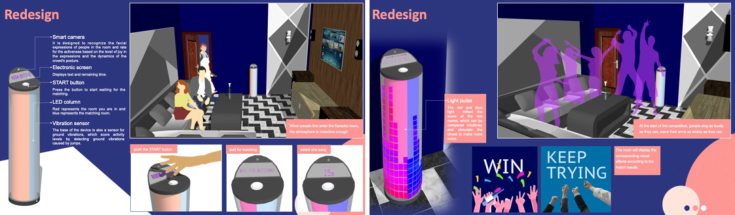
Dilemma Driven Design: Room Battle The student team focused on emotional dilemmas experienced in the context of Karaoke, which is a popular leisure activity in China. They uncovered the dilemma of “I want to feel free to express myself” versus “I do not want
Emotion Deep Dive for Designers: Seven Propositions That Operationalize Emotions 175
Figure 4: The Karaoke “Room Battle” system redesigns.
to be judged”. They designed the “Room Battle” (see Figure 4), which is a system that enables you to battle with people in other bar rooms of the Kara- oke facility. The battle requires loud singing and wild movements. Instead of competing for singing skills, this new design measures decibels, body move- ments, and bounces in the competing the rooms, which are visualized on a LED column in each room. By redirecting the participants’ attention from the individual to the inter-room dynamics, the system helps them to avoid feeling judged as a person, which can help raising the room atmosphere as soon as possible.
Course Evaluation The university conducts evaluations for all courses as quality assurance for pedagogy. For the current course, students (n=53) reported their evaluation on a ten-point scale on 11 criteria that focus on the course’s content, material, organization, teacher’s performance, and teaching methods. Results showed a high-level assessment with an overall mean score of 9.76 and a score of 9.65 or higher on all criteria. Students also answered some open questions about their learning experiences. Responses indicated that students appreci- ated gaining a deeper understanding of emotion-driven design. Two elements that were often mentioned as inspiring, were (1) the experience of ‘zooming in and out’ to balance their designs, and (2) how both positive and negative emotions were interesting from a design point of view: “I am surprised by this human emotional experience, the combination with negative and posi- tive is so interesting and fun. It is amazing how contradictory and rational human emotional experiences can be, e.g., the frightening thrill of riding a rollercoaster…”
CONCLUSION
This paper presented a five-day intensive course that was developed to teach EDD to graduate students with a broad variety of disciplinary backgrounds. We discussed seven principles drawn from 25 years of research into EDD. These principles informed the design of the course’s overall structure and guided the development of learning activities and materials. We envision this paper will interest design educators who aspire to better integrate EDD into their design pedagogy.
REFERENCES
Desmet, P.M.A. & Fokkinga, S.F. (2020a). Beyond Maslow’s pyramid: Introducing a typology of thirteen fundamental needs for human-centered design. Multimodal Technologies and Interactions, 4(3), 38. Desmet, P.M.A. & Fokkinga, S.F. (2020b). Human Experience Catalog: Six typolo-
gies of human experiences. Delft: Delft University of Technology. Desmet, P.M.A. & Hekkert, P. (2009). Special issue editorial: Design & emotion.
International Journal of Design, 3(2), 1–6. Desmet, P.M.A., Fokkinga, S.F., Ozkaramanli, D., & Yoon, J. (2021). Emotion-driven product design. Emotion Measurement, 645–670. Fokkinga, S.F. & Desmet, P.M.A. (2012). Darker shades of joy: The role of negative
emotion in rich product experiences. Design Issues, 28(4), 42–56. Liu, W., Lee, K.P., Gray, C.M., Toombs, A.L., Chen, K.H., & Leifer, L. (2021).
Transdisciplinary teaching and learning in UX design: A program review and AR case studies. Applied Sciences, 11(22), 10648. Ozkaramanli, D., Desmet, P.M.A., & Özcan, E. (2018). From teatime cookies to rainpants: Resolving dilemmas through design using concerns at three abstraction levels. International Journal of Design Creativity and Innovation, 6(3-4), 169– 184. Yoon, J., Pohlmeyer, A.E., & Desmet, P.M.A. (2016). When “feeling good” is
not good enough: Seven key opportunities for emotional granularity in product development. International Journal of Design, 10(3), 1–15. Zhu, D., Gray, C. M., Toombs, A. L., & Liu, W. (2021). Building a cross-cultural UX design dual degree. IASDR.
LISTED IN THE AHFE DIGITAL BOOKSTORE CATALOGUE
Explore the complete digital volume
Creativity, Innovation and Entrepreneurship
Read this individual research paper free through the original publisher, or explore the full digital proceedings book.
ISBN 978-1-958651-07-0
Explore this ISBN in the AHFE Bookstore ↗Listed in the July 2026 bookstore catalogue; search by ISBN to confirm current availability · Digital book purchase optional