Nao Takizawa, Takuya Washio, Masamoto Fukawa, Kenichi Takeda, Hiroyuki Ito, Miki Saijo, Takumi Ohashi (2022). Human-Centered Design of Cattle Behavior Monitoring System for Grazing in Abandoned Farmland. In: Human Factors in Accessibility and Assistive Technology. AHFE Open Access, vol. 37, pp. 117–124. https://doi.org/10.54941/ahfe1001650
The livestock industry faces a shortage of workers due to aging populations and falling numbers of young farmers. Researchers have collected and analyzed big data, and attempted to use it to improve livestock farming practices and reduce labor costs. We developed a cattle behavior monitoring system, PETER, using edge-AI and low-power wide-area (LPWA) technologies. PETER enables us to detect behaviors of grazing cattle (e.g., foraging, ruminating, walking, resting). Conversely, in the development of conventional livestock breeding support systems, user requirements are defined in a top-down manner. Few R&D projects feature user-centered design (UCD) or consider interactions between actors (e.g., farmers, livestock, technologies). This study aimed to apply UCD to the raising of grazing livestock, and to develop a prototype system offering farmers more precise and less labor-intensive livestock management.Our study started with fieldwork at a small grazing farm in Japan, located on abandoned farmland about 700 km from Tokyo. Two Japanese Black breeding cows are being raised and managed by a farmer and the farm owner. The farmer is employed part-time. The owner lives in Tokyo, is a veterinarian, and decides how to manage the cows. The information used by the owner to make decisions, such as nutritional deficiencies, or signs of disease or estrus, is provided only by the farmer. We investigated how remotely located veterinarians or owners could notice abnormalities in cattle and decide how to treat them, without waiting to consult the local farmer. Our UCD comprised three rounds: sketches; mock-ups; and finally functional prototypes to test and validate our ideas and hypotheses on users. We developed a web-based app as a functional user-interface prototype of PETER, showing the cows’ behavior history, the farm calendar, and the estimated amount of pasture grass. This information alone is insufficient for the farmer’s or owner’s understanding and decision-making. Therefore, the app can notify the chat communication service originally used by the farmer and owner whenever PETER detects possibly abnormal behavior in cattle, such as a reduced daily foraging or ruminating or walking duration, or an increase in resting duration. This is to attract their attention whenever PETER detects something unusual about the cattle. The farmer can then provide supplementary practical information on the spot, and the remote owner can make decisions and give instructions on the spot. During the four-week user test with the functional prototype, 10 notifications were made to the chat service, eight of which were supplemented with further information, such as farmers sending photos, and six of which confirmed the owner’s instructions and advice to the farmer. Some of the responses were confirmed, such as the owner calling a local veterinarian when a cow had diarrhea.This study shows that when the cattle behavior monitoring system detects any unusual information in pasture-raised livestock, it notifies the communication tool used by the owners, enabling them to take action before the matter becomes serious, even if they are remotely located. This study also indicates that the UCD approach is effective in the raising of pasture livestock.
The livestock industry faces a severe shortage of workers due to population outflow from rural areas to urban areas and the aging of the population (Taylor et al., 2012). Scholars have thus made efforts to collect and analyze big data and its usage to simultaneously achieve precise livestock farming and labor cost reduction (Wark et al., 2007). In this context, the Food and Agriculture Organization of the United Nations (FAO) has stated that there is a need to promote research that addresses the needs and demands of the small to midsize and family farmers (FAO, 2014), in other words, human- centered design (HCD). However, compared to fields such as medical and care where HCD has been widely applied (Ohashi et al., 2021), there is very little research that has applied HCD in the livestock sector. The pur- pose of this study is to apply HCD to the development of the user interface (UI) of a cattle behavior monitoring system, “PETER,” using edge AI and GPS, which enable the detection of the behavior (e.g., eating, ruminating, walking, resting) and locations of grazing cattle (Li et al., 2021a; Li et al., 2021b).
METHODOLOGY
In this study, we developed a UI for a behavior analysis device using a gra- zing pasture in Shimane Prefecture, Japan, as a field. In this pasture, two
beef breeding cows (Japanese Black breed) graze on about 1 ha of abando- ned land. The pasture is currently managed by a local farmer (hereinafter, the “farmer”), who used to graze the cattle, by outsourcing. The farmer visits the pasture every morning and evening for about an hour to feed the cattle and check their health. The person requesting the outsourcing of the work is an employee of the company that owns the pasture, who lives 700 kilometers away in Tokyo (hereinafter, the “owner”). As the owner is a licensed veterinarian, he is consulted remotely when any problems arise. Therefore, the target users of the HCD in this study were the farmer and the owner.
The R&D process was organized based on the HCD framework as defined in ISO 9241-210 (ISO, 2019). In HCD, the following four processes are sup- posed to be repeated until the product meets the user’s needs: a) Understan- ding and specifying the context of use, b) Specifying the user requirements, c) Producing design solutions, and d) Evaluating the design. In this study, these processes were conducted for three rounds, as described in Table 1. In addition to the farmer and the owner, the developer of the behavior analysis device and a livestock expert were also interviewed to provide expertise.
The purpose of Round 1 was to organize the problem situation and con- firm the ideas and concept. The observation items from the fieldwork and the data from the interviews with the farmer and the owner were open coded to organize the problem situation, and from there the issues considered high priority were extracted to define the requirements for the product (Burnard, 1991). They then listed the ideas, created a figure representing the concept (sketch), and showed it to the users to receive feedback on whether the requi- rements were on target and whether the ideas could meet the requirements (Szekely, 1995; Walker et al., 2002).
Next, in Round 2, we aimed to revise and improve the ideas. Based on the results of Round 1, we identified the problem, defined the requirements, and created a web app without actual functions, but which the participants could use as a mock-up. In addition, in testing notifications from the web app, we used the Wizard of Oz method by sending test notifications to the existing chat app instead of the mock-up to check the user’s response (Dahlbäck et al., 1993). Here, we prepared multiple candidates for notifications, including graphs and phrases, and checked with the users to see which ones met their requirements.
Finally, in Round 3, we created a web app using actual livestock data (functional prototype) and had users use it for 30 days. At the middle and the end of the user test period, a five-point Likert scale questionnaire on whether each function was useful (strongly disagree, disagree, neither agree nor disagree, agree, strongly agree) and a semi-structured depth-interview were conducted to verify that each function met the respective requirements. In addition, based on the chat communication app records, we observed how communication was generated by the farmer and the owner during notifications.
Human-Centered Design of Cattle Behavior Monitoring System for Grazing 119
Table 1. The R&D process organized based on HCD.
Table available in the original PDF paper.
HCD Activity Data source Time process
device developer 3 Nov. 2020
Round 1 a Fieldwork / Interview farmer 3 Nov. 2020 Interview owner 3 Nov. 2020 b Defining requirements Nov. 2020 c Expert interview / prototype
Dec. 2020
livestock expert 17 Nov. 2020 d User test and interview owner 11 Dec. 2020 farmer 18 Dec. 2020 Round 2 a, b Revision of problems / requirements device developer 21 Dec. 2020 c Expert interview and prototype
device developer Jan.–Apr. 2021
livestock expert 15 Jan. 2021 d User test / interview owner 19 Jan. 2021 the farmer 21 Jan. 2021 Round 3 c Expert interview / prototype d User test / interview owner Jun. 2021 farmer Jun. 2021
RESULT
Round 1: Organize the Problem and Confirm the Idea Concept As a result of open coding of the observation items from the fieldwork and the speech data from the interviews with the farmer and the owner, 19 issues were found. Of these, we extracted and organized problems that were considered high priority and those that could be solved by PETER, and defined three requirements.
The first requirement was as follows: “Veterinarians and advisors in remote areas will be able to notice signs of estrus, disease, and nutritional abnormalities and consider how to deal with them, without waiting for con- sultation from managers in the field” (Requirement 1-1). The requirement is reflected the structural problems of this farm. That is, the farmer is in the position of receiving orders/instructions from the owner, and on the other hand, the owner has to notice and deal with the problems of estrus, disease, and nutritional management of cattle; however, they cannot drive to the site because they live in a remote area. Thus, conventionally, the only way for the owner to make decisions was to wait for the farmer’s notification of the problem and consult with them.
The second requirement was as follows: “Veterinarians who do not nor- mally see the cattle will be able to treat diseases without relying solely on the memory of the manager”(Requirement 1-2). This was set in the hope that the PETER information also would be useful to local veterinarians who would have the responsibility of dealing with the estrus, disease, and nutritional management problems noticed in Requirement 1-1.
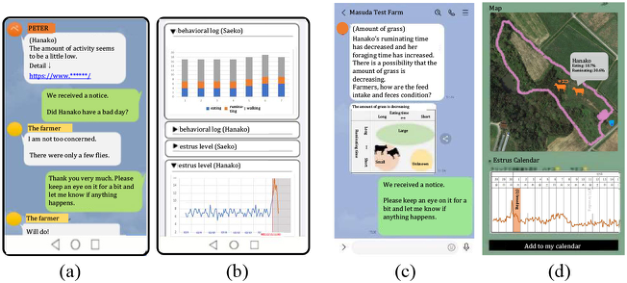
Figure 1: Prototypes. (a, b) Sketches in Round 1. (c, d) Mock-ups in Round 2.
The third requirement was as follows: “Veterinarians and advisors in remote areas will be able to design feeds with a clear rationale” (Require- ment 1-3). This was determined based on the issue that regarding grazing on abandoned land where the amount of grass is not abundant, the missing nutrition is supplemented by roughage, but since it is not known how much grass the cattle are eating while grazing, it is not known how much roughage should be fed to them, which causes the cattle to be undernourished, resulting in reproductive problems.
We conceived the idea based on these requirements and created figures to represent the concept. Some of them are shown in Fig. 1. Figure 1(a) shows a function that notifies the communication tool (LINE Corporation, n.d.) that the farmer and owner have been using when it detects signs of estrus, disease, or nutritional abnormalities. This corresponds to Requirement 1-1. It is thought that it is possible to detect estrus based on the 21-day estrus cycle and changes in the activity of cows, and illness based on changes in activity time; regarding nutritional deficiency, while it is difficult to estimate the absolute amount of forage, it is possible to grasp signs of changes in the amount of grass based on the relationship between ruminating and eating time (Ertjmry, 2007). Although it is not clear that such information from these behavior analysis devices alone would be sufficient for the owner in a remote area to decide how to deal with the situation, we expected that this notification would encourage the farmer and the owner to become aware of the situation, and that the farmer would be able to give explanations supple- mentary to the notification so that the owner could give instructions on how to deal with the situation on the spot. Figure 1(b) is an app that allows users to refer to the condition of the pasture and past activity data, corresponding to Requirements 1-2 and 1-3.
Based on these figures, we obtained feedback from the farmer and owner on the requirements and the concept. The results were that Requirement 1-1 was acceptable, and both the farmer and the owner had high expectations for the notifications in the communication tool. In particular, they expected that the change in the amount of grass would be one of the factors involved in decision making, even if such information was not complete, because they had to deal with reproductive problems among cattle due to lack of nutrition
Human-Centered Design of Cattle Behavior Monitoring System for Grazing 121
in the past. On the other hand, they were not sure if they needed to see the past behavioral history. There were also requests for other functions, such as knowing the expected date of estrus and calving, knowing where the cows are when they do not come to the feeder, and knowing when they are stuck due to accidents.
Round 1 user testing showed that notifications to the communication tool and app for archiving are expected to be effective. However, whether these meet the requirements depends on the wording of the notification and how the data is presented. As some information on the problems and needs in the field was updated, it was decided to revisit the problem from the problem organization and requirements definition in Round 2.
Round 2: Brushing up on Ideas We redefined the requirements in the following three categories, incorpora- ting the issues identified in Round 1: “Veterinarians and advisors should be able to recognize the possibility of poor health, nutritional deficiencies, and accidents even from remote locations without waiting for consultation from managers in the field, and gather the information necessary to make decisi- ons”(Requirement 2-1); “The timing of events related to estrus and childbirth can be scheduled in advance, and the timing at which treatment is needed will not be missed” (Requirement 2-2); “Locate cows when they do not show up following calls for them from the on-site manager” (Requirement 2-3). Based on these requirements, we created a web app without real data, and for the notification function, we confirmed the response of the farmer and the owner through test notifications sent by the author. We prepared several candidates for the display method of each function and the wording of the notificati- ons, and asked the users which among them satisfied the requirements better. Figure 1 (c) and (d) are the excerpts.
In terms of notifications, we incorporated feedback such as the link to the app is not being referenced when sent, so it would be better to post the diagram as is, and the earmark number is better than the name for identif- ying cows. Regarding the app, we adopted a graph that shows the amount of activity per day, a diagram that estimates the amount of grass based on the relationship between ruminating time and foraging time, a map that shows the location of the cows as well as their own location and the range of the pasture, and an estrus and calving calendar that overlays changes in the amount of activity of the cows. However, since we needed to experiment with actual data to see if these requirements were actually met, we decided to create a functional prototype in Round 3.
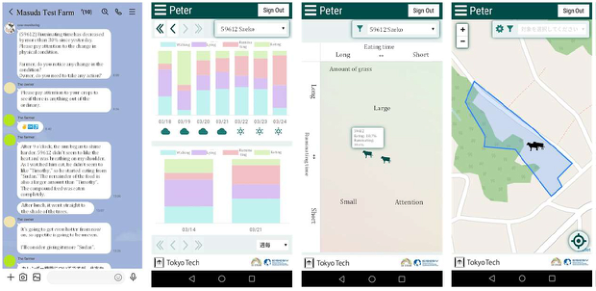
Round 3: User Testing with an App Using Actual Livestock Data Based on what was discussed in Round 2, we created a web app as a functional prototype that incorporates actual cow behavior data and has a notification function for the chat app (Fig. 2), and had the farmer and the owner use it for 30 days to verify whether or not Requirements 2-1 and 2-3 were met. Requirement 2-2 could not be verified because there were no
Figure 2: Screenshot of functional prototype in Round 3.
estrus or birth events during the user test period. Also, accident notification in Requirement 2-1 could not be verified because no accident occurred.
First, the notification was set to arrive before the farmer’s morning work when the activity time of each cattle in the past 24 hours changed more than a certain percentage compared with the preceding 24 hours. The thresholds were adjusted accordingly by the authors so that each of the following types of notification could be tried within the user test period: decrease in rumina- tion, decrease in foraging, decrease in walking, and increase in resting. The app was made available to use for free, with graphs showing daily and wee- kly changes in the amount of each activity, a diagram showing the amount of grass, and the pasture map. After the user testing, the farmer and the owner answered a five-point Likert scale questionnaire on whether the information was useful or not. A semi-structured depth-interview was also conducted regarding usage and potential improvements.
During the month of user testing, there were 10 notifications in total, 8 of which resulted in the farmer providing supplemental information, 6 of which resulted in owner responding, and 1 of which resulted in a response to call a local veterinarian. The day the local veterinarian was called, a cow had diarrhea. That morning, there was a notification of a change in the amount of ruminating, and when the farmer looked at the cattle, the cow did not look well, so the farmer consulted the owner and the veterinarian was cal- led. According to the questionnaires after the user test, the owner could not say whether the notification itself was useful or not, but the owner thou- ght that the supplementary information was strongly useful. In the interview, the owner said, “The role of PETER is as a trigger, a lubricant to facilitate communication,” and “It may be a trigger for me to take action. However, when it comes to deciding what to do, I rely on the supplementary infor- mation provided by the farmer.” On the other hand, the farmer responded that they thought the notice itself was useful, saying, “When I receive the notification, I look at the cows and check if there are any abnormalities, as PETER indicated.” These results did not differ according to the type of noti- fication. Therefore, rather than the specific content of the notifications, it is thought that the notifications themselves, which indicate that something is unusual, were valuable. These prompted the farmer to direct attention and
Human-Centered Design of Cattle Behavior Monitoring System for Grazing 123
provide sensory support, and for the owner in remote areas to help him make decisions at an early stage.
Regarding the app, the farmer rarely looked at the weekly activity graph, but did look at the daily activity graph almost every day. Regarding the grass amount graph, the farmer said, “I can’t say what percentage is too much or too little,” and in the questionnaire on whether the function was useful, they answered “neither agree nor disagree.” Regarding the map, the farmer answered “disagree”in the questionnaire on whether the function was useful. This was because the GPS was not accurate in mountainous areas, and the location of the cattle was often shown to be far from the farm. Based on these results, we considered that requirement 2-1 was partly achieved by the notifications and the daily activity graph. Decision making regarding poor health among cattle was achieved, but that regarding nutritional deficiencies was not. The reason for this is that the ruminating and eating times of the cows varied greatly (Kilgour, 2012), and it was not possible to determine one cow’s ideal nutritional management at that time. It will be required to analyze not only individual cows but also a herd and to track the changes over time to get data of the grass amount. Requirements 2-3 were also not achieved due to the GPS accuracy problem. It will be necessary to devise a way to accurately acquire location information in mountainous areas.
CONCLUSION
As a result of adapting HCD to the field of pasture-based livestock farming, it became clear that problems faced by such farmers can be identified and that a UI that can be incorporated into their daily work can be designed. The actual UI is such that when the cattle behavior analysis device detects unusual behavior, it notifies the communication tools of the stakeholders, which attracts their attention, generates communication between them, and as a result, leads to early action. If this product is realized, even if on-site farm managers do not have sufficient skills or time to observe the cattle, breeding management of grazing cattle may become possible with the support of knowledgeable people in the surrounding area. In future research, we aim to resolve the technical problems of how to represent the grass data and the accuracy of GPS, and to test the product with multiple farmers.
ACKNOWLEDGMENT
This study was partly supported by JST Center of Innovation Program (JPM- JCE1309). The authors appreciate the continuous support from Masuda Test Farm and Leave a Nest Co., Ltd., Japan.
REFERENCES
Burnard, P. (1991). “A method of analysing interview transcripts in qualitative research.” Nurse Education Today, 11(6), 461–466. https://doi.org/10.1016/0260- 6917(91)90009-Y Dahlbäck, N., Jönsson, A., and Ahrenberg, L. (1993). “Wizard of Oz studies — why
and how.” Knowledge-Based Systems, 6(4), 258–266. https://doi.org/10.1016/ 0950-7051(93)90017-N
International Organization for Standardization: ISO 9241-210 Ergonomics of Human system Interaction — Part 210: Human-centered Design for Interactive Systems. ISO, Geneva. (2019). https://www.iso.org/standard/21197.html Kilgour, R. J. (2012). “In pursuit of ‘normal’: A review of the behaviour of cattle at
pasture.” Applied Animal Behaviour Science, 138(1–2), 1–11. https://doi.org/10. 1016/j.applanim.2011.12.002 Li, C., Tokgoz, K., Fukawa, M., Bartels, J., Ohashi, T., Takeda, K. I., and Ito, H.
(2021a). “Data Augmentation for Inertial Sensor Data in CNNs for Cattle Beh- avior Classification.” IEEE Sensors Letters, 5(11). https://doi.org/10.1109/LSEN S.2021.3119056 Li, C., Tokgoz, K. K., Okumura, A., Bartels, J., Toda, K., Matsushima, H., Ohashi, T., Takeda, K., and Ito, H. (2021b). “A Data Augmentation Method for Cow Beh- avior Estimation Systems Using 3-Axis Acceleration Data and Neural Network Technology.” IEICE Transactions on Fundamentals of Electronics, Communica- tions and Computer Sciences, 2021SMP0003. https://doi.org/10.1587/TRANSF UN.2021SMP0003 LINE Corporation. (n.d.). https://line.me/ja/ Ohashi, T., Ito, Y., Kurabayashi, D., and Saijo, M. (2021). “Designing an Abnor-
mal Posture Detection System to Prevent Accidents During Meal Assistance for Older Adults: A User-Centered Design Approach.” Lecture Notes in Networks and Systems, 263, 345–352. https://doi.org/10.1007/978-3-030-80744-3_43 P. Ertjmry. (2007). “Ruakura Sudies on the Grazing Behavior of Dairy.” Article, 20(livestock), 11–33. Szekely, P. (1995). “User interface prototyping: Tools and techniques.” Lecture Notes
in Computer Science (Including Subseries Lecture Notes in Artificial Intellige- nce and Lecture Notes in Bioinformatics), 896, 76–92. https://doi.org/10.1007/bf b0035808 Taylor, J. E., Charlton, D., and Yu´nez-Naude, A. (2012). “The End of Farm Labor Abundance.” Applied Economic Perspectives and Policy, 34(4), 587–598. https: //doi.org/10.1093/aepp/pps036 The State of Food and Agriculture 2014. (2014). In Food and Agriculture Arganiza-
tion of the United(FAO). https://doi.org/10.1017/S1876404512000115 Walker, M., Takayama, L., and Landay, J. A. (2002). “High-Fidelity or Low-Fidelity, Paper or Computer? Choosing Attributes when Testing Web Prototypes.” Pro- ceedings of the Human Factors and Ergonomics Society Annual Meeting, 46(5), 661–665. https://doi.org/10.1177/154193120204600513 Wark, T., Corke, P., Sikka, P., Klingbeil, L., Ying, G., Crossman, C., Valencia, P.,
Swain, D., and Bishop-Hurley, G. (2007). “Transforming agriculture through pervasive wireless sensor networks.” IEEE Pervasive Computing, 6(2), 50–57. https://doi.org/10.1109/MPRV.2007.47
LISTED IN THE AHFE DIGITAL BOOKSTORE CATALOGUE
Explore the complete digital volume
Human Factors in Accessibility and Assistive Technology
Read this individual research paper free through the original publisher, or explore the full digital proceedings book.
ISBN 978-1-958651-13-1
Explore this ISBN in the AHFE Bookstore ↗Listed in the July 2026 bookstore catalogue; search by ISBN to confirm current availability · Digital book purchase optional