Risako Yanagase, Nao Takizawa, Takumi Ohashi, Miki Saijo (2024). The Development of a Care Assistive Device Based on Design Thinking: An Examination of Interview Methods by Visualizing Ideas Using Sketches. In: Human Factors in Communication of Design. AHFE Open Access, vol. 136, pp. 39–48. https://doi.org/10.54941/ahfe1004967
In the design thinking process, interviews are essential to incorporating user perspectives. Typically, the initial interviews aim for empathy, while subsequent ones during the user test phase validate prototypes. However, this often means that direct user input is not integrated during the ideation and prototype creation stages, potentially leading to a disconnect between developers and users. This study aims to promote user participation throughout the design thinking process and align perceptions between developers and users. We conducted a case study where interviews were held during the ideation phase, and hand-drawn sketches were used for visualizing ideas, thereby incorporating direct user feedback on prototype concepts. The case study focused on the development of a device to prevent falls among elderly residents in a care facility. The results suggest that using hand-drawn sketches for idea visualization during ideation interviews contributes to aligning developer and user understandings, enhancing the development process.
In the evolving landscape of engineering and design, the concept of design thinking has emerged as a cornerstone of innovation and user-centric devel- opment. This paper delves into the challenges and potential enhancements of the design thinking process, particularly focusing on the integration of visualization techniques to streamline the design cycle and improve user engagement.
At the heart of design thinking’s five steps (Brown, 2008) lies empathy- based problem definition, which is integral to user-aligned development. However, a significant limitation in the current design thinking model is the delayed incorporation of direct user feedback. This feedback often only emerges during the user testing phase, after substantial resources have been allocated to prototype development. Consequently, this can necessitate sig- nificant pivots, despite the substantial investment in the prototyping phase. While iterative processes are essential to design thinking, the time-intensive nature of current practices poses a challenge that demands attention.
To address this challenge, it is necessary consider whether the design think- ing process can be expedited. The potential of visualization in this context has been recognized, as indicated in prior research: the effectiveness of freehand sketches in participatory design, highlighting their role in facilitating commu- nication and idea generation (Al-Kodmany, 1999; Shimizu, 2017). Similarly, recent research not only highlights the advantages of incorporating visualiza- tion into the design process but also proposes a framework for its effective integration. These insights suggest a substantial opportunity to improve the efficiency and effectiveness of design thinking by utilizing visualization tech- niques (Bresciani, 2019). Despite the recognized potential of visualization, comprehensive studies detailing its integration throughout the design think- ing process are scarce. This paper aims to bridge this gap by presenting a case study about developing an assistive technology (AT) device designed to support decision-making in refraining from engaging in hazardous activ- ities autonomously that implies visualization techniques from the ideation phase to the user testing stage. By doing so, it seeks to propose a refined methodology for design thinking, one that harnesses the power of visualiza- tion to define challenges for designers and users more accurately, generate more creative and relevant ideas, and test these ideas more effectively with users.
CURRENT SITUATION The First Development
In Japan, there exists a public social insurance system called nursing care sys- tem, which provides financial assistance to individuals who need caregiving. Enrollment is mandatory for those aged 40 and above, and principally, peo- ple aged 65 or older are eligible to receive services under this scheme. Elderly health services facilities, or “kaigo roken” facilities, are designed to sup- port the independence of elderly individuals requiring care, primarily through rehabilitation. They play a crucial role in facilitating the return of residents to their homes or in providing support for at-home care. Being public facilities, they are characterized by the applicability of long-term care insurance, which covers a portion of the care costs (Ministry of Health, Labour and Welfare, 2021). The growing challenge of understaffing in modern geriatric care, driven by an aging global population, is a pressing concern. Addressing this issue neces- sitates innovative solutions, particularly in the realm of assistive technology development. This paper discusses our research team’s approach to devel- oping assistive devices for elderly care, following the principles of design thinking—a methodology that focuses on user-centered, iterative design processes.
This prototype is being developed as a research project under the guidance of instructors, with multiple students collaborating as a team. Additionally, this project is conducted in collaboration with a certain “kaigo roken” facil- ity in Japan, hereinafter referred to as “elderly health services facility Z,” integrating practical insights from the field into our development process.
The Development of a Care Assistive Device Based on Design Thinking 41
Our initial step involved conducting comprehensive interviews with staff at elderly health services facility Z. These interviews aimed to pinpoint spe- cific user scenarios and understand the unique needs and challenges faced by both caregivers and the elderly users. Such insights are pivotal in shaping the development of assistive devices that are not only technologically sound but also align closely with real-world caregiving environments.
The assistive device under development is a wheelchair-oriented system designed to support elderly individuals. It enables them to make safe, per- sonalized decisions about their activities, considering their risk-taking capa- bilities. Furthermore, it assists caregivers in providing timely support. The system incorporates a mat sensor fitted to the wheelchair to detect move- ments indicating the user’s intent to stand up. It then uses a microphone and speaker-based dialogue system to infer the user’s intentions, providing appropriate feedback. If the intended action is within the elderly person’s capabilities, the system offers safety reminders; if not, it triggers a notification to the caregivers.
Despite the promising design, the first user test (prototype 1) revealed a sig- nificant issue: the elderly users had difficulty recognizing and interacting with the dialogue system, leading to ineffective feedback communication. Conse- quently, this necessitated a redesign of the feedback system in the second version of the assistive device.
Consequently, prototype 1 was not user-friendly, necessitating a significant update with a return to the ideation stage. The development team, aiming to gain fresh insights into user behaviours, conducted participant observation (Fujinaga et al., 2013) at elderly health services facility Z using prototype 1.5—a version operating solely on the system, excluding user feedback. This version included an enhanced mat sensor and excluded the dialogue system. Based on these observations, the development team, including myself, inter- viewed Mr. K, the administrative head of elderly health services facility Z. During the interview, the team collaborated with Mr. K to design the feed- back system, striving to more accurately reflect the caregiving environment using ideas generated by the team members (Takizawa et al., 2023).
This outlines the trajectory for an extensive discussion on the design think- ing process applied in the development of assistive devices for elderly care. Subsequent sections of the paper will delve into a detailed analysis of the challenges encountered, solutions proposed, and the results achieved.
Participant Observation and Ideation To conceptualize feedback ideas for the second prototype, we conducted par- ticipant observation to study the living conditions of users. The observation was carried out over two days by members of the development team at the elderly users health services facility Z. On the first day, observations were made from post-breakfast until pre-lunch, and on the second day, from pre- lunch to post-lunch. It is important to note that the residential section of elderly health services facility Z is organized in a unit-based system, where the elderly residents are grouped into six different units. Our participant obser- vations were conducted on the floors of two such groups, with permission
granted by the facility’s management, and focused on the behaviours and interactions of both residents and staff.
The insights gained from the participatory observations are as follows.
Installing feedback devices like smartphones on wheelchair handrails is difficult.
The residents of the facility did not abruptly stand up from their wheelchairs; instead, they typically moved toward a destination, such as a restroom, before standing up.
Facility users seated in chairs tend to move after standing up. The transi- tion from sitting to standing is often instantaneous, while the time from standing to starting to walk is comparatively longer.
Some facility users have higher than expected ADL (Activities of Daily Living) scores and are capable of brisk walking, whereas others tend to take in their surroundings.
Around meal times, staff members are constantly busy with tasks like serving meals, collecting dishes, assisting with medication, encourag- ing toothbrushing, aiding in toilet use, and helping users move to their rooms. With each user exhibiting different behaviors, risk assessment is not straightforward.
Daytime activity levels of facility users are not very high. While more active behavior, like walking in corridors, is desirable for health reasons, it poses a risk of accidents when users act alone, making it difficult to balance accident prevention with encouraging activity.
Based on these insights, the development team members formulated ideas for prototype 2. The conceived ideas, utilized in Interview 1, pivoted from being wheelchair-centric to a format that involves installation within the facility.
METHODOLOGY
Visualization The visualization methods used in the interviews consisted of three types, as detailed in Table 1.
Table 1. Visualization methods used for interview (created by the first author).
Table available in the original PDF paper.
Name Creation Timing Content Design drawing Before interview Ideas conceived by the development team members, represented in drawings Additive sketch During Interview Modified proposals reflecting opinions on design drawings, represented in drawings Free sketch During Interview Drawings of new ideas not captured in design drawings or additive sketches
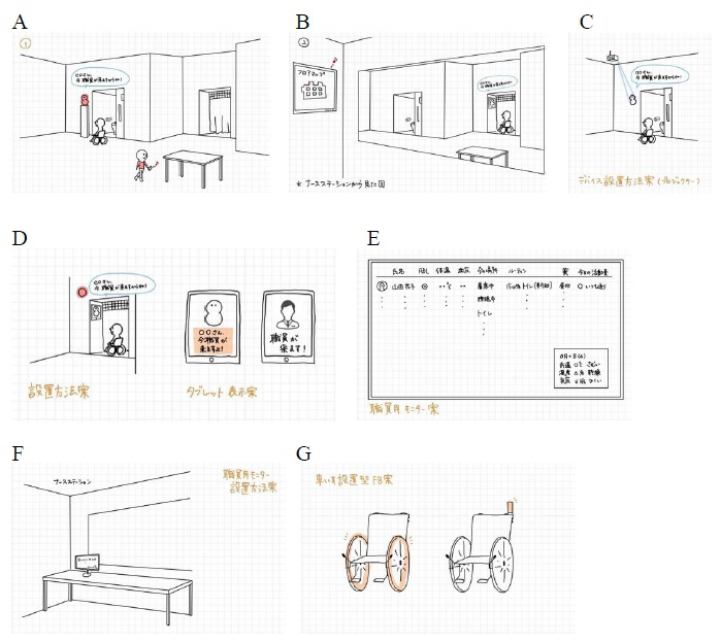
Prior to the interviews, seven types of design drawings related to feed- back ideas were prepared under the following conditions (Figure 1). It should
The Development of a Care Assistive Device Based on Design Thinking 43
be noted that the wheelchair representations were simplified and partially differed from the actual structure.
Anticipating that presenting a single design drawing might not effectively convey the point to the interviewees and might not elicit precise responses, multiple design drawings were created, each incorporating different ideas. These focused on specific discussion points, such as “method of installation (wall-mounted or placed on a base)” and “device design (physical 3D object or digital 2D display).” Notably, the figures including backgrounds replicate the scenario of the floors at elderly health services facility Z.
Figure 1: Design drawings (created by the first author).
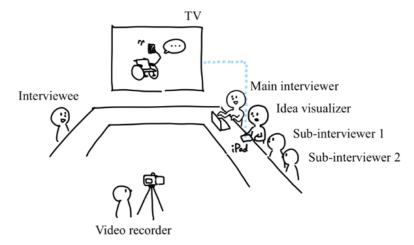
Interview 1 – After Ideation The interview was conducted by four members from the development team, their instructor: the last author, and Mr. K, the administrative head of elderly health services facility Z. The author was responsible for idea visu- alization. Prior to the interview, the author prepared design drawings and, in real time, created additive sketches and free sketches. Three other stu- dents were assigned distinct roles: one as the main interviewer, another as the sub-interviewer, and the third as the video recorder. The instructor also contributed as a sub-interviewer. The content of the interview is detailed in Table 2 below.
Table 2. Interview 1 content (created by the first author).
Table available in the original PDF paper.
Topics
Sharing results from user tests and participant observations and soliciting opinions
Opinions on feedback (FB) ideas for prototype 2 (gath- ering feedback on design drawings from interviewees and incorporating it into new ideas through additive and free sketches) Interview Method Semi-structured interview Date and Time June 19, 2023 (Monday), 14:30 to 16:00 Location Elderly health services facility Z (reception room) Participants Mr. K, Administrative Head of elderly health services facility Z (interviewee) 4 students (main interviewer, sub-interviewer, idea visualizer, video recorder) 1 instructor (sub-interviewer) Recording Methods
Minutes recorded on a PC
Video recording of the interview
Audio recording of the interview
Screen recording of the iPad
During the interview, visualized ideas were displayed on a large screen, and the process involved appropriately zooming in and out, as illustrated in Figure 2.
Figure 2: Illustration of the interview session (created by the first author).
The Development of a Care Assistive Device Based on Design Thinking 45
Interview 2 – After Prototyping Following Interview 1, a preliminary prototype was created, and a second interview was conducted with Mr. K. This interview served as a precursor to the user test, aiming to verify the extent to which the visualizations used in Interview 1 successfully incorporated Mr. K’s feedback into the prototype. The content of the interview is detailed in Table 3 below.
Table 3. Interview 2 content (created by the first author).
Table available in the original PDF paper.
Topics
Confirmation of the agreements made during the first interview
Opinions on the prototype developed based on Inter- view 1 Interview Method Semi-structured interview Date and Time December 14, 2023 (Thursday), 10:00 a.m. to 11:00 a.m. Location Elderly health services facility Z (reception room) Participants Mr. K, Administrative Head of elderly health services facility Z (interviewee) 4 students (main interviewer, 2 sub-interviewers, video recorder) 1 instructor (sub-interviewer) Recording Methods
Minutes recorded on a PC
Video recording of the interview
Audio recording of the interview
This study has been approved by the Research Ethics Committee for Human Subjects at Tokyo Institute of Technology (Approval Number: No. 2022044).
RESULT
Visualization and Interview 1 – After Ideation During Interview 1, Mr. K provided numerous opinions on the ideas pro- posed by the development team’s students, leading to a dynamic discussion. Initially considering a wheelchair-mounted device, we pivoted to a facility- installed format. Presenting the design drawings to Mr. K garnered a very positive response. However, Mr. K offered detailed suggestions for improve- ments rather than only affirmation, which the visualizer sketched in real time. This process triggered further questions from the interviewer students and clarifications from Mr. K, deepening the discussion. Below are excerpts from the discussion transcript, showing how sketches facilitated deeper dialogue (Table 4).
Table 4. Discussion transcript example.
Table available in the original PDF paper.
162 Main interviewer Yes, indeed. Then it would be simple, not a character. Another big problem with this is that even if it is placed outside, the amount of light from the smartphone screen is quite limited, so no one will notice it no matter how many lights are on at the edge of the room. So, it would be necessary to prepare another light, so a round light would speak to the user in a way that is slightly linked to the sound, and in a color that is easy to recognize. I wonder if it would be better to install a new light attached to the wall, rather than, say, something new like a foundation, such as a tripod, or something like that, or, say, a new light attached to the wall. 163 Interviewee It is definitely better to put it on a wall, you know, because it becomes an obstacle. 164 Main interviewer But, if it’s simple… 165 Sub-interviewer 2 Mounting it on the wall. 166 Main interviewer Then, it would be… 167 Idea visualizer It looks like it would be high. 168 Main interviewer How about the height? For example, how high is the height of the handrail of a person’s room? 169 Sub-interviewer 2 It’s about the same as that one, isn’t it? 170 Main interviewer It’s about the same height as that one. From the perspective of a wheelchair user, the handrail would be right in front of you. 171 Interviewee Yes, it is about in the middle. 172 Main interviewer Yes, yes, yes. It has a very long torso. 173 Idea visualizer It’s a little long in the torso. 174 Main interviewer For a person who is standing... 175 Interviewee For a person who is standing, the railing, for example, is, you know, really a lamp. Well, it depends on how thin it is, but it’s at the top of the railing. If a power source is required, it may be difficult to put it there. If the lamp is placed there, it will be close to both standing and sitting people. 176 Main interviewer Certainly, certainly, certainly. The handrail is a vertical one like this, so it’s a little bit.... 177 Sub-interviewer 2 I’ll take a picture later. 178 Main interviewer Just take your time. It’s about the size of a handrail, and if you put something on it, it’s going to be very small. Yes, yes, yes. I think it’s an image, but since you wrote it down, I think it’s a good thing that it’s more concrete. That’s great. That’s great. What do you think is shining in the image you have now, Mr. K? 179 Interviewee I think the top one is fine. I think it should be at the top of the list. Yes, that’s right. Yes, that’s right.
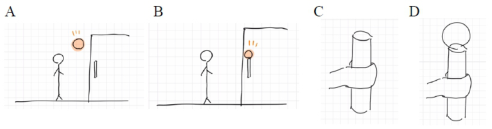
Below are some of the additive and free sketches created during Interview 1. These were developed to support the discussions between Mr. K and the students, and were drawn in real time in response to the conversation.
Figure 3: Additive sketches and free sketches drawn in interview 1 (created by the first author).
The Development of a Care Assistive Device Based on Design Thinking 47
The main interviewer, in utterance 162, inquired whether to mount a round light on the wall or place it on a pedestal. Considering the differ- ing eye levels of walking and wheelchair-using facility residents, a sketch (Figure 3A) was created during utterances 163 to 174. This led to a spon- taneous proposal from Mr. K (utterance 175). Subsequent modifications, as shown in Figure 3B, led to the realization that handrails are a common focus point for all residents, resulting in agreement on the installation location. To form a more concrete agreement on light placement on the handrails, a free sketch (Figure 3C) was created. The main interviewer then questioned Mr. K about the size and installation image of the light on the handrails and hands (utterance 178). Based on the response, Figure 3D was created, leading to a consensus on installing a fist-sized light on the handrails.
Interview 2 – After Prototyping In Interview 2, we sought Mr. K’s assessment of the prototype compared to what was envisioned in Interview 1. Although still rudimentary, we created a facility-installed light prototype, as discussed in the previous section’s dia- logue. This prototype was functional and could be operated in real time. After the demonstration, we asked Mr. K to compare it with his initial imagination from Interview 1. He responded, “This is exactly right, and I would like to use it as soon as it’s completed.”
CONCLUSION
This study presented a design thinking process that incorporates sketches into interviews. In the design thinking process, empathizing with users during interviews typically leads to incorporating their direct feedback only at the user test stage, after creating a prototype. This approach has been challenging due to the excessive resources required for prototype development. However, as illustrated in the case presented in this paper, conducting user interviews during the ideation stage and introducing sketches allows for early verifica- tion of the solution’s direction and a more detailed reflection of user feedback before creating a prototype. This method proves to be an effective approach for implementing the design thinking process more rapidly and efficiently, with potential for further practical applications in the future.
LIMITATION The primary challenge of this methodology lies in its reliance on human resources. In this study, the author executed the sketches by hand, but it is conceivable that if someone else had conducted the sketches, different results might have been obtained. Additionally, some teams may not have individ- uals capable of sketching. In the future, further refinement and practice of methodologies that address these human resource challenges are anticipated.
ACKNOWLEDGMENT
This work was supported by Tokyo Institute of Technology Fund, donated by Mr. Shoichi Mihara. The authors thank Mr. Kuroda of the Medical Cor- poration Foundation Seiseki-kai for his invaluable contribution. The authors thank all those who participated in the study and members of Tokyo Institute
of Technology’s Saijo laboratory. This work utilized OpenAI’s ChatGPT for initial drafting, which was thoroughly reviewed, edited, and supplemented by the authors. We therefore assume full responsibility for the final content of this publication.
REFERENCES
Al-Kodmany, K. (1999) ‘Using visualization techniques for enhancing public participation in planning and design: process, implementation, and eval- uation’, Landscape and Urban Planning, 45(1), pp. 37–45. Available at: https://doi.org/10.1016/S0169-2046(99)00024-9. Bresciani, S. (2019) ‘Visual design thinking: a collaborative dimensions framework
to profile visualisations’, Design Studies, 63, pp. 92–124. Available at: https://do i.org/10.1016/j.destud.2019.04.001. Brown, T. (2008) ‘Design Thinking’, Harvard business review, 86(6), pp. 84–92. Fujinaga, T. et al. (eds) (2013) [Dictionary of Modern Psychology] Saishin shinrigaku jiten (in Japanese). Shohan. T¯oky¯o-to Chiyoda-ku: Heibonsha. Goodnotes | Notes Reimagined | Note-Taking App (2019). Available at: https://ww
w.goodnotes.com/ (Accessed: 5 August 2023). Ministry of Health, Labour and Welfare (2021) The outline of a nursing care system. Available at: https://www.mhlw.go.jp/stf/seisakunitsuite/bunya/hukushi_kai go/kaigo_koureisha/gaiyo/index.html (Accessed: 25 January 2024). Shimizu, J. (2017) [Graphic Recorder: a graphic recording textbook for visualising
discussions] Graphic Recorder: Giron wo kashika suru gurafikku reko-dingu no kyoukasho (in Japanese). BNN, Inc. Takizawa, N., Yanagase, R. and Saijo, M. (2023) ‘[Investigation of a direct support system for accident risk management for older people in collaboration with nurs- ing homes] Kaigo shisetsu to kyoudou de okonau koureisha jiko risuku kanri no chokujiteki shien shisutemu no kentou (in Japanese)’, in. LIFE2023, Kashiwazaki.
LISTED IN THE AHFE DIGITAL BOOKSTORE CATALOGUE
Explore the complete digital volume
Human Factors in Communication of Design
Read this individual research paper free through the original publisher, or explore the full digital proceedings book.
ISBN 978-1-964867-12-0
Explore this ISBN in the AHFE Bookstore ↗Listed in the July 2026 bookstore catalogue; search by ISBN to confirm current availability · Digital book purchase optional