Seina Nakayama, Chenjun Ma, Kaede Ichikawa, Tsuzumi Nakamura, Wataru Umishio, Katsuhiko Sakata, Kiyoshi Kanaya, Miki Saijo (2026). How People Really Take Breaks: Insights for Human-Centered Office Space Design. In: Social and Occupational Ergonomics. AHFE Open Access, vol. 228, pp. 118–129. https://doi.org/10.54941/ahfe1007942
In Japan, workstyle reforms have progressed in response to long working hours; however, research examining how workday breaks contribute to employee recovery and how break spaces can be designed from a Human-Centered Design (HCD) perspective remains limited. This study aims to derive design implications for HCD-based break space design by comprehensively capturing office workers’ break behaviors. A mixed-methods research design was adopted. First, a questionnaire survey was conducted with 263 office workers across four office buildings to assess worker attributes, break behaviors, and recovery experiences. Chi-square tests and hierarchical regression analyses were conducted to investigate differences in break behaviors and factors influencing recovery. Next, beacon-based behavioral data were collected over approximately two months from 20 participants in a multi-area break space, enabling objective analysis of area usage. Semi-structured interviews with the same participants were conducted to explore factors influencing space use. The results indicated significant differences in break behaviors depending on building characteristics. Napping showed the strongest positive association with recovery and was more likely to occur in environments with dimmed lighting. Beacon data revealed frequent use of peripheral areas that allowed users to avoid others’ gaze, whereas an open central area was rarely used. Interview findings suggested that concerns about being observed by others inhibited use of otherwise attractive spaces. These findings demonstrate that spatial characteristics strongly influence break behaviors and recovery, highlighting the necessity of designing break spaces that support recovery by balancing functional affordances with psychological comfort, such as visual exposure to others and social context.
In recent years, interest in well-being has increased rapidly in Japan. Long working hours and issues such as karoshi (death from overwork) have been recognized as serious social problems. In response, the government has promoted work style reform policies, including the introduction of flexible working arrangements and the reduction of working hours (Ministry of Received February 6, 2026; Revised April 11, 2026; Accepted April 30, 2026; Available online July 20, 2026
How People Really Take Breaks: Insights for Human-Centered Office 119 Health, Labour and Welfare, 2024). In contrast, how people take breaks during the workday and what kinds of behaviors they engage in during these breaks have received relatively little attention.
Breaks provide an important opportunity for workers to recover their mental and physical resources depleted by work demands. According to the Recovery Experience framework proposed by Sonnentag and Fritz, recovery is facilitated through four key experiences: psychological detachment, relaxation, mastery, and control (Sonnentag & Fritz, 2007). Previous reviews suggest that recovery research has mainly been conducted in Western countries, with relatively limited evidence from Asian contexts (Sonnentag, et al., 2022). In Japan, empirical studies focusing on lunch breaks remain limited. While existing research has explored associations between personal attributes, work environments, and break-related behaviors (Fukumitsu & Hayashi, 2023), the influence of spatial factors—such as office layout and surrounding environmental conditions—on how lunch breaks are taken has not been sufficiently investigated. Understanding these factors is essential for generating insights that can inform future break space design.
Human-Centered Design (HCD) is a design approach that places users’ behaviors, needs, and contexts of use at the center of the design process, emphasizing evaluation and refinement based on actual use (International Organization for Standardization, 2019). Rather than prioritizing designers’ intentions or predefined functions, HCD emphasizes deriving design decisions from how people behave and experience their environments. Previous studies conceptualize the architecture, engineering, and construction (AEC) industry as an inherently human–building interaction (HBI) domain, in which occupants continuously interact with buildings and embedded technologies. From this perspective, they emphasize the importance of adopting human- centered approaches in architectural design. However, they also point out that such approaches have not yet been fully integrated into practice, as the AEC industry remains largely technology-driven and linear characterized by linear design processes (Agee, et al., 2021).
Therefore, this study aims to comprehensively examine the relationships among office workers’ break behaviors, recovery experiences, and the characteristics of break spaces. By doing so, this study seeks to provide empirical insights for the design of break spaces that support employee recovery.
METHODOLOGY
This study adopted a mixed-methods research design to comprehensively examine office workers’ break behaviors and their relationships with recovery (Sharma et al., 2023). Specifically, a sequential explanatory design was employed, in which quantitative analysis was conducted first, followed by qualitative investigation to deepen the interpretation of the quantitative findings to attain the following research objectives.
The study was structured in three sequential phases: (1) a questionnaire survey to capture general patterns of break behaviors
and recovery experiences across different building types and worker attributes; and (2) behavioral data collection using a beacon system to objectively record actual space use within a specific break space; and (3) semi-structured interviews to explore the underlying reasons for the
selection or avoidance of break behaviors and spaces.
Questionnaire Survey To develop the questionnaire, site visits were conducted at the four surveyed office buildings prior to the survey. During these visits, the researchers documented key spatial characteristics, as shown in Table 1. Because detailed information on the physical environment of office buildings is often limited in previous studies, this study leveraged site visits to select building characteristics expected to be closely related to break behaviors, thereby enabling a more in-depth discussion.
Table 1: Building characteristics.
Table available in the original PDF paper.
Building A Building B Building C Building D Industry Construction Construction Construction Healthcare and Welfare
Location
Chofu (a suburban city in the Tokyo metropolitan area)
Akasaka (a central district in the Tokyo metropolitan area)
Akasaka (a central district in the Tokyo metropolitan area)
Yokohama (a major city in the Tokyo metropolitan area) Cafeteria No Yes No No
Lights off during lunch Yes Yes No No A questionnaire survey was conducted with 263 office workers (121 males, 130 females, and 12 non-responses) working in four office buildings. The survey consisted of 78 items covering demographic attributes, break behaviors, and recovery experiences. This paper focuses on a subset of questionnaire items relevant to the research objectives, and an overview of the analyzed items is presented in Table 2. It was administered via Google Forms between November 28 and December 13, 2024. Recovery experiences were measured using the Japanese Version of the Recovery Experience Questionnaire (REQ-J) (Shimazu et al., 2012).
2) Activities other than lunch Type of activity, activity location (multiple-choice)
3) Four Recovery experiences Japanese Version of the Recovery Experience Questionnaire (REQ-J; 5-point Likert scale)
4) Effects of lunch breaks Satisfaction, Recovery (5-point Likert scale) To analyze differences in break behaviors—such as with whom workers had lunch, where they had lunch, and what activities they engaged in during lunch breaks—across buildings, a chi-square test of independence was conducted. Hierarchical regression analysis was conducted with recovery scores as the dependent variable. Worker attributes were entered in Step 1 as covariates, break behaviors and lunch companion variables were entered in Step 2 as behavioral predictors, and recovery experiences were entered in Step 3 as psychological process variables. This hierarchical structure reflects the conceptual assumption that relatively stable individual and environmental characteristics influence break behaviors, which in turn shape recovery experiences contributing to recovery outcomes. In addition, binary logistic regression analysis was performed to identify worker attributes associated with the frequently selected activities and lunch companions.
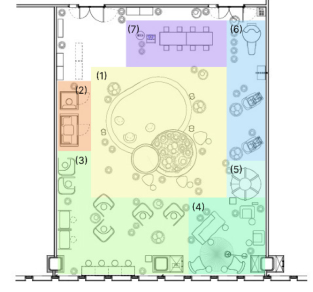
Behavioral Data Collection Using Beacons To objectively capture actual break behaviors, behavioral tracking using beacon technology was conducted in Building D. This building features an experimental break space covering 255 m². Prior to the study, health check-up center employees in Building D were already permitted to use this space for their regular breaks, and these employees were subsequently invited to participate in the tracking study. Twenty female employees working at a health check-up center participated in this phase of the study over a period of approximately two months from March 4 to April 28, 2025. Each participant wore a name badge embedded with a beacon device (EXTxx, model: 2CFDB3698600, WHERE Inc.) around their neck during break times. Multiple transceiver beacons (EXBeacon_2, model: EYWHANAWZ, WHERE Inc.) installed throughout the break space received signals from BLE tags carried by participants, enabling the collection of location data. For analytical purposes, the break space was divided into seven functional areas (Figure 1):
(1) lawn and sandbox area, (2) private area, (3) desk area, (4) sofa area, (5) meditation area, (6) massage chair and nap chair area, and (7) face-to-face table area.
Figure 1: Layout map of the break space zoning by functional areas.
Interviews and Qualitative Analysis To explore motivations and perceptions related to break space use, semi- structured interviews were conducted with all 20 participants in the beacon study between April 17 and April 30, 2025. Each interview lasted approximately 30 minutes and was audio-recorded with participants’ consent, then transcribed verbatim. The interview protocol focused on participants’ patterns of break space use, motivations, and spatial preferences. To facilitate discussion of concrete experiences, participants were shown a layout map of the break space during the interviews. For qualitative analysis, co-occurrence network analysis was conducted using KH Coder (Higuchi, 2016), a quantitative text analysis tool. This method visualizes relationships between frequently co-occurring words and concepts, enabling the identification of thematic structures within participants’ narratives.
RESULT
Differences in Break Behaviors by Building Type Differences in break behaviors across buildings are summarized in Tables 3-5. Chi-square tests of independence indicated significant differences across buildings in all three factors: who workers spent their breaks with (χ² = 116.28, df = 9, p < 0.001), break location (χ = 318.38, df = 12, p < 0.001), and post-lunch behaviors (χ² = 61.22, df = 18, p < 0.001). For example, in Building B, which has a cafeteria, workers were more likely to eat lunch with members of the same team and engage in communication during lunch breaks. In contrast in Building A, where workers are primarily desk-assigned, they tended to eat lunch alone at their own desks.
Table 3: Distribution of lunch companions across buildings.
Table available in the original PDF paper.
Alone Same Team Other Departments
Nearby Coworkers Building A 58 5 1 0
Building B 13 41 1 0 Building C 62 18 12 0
Building D 42 0 1 1
Table 4: Distribution of lunch locations across buildings.
Table available in the original PDF paper.
Own Desk Cafeteria Break Space
Other
Outside Restaurants/ Cafes Building A 54 0 1 7 2
Building B 5 43 4 4 1 Building C 48 1 12 30 6
Building D 4 2 35 0 4
Table 5: Distribution of break activities across buildings.
Table available in the original PDF paper.
Smartphone use Napping Communication Working Resting Reading/
Studying Other Building A 19 22 3 4 5 5 6
Building B 10 25 6 7 2 4 3 Building C 27 18 24 15 3 3 7
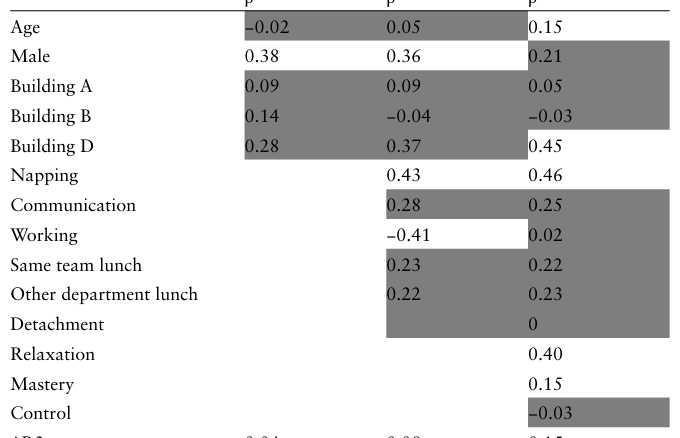
Building D 28 12 0 3 2 0 0 The results of the final model of the hierarchical regression analysis are shown in Table 6. Cells shaded in black indicate variables that were not statistically significant at p < .05.
In Step 1, the model including only demographic attributes explained 4% of the variance in recovery, indicating limited explanatory power. In Step 2, the explained variance increased to 12%; napping was found to have a positive effect on recovery, whereas working during lunch breaks showed a negative association with recovery. In Step 3, the explanatory power of the model further increased to 27%, indicating that relaxation and mastery played important roles in recovery.
Table 6: Factors affecting recovery during lunch breaks.
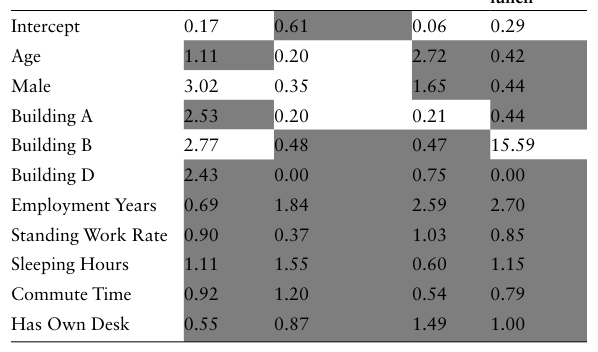
The results of the binary logistic regression analysis are presented in Table 7. Odds ratios (ORs) are reported, and cells shaded indicate variables that were not statistically significant at p < .05. The analysis revealed that napping was significantly more likely to be selected in Building B (OR = 2.77) and among male workers (OR = 3.02). Working in Building B was associated with a substantially higher likelihood of having lunch with members of the same department or team (OR = 15.59), compared with other buildings.
Table 7: Factors associated with break behaviors and lunch companions.
Napping Communication Working Same team lunch Intercept 0.17 0.61 0.06 0.29
How People Really Take Breaks: Insights for Human-Centered Office 125 Usage Tendencies in a Multi-Functional Break Space
The beacon-based behavioral data revealed clear differences in usage patterns across the functional areas of the break space. The most frequently used area was the desk area, accounting for 42.9% of all recorded visits, with an average stay duration of approximately 34.9 minutes. The massage chair and nap chair area was the next most frequently used area, representing 15.1% of total visits. In contrast, the lawn and sandbox area showed very low usage, accounting for only 6.1% of visits, and was associated with shorter stays, averaging around 16.2 minutes. In addition, many participants moved directly to either the desk area or the massage chair and nap chair area at the beginning of their breaks, and movements across multiple areas during a single break were limited.
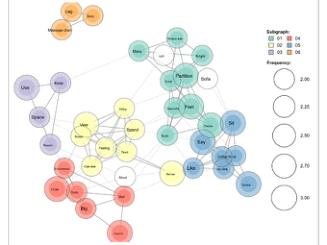
Reasons for Use and Non-Use of Specific Areas A co-occurrence network analysis of reasons for using the most preferred break area identified a cluster in which words such as “tired,” “view,” “break,” and “feelings” were strongly connected. In addition, another cluster including words such as “partition,” “window-side,” and “bright” was observed (Figure 2a).
In contrast, a co-occurrence network analysis of reasons for low use of the lawn and sandbox area—which was the least utilized area according to the beacon data—identified a cluster in which words such as “first,” “come,” “area” and “embarrassed” co-occurred. Another cluster consisting of words such as “male,” “side,” and “nap”, “passed” was also identified (Figure 2b).
(a)Reasons related to break area preferences. (b)Reasons for not using the lawn and
sandbox area
Figure 2: Reasons related to break area preferences.
DISCUSSION
This study examined the relationship between break behaviors and spatial characteristics, and recovery by integrating questionnaire survey data, beacon-based behavioral data, and interview findings.
Through comparisons across buildings, the results demonstrated that differences in the design of facilities and the lunchtime environment within buildings were associated with differences in how workers took breaks. The results indicated that the presence of a cafeteria was associated with break behaviors involving interaction with colleagues, suggesting that providing a cafeteria may be effective when the goal is to promote team communication. Hierarchical regression analysis indicates that recovery was influenced more strongly by break behaviors and recovery experiences than by worker attributes, highlighting the importance of how workers spend their breaks and what they experience during those breaks. In particular, napping and relaxation emerged as key break behaviors contributing to higher levels of recovery. Logistic regression results further indicated that napping was more likely to be selected in buildings where lighting was dimmed during lunch breaks and among male workers. These findings suggest that lighting conditions may play an important role in environmental design aimed at facilitating napping and encouraging disengagement from work during breaks. Furthermore, while napping was more frequently selected by male workers, this result implies that creating break environments in which female workers can also feel comfortable taking naps may be an important challenge for future break space design.
The beacon data analysis showed that enclosed areas, such as desk area and massage chair and nap chair area, were used more frequently than open areas, while use of the lawn and sandbox area was limited. Taken together, these usage patterns suggest that break behaviors are guided by clear preferences for specific spaces rather than exploratory movement across multiple areas within a single break.
The interview findings provided further insight into the reasons underlying these behavioral patterns. For the lawn and sandbox area, participants frequently mentioned concerns related to being seen by others, such as feeling exposed or being in full view, indicating that being seen by others may discourage use of open break spaces. In addition, some participants expressed discomfort with using spaces where members of the opposite gender were lying down, suggesting that psychological considerations related to gender may influence break space selection.
The break space examined in this study was an experimental setting in which rearranging spatial layouts or adding physical elements was not feasible. As a result, it was not possible to directly reflect the interview findings in design modifications. However, by combining actual usage data with participants’ narratives, this study revealed a potential gap between designers’ intentions and how spaces are used in practice. Even when a space is designed to allow people to lie down and rest, it may not be used as intended depending on surrounding conditions, such as visual exposure and social context.
This observation is particularly relevant when considered from a Human- Centered Design (HCD) perspective. Rather than indicating shortcomings in a specific design, these findings highlight the inherent difficulty of predicting how spaces will be experienced and used in real contexts. Although architectural practice, however, opportunities to iteratively modify spatial configurations based on user feedback are often limited once a space has been constructed.
How People Really Take Breaks: Insights for Human-Centered Office 127 This structural characteristic of the built environment can make it difficult to implement the continuous evaluation–refinement cycles central to HCD. Although architectural projects often have limited opportunities for post- construction modification, the present findings suggest that incorporating post-occupancy feedback and user-informed evaluation may be valuable for future break space design.
Furthermore, by examining break behaviors, recovery experiences, spatial use patterns, and users’ subjective accounts within actual office environments in Japan, this study provides foundational insights for Human-Centered Design of workplace break spaces in a Japanese context. While many recovery and workplace studies have been conducted in Western settings, the present findings highlight the role of cultural and social factors, such as sensitivity to being seen by others and interpersonal context, in shaping how break spaces are experienced. These results therefore contribute to building a knowledge base that can support more context-sensitive, human-centered approaches to break space design.
LIMITATIONS Several limitations of this study should be acknowledged. First, all measures of recovery used in the questionnaire were based on self-reported data. Although subjective evaluations are valuable for capturing individual experiences, they may not fully reflect actual levels of physiological recovery. Future studies should incorporate objective indicators, such as physiological or biometric data, to provide a more comprehensive assessment of recovery. Second, the questionnaire survey included participants from only two major occupational groups: healthcare-related work (a health check-up center) and construction-related work. Because the range of job types was limited, the findings may not fully capture the diversity of break behaviors across different occupations. Future research should examine a wider variety of job types to improve the generalizability of the results.
There were also limitations related to the beacon-based behavioral data and interviews. Due to site constraints, the behavioral tracking and interview study was conducted with 20 female participants working in a healthcare setting. As a result, the sample exhibited a strong bias in terms of gender and occupation, which limits the generalizability of the findings. In addition, while the beacon system enabled objective tracking of movement and area usage, it could not reliably distinguish whether participants merely passed through an area or stayed there for a certain period.
CONCLUSION
By integrating questionnaire data, beacon-based behavioral tracking, and interview findings, this study provides a comprehensive picture of break behaviors and recovery in real work environments.
The results demonstrated that recovery was influenced more strongly by break behaviors and recovery experiences than by worker attributes, emphasizing the importance of how workers spend their breaks. Importantly,
the findings revealed that even break spaces intended to support recovery— such as areas designed for lying down—are not necessarily used for recovery in practice. Instead, spatial characteristics, social context, and perceived comfort strongly shaped whether recovery-oriented behaviors, such as napping, were selected in practice. These findings provide empirical insights that can inform future break space design from a Human-Centered Design perspective.
By grounding design decisions in an understanding of users’ actual behaviors, preferences, and psychological comfort, break spaces can be better designed to support recovery and well-being across diverse users and work contexts.
Despite certain limitations, this study contributes to bridging the gap between intended design concepts and real-world use, offering a foundation for future Human-Centered Design interventions in workplace break spaces.
ACKNOWLEDGMENT
This study was determined to be exempt from ethical review by the Institute of Science Tokyo and was conducted in accordance with relevant ethical guidelines, with financial support from Kajima Corporation. We express our sincere gratitude to the facility and company staff who contributed significantly to this study, particularly Mr. Katsuhiko Sakata of Kajima Corporation and Mr. Kiyoshi Kanaya of ILYA Corporation. The authors also wish to thank all office workers and health check-up center staff who participated in the study for their time and cooperation. We further acknowledge the support of members of Saijo Laboratory and Ohashi Laboratory, Institute of Science Tokyo. This study utilized ChatGPT (version 5.2) for initial drafting and language refinement. All outputs were carefully reviewed, edited, and supplemented by the authors, who take full responsibility for the content of this publication.
REFERENCES
Agee, P., Gao, X., Kleiner, B. & al., e., 2021. A human-centred approach to smart housing. Building Research & Information, 49(1), pp. 84–99. Fukumitsu, S. & Hayashi, T., 2023. Study on breaks in the office environment:
Analysis of the correlation between individual attributes, work environment, and behavior during break, willingness to take a break, and wellness. The Japanese Journal of Real Estate Sciences, 36(4), pp. 126–134. Higuchi, K., 2016. A two-step approach to quantitative content analysis: KH Coder tutorial using Anne of Green Gables (Part I). Ritsumeikan Social Sciences Review, 52(3), pp. 77–91. International Organization for Standardization, 2019. ISO 9241-210: Ergonomics
of human-system interaction—Part 210: Human-centred design for interactive systems, Geneva: ISO. Ministry of Health, Labour and Welfare, 2024. Overview of work style reform. [Online] Available at: https://www.mhlw.go.jp/stf/seisakunitsuite/bunya/0000148322.html [Accessed 28 1 2025].
How People Really Take Breaks: Insights for Human-Centered Office 129 Sharma, L. R. et al., 2023. Exploring the mixed methods research design: Types,
purposes, strengths, challenges, and criticisms. Global Academic Journal of Linguistics and Literature, 5(1), pp. 3–12. Shimazu, A., Sonnentag, S., Kubota, K. & Kawakami, N., 2012. Validation of the Japanese Version of the Recovery Experience Questionnaire. Journal of Occupational Health, 54(3), pp. 196–205. Sonnentag, S. & Fritz, C., 2007. The Recovery Experience Questionnaire: Development
and validation of a measure for assessing recuperation and unwinding from work. Journal of Occupational Health Psychology, 12(3), pp. 204–221. Sonnentag, S., Cheng, B. H. & Parker, S. L., 2022. Recovery from Work: Advancing the Field Toward the Future. Annual Review of Organizational Psychology and Organizational Behavior, Volume 9, pp. 33–60.
LISTED IN THE AHFE DIGITAL BOOKSTORE CATALOGUE
Explore the complete digital volume
Social and Occupational Ergonomics
Read this individual research paper free through the original publisher, or explore the full digital proceedings book.
ISBN 979-8-950676-04-8
Explore this ISBN in the AHFE Bookstore ↗Listed in the July 2026 bookstore catalogue; search by ISBN to confirm current availability · Digital book purchase optional