Ikiah Bolivar, Rafael Isidore Daquipil, Joshua Ardgel Galimba, Marien Libuit, Yoshiki Kurata (2026). Factors Influencing the Perceived Parenting of Multigenerational Parents: A Partial Least Squares - Structural Equation Modeling Approach. In: Social and Occupational Ergonomics. AHFE Open Access, vol. 228, pp. 98–108. https://doi.org/10.54941/ahfe1007940
Parenting in multigenerational Filipino households is shaped by evolving social expectations, emotional dynamics, and cultural influences. This study aimed to investigate the key factors that influence the perceived parenting of multigenerational parents in the Philippines. By integrating the Theory of Planned Behavior (TPB), the research examined how generational influence, emotional connection, media, and cultural beliefs affect parents’ attitudes, social norms, perceived behavioral control, and behavioral intentions toward parenting. Using Partial Least Squares Structural Equation Modeling (PLS-SEM), the study analyzed the predictive relationships among parenting-related latent variables across multigenerational parents. Moreover, emotional connection (β: 0.585, p < 0.001) was the strongest among generational factors, while behavioral intention (β: 0.609, p < 0.001) was the most significant predictor of perceived parenting. The findings contribute to the human factors and ergonomics literature by offering a culturally grounded understanding of multigenerational parenting in the Philippine context and validating the use of the Theory of Planned Behavior in modeling parenting behavior. These insights support the development of human-centered parenting interventions, educational strategies, and policy designs.
Parenting is a complex, planned process in which caregivers, or parents support children’s social, emotional, cognitive, and physical development through guidance, discipline, and care. It involves the strategies and decisions parents use to fulfill their roles and is shaped not only by instinct but also by social norms, situation, and experiences that change over time. As noted by Arafat et al. (2020), parenting involves a lasting emotional connection that influences children’s behavioral and psychological development, while Keizer et al. (2019) and Awiszus et al. (2022) highlight the importance of active Received February 20, 2026; Revised April 3, 2026; Accepted April 23, 2026; Available online July 20, 2026
Factors Influencing the Perceived Parenting of Multigenerational Parents 99 parental involvement for long-term health outcomes. Given that parenting decisions are influenced by parents’ values, it is important to understand the factors shaping perceived parenting, decision-making, and how these translate into actual practices.
Although research on parenting influences is growing, it is largely based on Western contexts, limiting its applicability to Southeast Asian and Filipino families with different norms, structures, and socioeconomic conditions. In the Philippines, parenting is shaped by strong family ties, interdependence, and multigenerational living arrangements, where caregiving is often shared among extended family and community members (ChildHope Philippines, 2024; Conwi, 2024). However, there is a lack of systematic, theory-driven studies examining how these contextual and behavioral influences interact across generations of Filipino parents.
In the Philippines, parenting is further shaped by contextual conditions such as economic struggles and educational access, which affect resources, time, and stress levels (Sirin, 2021; Rose et al., 2024). However, these factors reflect social position rather than directly shaping parental behavior (Peng, 2023). To address this gap, the study examines perceived parenting behaviors among Filipino parents across Baby Boomer, Generation X, Millennial, and Generation Z cohorts, guided by the Theory of Planned Behavior (Ajzen, 1991) and integrating generational influence, emotional connection, media exposure, and cultural beliefs as factors shaping parenting behavior.
Using Partial Least Squares–Structural Equation Modeling (PLS-SEM), this research provides a culturally grounded, behavior-focused framework for understanding how multigenerational Filipino parents form and enact parenting intentions. Rather than measuring children’s development outcomes, it emphasizes parents’ subjective experiences, capturing how they interpret their own practices through self-perception. By situating the parents’ perspective, the study recognizes parenting as a construct shaped by cultural background, media interactions, and generational context.
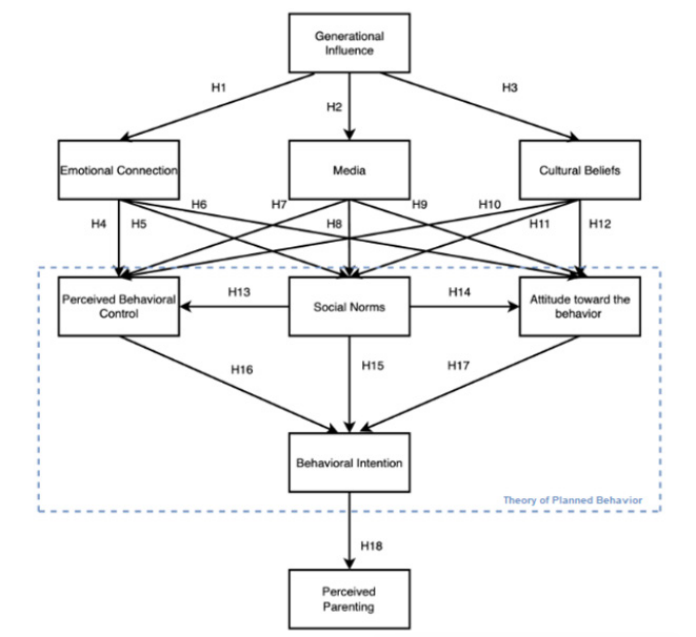
The study focused on the factors influencing parenting among multigenerational parents and evaluates the Theory of Planned Behavior (TPB) as a direct influence (see Figure 1). It first hypothesizes that the generational cohort affects internal (emotional connection) and external factors (media exposure and cultural beliefs). These hypothesized factors are then observed for their influence on TPB components: Perceived Behavioral Control, Social Norms, and Attitude Toward the Behavior, to predict Behavioral intention, which then influences the parenting of parents across different generations. In total, 18 hypotheses were formulated within the theoretical framework.
METHODOLOGIES Using a quantitative correlational descriptive research design, numerical data on the variables affecting multigenerational parents’ perceptions of parenting were gathered and analyzed. Included are the demographic and contextual variables that may affect parenting. The study examined correlations within the sample group despite the lack of confirmed causality. Google Forms was
used to disseminate a structured questionnaire aligned with the study’s latent variables to collect data.
Figure 1: Theoretical framework.
The paper utilized Partial Least Squares–Structural Equation Modeling (PLS-SEM) to evaluate the measurement and structural models. Reliability and validity were checked using factor loadings, composite reliability, average variance extracted, and discriminant validity. Data were collected using a structured questionnaire with standardized statements. These assessed multigenerational parents’ perceptions on generational influence, media exposure, emotional connection, cultural beliefs, and aspects of the Theory of Planned Behavior.
Hair et al. (2022) noted that PLS-SEM is effective for studies aiming to predict and explain constructs, as in this exploratory study on factors influencing perceived parenting across generations. PLS-SEM works well with smaller sample sizes, though the number of constructs matters. For studies with eight or more constructs, at least 500 respondents are needed, and this minimum should be higher if the data are not normally distributed (Kurata et al., 2023; Hair et al., 2019).
A five-point Likert scale was used to measure participants’ attitudes and perceptions regarding the constructed questions relevant to each latent variable
Factors Influencing the Perceived Parenting of Multigenerational Parents 101 in the study, which present real or hypothetical parenting scenarios. This aligned with the view that attitudes reflect relatively stable ways of thinking or acting in specific situations, such as parenting. The sampling method used was purposive sampling, gathering data across regions in the Philippines.
RESULTS AND DISCUSSION
A total of five hundred thirteen (513) Filipino multigenerational parents participated in the study. According to Hair et al. (2022), PLS-SEM is suitable for studies that aim to predict and explain target constructs.
Table 1: Respondents’ profile (n = 513).
Table available in the original PDF paper.
Characteristics Category N % Generation Baby Boomers (1946-1965) Generation X (1966-1980) Millennial (1981-1996) Generation Z (1997-2012)
106 182 172 53
20.66% 35.48% 33.53% 10.33%
Marital Status Married Single Widowed Separated Living with Partner
386 52 36 26 13
75.24% 10.14% 7.02% 5.07% 2.53%
This study examines and predicts the factors influencing perceived parenting across different generations, deeming PLS-SEM as an appropriate analytical approach. Model fit was assessed using established goodness-of-fit indices, such as the Standardized Root Mean Squared Residual and Normal Fit Index.
Table 2: Model fit indices.
Table available in the original PDF paper.
Saturated
Estimated
Threshold Reference
Model
Model 0.085 0.133 ≤ 0.10 Kock (2020)
Standard Root Mean Squared Error (SRMR) Normal Fit Index (NFI) 0.700 0.664 ≥ 0.70 Yusif et al. (2020)
The Standardized Root Mean Squared Residual (SRMR) was 0.085, indicating a satisfactory model fit, as it is below the suggested threshold of 0.10 (Kock, 2020). The Normal Fit Index (NFI) also gave a value of 0.70. Meanwhile, Bentler (1990) recommended that the NMI value be ≥ 0.90; it remains within the acceptable range for improvement, indicating an overall excellent fit (Yusif et al., 2020).
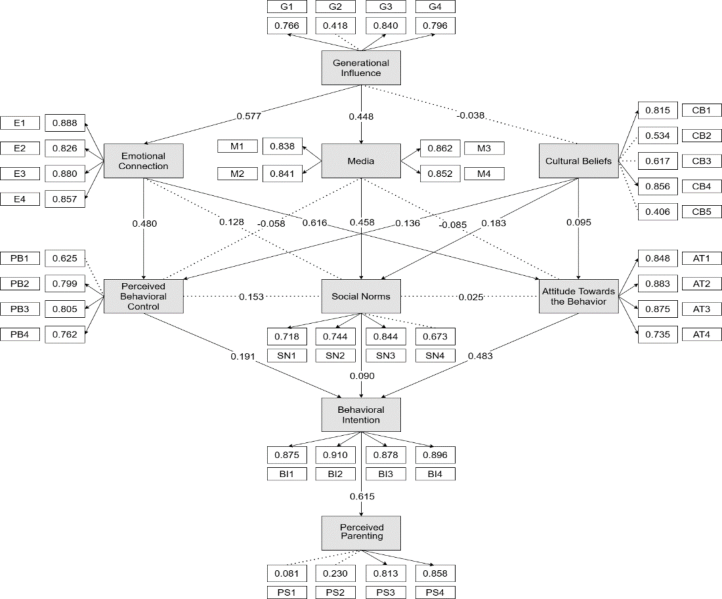
Figure 2 presents the initial SEM model for the study, which includes all hypothesized paths and indicators. During model evaluation, several indicators exhibited factor loadings below the recommended threshold of 0.70, and multiple structural paths were found to be statistically insignificant (p > 0.05). Consequently, these indicators and paths were removed to improve the model.
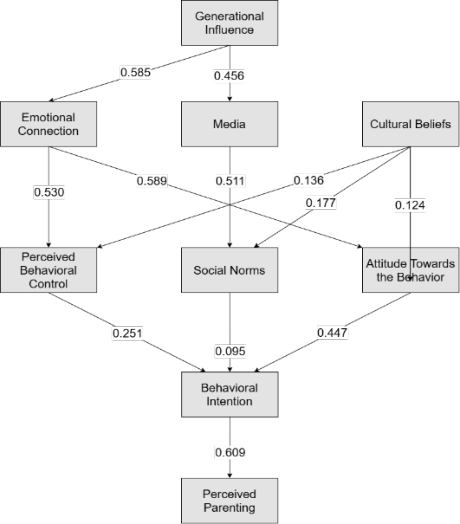
Figure 2: Initial SEM model.Figure 3: Final SEM model.
Factors Influencing the Perceived Parenting of Multigenerational Parents 103 The refined SEM model is shown in Figure 3 below, retaining only indicators with acceptable factor loadings (≥ 0.70) and statistically significant relationships. The final model demonstrated satisfactory goodness-of-fit, with the Standardized Root Mean Square Residual (SRMR) ≤ 0.10, indicating an acceptable fit.
The Variance Inflation Factor (VIF) was calculated to evaluate multicollinearity among the indicators. According to Kock’s (2020) criteria, VIF values should ideally be below 3.30 to indicate the absence of collinearity. All indicators in this study fall within the acceptable threshold, confirming that no multicollinearity issues have been observed.
SN 0.167 0.220 0.228 0.268 0.379 0.597 0.350 0.286
Table 3 establishes discriminant validity by showing that all HTMT values are below the 0.90 threshold. This confirms that each latent construct in the parenting model is statistically distinct from the others.
SN 0.139 0.210 0.141 0.252 0.395 0.499 0.243 0.210 0.810
Table 4 further validates the model by demonstrating that the square root of the Average Variance Extracted (AVE) for each construct (diagonal values) is higher than its correlations with any other construct, ensuring each variable shares more variance with its own indicators than with other latent variables.
Table 5: R-Square.
Table available in the original PDF paper.
R Square R Square Adjusted Attitude Towards the Behavior (AT) 0.376 0.374 Behavioral Intention (BI) 0.440 0.437
Perceived Behavioral Control (PB) 0.313 0.310 Social Norms (SN) 0.280 0.277
The R-Square values in Table 5 measure the model’s explanatory power. A value of 0.371 for Perceived Parenting (PS) indicates that the integrated factors explain 37.1% of the variance in parents’ subjective parenting experiences, while Behavioral Intention (BI) shows an R-Square of 0.440, demonstrating moderate-to-strong predictive strength.
Table 6: f-Square.
Table available in the original PDF paper.
AT BI CB EC GI M PS PB SN AT 0.204 BI 0.589
CB 0.025 0.026 0.043 EC 0.550 0.405 GI 0.521 0.262
M 0.361 PS PB 0.063
SN 0.015
Table 6 evaluates the substantive impact of specific predictors. The path from Behavioral Intention (BI) to Perceived Parenting (PS) (0.589) and Emotional Connection (EC) to Attitude Towards the Behavior (AT) exhibit large effect sizes, confirming these are the most critical drivers within the structural model.
Table 7: Q-Square.
Table available in the original PDF paper.
Variable SSO SSE Q² Attitude Towards the Behavior (AT) 2052.000 1538.481 0.250 Behavioral Intention (BI) 2052.000 1346.114 0.344
Media (M) 2052.000 1754.295 0.145 Perceived Parenting (PS) 1026.000 764.056 0.255 Perceived Behavioral Control (PB) 1539.000 1254.037 0.185
Social Norms (SN) 1539.000 1271.246 0.174
Factors Influencing the Perceived Parenting of Multigenerational Parents 105 The Q-Square values, obtained via the blindfolding procedure, confirm the model’s out-of-sample predictive relevance. All values are greater than zero, with Perceived Parenting achieving a Q-Square of 0.255, indicating that the model successfully predicts parenting outcomes beyond the immediate sample.
The results shown in the final model in Figure 3 indicate that Behavioral Intention (BI) strongly influences Perceived Parenting (PS) (β: 0.609, p < 0.001), confirming that intention is a critical determinant of perceived parenting practices. Paulin’s (2024) study grounded in the Theory of Planned Behavior and found that parents’ behavioral intentions serve as a strong and direct predictor of their actual parenting behaviors. Also, the relationship between Emotional Connection (EC) and Attitude Towards the Behavior (AT) is significant, with a path coefficient of β: 0.589. This result indicates that Emotional Connection (EC) has a strong influence on Attitude Towards the Behavior (AT) of multigenerational parents within the model. Ferreira et al. (2024) showed that parents who display secure attachment exhibit better emotion regulation skills, which are associated with more positive, consistent, and intentional parenting behaviors, contrary to the study of Kurata et al. (2022).
Thirdly, Generational Influence (GI) played a vital role in the model, showing direct effects on Emotional Connection (EC) (β: 0.585, p < 0.001), suggesting that intergenerational values strongly shape emotional connections in parenting contexts. Carone et al. (2023) found that parents with stronger emotional attachment and greater awareness of their own thoughts and feelings were more likely to have children with secure attachment. Emotional Connection (EC) has a significant effect on Perceived Behavioral Control (PB) (β: 0.530, p < 0.001), indicating acceptance of the hypothesis. This was supported by a study by Mortazavizadeh et al. (2022), which showed that parents with higher emotional competence tend to form stronger emotional bonds with their children, fostering more adaptive and positive parenting behaviors.
Fifth, it is shown that Media (M), as another factor, significantly affected Social Norms (SN) (β: 0.511, p < 0.001) among multigenerational parents. Jorge et al. (2023) found that exposure to curated parenting content on platforms significantly alters parents’ normative beliefs about what counts as acceptable or ideal parenting. Moreover, Media use (M) is positively associated with Generational Influence GI) (β: 0.456, p < 0.001). The hypothesis corresponding to this relationship was supported, demonstrating that Media use (M) contributes directly to Generational Influence GI). This was further supported by Poulain et al.’s (2023) study implying that children who grow up in environments shaped by parents’ media behaviors may internalize specific media attitudes and regulation styles that can be carried on when they become parents.
Seventh, Attitude towards the Behavior (AT) significantly predicted Behavioral Intention (BI) (β: 0.447, p < 0.001) as well. Woo et al. (2022) found that parents who held more positive attitudes toward preventive measures displayed significantly higher intentions to carry out those behaviors. Meanwhile, it was revealed that the relationship between Perceived Behavioral Control (PB) and Behavioral Intentions (BI) is significant (β: 0.251, p < 0.001). This result indicates that Perceived Behavioral Control (PB) has a moderate influence on Behavioral Intentions (BI) within the
model. Woo et al. (2022) found that individuals who perceive higher control over performing a behavior are more likely to perform that behavior.
Ninth, Cultural Belief (CB) significantly predicted Social Norms (SN) (β: 0.177, p = 0.001) as well. Elsayed (2024) supported the claim, stating that when cultural beliefs are consistently practiced in the home, these beliefs gradually turn into expected behaviors in the wider community. Tenth, it is shown that Cultural Beliefs (CB), as another factor, significantly affected Perceived Behavioral Control (PB) (β: 0.136, p = 0.003). Cheng et al. (2025) argued that cultural values play a significant role in shaping individuals’ perceived ability to act in socially appropriate ways.
Lastly, Cultural Beliefs (CB) played a vital role in the model, showing direct effects on Attitude Towards the Behavior (AT) (β: 0.124, p = 0.008). Lansford et al. (2021) examined how individualism and collectivism shape parents’ attitudes towards child raising and suggested that cultural beliefs serve as key antecedents of parents’ attitudes toward their own parenting behaviors.
Theoretical Contributions and Practical Implications This study demonstrates that parenting, although often perceived as emotional, instinctive, and culturally influenced, is an intentional cognitive process influenced by attitudes, social norms, and perceived behavioral control. This supports the theoretical integration of relational-emotional constructs with the cognitively driven structure of TPB, effectively bridging attachment theory with behavioral intention models. The study also offers a theoretically supported framework that incorporates psychological, cultural, emotional, and generational factors in parenting, developing a multigenerational parenting-based model using PLS-SEM.
Moreover, translating these findings into real-world applications can guide parents toward more effective practices by leveraging key factors. Generational differences, particularly in relation to emerging trends and technology, highlight the value of learning across generations through seminars, gatherings, and parenting programs that encourage shared experiences and strategies. Media literacy is also recommended, especially for older generations, to help evaluate credible information. A warmer, more empathetic approach to parenting can strengthen perceived behavioral control through better communication, quality time, and trust-building activities. Additionally, regulating parenting-related media content and promoting discourse on cultural practices can support healthier approaches, while research-based strategies may enhance emotional responsiveness and parent-child relationships, as opposed to potentially harmful authoritarian styles.
CONCLUSION
Parenting practices evolve across generations and are shaped by both personal and social influences. This study found that emotional connection, attitude toward the behavior, subjective norms, and behavioral intention
Factors Influencing the Perceived Parenting of Multigenerational Parents 107 are important factors that affect how Filipino multigenerational parents see parenting. However, generational influence and media were also found to be vital variables that interact with these core constructs and indirectly shape parenting. These findings suggest that parenting is not determined by a single factor but results from the dynamic interplay of generational experiences, emotional bonds, and social influences, highlighting the complexity of parenting across different generations.
REFERENCES
Ajzen, I. (1991). The theory of planned behavior. Organizational Behavior and Human Decision Processes, 50(2), 179–211. Arafat, S. M. Y., Akter, H., Islam, M. A., Shah, M. M. A., & Kabir, R. (2020).
Parenting: types, effects and cultural variation. Asian Journal of Pediatric Research, 32–36. https://doi.org/10.9734/ajpr/2020/v3i330130 Awiszus, A., Koenig, M., & Vaisarova, J. (2022). Parenting Styles and Their Effect on Child Development and Outcome. Journal of Student Research. https://doi. org/10.47611/jsrhs.v11i3.3679 Carone, N., Mirabella, M., Innocenzi, E., Quintigliano, M., Antoniucci, C., Manzi,
D., Fortunato, A., Giovanardi, G., Speranza, A. M., & Lingiardi, V. (2023). The intergenerational transmission of attachment during middle childhood in lesbian, gay, and heterosexual parent families through assisted reproduction: The mediating role of reflective functioning. Attachment & Human Development, 1–27. https://doi.org/10.1080/14616734.2023.2292053 Cheng, L., Wu, W., Hu, Y. J., & Cheng, C. C. (2025). Influence of traditionality and modernity on public breastfeeding behaviors: a theory of planned behavior approach. International Breastfeeding Journal, 20(1), 66. https://doi. org/10.1186/s13006-025-00761-1 Child-Rearing: Approaches, Global Practices, and Programs. (2024, September 5).
ChildHope Philippines. https://childhope.org.ph/child-rearing/ Conwi, L. J., P. Sato, H., D. Abdon, K. R., M. Bancoro, Y. R., L. Santos, F. A., & B.
Reyes, R. (2024). Perceived Parenting Styles and Traumatic Experiences among Filipino College Students: Explanatory Sequential Design. Proceedings of the International Conference on Teaching, Education and Learning, 1–13. https:// doi.org/10.32789/tel.2023.1001 Ferreira, T., Matias, M., Carvalho, H., Matos, P. M., & Faculty of Psychology and Education Sciences, Center for Psychology at University of Porto, Portugal. (2024). Parent-partner and parent-child attachment: Links to children’s emotion regulation. In Journal of Applied Developmental Psychology (Vol. 91, p. 101617). https://doi.org/10.1016/j.appdev.2023.101617 Garcia, O. F., Fuentes, M. C., Gracia, E., Serra, E., & Garcia, F. (2020). Parenting
Warmth and Strictness across Three Generations: Parenting Styles and Psychosocial Adjustment. International Journal of Environmental Research and Public Health, 17(20), 7487. https://doi.org/10.3390/ijerph17207487 Hair, J. F., Babin, B. J., Anderson, R. E., & Black, W. C. (2019). Multivariate Data Analysis (8th ed.). England: Pearson Prentice. Hair, J. F., Sarstedt, M., Ringle, C. M., & Mena, J. A. (2022). A primer on partial
Johan Paulin, Kimmo Sorjonen, Gunilla Sydsjö, Claudia Lampic, Using the theory of planned behavior to predict parents’ disclosure of donor conception to their children: a longitudinal study, Human Reproduction, Volume 39, Issue 6, June 2024, Pages 1247–1255, https://doi.org/10.1093/humrep/deae070 Jorge, A., Garcez, B., Janiques de Carvalho, B., & Coelho, A. M. (2023). Parenting
on Celebrities’ and Influencers’ Social Media: Revamping Traditional Gender Portrayals. Journalism and Media, 4(1), 105–117. https://doi.org/10.3390/ journalmedia4010008 Keizer, R., Van Lissa, C. J., Tiemeier, H., & Lucassen, N. (2019). The Influence of Fathers and Mothers Equally Sharing Childcare Responsibilities on Children’s Cognitive Development from Early Childhood to School Age: An Overlooked Mechanism in the Intergenerational Transmission of (Dis) Advantages? European Sociological Review. https://doi.org/10.1093/esr/jcz046 Kock, N. (2020). Using indicator correlation fit indices in PLS-SEM: Selecting
the algorithm with the best fit. In Data Analysis Perspectives Journal. https://scriptwarp.com/dapj/2020_DAPJ_1_4/Kock_2020_DAPJ_1_4_ XsCorrMatrixIndices.pdf Kurata, Y. B., Ong, A. K. S., Cunanan, A. L. M., Lumbres, A. G., Palomares, K. G.
M., Vargas, C. D. A., & Badillo, A. M. (2023). Perceived Behavior Analysis to Boost Physical Fitness and Lifestyle Wellness for Sustainability among Gen Z Filipinos. Sustainability, 15(18), 13546. https://doi.org/10.3390/su151813546 Kurata, Y. B., Ong, A. K. S., Andrada, C. J. C., Manalo, M. N. S., Sunga, E. J.
A. U., & Uy, A. R. M. A. (2022). Factors Affecting Perceived Effectiveness of Multigenerational Management Leadership and Metacognition among Service Industry Companies. Sustainability, 14(21), 13841. https://doi.org/10.3390/ su142113841 Mortazavizadeh, Z., Göllner, L. & Forstmeier, S. Emotional competence, attachment, and parenting styles in children and parents. Psicol. Refl. Crít. 35, 6 (2022). https://doi.org/10.1186/s41155-022-00208-0 Woo, S., LePage, B., Chiang, Y., & Fang, W. (2022). Predicting the protective
behavioral intentions for parents with young children that possess different levels of education in Hong Kong using the theory of planned behavior for air polluted with PM2.5. BMC Public Health, 22(1), 761. https://doi.org/10.1186/ s12889-022-13141-9
LISTED IN THE AHFE DIGITAL BOOKSTORE CATALOGUE
Explore the complete digital volume
Social and Occupational Ergonomics
Read this individual research paper free through the original publisher, or explore the full digital proceedings book.
ISBN 979-8-950676-04-8
Explore this ISBN in the AHFE Bookstore ↗Listed in the July 2026 bookstore catalogue; search by ISBN to confirm current availability · Digital book purchase optional