Bianca Mercy Cinco, Crissen Ann Ico, Franz Jmarc Tabafunda, Kyla Louise Uy, Yoshiki Kurata (2023). Predicting Factors Influencing Online Gaming Towards Effective Decision Making among Filipinos: A Structural Equation Modeling Approach. In: Human-Centered Metaverse and Digital Environments. AHFE Open Access, vol. 99, pp. 56–65. https://doi.org/10.54941/ahfe1003931
Online gaming is a popular pastime for people of all ages, with most players using their mobile devices or going online to play with their game consoles. It has been a prospering industry in the Philippines, especially since the beginning of the COVID-19 pandemic. The study aims to identify how online gaming influences Filipino gamers' effective decision-making, incorporating the Theory of Planned Behavior and Behavioral Decision Theory utilizing the structural equation modeling approach. A self-administered survey was conducted in the study and identified variables such as Cognitive Flexibility, Personality, Online Game Strategies, Certainty, Uncertainty, Subjective Norms, Behavioral Intention, and Attitude as significant factors affecting the perceived decision-making among Filipino online game players. Findings may serve as input to gaming developers in software and game development. This paper is the first study to analyze the factors affecting effective decision-making among Filipino online game players.
Video games are considered mainstream media and one of the most potent influences in the entertainment business today. Online gaming is a growing sector in the Philippines. In terms of game income, the country is ranked 29th in the world, and more than 29.9 million gamers were reported in the country in 2017 [Statista Research Department, 2022]. The proportion of Filipinos aged 25 to 34 who regularly play online games was the greatest across all age groups. Despite having the lowest percentage of everyday online gamers, respondents aged 55 and older still played games daily in roughly 48 percent of cases. [Statista Research Department, 2022]. The video game industry has exploded in popularity, becoming one of the most widely used types of enter- tainment of dynamic games on new platforms, which are more challenging and entertaining than the ones they replaced are released [Ulloa Jr., 2022].
Predicting Factors Influencing Online Gaming Towards Effective Decision-Making 57
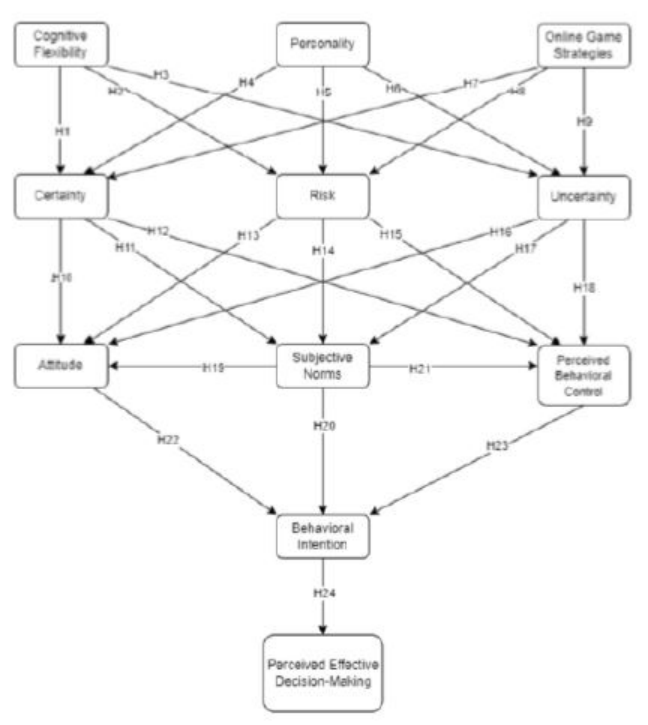
Figure 1: Theoretical framework.
From the basic and straightforward usage of joystick controllers and visuals, the gaming field’s structure has wholly altered because of the rapid growth of video gaming. The study provides knowledge associated with a gaming-based learning experience on cognitive learning, specifically in decision-making.
This paper is focused on predicting how online gaming influences the decision-making of Filipino online gamers, incorporating the Theory of Plan- ned Behavior and Behavioral Decision Theory. The conceptual framework revealed the connections between each hypothesis that led to perceived effe- ctive decision-making, resulting in 24 hypotheses. Based on literature reviews conducted and the behavioral theories integrated into the study, it was supposed that: Hypothesis 1 (H1): Cognitive Flexibility has a significant relation towards Certainty that will lead to effective decision making.
Hypothesis 2 (H2): Cognitive Flexibility has a significant relation towards Risk that will lead to effective decision-making.
Hypothesis 3 (H3): Cognitive Flexibility has a significant relation towards Uncertainty that will lead to effective decision-making.
Hypothesis 4 (H4): Personality has a significant relation towards Certainty that will lead to effective decision-making.
Hypothesis 5 (H5): Personality has a significant relation towards Risk that will lead to effective decision-making.
Hypothesis 6 (H6): Personality has a significant relation towards Uncer- tainty that will lead to effective decision-making.
Hypothesis 7 (H7): Online Game Strategies has a significant relation towards Certainty that will lead to effective decision-making.
Hypothesis 8 (H8): Online Game Strategies has a significant relation towards Risk that will lead to effective decision-making.
Hypothesis 9 (H9): Online Game Strategies has a significant relation towards Uncertainty that will lead to effective decision-making.
Hypothesis 10 (H10): Certainty has a significant relation towards Attitude that will lead to effective decision-making.
Hypothesis 11 (H11): Certainty has a significant relation towards Subje- ctive Norms that will lead to effective decision-making.
Hypothesis 12 (H12): Certainty has a significant relation towards Percei- ved Behavioral Control that will lead to effective decision-making.
Hypothesis 13 (H13): Risk has a significant relation towards Attitude that will lead to effective decision-making.
Hypothesis 14 (H14): Risk has a significant relation towards Subjective Norms that will lead to effective decision-making.
Hypothesis 15 (H15): Risk has a significant relation towards Perceived behavioral control that will lead to effective decision-making.
Hypothesis 16 (H16): Uncertainty has a significant relation towards Attitude that will lead to effective decision-making.
Hypothesis 17 (H17): Uncertainty has a significant relation towards Subjective Norms that will lead to effective decision-making.
Hypothesis 18 (H18): Uncertainty has a significant relation towards Perceived Behavioral Control that will lead to effective decision-making.
Hypothesis 19 (H19): Subjective Norms has a significant relation towards Attitude that will lead to effective decision–making.
Hypothesis 20 (H20): Subjective Norms has a significant relation towards Behavioral Intention that will lead to effective decision-making.
Hypothesis 21 (H21): Subjective Norms has a significant relation towards Perceived Behavioral Control that will lead to effective decision-making.
Hypothesis 22 (H22): Attitude has a significant relation towards Behavi- oral Intention that will lead to effective decision-making.
Hypothesis 23 (H23): Perceived Behavioral control has a significant rela- tion towards Behavioral Intention that will lead to effective decision-making.
Hypothesis 24 (H24): Behavioral Intention has a significant relation towards Perceived Effective Decision-Making.
METHODS
The study considered five hundred (500) Filipino online game players. Stru- ctural Equation Modeling (SEM) was applied in this study. According to Beran & Violato [2010], SEM is a popular multivariate research technique
Predicting Factors Influencing Online Gaming Towards Effective Decision-Making 59
Table 1. Profile of Respondents (n = 500).
Table available in the original PDF paper.
used in analyzing the correlation of variables and latent constructs. [Stati- stics Solutions, n.d.]. Its application ranges from simple variable connection analysis to advanced measurement equivalence analysis for first and high- order constructs [Beran & Violato, 2010]. SEM was used to determine the final model of the study showing the significant variables and their direct and indirect interactions that influence the perceived effective decision-making of Filipino gamers [Kurata et al., 2022].
RESULTS
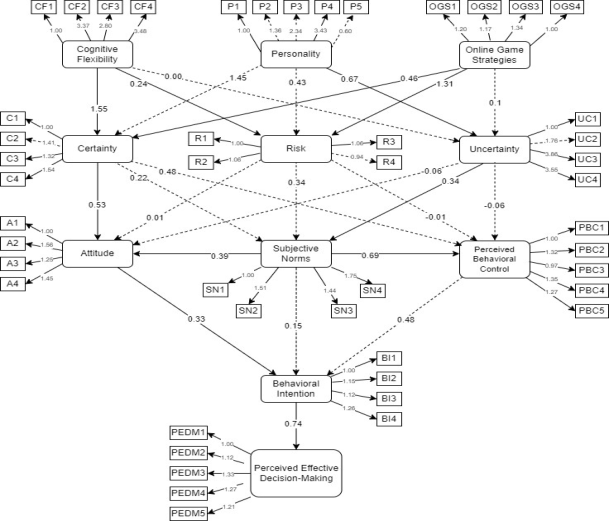
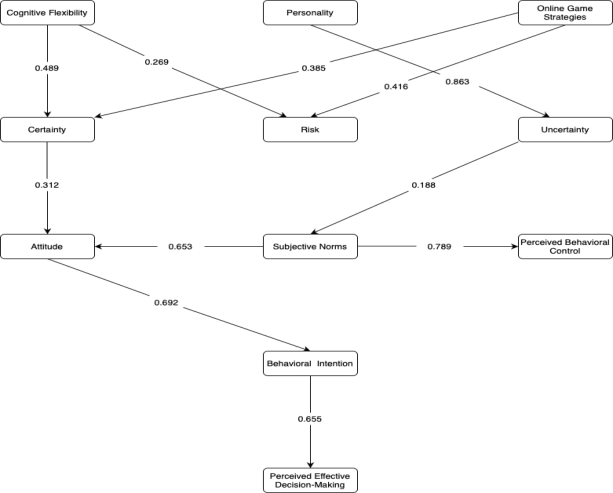
The figure below shows the initial SEM model for the study. Several hypo- theses were shown to be insignificant in the model. As a result, a new model was created for the final SEM model: The values for the Incremental Fit Index (IFI), Tucker Lewis Index (TLI), Comparative Fit Index (CFI), Goodness of Fit Index (GFI), and Adjusted Goodness of Fit Index (AGFI) each had parameter estimations that were
Figure 2: Initial SEM model.Figure 3: Final SEM model.
higher above the cutoff of 0.80. The Root Mean Square Error of Approxi- mation (RMSEA) parameter estimate of 0.056 was lower than the required minimal level, demonstrating an outstanding model fitness.
Predicting Factors Influencing Online Gaming Towards Effective Decision-Making 61
Table 2. Model fit indices.
Table available in the original PDF paper.
Suggested by
Goodness of Fit Measures Parameter Estimates
Minimum Cutoff
0.809 >0.80 [Gefen et al., 2000]
Incremental Fit Index (IFI) 0.806 >0.80 [Gefen et al., 2000] Tucker Lewis Index (TLI) 0.789 >0.80 [Gefen et al., 2000] Comparative Fit index (CFI) 0.804 >0.80 [Gefen et al., 2000] Goodness of Fit Index (GFI) 0.831 >0.80 [Gefen et al., 2000] Adjusted Goodness of Fit Index (AGFI) 0.056 <0.07 [Steiger, 2007] Root Mean Square Error of Approximation (RMSEA)
SEM results show that Personality is the most significant latent factor influencing Uncertainty (β: 0.863; p = 0.001). When people lack an under- standing of the game, they tend to make effective decisions which corresponds to the study of Bloemen et al. [2019], where they stated that Uncertainty also results from activities over time in the areas of reaction to changing and unforeseen circumstances. This implies that a player’s personality is one of the most critical parts of figuring out how games may influence players. A game’s quality increases with the number of players playing it, reflecting the diversity of the players’ knowledge and playing styles, which then influences their decision-making.
Second, Subjective Norms showed a direct relationship to Perceived Beha- vioral Control (β: 0.789; p = 0.003). The result indicates that Filipino online gamers perceive playing online games can influence their peers to try various online games. Influencers also play a role in influencing a particular gamer to try chosen games. According to Sassine [2017], professional gamers are social influencers, and this perspective brings an immediate connection betw- een celebrity endorsement and social media influencers. It can indicate that although Filipino online gamers perceive that the people they look up to influ- ence them in playing online games, they can still manage to make effective decisions and carry them out.
Third, Attitude directly affects Behavioral Intention (β: 0.692; p = 0.007). According to the Theory of Planned Behavior, a person’s attitude reflects their beliefs and thoughts, while the intention is a person’s persistence and deter- mination in pursuing a course of action [Mamman et al., 2016; Alzahrani et al., 2017]. From TBP, attitude influences behavioral intention, affecting how people want to carry out their tasks, and that intention directly affe- cts how we behave [Ajzen, 1991]. It can infer that Filipino gamers’ attitude reflects their intention on how they play and make decisions in the game.
Fourth, Behavioral Intention significantly impacts Perceived Effective Decision-Making (β:0.655; p = 0.003). Yang [2016] explained that inte- raction with games and digital games could effectively improve energy knowledge from interactions with different games. Learners might gain posi- tive behavioral intentions and absorb different energy knowledge. According to Reynaldo et al. [2021], video games can improve a person’s skills, espe- cially when it comes to decision-making and cognitive skills. Thus, this can
make an impact on intelligence. It is also explained by Reynaldo et al. [2021] that playing games may train the player’s brain, and a controlled way is vital for optimal results.
Fifth, Subjective Norms showed a direct relationship to Attitude (β: 0.653; p = 0.002). According to Hahn & Roos [2017], Subjective Norms are the outcome of expectations about others’ typical behavior and the desire to con- form to them. Online games provide virtual worlds that enhance various social interactions with multiplayer collaboration and competition. Players adhere to group norms in these environments. These pursuits match the group’s interests, and the players interact socially [Kaye et al., 2017; Gong et al., 2019]. Playing video games can influence players’ attitudes through various mechanisms, including perspective-taking, which allows them to consider events from someone else’s perspective [Peña et al., 2018].
Sixth, Cognitive Flexibility directly affects Certainty (β: 0.489; p = 0.002). Cognitive Flexibility is the capacity to adapt to a changing environment, and certainty is the metacognitive assessment of a person’s perception of the truth, clarity, or accuracy of a thought, sensation, belief, or attitude [Kim et al., 2022]. According to Baer & Kidd [2022], metacognitive people use their level of certainty to gauge what they know, which further supports the claim in this study that cognitive flexibility affects certainty. In addition, as stated by Wang et al. [2021], people frequently make recurrent errors when unaware of a task’s certainty, meaning that one’s cognitive flexibility is related to the certainty of the information.
Seventh, Online Game Strategies influencing Risk (β: 0.416; p = 0.001). This result shows online game strategies have a significant relationship with behavioral decision theory; hence online game strategies influence certainty (β: 0.385; p = 0.002). Depending on encounters with opponents, Filipino gamers can swiftly switch gaming from defensive to offensive or in other ways and adjust to making effective choices accordingly. According to Hsieh & Sun [2008], Real Time Strategies (RTS) games provide a suitable environment for exploring ideas. As a result, interesting alternatives can produce beneficial results while playing online games.
Eight, Certainty directly affects Attitude (β: 0.312; p = 0.003). Accor- ding to Tormala [2016], psychological certainty is essential in deciding how individuals think, judge, feel, and act. The subjective sense of assurance regarding an attitude is called attitude certainty. Online games enable pla- yers to collaborate to win engagements, talk to each other to solve issues, and discuss gameplay and latest game successes [Arbeau et al., 2020]. This will reflect on their confidence in their attitudes, making them more incli- ned to examine them, share them with others, and even persuade others to agree.
Ninth, SEM results show that Cognitive Flexibility is the second to the least effect on Risk (β: 0.269; p = 0.002). According to Dong et al. [2018], Cognitive Flexibility is a task-switching or mental-shifting ability wherein it is the reconfiguration of mental processes by people resources in alterna- ting order. According to Dahabiyeh et al. [2020], risk perception significantly increases when a negative outcome is possible. However, there is a suggestion that individuals look for other ways to reduce the risk when perceived risk
Predicting Factors Influencing Online Gaming Towards Effective Decision-Making 63
increases, such as carefully considering alternatives. When it comes to online gaming, a high level of risk is associated with a person with behavioral inten- tion, i.e., playing games; they are the person who is more likely to be hesitant to participate.
Lastly, Uncertainty has the least latent factor on Subjective Norms (β: 0.188; p = 0.006). Power et al. [2018] stated that uncertainty also lies in other game elements. However, uncertainty may be regarded as a subjective player experience rather than an objective measure of the game. Another study by Peña et al. [2018] explains that video games allow players to be the protagonist of a story and make consequential decisions. It is also stated that subjective norms could also affect optimism and attitude, influencing an individual’s ability and motivation [Sany et al., 2021].
CONCLUSION
Games provide an escape from one’s daily routine and an opportunity to have fun and be entertained. Researchers identified that Personality, Subjective Norms, Behavioral Intention, and Attitude are significant factors in effective decision-making. However, Online Game Strategies, Cognitive Flexibility, Uncertainty, and Certainty are additional vital variables that are influenced by the other variables that can influence perceived effective decision-making.
REFERENCES
Ahmad, S. L., Hassan, T., Sousa, A., Yuen, K., Douris, P., & Zwibel, H. (2020). Physiological and Cognitive Functions Following a Discrete Session of Competitive Esports Gaming. Frontiers in Psychology, 11. https://doi.org/10.3389/fpsyg.2020. 01030 Ajzen, I. (1991). The theory of planned behavior. Organizational Behavior and Human Decision Processes, 50(2), 179–211. https://doi.org/10.1016/0749- 5978(91)90020-t Alzahrani, A., Alalwan, N., Alfarraj, O., Mahmud, I., & Ramayah, T. (2017).
Extending the theory of planned behavior (TPB) to explain online game playing among Malaysian undergraduate students. Telematics and Informatics. https:// doi.org/10.1016/j.tele.2016.07.001 Arbeau, K., Thorpe, C., Stinson, M., Budlong, B., and Wolff, J. (2020). The meaning of the experience of being an online video game player. Comput. Hum. Behav. Rep. 2:100013. doi: 10.1016/j.chbr.2020.100013 Aydemir, M., & Bayram, N. (2017). Decision-Making Styles and Persona- lity Traits. International Journal of Recent Advances in Organizational Behaviour and Decision Sciences (IJRAOB): An Online International Research Journal. https://www.researchgate.net/profile/Mine-Aydemir- Dev/publication/330832648_Dec ision-Making_Styles_and_Personality_Traits/ links/61a60d88b4bbff76e277843b/Deci sion-Making-Styles-and-Personality- Traits.pdf Baer, C., & Kidd, C. (2022). Learning with certainty in childhood. Trends in
Cognitive Sciences, 26(10), 887–896. https://doi.org/10.1016/j.tics.2022.07.010 Beran, T. N., & Violato, C. (2010). Structural equation modeling in medical research: a primer. BMC Res Notes 3, 267. https://doi.org/10.1186/1756-0500-3-267 Chen, L. S. L. (2010). The impact of perceived risk, intangibility and consumer
characteristics on online game playing. Computers in Human Behavior, 26(6), 1607–1613. https://doi.org/10.1016/j.chb.2010.06.008
Cheng, T., Huang, H., Huang, W., & Teng, C. (2017). Impact of online gamers’ personality traits on interdependence, network convergence, and continuance inten- tion: Perspective of social exchange theory. International Journal of Information Management. https://doi.org/10.1016/j.ijinfomgt.2017.08.009 Cui, R., Dong, L., Gan, X., Gong, D., Jiang, D., Lui, H., Liu, T., Ma, W., Qui,
N., Tang, X., Xie, J., Yao, Y., & Zong, X. (2020). Action Real-Time Strategy Gaming Experience Related to Increased Attentional Resources: An Attentional Blink Study. Cognitive Neuroscience. https://doi.org/10.3389/fnhum.2020.00101 Dahabiyeh, L., Najjar, M. S. & Agrawal, D. (2020). The effect of risk levels on technology adoption decisions: the case of online games. Information Technology & People, 33(5), 1445–1464. https://doi.org/10.1108/ITP-09-2019-045 DeMarree, K. G., Petty, R. E., Briñol, P., & Xia, J. (2020). Documenting individual
differences in the propensity to hold attitudes with certainty. Journal of Personality and Social Psychology, 119(6), 1239–1265. https://doi.org/10.1037/pspa0000241 Ding, Y., Lui, R., Lui, Y., Wang, J., Xu, L., & Zhen, R. (2017). What Influences Chinese Adolescents’ Choice Intention between Playing Online Games and Learning? Application of Theory of Planned Behavior with Subjective Norm Manipulated as Peer Support and Parental Monitoring. Frontiers in Psychology. https://www.frontiersin.org/article/10.3389/fpsyg.2017.00589 Dong, G., Potenza, M., Wang, L., Wang, M., & Sheng, H. (2018). Brain responses
during strategic online gaming of varying proficiencies: Implications for better gaming. Brain and Behavior. https://doi.org/10.1002/brb3.1076 Dor, S. (2018). Strategy in Games or Strategy Games: Dictionary and Encyclopedic Definitions for Game Studies. International Journal of Computer Game Research, 18(1). http://gamestudies.org/1801/articles/simon_dor Faqih, K. M. (2022). Factors influencing the behavioral intention to adopt a tech-
nological innovation from a developing country context: The case of mobile augmented reality games. Technology in Society, 69, 101958. https://doi.org/10. 1016/j.techsoc.2022.101958 Gamage, T. C., Martin, E., Rasoolimanesh, S. M., & Tajeddini, K. (2021). Exploring the visitors’ decision-making process for Airbnb and hotel accommodations using value-attitude-behavior and theory of planned behavior. International Journal of Hospitality Management. https://doi.org/10.1016/j.ijhm.2021.102950 Gefen, D. Straub, D., Boudreau, M.-C. (2000). Structural equation modeling and
regression: guidelines for research practice. Commun. Assoc. Inf. Syst. https://do i.org/10.17705/1cais.00407. Hahn, R. & Roos, D. (2017). Does shared consumption affect consumers’ values, attitudes, and norms? A panel study, Journal of Business Research, Volume 77, Pages 113-123, https://doi.org/10.1016/j.jbusres.2017.04.011 Horcajo, J., Santos, D., & Higuero, G. (2022). The effects of self-efficacy on physical
and cognitive performance: An analysis of meta-certainty, Psychology of Sport and Exercise, Volume 58, https://doi.org/10.1016/j.psychsport.2021.102063 Hsieh, J. L., & Sun, T. C. (2008). Building a player strategy model by analyzing replays of real-time strategy games. IEEE Xplore. https://ieeexplore.ieee.org/docu ment/4634237 Kaye, L. K., Kowert, R., and Quinn, S. (2017). The role of social identity and online
social capital on psychosocial outcomes in MMO players. Comput. Hum. Behav. 74, 215–223. doi: 10.1016/j.chb.2017.04.030 Kim G. M., Jeong E. J., Lee J. Y., Yoo J. H. (2022). Role of social capital in adolescents’ online gaming: A longitudinal study focused on the moderating effect of social capital between gaming time and psychosocial factors. Frontiers in Psychology, 13. DOI=10.3389/fpsyg.2022.931134
Predicting Factors Influencing Online Gaming Towards Effective Decision-Making 65
Kim, J., Ryu, K., & Woo M. (2021). False accusation of online games: Internet gaming can enhance the cognitive flexibility of adolescents. Asian Journal of Sport and Exercise Psychology. https://doi.org/10.1016/j.ajsep.2021.09.006 Kurata, Y. B., Prasetyo, Y. T., Ong, A. K. S., Nadlifatin, R., & Chuenyindee, T. (2022).
Factors affecting perceived effectiveness of Typhoon Vamco (Ulysses) flood disa- ster response among Filipinos in Luzon, Philippines: An integration of protection motivation theory and extended theory of planned behavior. International Journal of Disaster Risk Reduction. https://doi.org/10.1016/j.ijdrr.2021.102670 Mamman, M., Ogunbado, A., & Abu-Bakr, A. (2016). Factors Influencing Customer’s Behavioral Intention to Adopt Islamic Banking in Northern Nige- ria. IOSR Journal of Economics and Finance. e-ISSN: 2321-5933, p-ISSN: 2321–5925.Volume 7, Issue 1. Ver. III (Jan. - Feb. 2016), pp. 51–55 www.iosrjournals.org Peña, J., Perez, J. F. H., Khan, S., Gomez, A. P. C. (2018). Game Perspective-Taking
Effects on Players’ Behavioral Intention, Attitudes, Subjective Norms, and Self- Efficacy to Help Immigrants: The Case of “Papers, Please”. Mary Ann Libert, Inc. Publisher. https://www.liebertpub.com/doi/abs/10.1089/cyber.2018.0030 Power, C., Cairns, P., Denisova, A., Papaioannou, T., Gultom, R. (2018).
Lost at the Edge of Uncertainty: Measuring Player Uncertainty in Digital Games. International Journal of Human-Computer Interaction, https://www.tandfonline.com/doi/abs/10.1080/10447318.2018.1507161. Sany, S. B. T., Aman, N., Jangi, F., Lael-Monfared, E., Tehrani, H., & Jafari, A. (2021). Quality of life and life satisfaction among univer- sity students: Exploring, subjective norms, general health, optimism, and attitude as potential mediators. Taylor & Francis Online: https://www.tandfonline.com/doi/abs/10.1080/07448481.2021.1920597 Sassine, R. (2017). What is the impact of Social Media Influencers? https://digitalme-up.com/2017/04/06/impact-social-media-influencers Sörman, D. E., Dahl, K. E., Lindmark, D., Hansson, P., Vega-Mendoza, M.,
& Körning-Ljungberg, J. (2022). Relationships between Dota 2 expertise and decision-making ability. PLOS ONE, 17(3), e0264350. https://doi.org/10.1371/ journal.pone.0264350 Statista Research Department. (2022). Popular genres for online gaming Philippines 2020. https://www.statista.com/statistics/1117942/philippines-popular-genr es-for-online-gaming/ Steiger, J, H. (2007). Understanding the limitations of global fit assessment in stru-
ctural equation modeling, Pers. Indiv. Differ. https://doi.org/10.1016/j.paid.2006. 09.017 To, A., Ali, S., Kaufman, G. F., & Hammer, J. (2016). Integrating Curiosity and Uncertainty in Game Design. http://www.digra.org/digital-library/publications/i ntegrating-curiosity-and-uncertainty-in-game-design/ Tormala, Z. (2016). The role of certainty (and uncertainty) in attitudes and persua-
sion, Current Opinion in Psychology, Volume 10, Pages 6-11, https://doi.org/10. 1016/j.copsyc.2015.10.017 Wang, X., Liu, X., & Feng, T. (2021). The continuous impact of cognitive flexibility on the development of emotion understanding in children aged 4 and 5 years: A longitudinal study. Journal of Experimental Child Psychology, 203, 105018. https://doi.org/10.1016/j.jecp.2020.105018 Yang, J. C., Lin, Y. L., & Liu, Y.-C. (2016). Effects of locus of control on beha-
vioral intention and learning performance of energy knowledge in game-based learning. Environmental Education Research. https://doi.org/10.1080/13504622. 2016.1214865
LISTED IN THE AHFE DIGITAL BOOKSTORE CATALOGUE
Explore the complete digital volume
Human-Centered Metaverse and Digital Environments
Read this individual research paper free through the original publisher, or explore the full digital proceedings book.
ISBN 978-1-958651-75-9
Explore this ISBN in the AHFE Bookstore ↗Listed in the July 2026 bookstore catalogue; search by ISBN to confirm current availability · Digital book purchase optional