Linne Samantha Abracero, Valiant Victor Ang, Reign Aldrin Balatbat, Gabriel Carbonell, Yoshiki Kurata (2026). Factors Affecting Binge-Watching Motivations among Filipino Viewers Across Streaming Platforms: An Integration of the Theory of Planned Behavior. In: Human-Computer Interaction & Emerging Technologies. AHFE Open Access, vol. 233, pp. 404–413. https://doi.org/10.54941/ahfe1007540
The rise of streaming platforms has contributed to the growing prevalence of binge-watching among Filipino viewers. This study aimed to investigate the key factors that influence binge-watching motivations among Filipino viewers across various streaming platforms. By integrating the Theory of Planned Behavior (TPB), the research examined how social norms, peer influence, attitudes, and perceived behavioral control influence individuals' intentions to binge-watch. Using Partial Least Squares Structural Equation Modeling (PLS-SEM), the study examined the relationships between motivational constructs, including hedonic motivations, escapism, and the fear of missing out (FOMO). Results revealed significant latent variables were hedonic motivation (HM), escapism (ES), fear of missing out (FM), attitude towards the behavior (ATB), social norms (SN), perceived behavioral control (PBC), and perceived binge-watching intentions (PBWI). Moreover, FM was identified as the most significant predictor of binge-watching intentions (β: 0.706; p = 0.000). The findings will provide a culturally grounded understanding of binge-watching behavior in the Philippine context, offering insights for media producers, platform developers, and behavioral researchers on the psychological and social drivers behind prolonged media consumption.
The rapid growth of Over-The-Top (OTT) platforms has transformed the entertainment industry by allowing viewers to access content anytime through streaming services such as Netflix and Amazon Prime Video. In the Philippines, demand for both local and international content has increased due to easier and prolonged access to streaming platforms (Statista, 2024). This shift from traditional television intensified during the COVID-19 Received February 20, 2026; Revised March 31, 2026; Accepted April 20, 2026; Available online July 20, 2026
Factors Affecting Binge-Watching Motivations Among Filipino 405 lockdown, when streaming became a common coping mechanism that allowed individuals to escape pandemic-related restrictions (Blanco et al., 2022). As a result, binge-watching behavior increased, raising concerns about its effects on productivity, well-being, and daily routines (Paulus & Aziz, 2023). Prior studies have also linked binge-watching to procrastination and other negative behavioral outcomes (Suntharalingam, 2022).
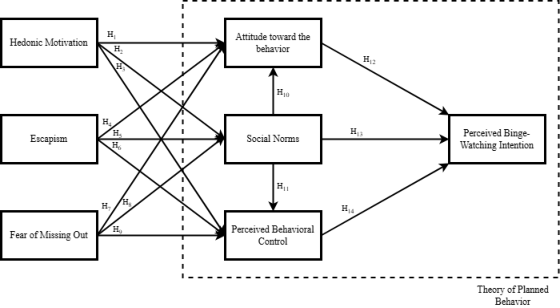
Figure 1: Conceptual framework.
This study applies the Theory of Planned Behavior to examine how social, psychological, and behavioral factors influence binge-watching intentions among Filipino viewers. The proposed framework outlines the relationships among these variables, resulting in 14 hypotheses.
Hypothesis 1 (H1): Hedonic motivations have a significant relationship with the attitude toward behavior. Hypothesis 2 (H2): Hedonic motivations have a significant relationship with social norms. Hypothesis 3 (H3): Hedonic motivations have a significant relationship with perceived behavioral control. Hypothesis 4 (H4): Escapism has a significant relationship with the attitude toward behavior. Hypothesis 5 (H5): Escapism is significantly related to social norms. Hypothesis 6 (H6): Escapism is significantly related to perceived behavioral control. Hypothesis 7 (H7): Fear of missing out has a significant relationship with the attitude toward behavior Hypothesis 8 (H8): Fear of missing out has a significant relationship with social norms. Hypothesis 9 (H9): Fear of missing out has a significant relationship with perceived behavioral control Hypothesis 10 (H10): Social norms have a significant direct relationship with the attitude toward behavior. Hypothesis 11 (H11): Social norms have a significant direct relationship with perceived behavioral control.
Hypothesis 12 (H12): Attitude toward the behavior has a significant direct relationship with the perceived binge-watching intention. Hypothesis 13 (H13): Social norms have a significant direct relationship with the perceived binge-watching intention Hypothesis 14 (H14): Perceived behavioral control has a significant direct relationship with the perceived binge-watching intention.
METHODOLOGIES This study employed a quantitative design to examine binge-watching motivations among Filipino viewers. A total of 506 respondents who actively use streaming platforms were included in the analysis. Partial Least Squares Structural Equation Modeling (PLS-SEM) was used to test the relationships among variables due to its suitability for analyzing complex models with multiple latent constructs (Hair et al., 2021; Prasetyo et al., 2024).
Table 1: Profile of the respondents (N = 506).
Table available in the original PDF paper.
Characteristics Category N % Age 18-28 years old 29-44 years old 45-60 years old 61-79 years old
Region Region I – Ilocos Region Region II – Cagayan Valley Region III – Central Luzon National Capital Region (NCR) Region IV A – CALABARZON Region IV B – MIMAROPA Region V – Bicol Region Region VI – Western Visayas Negros Island Region (NIR) Region VII – Central Visayas Region VIII – Eastern Visayas Region IX – Zamboanga Peninsula Region X - Northern Mindanao Region XI - Davao Region Region XII - SOCCSKSARGEN Region XIII - CARAGA CAR - Cordillera Administrative Region BARMM - Bangsamoro Autonomous Region In Muslim Mindanao
14
2.80%
Time Spent Watching
2 hours 3 hours 4 hours 5 or more hours
114 151 119 112
22.50% 29.80% 23.50% 24.10%
(Continued)
Table 1: Continued.
Table available in the original PDF paper.
Characteristics Category N % Genre Preference Comedy Horror Action Thriller Drama Mystery Fantasy Romantic Comedy Other Genres
PLS-SEM was selected for its ability to examine relationships between latent variables and to handle non-normal data distributions (Hair et al., 2021; Prasetyo et al., 2024). This method is appropriate for analyzing complex models that integrate constructs such as hedonic motivation, escapism, fear of missing out, and behavioral intention within the TPB framework.
RESULTS AND DISCUSSION
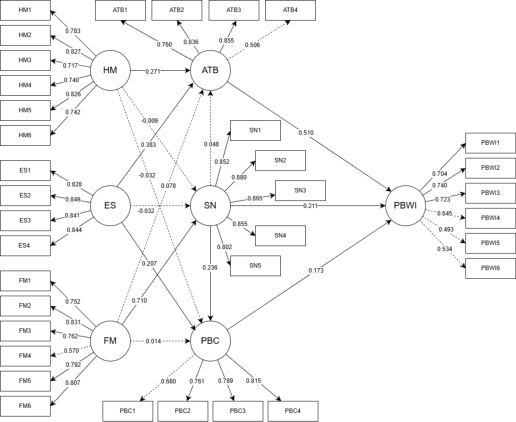
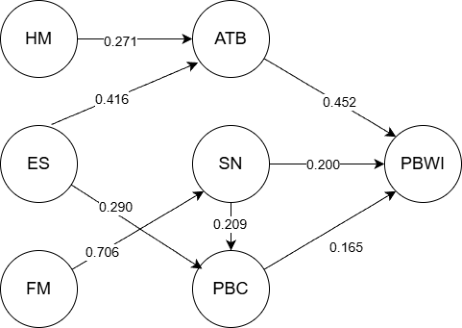
The initial SEM model (see Figure 2) was constructed using the proposed conceptual framework with seven latent variables and 35 indicators representing the 14 proposed hypotheses. The researchers eliminated insignificant hypotheses by setting path coefficients with p-values greater than 0.05 to 0.00 (Kurata et al., 2023). Thus, leading to the final SEM model (see Figure 3), which yielded an overall good fit. The model fit was measured using the Standardized Root Mean Square Residual (SRMR), yielding a value of 0.065, which falls within the threshold of 0.08 or lower (Al-Haj et al., 2024; Flayelle et al., 2018; Hu and Bentler, 1998; Marsall et al., 2024).
Another model fit index was the Normed Fit Index (NFI), which yielded 0.807, within the range of 0.80-0.90 (Cheng et al., 2023; Li et al., 2022).
Figure 2: Initial SEM model.Table 2: Model fit indices.
Table available in the original PDF paper.
Saturated Model
Estimated Model Threshold Reference SRMR 0.065 0.068 <0.08 Hu and Bentler (1998) d_ULS 1.951 2.148 - -
Factors Affecting Binge-Watching Motivations Among Filipino 409 Arof et al. (2018) found that the range of reliability and its coefficient of Cronbach’s Alpha are that 0.70 - 0.79 is an acceptable reliability level, while 0.80 - 0.89 is a good reliability level, and greater than 0.90 is an excellent reliability level. Moreover, the Cronbach’s Alpha (see Table 3) falls within the acceptable-to-good reliability range (Roquid et al., 2025).
The study used two criteria to determine discriminant validity: the Fornell- Larker criterion and the Heterotrait-Monotrait Ratio (HTMT). The Fornell- Larcker criterion (see Table 4) demonstrates discriminant validity when the square root of the average variance extracted (AVE) for each variable is greater than the correlations between that variable and any other variable in the model (Da Silva et al., 2024). As shown in Table 4, the square roots of the AVEs are all greater than their correlations with the other latent variables, indicating discriminant validity. Roemer et al. (2021) stated that HTMT has a recommended threshold of 0.85, and all of the researchers’ HTMT values (Table 5) are below this threshold, which supports their data.
ATB ES FM HM PBC PBWI SN ATB 0.838 ES 0.601 0.840 FM 0.220 0.288 0.800 HM 0.556 0.684 0.200 0.774 PBC 0.330 0.331 0.220 0.256 0.814 PBWI 0.540 0.446 0.317 0.393 0.368 0.738
SN 0.165 0.196 0.706 0.139 0.266 0.319 0.851
Table 5: Heterotrait-Monotrait ratio.
Table available in the original PDF paper.
ATB ES FM HM PBC PBWI SN ATB ES 0.728 FM 0.279 0.354 HM 0.667 0.790 0.259 PBC 0.420 0.408 0.271 0.302 PBWI 0.703 0.558 0.412 0.492 0.488 SN 0.199 0.223 0.782 0.164 0.325 0.406
All the proposed factors were significant to the perceived binge-watching intention (PBWI) of Filipino viewers: Fear of Missing Out (β: 0.706, p = 0.000), Escapism (β: 0.416, p = 0.000), and Hedonic Motivations (β: 0.271, p = 0.000) as seen in Figure 3, represented by the path coefficients and beta values. Fear of Missing Out (FM) was identified as the most significant factor in Filipino viewers’ perceived intention to binge-watch. The results showed that FM is a key driver of binge-watching, as individuals fear that others are enjoying media without them, prompting faster media consumption (Ort et al., 2020).
Second, Attitude Towards Behavior (ATB) has a significant effect on PBWI (β: 0.452, p = 0.000). According to Aytas and Topatan (2024), younger individuals and those who are unemployed or have never worked showed a more positive attitude towards binge-watching. Third, Escapism (ES) directly affects ATB (β: 0.416, p = 0.000). Sun and Chang (2021) pointed out that using media as a coping mechanism to avoid negative emotions can reinforce a positive ATB.
Fourth, ES also directly affects PBC (β: 0.290, p = 0.000). Castro et al. (2021) observed that participants were only moderately aware of how much time they spent binge-watching, indicating fluctuating control depending on their level of immersion. Fifth, Hedonic Motivation (HM) significantly affects ATB (β: 0.271, p = 0.000). Ong et al. (2023) found that people find interactive entertainment fun, enjoyable, and highly engaging. As explained in their study, when people’s expectations for an activity are met, they are entertained.
Sixth, Social Norms (SN) has the third-lowest significant effect on PBC (β: 0.209, p = 0.000). Li et al. (2022) found that social norms often stem from social influence, where pressure to keep up with peers creates a sense of belonging. Seventh, SN has the second-lowest effect on PBWI (β: 0.200, p = 0.000). Pittman and Steiner (2021) found that binge-watching can foster social bonding as part of its benefits. The findings also aligned with one of their concepts, “feast-watching,” in which binge-watching is an intentional activity used to reward oneself, gain social benefits, and experience gratification.
Lastly, Perceived Behavioral Control (PBC) has the lowest significant effect on the PBWI of Filipino viewers (β = 0.165, p = 0.000). Starosta et al. (2021) found that if the action is not premeditated, then there would be negative consequences.
CONCLUSION
This shows that although viewers desire to keep up with others, their sense of control over how often they watch has less impact on their intentions. Binge-watching may seem easy and convenient, but this feeling of control is weaker than the pressure to stay updated. This research highlights that a loss of control is often rooted in internal struggles, such as impulsivity, rather than in external factors alone, such as enjoyment or social pressure. Starosta et al. (2021) note that emotional regulation is a primary predictor of problematic binge-watching. Furthermore, highly engaging content can cause viewers to lose track of time, which aligns with Castro et al.’s [2021] findings that reduced self-regulation occurs when individuals are deeply immersed in a show.
Factors Affecting Binge-Watching Motivations Among Filipino 411 The study also clarifies that personal motivations, such as pleasure and escapism, operate at the individual level and do not necessarily shape a group’s collective social norms. Athari et al. (2024) explain that individuals often use escapism to withdraw from social stressors rather than to build or conform to social expectations. For many Filipino viewers, the act of binge- watching is driven more by a desire to share common interests with family and friends than by a strictly personal attitude toward the behavior itself. While personal enjoyment is certainly part of the equation, the cultural value placed on shared experiences remains a much more significant engine for sustaining long viewing sessions.
Since binge-watching often becomes habitual, there are several practical ways for viewers to manage their consumption more effectively. Because people frequently use streaming to relieve stress, platform designers could introduce features such as optional playback timers or wellness reminders to help users stay aware of their viewing time. Pittman and Steiner (2021) suggest that while viewers can plan their time, they often lose track of those goals once the behavior becomes unmonitored. For younger viewers who are particularly influenced by their peers, establishing shared social norms, such as viewing schedules or agreements to avoid spoilers, can turn media consumption into a coordinated activity that respects both social needs and personal responsibilities (Taber et al., 2023).
REFERENCES
Al-Haj, E., Alamoush, S., & Darwish, M. M. (2024). Service Quality of Amman BRT Based on User’s Perceptions: A structural equation modeling approach. KSCE Journal of Civil Engineering, 28(8), 3506–3519. https://doi.org/10.1007/ s12205-024-0175-8 Arof, K. Z. M., Ismail, S., & Saleh, A. L. (2018). Contractor’s performance appraisal
system in the Malaysian construction industry: Current practice, perception and understanding. International Journal of Engineering & Technology, 7(3.9), 46. https://doi.org/10.14419/ijet.v7i3.9.15272 Athari, N., Abazari, A., & Rashki, M. (2024). Prediction of Escapism Based on Interpersonal Sensitivity, Self-Criticism, and the Need for Social Approval. Iranian Journal of Neurodevelopmental Disorders, 3(3), 10–16. Aytas, M., & Topatan, I. B. (2024). Determining factors of university students’ binge-
watching attitudes. Heliyon, 10(20). Blanco, M. R. C., Manaloto, A. M., Hipona, J. B., & Jordan, C. V. J. (2022).
Mental Health and Escapism Through TV Show Consumption Among Filipino Undergraduate Students While on COVID-19 Community Quarantine. Globus: An International Journal of Medical Science, Engineering & Technology, 11(1). Castro, D., Rigby, J. M., Cabral, D., & Nisi, V. (2021). The binge-watcher’s journey: Investigating motivations, contexts, and affective states surrounding Netflix viewing. Convergence, 27(1), 3–20. https://journals.sagepub.com/doi/ full/10.1177/1354856519890856 Cheng, N., Zhao, Y., Li, X., He, X., & Wang, A. (2023). Translation and validation
study of the Chinese version of the service user technology acceptability questionnaire. Asia-Pacific Journal of Oncology Nursing, 10(6), 100239. https:// doi.org/10.1016/j.apjon.2023.100239
Da Silva, J. M. N., Bispo, L. G. M., Leite, W. K. D. S., De Araujo Vieira, E. M., Lisboa, A. H. S., & De Sá Teixeira, R. (2024). Assessing the link between occupational risk factors, work-related musculoskeletal disorders and quality of work life: An analysis using PLS-SEM. International Journal of Industrial Ergonomics, 104, 103658. https://doi.org/10.1016/j.ergon.2024.103658 Flayelle, M., Maurage, P., Di Lorenzo, K. R., Vögele, C., Gainsbury, S. M., & Billieux,
J. (2020). Binge-watching: What do we know so far? A first systematic review of the evidence. Current Addiction Reports, 7, 44–60. Hu, L.-t., & Bentler, P. M. (1998). Fit indices in covariance structure modeling: Sensitivity to underparameterized model misspecification. Psychological Methods, 3(4), 424–453. https://doi.org/10.1037/1082-989X.3.4.424 Kurata, Y. B., Ong, A. K. S., Cunanan, A. L. M., Lumbres, A. G., Palomares, K. G. M.,
Vargas, C. D. A., & Badillo, A. M. (2023). Perceived Behavior Analysis to Boost Physical Fitness and Lifestyle Wellness for Sustainability among Gen Z Filipinos. Sustainability, 15(18), 13546. https://doi.org/10.3390/su151813546 Li, Z., Du, N., Wang, B. & Oteng-Darko, C. (2022). Impact of Social Influence on Users’ Continuance Intention Toward Sports And Fitness Applications. Front Public Health, 10, 1031520. https://www.ncbi.nlm.nih.gov/pmc/articles/ PMC9650225/ Retrieved on: June 2023 Marsall, M., Dinse, H., Schröder, J., Skoda, E., Teufel, M., & Bäuerle, A. (2024).
Assessing electronic health literacy in individuals with the Post–COVID-19 condition using the German Revised eHealth Literacy Scale: Validation study. JMIR Formative Research, 8, e52189. https://doi.org/10.2196/52189 Ong, A. K. S., Josue, N. L., Urbiztondo, A. M. B., German, J. D., & Espeño, P. R.
E. (2023). Evaluation of consumer usage behavior for interactive entertainment: A Netflix case study. Entertainment Computing, 49, 100627. https://doi. org/10.1016/j.entcom.2023.100627 Ort, A., Wirz, D., & Fahr, A. (2020). Is binge-watching addictive? Effects of motives for TV series use on the relationship between excessive media consumption and problematic viewing habits. Addictive Behaviors Reports, 13, 100325. https://doi. org/10.1016/j.abrep.2020.100325 Paulus, A. M., & Aziz, A. (2023). Binge Watching, Compensatory Health Beliefs
and Academic Procrastination among University Students. Journal of Behavioural Sciences, 33(1). Pittman, M., & Steiner, E. (2021). Distinguishing feast-watching from cringewatching: Planned, social, and attentive binge-watching predicts increased well- being and decreased regret. Convergence, 27(5), 1507–1524. Prasetyo, Y.T., Kurata, Y. B., Zahra, K., Madel, M., Reny Nadlifatin, & Janice, M.
(2024). Factors affecting compliance with vehicular environmental laws and pro- environmental behavior in Lahore, Pakistan. Acta Psychologica, 251, 104614– 104614. https://doi.org/10.1016/j.actpsy.2024.104614 Roquid, J. P. R., Prasetyo, Y. T., Kurata, Y. B., Cahigas, M. M. L., Nadlifatin, R., & Gumasing, M. J. J. (2025). Bridging the green gap in laboratory practices: Examining the influence of organizational culture, environmental literacy, and sustainability communication on pro-environmental behaviors. Environmental Development, 57, 101348. https://doi.org/10.1016/j.envdev.2025.101348 Roemer, E., Schuberth, F., & Henseler, J. (2021). HTMT2–an improved criterion
for assessing discriminant validity in structural equation modeling. Industrial Management & Data Systems, 121(12), 2637–2650. https://doi.org/10.1108/ imds-02-2021-008 Starosta, J., Izydorczyk, B., Sitnik-Warchulska, K., & Lizińczyk, S. (2021). Impulsivity and difficulties in emotional regulation as predictors of binge-watching behaviours. Frontiers in Psychiatry, 12, 743870.
Factors Affecting Binge-Watching Motivations Among Filipino 413 Statista. (2024). Leading streaming services based on market share Philippines Q1
2024. https://www.statista.com/statistics/1257753/philippines-leading-streaming- services-market-share/ Sun, J., & Chang, Y. (2021). Associations of Problematic Binge-Watching with Depression, Social Interaction Anxiety, and Loneliness. International Journal of Environmental Research and Public Health, 18(3), 1168. https://doi.org/10.3390/ ijerph18031168 Suntharalingam, A. (2022). Can video on demand binge-watching behavior make you
procrastinate more?: An experience sampling study (Master’s thesis, University of Twente). Taber, L., Dominguez, S., & Whittaker, S. (2023). Ignore the Affordances; It’s the Social Norms: How Millennials and Gen-Z Think About Where to Make a Post on Social Media. Proceedings of the ACM on Human-Computer Interaction, 7(CSCW2), 1–26.
Read this individual research paper free through the original publisher, or explore the full digital proceedings book.
ISBN 979-8-950676-09-3
Explore this ISBN in the AHFE Bookstore ↗Listed in the July 2026 bookstore catalogue; search by ISBN to confirm current availability · Digital book purchase optional