Yoshiki Kurata, Xyza Nicole Bandoquillo, Sophia Marie Hernandez, Ruth Zyrene Monge, Karlos Francis Dominique Tomas (2022). Factors Affecting Perceived Work Performance Among Work- From-Home Filipino Workforce: An Integration of the Job Demands-Resources Theory. In: Social and Occupational Ergonomics. AHFE Open Access, vol. 65, pp. 130–138. https://doi.org/10.54941/ahfe1002667
Work-from-home arrangements became the best response to the current world situation at the beginning of 2020; with the increase of employees partaking in this arrangement, along with this shift, inevitable effects on the workers’ perceived performance might be observed. This study was intended to make relevant and credible contributions in the analysis of work performance in the Philippine workforce. Thirty Filipino work-from-home online workers answered a self-administered online questionnaire with 73 questions (9 latent variables and 52 indicators). Structural equation modeling was utilized to analyze the variables and identified workload (W), employee well-being (EW), and organizational culture (OC) to have a substantial direct effect on job demands (JD), job resources significantly affected cynicism (C) and job demands directly affect both exhaustion (EX) and cynicism (C). Moreover, exhaustion was found to have a significant effect on perceived work performance (WP). Interestingly, job demands (JD) have no significant impact on job resources (JR). Recommendations provided in this study are expected to provide a reasonable scientific basis to improve the current work-from-home scheme in the Philippine workforce.
The impact of teleworking has been heavily experienced in today’s time due to the rapid change in the business environment, globalization, and changing customer demand. The work-from-home arrangement has both advanta- ges and challenges. With respect to the challenges with health, employees working from home are at risk of musculoskeletal problems in the neck, shoulders, wrist, and hand regions. Work performance indicates how well
an employee executes their expected work-related activities [Orta & Cam- goz 2017] and is defined as accomplishing the assigned tasks to achieve an organization’s goal [Patro, 2017].
In this paper, Job Demands-Resources Theory was evaluated to deter- mine how job demands and job resources correlate with the performance of the Filipino workforce. This study aims to identify the factors that prima- rily affect the perceived work performance of a work-from-home employee through the integration of the Job Demands - Resource Theory utilizing the structural equation modeling approach. The study shall serve as a reliable basis among organizations to improve work experiences among work-from- home employees and maximize employee productivity and satisfaction.
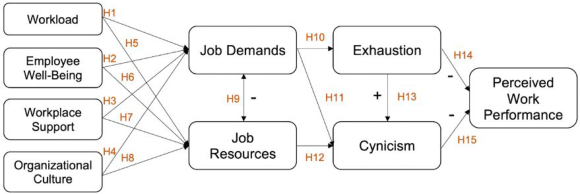
The framework of the study showed the relationships of each hypothesis that resulted in having an effective perceived work performance. The framew- ork presented a total of 15 hypotheses and four main factors being workload, employee well-being, workplace support, and organizational culture: Hypothesis 1 (H1): Workload has a significant relationship with job demands. Hypothesis 2 (H2): Employee Well-being has a significant relationship with job demands. Hypothesis 3 (H3): Workplace support has a significant relationship with job demands. Hypothesis 4 (H4): Organizational Culture has a significant relationship with job demands. Hypothesis 5 (H5): Workload has a significant relationship with job resources. Hypothesis 6 (H6): Employee Well-Being has a significant relationship with job resources. Hypothesis 7 (H7): Workplace Support has a significant relationship with job resources. Hypothesis 8 (H8): Organizational Culture has a significant relationship with job resources. Hypothesis 9 (H9): Job Demands and Job Resources have a significant relationship with each other. Hypothesis 10 (H10): Job Demands have a significant relationship with employee’s exhaustion.
Hypothesis 11 (H11): Job Demands has a significant relationship with cynicism. Hypothesis 12 (H12): Job Resources has a significant relationship with cynicism. Hypothesis 13 (H13): Exhaustion has a significant relationship with cynicism. Hypothesis 14 (H14): Exhaustion has a significant relationship with perceived work performance. Hypothesis 15 (H15): Cynicism has a significant relationship with percei- ved work performance.
The Job Demand-Resource model focuses on the effects of the resources– demand on employee burnout with the influence of the burnout inventory of Maslach with regards to exhaustion, cynicism, and self-efficacy [Peng Hui and Aye, 2018]. The model was used in the study to create hypothetical situ- ations to examine the relationships between the factors and the demanding aspects of work to the perceived work performance of workers. Higher occu- pation requests lead to strain and well-being exhaustion, and higher resources result in more elevated levels of work execution [Nakrošien˙e et al. 2019]. As individuals tend to be burned out from their daily jobs, these workers start to lose their interest in making a positive work contribution. Moreo- ver, employees at their psychological capital are also more likely to perform much actively and successfully to accomplish their tasks while having fun [Cenciotti, Alessandri, & Borgogni 2017].
METHODS
A self-administered survey was distributed among Filipino employees who work-from-from through online platforms to evaluate the factors affe- cting employee work performance. The researchers used the Likert scale as a measurement, ranging from 1 = strongly disagree to 5 = stron- gly agree. In this study, there were a total of three hundred thirty (330) individuals who voluntarily participated and answered the survey questionnaire.
Multivariate Analysis was applied to analyze the data, specifically Stru- ctural Equation Modeling (SEM). SEM explains the relationships among multiple variables and examines the structure of interrelationships in the system [Abbas et al. 2021, Kurata et al. 2022a, Kurata et al. 2022b]. The equ- ations depict all relationships among constructs and variables in the analysis. This is a multivariate technique that combines factor analysis and multiple regression [Hair et al. 2018, Kurata et al. 2018]. This enabled the researchers to investigate using SEM, as it can make a precise statistical approximation of the relationship and interaction between the latent constructs and variables of the study. Maximum Likelihood Estimation was applied to estimate the parameters of a statistical model based on parameter values that will meet the most optimal likelihood function using the SPSS AMOS 22, a software program used to fit structural equation models.
Industry Manufacturing Automotive Banking & Finance BPO Business Services Engineering Construction Logistics Multimedia E-commerce Education Energy Food Government Healthcare Rental Services Hospital Information Technology Operator Consulting Services Marketing Oil and Gas Real Estate Retail Tourism Transportation Warehousing
RESULTS
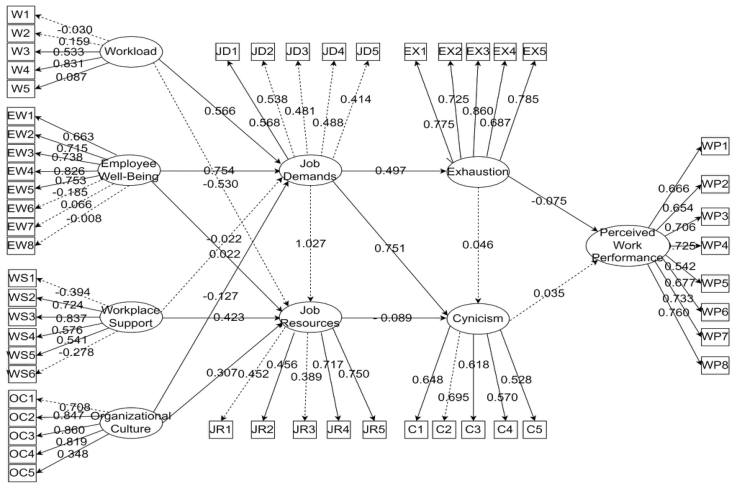
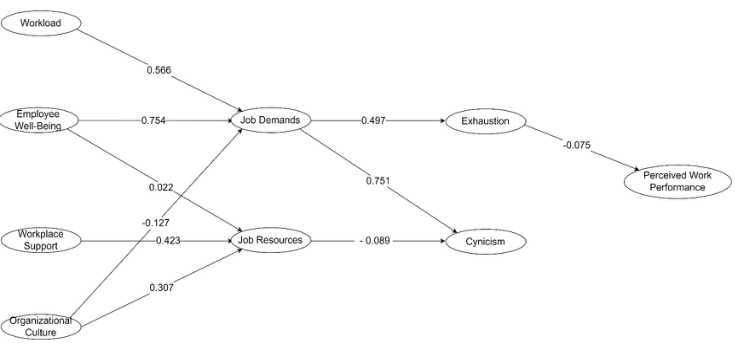
The initial SEM model (see Figure 2) was constructed according to the resea- rch paradigm containing nine latent variables and 52 indicators representing 15 proposed hypotheses. The researchers have eliminated the non-significant factors by removing the indicator with values less than 0.50 and arrived in the final SEM model (see figure 3) with a good model fit. Moreover, a rela- tionship with standardized direct effects greater than the value of 0.05 or correlated errors causing multicollinearity was considered insignificant and omitted in the model [Awang et al. 2015]. Figure 3 shows the identified signi- ficant factors and interrelated variables. It was further evaluated based on the model fit indices shown in table 2.
Based on the results of the model fit indices, the results of the Incremen- tal Fit Index (IFI), Tucker Lewis Index (TLI), Comparative Fit Index (CFI), Goodness of Fit Index (GFI), Adjusted Goodness of Fit Index (AGFI) were
Figure 2: Initial SEM model.Figure 3: SEM final Model.
greater than 0.70 and was evaluated as acceptable, as well as the Root Mean Square Error of Approximation (RMSEA) less than 0.08 is known to have a margin with an acceptable value [Abbas et al. 2021].
The study found out that Employee well-being (β: 0.754; p = 0.002), Workload (β: 0.566; p = 0.003), and Organizational Culture (β: −0.127; p = 0.071) have significant effects on perceived work performance. Emplo- yee well-being was identified to be the most significant factor in perceived work performance. The results showed that employee well-being aligns with
Factors Affecting Perceived Work Performance 135
Table 2. Model fit indices.
Table available in the original PDF paper.
Suggested by
Goodness of Fit Measures Parameter Estimates
Minimum Cutoff
Incremental Fit Index (IFI) 0.807 > 0.70 [Abbas et al. 2021, Kurata et al. 2022a, Kurata et al. 2022b]. Tucker Lewis Index (TLI) 0.787 > 0.70 [Abbas et al. 2021, Kurata et al. 2022a, Kurata et al. 2022b]. Comparative Fit Index (CFI) 0.805 > 0.70 [Abbas et al. 2021, Kurata et al. 2022a, Kurata et al. 2022b]. Goodness of Fit Index (GFI) 0.769 > 0.70 [Abbas et al. 2021, Kurata et al. 2022a, Kurata et al. 2022b]. Adjusted Goodness of Fit Index (AGFI)
0.734 > 0.70 [Abbas et al. 2021, Kurata et al. 2022a, Kurata et al. 2022b]. Root Mean Square Error of Approximation (RMSEA)
0.074 < 0.08 [Abbas et al. 2021, Kurata et al. 2022a, Kurata et al. 2022b].
employees’ job demands as research showed that work pressure, an example of job demands, leads to sleeping problems, exhaustion, and impared health. Job demands can predict health problems such as exhaustion, emotional con- flict, psychosomatic health problems, and extreme strain since it requires effort and energetic resources. Also, when employees find their workload heavy and challenging, workload accords with employees’ job demands.
Work that requires a reasonable amount of energy often indicated by wor- kload [Tomo & De Simone 2018]. In addition, promotion of leaders to the career growth of each employee, the long-term plans within the organization for workplace growth, innovation development for advanced learning con- ducted by leaders, and the conduction of their responsibilities due to mere commitment have a very weak relationship with their time for taking bre- aks. The organizational culture can mold the personality or atmosphere of an employee in the workplace, and these personalities will shape employee behavior while working [Purwadi et al. 2020].
Furthermore, Workplace Support (β: 0.423; p = 0.002), Organizational Culture (OC) (β: 0.307; p = 0.002), and Employee well-being (β: 0.022; p = 0.774) were found to have a noteworthy relationship with Job Resources. This result would say that the proper insight of supervisors, taking an emplo- yee’s opinion into account, a good co-working atmosphere, and the support of an organization to good daily management has a significant relationship with proper job resources (JR) given by their organization. The results show that an employee is most likely to stay in an organization for longer if appro- priate and enough workplace support is given, be it benefits or rewards [Paje et al. 2020]. Along with this, human resources are the most crucial of all job
resources as it is critical to achieving the goals of an organization. The most important aspect in ensuring excellence in an organization is the employees’ contribution [Stephen & Stephen, 2016]. These variations of job demand, and job resources bring about disadvantage and advantage cycles that cre- ate varying impacts toward the well-being of employees, as these result in burnout, health, motivation, and work engagement [Upadyaya et al. 2016].
Interestingly, Job demands (β: 0.751; p = 0.003) and Job resources (β: −0.089; p = 0.205) were found to have a significant effect on Cynicism. The results demonstrate that when an employee finds it hard to take breaks during the working shift, the more doubtful they become with implementing fast changes and innovation of the processes in the organization [Venka- tesh et al. 2018]. Thus, the employees’ adherence to goals and policies could be seen poorly. In addition, the employees are more likely to see the disadvantages in the workplace and find their work not interesting. In addi- tion, when an employee has access to work equipment, diversity of skills sets among co-workers and job performance feedback, the less these peo- ple distant and possess a cynical attitude towards their work responsibilities and with their colleagues [Andersson & Bateman, 1997, Fosso Wamba et al. 2017, Wilkerson et al. 2008]. Moreover, Job demands was found to have a significant relationship with Exhaustion (β: 0.497; p = 0.003). When employee’s experiences difficulties in taking breaks, it gives room for them to become physically and emotionally tired due to workload and work pressure and time-constraint work activities that make them feel confused about their job responsibilities [Bakker et al. 2005, Bakker et al. 2003]. Lastly, Exhaustion has a significant relationship with Perceived work per- formance (β:-0.075; p =0.196). This means that as employees are exposed to harmful practices such as excessive workload, constant work pressure, and overwork, their performance at work fluctuates. [Harjanti and Todani, 2019] indicated that burnout and exhaustion could lead to adverse effects in the guise of diminished work performance and effectiveness, development of job turnover, and absenteeism. Considering that the results from the condu- cted survey showed that most employees are in the education (24.20%), BPO (14.20%), and information technology (14.20%) industries, it can be conclu- ded that employees in these fields of work are more likely to be exposed to exhaustion and burnout due to abnormal workload and the likes.
CONCLUSION
The results explain that employees are more likely to be exposed to exhau- stion due to too much workload, constant work pressure, too much time on work, and time constraints. This study is the first of its kind and will contri- bute to the current literature and analyses of the factors affecting employees’ perceived work performance in the Philippines.
This study will support employers and organizations in determining ways to improve their employees’ current work performance, including the pro- motion of organizational culture, extension of workplace support, securing well-being, and adjustment of workload. Likewise, this will aid employees
Factors Affecting Perceived Work Performance 137
to be well-informed of the proper working conditions to maximize their performance. Hence, employers will provide them with the necessary sup- port, feedback, and training to sustain a consistent and satisfactory work performance.
On a more critical note, the authors acknowledged several limitations in this research, including considering more male respondents and respondents from Visayas and Mindanao to make the study more diversified and broader in terms of its scope. Further, the study only utilized survey questionnaires, and future research could facilitate interviews with respondents to gather direct information about their physical and mental experiences. The work environment among work-from-home employees with dedicated workspaces at home should be considered. Lastly, the study focused on single respondents and neglected to focus on working parents with children at their homes. Con- sidering the limitations encountered, this study delivers a reliable model and dependable results for professionals to analyze their current work-from-home structure and utilize it to improve the organization’s working environment. Thus, the SEM construct can be further developed, adapted, and extended to studies relating to assessing the work-from-home employees’ perceived work performance integrating the Job Demands-Resources Model.
REFERENCES
Abbas, K., Xu, D., Li, S., & Baz, K. (2021). Health implications of household multidimensional energy poverty for women: A structural equation modeling technique. Energy And Buildings, 234, 110661. doi: 10.1016/j.enbuild.2020.110661 Awang, Z. et al., 2015. An evaluation of measurement model for medical tourism
research: The Confirmatory Factor Analysis Approach. International Journal of Tourism Policy, 6(1), p. 29. Aye, L., & Peng Hui, F.K. (2018). Occupational Stress and Workplace Design. DOI: 10.3390/buildings8100133 Bakker, A.B., Demerouti, E., (2006). The Job Demands-Resources model: state of
the art. DOI: 10.1108/02683940710733115 Bakker, A. B., Demerouti, E., & Schaufeli, W. B. (2003a). Dual processes at work in a call centre: An application of the job demands–resources model. European Journal of Work and Organizational Psychology, 12, 393– 417. Cenciotti, R., Alessandri, G., & Borgogni, L. (2017). Psychological Capi- tal and Career Success Over Time: The Mediating Role of Job Craf- ting. Journal of Leadership and Organizational Studies, 24(3), 372-384. https://doi.org/10.1177/1548051816680558 Fosso Wamba, S., Gunasekaran, A., Akter, S., Ren, S. J.-f., Dubey, R., & Childe, S. J. (2017). Big data analytics and firm performance: Effe- cts of dynamic capabilities. Journal of Business Research, 70, 356– 365. https://doi.org/10.1016/j.jbusres.2016.08.009 Hair, J.F. Jr, Black, W.C., Babin, B.J., Anderson, R.E., (2018). Multivariate Data Analysis. (8th ed.). Cengage Learning EMEA.https://www.cengage.co.uk/books/9781473756540/ Harjanti, D. and Todani, F., 2019. Burnout and Employee Performance in Hospita-
lity Industry: The Role of Social Capital. Jurnal Teknik Industri, [online] 21(1), pp. 15–24. Available at: https://www.researchgate.net/publication/334302360_ Burnout_and_Employee_Performance_in_Hospitality_Industry_The_Role_of_S ocial_Capital
Kurata, Y. B., Bano, R. M. L. P., & Marcelo, M. C. T. (2018). Effectiveness of Learning Management System Application in the Learnability of Tertiary Stu- dents in an Undergraduate Engineering Program in the Philippines. In T. Andre (Ed.), Advances in Human Factors in Training, Education, and Learning Sciences (pp. 142–151). Springer International Publishing. Kurata, Y. B., Prasetyo, Y. T., Ong, A. K. S., Nadlifatin, R., Persada, S. F.,
Chuenyindee, T., & Cahigas, M. M. L. (2022a). Determining factors affecting preparedness beliefs among Filipinos on Taal volcano eruption in Luzon, Phi- lippines. International Journal of Disaster Risk Reduction, 76(May), 103035. https://doi.org/10.1016/j.ijdrr.2022.103035 Kurata, Y. B., Prasetyo, Y. T., Ong, A. K. S., Nadlifatin, R., & Chuenyindee, T.
(2022b). Factors affecting perceived effectiveness of Typhoon Vamco (Ulysses) flood disaster response among Filipinos in Luzon, Philippines: An integration of protection motivation theory and extended theory of planned behavior. Interna- tional Journal of Disaster Risk Reduction, 67(September 2021), 102670. https: //doi.org/10.1016/j.ijdrr.2021.102670 Nakrošiene, A., Buciuniene, I., & Goštautait˙e, B. (2019). Working from home: characteristics and outcomes of telework. International Journal of Manpower. DOI: 10.1108/IJM-07-2017-0172. Orta, I.M. & Camgoz, S.M. (2017). Exploring Emotional Intelligence at Work:
A Review of Current Evidence. Handbook of Research on Organizational Cul- ture and Diversity in the Modern Workforce. DOI: 10.4018/978-1-5225-2250- 8.ch016 Paje R.C., et al., (2020). The Effect of Workplace Design on Employee Engagement, Collaborative Capability, and on Perceived Work Performance in Coworking Spaces. Journal of Physics Conference Series, 1529:032063. DOI: 10.1088/1742- 6596/1529/3/0320 Patro, C. S. (2019). Performance appraisal system effectiveness: A conceptual
review. In Information Resources Management Association, Human performance technology: Concepts, methodologies, tools, and applications (p. 372–396). Busi- ness Science Reference/IGI Global. https://doi.org/10.4018/978-1-5225-8356-1. ch019 Prasetyo, Y. T., Kurata, Y. B., Acosta, A. R., Aben, A. P. F. B., Persada, S. F., Nadlifatin, R., & Redi, A. A. N. P. (2021). Factors affecting response actions of the 2020 Taal Volcano eruption among Filipinos in Luzon, Philippines: A structural equation modeling approach. International Journal of Disaster Risk Reduction, 63(November 2020), 102454. https://doi.org/10.1016/j.ijdrr.2021.102454 Purwadi, Dio Caisar Darma, Widya Febrianti, & Dedy Mirwansyah. (2020).
Exploration of leadership, organizational culture, job satisfaction, and employee performance. Technium Social Sciences Journal, 6, 116–130. https://doi.org/10.47577/tssj.v6i1.242 Stephen, E. N., & Stephen, E. A. (2016). Organizational Culture and Its Impact on Employee Performance and Job Satisfaction: A Case Study of Niger Delta University, Amassoma, Higher Education of Social Science, 11 (5), 36–45. DOI: http://dx.doi.org/10.3968/8876 Upadyaya K., Vartiainen M., & Salmela-Aro K. (2016). From job demands and
resources to work engagement, burnout, life satisfaction, depressive symptoms, and occupational health. https://doi.org/10.1016/j.burn.2016.10.001. Venkatesh, V., Rai, A., & Maruping, L. (2018). Information systems projects and individual developer outcomes: Role of project managers and process control. Information Systems Research, 29, 127–148. https://doi.org/10.1287/isre.201
LISTED IN THE AHFE DIGITAL BOOKSTORE CATALOGUE
Explore the complete digital volume
Social and Occupational Ergonomics
Read this individual research paper free through the original publisher, or explore the full digital proceedings book.
ISBN 978-1-958651-41-4
Explore this ISBN in the AHFE Bookstore ↗Listed in the July 2026 bookstore catalogue; search by ISBN to confirm current availability · Digital book purchase optional